
Radio and the Voice of the Aymara People

 Welcome back to our continuing series on radio in the Caribbean and Latin America: Radio de Acción. A consideration of the multilingual history of radio from Cuba, Jamaica, and Haiti to the Southern Cone and beyond, Radio de Acción turns this week to the Aymara in Peru, Chile, and especially Bolivia in a fascinating piece from anthropologist Karl Swinehart.
If you missed our first post, Alejandra Bronfman’s stunning history of radio and violence in the Caribbean, you can find it here. In the meantime, keep your dials tuned to Karl Swinehart’s study of the micropolitics of language and power on Aymaran radio.
– Guest Editor Tom McEnaney
—
“What do you like most about working at this radio station?” was a simple question I had asked Celia Colque Quispe, an Aymara language radio broadcaster on Radio San Gabriel in El Alto, Bolivia during an interview I conducted in 2007 as part of my dissertation research on Aymara-language media. Her response was simple, but profound.
“Clearly, here, being Aymara. I like to be Aymara.”
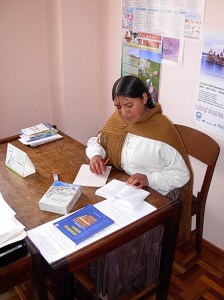
Celia Colque Quispe; photo by the author, all rights reserved
Quispe came to Radio San Gabriel from a small, rural community on the shores of Lake Titicaca. One day, she had heard an announcement on the radio that Radio San Gabriel would be hiring personnel through an open selection process involving an Aymara language fluency assessment. Competing against university-trained linguists and graduates of communications programs, Quispe stood out for her eloquent Aymara speech and was hired, beginning a career in radio where she came to not only to work as an announcer, but as a member of the Aymara Language Department where she wrote and approved scripts for the station’s programs. Stories like this are not unusual at Radio San Gabriel, but are otherwise rare in this multilingual Andean republic, still profoundly marked by anti-Indian racism. What “being Aymara” means in Bolivia remains highly contested. One thing was clear from my conversation with Quispe, however—her work at the radio allows her “to be Aymara.”
The presence of the Aymara language on Bolivian airwaves contrasts sharply with its general absence within other Bolivian media. There are some notable exceptions: Bolivian state television occasionally runs Aymara language programming on programs like Entre Culturas (‘Between Cultures’), and, famously, the neorealist director Jorge Sanjinés’ work has dramatized the struggles of highland Aymara and Quechua Indians in films like Yawar Mallku (Blood of the condor) and Nación Clandestina (Clandestine Nation).
These are exceptions, however, that prove the rule of Spanish language dominance within Bolivian television and film, leaving radio to stand out as the medium that most reflects the country’s multilingualism. In this post we will tune in to Radio San Gabriel, Bolivia’s oldest and most prominent Aymara language radio station, to ask how Aymara language radio might not just reflect Bolivia’s multilingualism, but also actively intervene in it, shaping how Aymaras hear their own language.
Aymaras and Bolivia

Geographic distribution of the Aymara language, public domain
The Aymaras are one of the the largest ethnolinguistic groups within Bolivia, a nation that is now officially a “Plurinational State” in which 36 indigenous languages are recognized as co-official with Spanish. Aymara is among the most widely spoken of these and Aymaras constitute a majority of the population in a contiguous territory surrounding the nation’s capital of La Paz, and crossing national borders into neighboring Chile and Peru. With approximately two and a half million people (and many more than this if speaking Aymara is removed as a criterion of ethnicity), Bolivia has the largest concentration of Aymaras in the region. Perhaps because Bolivia’s political capital sits within Aymara territory or because of their sheer numbers with respect to other indigenous populations, the Aymara have long played a significant role in Bolivian politics. Increasing the presence of the Aymara language in public space, on the airwaves or otherwise, is thus a prominent component of a multifaceted politics of indigenous resurgence in contemporary Bolivia.
Aymar Markan Arupa – “The Voice of the Aymara People” – Radio San Gabriel
As Bolivia’s first and longest running Aymara language radio station, Radio San Gabriel (RSG) calls itself “Aymar markan arupa” (the voice of the Aymara people). In the wake of the 1952 Bolivian revolution, a major social upheaval in which miners’ militias played a crucial role, Maryknoll Jesuit priests founded RSG in 1955 with aims of Christian evangelization within a broader effort at rural uplift. RSG’s mission was also in line with the new government’s hopes of integrating indigenous rural communities into national political life. Jesuits had experience with radio in mining communities, a broadcasting milieu dominated by radical syndicalist and communist political currents, where Jesuits had also founded radio stations of their own. Although miners are remembered as the central protagonists in the 1952 revolution, also crucial to its victory were the highland indigenous communities who overturned nearly feudal relations of the haciendas through insurrectionary land expropriations.

The offices and studios of Radio San Gabriel in El Alto, Bolivia; photo by the author, all rights reserved
In its early days, RSG approached the Aymara language as a bridge to Spanish language literacy and integration into the mainstream of the Catholic faith, an approach consistent with a mid-twentieth century view which formulated the “the Indian problem” as one of national integration. Yet these early assimilationist efforts would quickly change due to both developments in the Catholic Church, such as the Second Vatican Council (1962-1965) and the rise of “liberation theology,” and also political ferment in Bolivia in opposition to military rule. During the 1970s radical Aymara nationalism, or katarismo, was on the rise, finding institutional expression through organizations like the Movimiento Revolucionario Tupak Katari (MRTK, ‘Revolutionary Movement Tupak Katari’), and the founding of the Confederación Sindical Única de Trabajadores Campesinos Bolivianos (CSUTSB, ‘Trade Union Confederation of Rural Workers of Bolivia’) under katarista leadership in 1979.

“Tawa Chakana” by Wikimedia user Huhsunq, CC BY-SA 2.5
Influenced by Aymara nationalism, RSG made a dramatic shift in its orientation towards Aymara language and culture. Their adoption of an Aymara-centric idiom resonated with other nationalist currents, while maintaining Maryknoll Jesuit aims of social justice and service to the poor by reformulating “liberation theology” as a “theology of inculturation.” Practices earlier demonized by the Catholic Church as pagan were now celebrated as being essentially Christian—with the spilled blood of a sacrificed llama, for example, recast as analogous to the wine of the sacrament. This remains in many ways the orientation of RSG today, and the station positions itself as an authority on questions of Aymara linguistic and cultural authenticity.
Broadcast language – dehispanicized “pure” Aymara
One of the ways that RSG’s authority becomes audible to its Aymara audience is through the language used on the air. On RSG, radio announcers speak without using Spanish loan words, using what radio announcers and other Aymaras refer to as “Aymara puro” (pure Aymara). This is ensured through the radio’s Aymara Language Department, which intervenes prior to each broadcast by either writing or editing scripts, and is responsible, along with the radio’s director, for these scripts’ ultimate approval. However, its responsibilities do not end with broadcasts’ content. The department is also responsible for a protocol extending through and beyond the actual broadcasts called seguimiento, or “following.”
Seguimiento involves two procedures: the real-time monitoring of broadcasts for “aberrations,” and a follow-up interaction with those who utter them on air.The department finds alternatives or invents neologisms for the many loan words in Aymara from Spanish. These loan words include words as common as the verb “to speak”—parlaña from the sixteenth-century Spanish parlar—and are testament to 500 years of contact with Spanish. Contact, of course, is a euphemism for what was first colonial and later republican subjugation, making the aberración serve as a linguistic reminder of this painful history. This is why, rather than simply “Aymara puro,” a more apt term might be deshispanized Aymara. While Spanish loan words are purged from the broadcasts, many words shared between Quechua and Aymara escape the protocols of seguimiento, even though these also likely entered the language as the result of earlier subjugation of the Aymara under the Inca Empire. It was not the Inca period, however, but the domination of all Indians, whether Quechua, Aymara, or otherwise, by the Spanish under the colony, then by their descendants during the Republican period and into the 21st century that has most profoundly shaped Bolivia’s dynamics of race and class and, it turns out, the linguistic phenomena that accompanying them, leaving the loan word, the aberración, to be understood as the residue of this history.

Outside the studios of Radio San Gabriel in El Alto, Bolivia; photo by the author, all rights reserved
Decolonization over the Airwaves
Is the linguistic purism of the RSG any different from that of, say, the Academie Française? In terms of aims and procedures, much remains the same—both groups identify loan words and push for consensus to implement neologisms. Such a comparison, however, would obscure the starkly different social context in which this process unfolds in Bolivia. If “protecting” the language is commensurate with protecting the people, at RSG, this means targeting loanwords that serve as reminders of the painful processes of colonialism. In this light, many at RSG understand their work as fitting within a larger project of decolonization, a project not without its contradictions or ironies, particularly considering the role of the Catholic Church in both the past and the present. I explore these ironies more in a longer ethnographic account of the process of seguimiento at RSG.
Whatever the ironies, RSG’s cultivation of a model of refinement in Aymara speech has created opportunities for people who are otherwise profoundly marginalized in Bolivian society, particularly rural women, to advance professionally in a labor market that too often shuts them out. Where Celia Colque Quispe’s wearing of long braids, broached shawl, and full pollera skirt of rural Aymara women, for example, would have her barred from other employment whose job descriptions might demand of employees a euphemistically racist and sexist requirement of buena presencia, at RSG her traditional dress and status as a rural Aymara woman was valued and bolstered her authority within the institution. In a society still steeped in legacies of colonialism, it is no wonder, then, that what Quispe likes most about her work is simply that she can be Aymara.
In the broader media landscape, stations like RSG surely fill a gaping hole of Aymara language programming. Yet as “the voice of the Aymara people” extends across the high plain, radio introduces new absences: the absence of speech deemed too marked by colonialism to appear on air. Linguistically, then, the static on the frequencies of Aymara language airwaves are many. Both the neologisms of the voices cultivated for the airwaves and the incursion of Spanish into the speech of those whose tongues are less trained complicate any notion that the voice of the radio resonates free of the static of history.
—
Featured image: Aymaras marching to commemorate the uprising and massacre of 1921 in Jesús de Machaca, La Paz.
—
Karl Swinehart is Collegiate Assistant Professor and Harper-Fellow at the University of Chicago. He is currently working on a manuscript on hip-hop in Bolivia, Clear, Hidden Voices: Language, Indigeneity and Hip-Hop in Bolivia. He is a linguistic anthropologist with interests in media, popular music, social movements, racialization and multilingualism. He is co-editor of Languages and Publics in Stateless Nations, a special issue of Language and Communication. His work can also be found in the Journal of Linguistic Anthropology, Language in Society, and Social Text.
—
 REWIND!…If you liked this post, you may also dig:
“Violent Circuits, Contentious Voices: Caribbean Radio Histories”-Alejandra Bronfman
“Chicana Radio Activists and the Sounds of Chicana Feminisms”-Monica De La Torre
“On the Lower Frequencies: Norman Corwin, Colorblindness, and the ‘Golden Age’ of U.S. Radio”-Jennifer Stoever
Share this:

Revising the Future of Music Technology
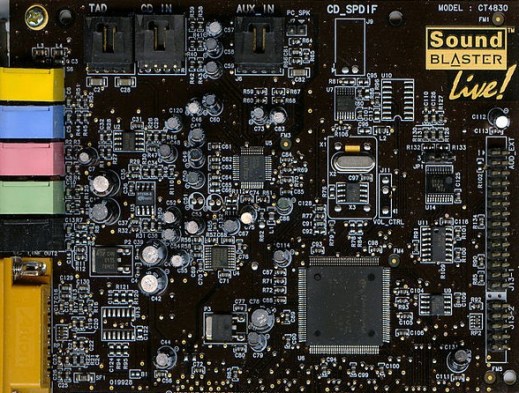
 This is the opening salvo in Sounding Out!‘s April Forum on “Sound and Technology.” Every Monday this month, you’ll be hearing new insights on this age-old pairing from the likes of Sounding Out! veterano Primus Luta, along with new voices Andrew Salvati and Owen Marshall. These fast-forward folks will share their thinking about everything from Auto-tune to productivity algorithms. So, program your presets for Sounding Out! and enjoy today’s exhilarating opening think piece from SO! Multimedia Editor Aaron Trammell. —JS, Editor-in-Chief
—
We drafted a manifesto.
Microsoft Research’s New England Division, a collective of top researchers working in and around new media, hosted a one-day symposium on music technology. Organizers Nancy Baym and Jonathan Sterne invited top scholars from a plethora of interdisciplinary fields to discuss the value, affordances, problems, joys, curiosities, pasts, presents, and futures of Music Technology. It was a formal debrief of the weekend’s Music Tech Fest, a celebration of innovative technology in music. Our hosts christened the day, “What’s Music Tech For?” and told us to make bold, brave statements. A kaleidoscope of kinetic energy and ideas followed. And, at 6PM we crumpled into exhausted chatter over sangria, cocktails, and imported beer at a local tapas restaurant.
The day began with Annette Markham, our timekeeper, offering us some tips on how to best think through what a manifesto is. She went down the list: manifestos are primal, they terminate the past, create new worlds, trigger communities, define us, antagonize others, inspire being, provoke action, crave presence. In short, manifestos are a sort of intellectual world building. They provide a road map toward an imagined future, but in doing so they also work to produce this very future. Annette’s list made manifestos seem to be a very focused thing, and perhaps they usually are. But, having now worked through the process of creating a manifesto with a collective, I would add one more point – manifestos are sloppy.
Our draft manifesto is a collective vision about what the blind-spots of music technology are, at present, and what we want the future of music technology to look like. And although there is general synergy around all of the points within it, that synergy is somewhat addled by the polyphonic nature of the contributors. There were a number of discussions over the course of the day that were squelched by the incommensurable perspectives of one or two of the participants. For instance, two scholars argued about whether or not technical platforms have politics. These moments of disagreement, however, only added a brilliant contour to our group jam. Like the distortion cooked into a Replacements single, it only serves to highlight how superb the moments of harmony and agreement are in contrast. This brilliant and ambivalent fuzziness speaks perfectly to the value of radical interdisciplinarity.
These disagreements were exactly the point. Why else would twenty academics from a variety of interdisciplinary fields have been invited to participate? Like a political summit, there were delegates from Biology, Anthropology, Computer Science, Musicology, Science and Technology Studies, and more. Rotating through the room, we did our introductions (see the complete list of participants at the bottom of this paper). Our interests were genuine and stated with earnestness. Nancy Baym declared emphatically that music is, “a productive site for radical interdisciplinarity,” while Andrew Dubber, the director of Music Tech Fest, noted the centrality of culture to the dialogue. Both music and technology are culture, he argued. The precarity of musical occupations, the gender divide, and the relationship between algorithm and consumer, all had to take a central role in our conversation, an inspired Georgina Born demanded. Bryan Pardo, a computer scientist, announced that he was listening with an open mind for tips on how to best design the platforms of tomorrow. Though collegial, our introductory remarks were all political, loaded with our ambitions and biases.
The day was an amazing, free-form, brainstorm. An hour and a half long each, the sessions challenged us to answer a big question – first, what are the problems of music technology, then what are some actions and possibilities for its future. Every fifteen or twenty minutes an alarm would ring and tables would exchange members, the new member sharing ideas from the table they came from. At one point I came to a new table telling stories about how music had the power to sculpt social relations, and was immediately confronted with a dialogue about problems of integration in the STEM fields.
In short, the brainstorms were a hodgepodge of ideas. Some spoke about the centrality of music to many cultural practices. Noting the ways in which humans respond to their environments through music, they questioned if tonal schema were ultimately a rationalization of the world. Though music was theorized as a means of social control many questions remained about whether it could or should be operationalized as such. Others considered different conversations entirely. Jocking sustainability and transduction as key factors in an ideal interdisciplinarity and shunning models that either tried to put one discipline in service of another, or simply tried to stack and combine ideas.

Borrowed from Margaret Atwater.
Some of the most productive debates centered around the nature of “open” technology. Engineers were challenged on their claim that “open source technology” was an unproblematic good, by Cultural Studies scholars who argued that the barriers to access were still fraught by the invisible lines of race, class, and gender. If open source technology is to be the future of music technology, they argued, much work must still be done to foster a dialogue where many voices can take part in that space.
We also did our best to think up actionable solutions to these problems, but for many it was difficult to dream big when their means were small in comparison. One group wrote, “we demand money,” on a whiteboard in capital letters and blue marker. Funding is a recurrent and difficult problem for many scholars in the United States and other, similar, locations, where funding for the arts is particularly scarce. On points like this, we all agreed.
We even considered what new spaces of interactivity should look like. Fostering spaces of interaction with public works of art, music, performance and more, could go a long way in convincing policy makers that these fields are, in fact, worthy of greater funding. Could a university be designed so as to prioritize this public mode of performance and interactivity? Would it have to abandon the cloistered office systems, which often prohibit the serendipitous occasion of interdisciplinary discussion around the arts?

Borrowed from bfishadow @Flickr.
There are still many problems with the dream of our manifesto. To start, although we shared many ideas, the vision of the manifesto is, if anything, disheveled and uneven. And though the radical interdisciplinarity we epitomized as a group led to a million excellent conversations, it is difficult, still, to get a sense of who “we” really are. If anything, our manifesto will be the embodiment of a collective that existed only for a moment and then disbursed, complete with jagged edges and inconsistencies. This gumbo of ideas, for me, is beautiful. Each and every voice included adds a little extra to the overall idea.
Ultimately, “What’s Music Tech For?” really got me thinking. Although I remain skeptical about the United States seeing funding for the arts as a worthy endeavor anytime soon, I left the event with a number of provocative questions. Am I, as a scholar, too critical about the value of technology, and blind to the ways it does often function to provoke a social good? How can technological development be set apart from the demands of the market, and then used to kindle social progress? How is music itself a technology, and when is it used as a tool of social coercion? And finally, what should a radical mode of listening be? And how can future listeners be empowered to see themselves in new and exciting ways?
What do you think?
Our team, by order of introduction:
Mary Gray (Microsoft Research), Blake Durham (University of Oxford), Mack Hagood (Miami University), Nick Seaver (University of California – Irvine), Tarleton Gillespie (Cornell University), Trevor Pinch (Cornell University), Jeremy Morris (University of Wisconsin-Madison), Diedre Loughridge (University of California – Berkley), Georgina Born (Oxford University), Aaron Trammell (Rutgers University), Jessa Lingel (Microsoft Research), Victoria Simon (McGill University), Aram Sinnreich (Rutgers University), Andrew Dubber (Birmingham City University), Norbert Schnell (IRCAM – Centre Pompidou), Bryan Pardo (Northwestern University), Josh McDermitt (MIT), Jonathan Sterne (McGill University), Matt Stahl (Western University), Nancy Baym (Microsoft Research), Annette Markham (Aarhus University), and Michela Magas (Music Tech Fest Founder).
—
Read the Manifesto here and sign on if you dig it. . . http://www.musictechifesto.org/
—
Aaron Trammell is co-founder and Multimedia Editor of Sounding Out! He is also a Media Studies PhD candidate at Rutgers University. His dissertation explores the fanzines and politics of underground wargame communities in Cold War America. You can learn more about his work at aarontrammell.com.
—
 REWIND! . . .If you liked this post, you may also dig:
Listening to Tinnitus: Roles of Media when Hearing Breaks Down— Mack Hagood
Sounding Out! Podcast #15: Listening to the Tuned City of Brussels, The First Night— Felicity Ford and Valeria Merlini
“I’m on my New York s**t”: Jean Grae’s Sonic Claims on the City— Liana Silva-Ford
Share this:


Current Top Posts





April 2021

January 2020

November 2019

October 2019

August 2019

April 2014

November 2017

March 2015

December 2017

October 2015
 Sounding Out!
Recent Comments