
Malcolm Gladwell’s Bad Aesthetics

Malcolm Gladwell, who recently wrapped the first season of his podcast Revisionist History, has been on a roll lately. Not a particularly endearing one, though. I’ve been trying to locate his nadir, but it’s not easy with so many options to choose from. Is it in the New Yorker, when he condescendingly exclaims “Of course not!” in response to whether Caster Semenya should be allowed to compete in the 800-meter at the Olympics? He follows up with the assertion that no track-and-field fan disagrees with him, as if the complexity of gender identification is somehow best left to a majority appeal. Or is it in Revisionist History’s Episode 9, “Generous Orthodoxy,” when he chides Princeton students protesting the use of Woodrow Wilson’s name around campus? Calling one student “angry”—a loaded word to lob at a black woman—and surmising she would later “regret her choice of words,” Gladwell advises the students to instead threaten to leave the university if their requests aren’t honored. Why? Because otherwise “every crotchety old Princeton alum” wouldn’t believe they actually care about the university.

For those keeping score, that’s Gladwell, who spent an entire other episode of his podcast lamenting that we don’t “capitalize” people’s educational potential well enough, counseling black students to separate themselves from an Ivy League education as a way to make a point about a pro-segregationist president. Gladwell’s seventh episode, “Hallelujah,” where he discusses musical genius, is not obviously about the kind of systemic inequalities he bumbles in the Semenya and Princeton examples. But the conclusions he draws about genius and the anti-pop aesthetic judgments he claims are informed by the same bad gender and race politics that would put a person’s gender identification in other people’s hands and place the burden of sacrifice on the aggrieved in matters of racial injustice.
The episode “Hallelujah” revolves around two songs that Gladwell argues reached their peak of genius years after they were initially recorded: “Deportees Club” (1984) by Elvis Costello and “Hallelujah” (1984) by Leonard Cohen. In each case, Gladwell asserts that the first recordings were flawed but that they attained a certain beauty in later versions that reveals something about how genius works, though each attained that genius status by different routes. While Costello is responsible for the version of “Deportees Club” that Gladwell loves—he re-recorded it as “Deportee” in 1985 (it wouldn’t be released until 1995 on a re-issue of Goodbye, Cruel World)—“Hallelujah” would peak for Gladwell in a series of covers, most famously by Jeff Buckley (1994), performed by artists other than Cohen. Gladwell’s focus on the process by which a song reaches genius status is a riff on David Galenson’s Old Masters and Young Geniuses theory. Here, Costello and the litany of “Hallelujah” coverers display a process of genius called “experimental innovation,” where the first draft is never the final draft, and genius is only unlocked after years of work. I’ll return to Gladwell’s notion of musical beauty and how it relates to his bad politics momentarily, but I first want to unpack the theory of genius that enthralls him in this episode.
 Galenson’s notion of genius is a binary, where some geniuses (“conceptual innovators”) are very young, decisive artists and others, like the “experimental innovators” responsible for “Deportee” and “Hallelujah,” are endless tinkerers who tend to reach their creative potential later in life. Gladwell uses the same paradigmatic examples that Galenson does to categorize geniuses; conceptual innovators are Pablo Picasso, while experimental innovators are Paul Cézanne. Curiously, Gladwell notes that this theory of genius may be best exemplified in music, but he doesn’t seem aware that music scholars have already laid out this same broad theory of genius with easy comps: Mozart the young genius and Beethoven the old master. Moreover, Gladwell doesn’t seem aware that this is a lousy theory of genius.
I’ve written elsewhere about genius myths, and there’s a rabbit hole of problematic ideas out there about classical music genius that run from benignly self-serving to violently racist. One critique is particularly useful for pushing back against Gladwell, as it highlights the gender and race problems with Gladwell’s approach to genius. Tia DeNora’s Beethoven and the Construction of Genius (1994) is a painstaking deconstruction of Beethoven’s genius. While DeNora’s argument includes a number of moving parts, it can be summarized as a demonstration of the way “genius” isn’t so much innate talent as it is a combination of several social and political ideals intersecting with a person’s talents or insights.
It was the 90s, when postmodernity crested in musicology, and the aim of DeNora’s analysis is quintessentially postmodern: undo the Great White Man myth to make room for other kinds of histories and notions of genius to be accommodated. If we understand Beethoven’s genius to be firmly rooted in a number of social and political attitudes—including the reflexive belief that only a white man could be a genius—that tipped in his favor, then we can understand that history isn’t telling us that only men or only white people can be geniuses; rather, history is showing its biases. This sort of deconstruction doesn’t really move the academic needle now—most college freshmen can articulate the Great White Man critique—largely due to the work of DeNora and other deconstructionists who effectively cleared the space for us to build other kinds of scholarship on top of their work.

“Pop!Tech 2008 – Malcolm Gladwell” by Flickr user Pop!Tech, CC BY 2.0
Alas, though, the 90s truly must be all the rage right now, because Gladwell is wading right back into Great White Man territory. To be clear, he isn’t doing it on purpose, for whatever that’s worth. In Episode 9, the one where he counsels the black Princeton students to threaten to leave the school, he performs a whole Great White Man rant to establish his credibility as A Guy Who Gets It. But beyond understanding that there are too many things named after white men, Gladwell doesn’t indicate that he knows what the rub really is, that the name on a building or School is a tiny piece of a much bigger, systemic problem of race and gender. Perhaps unsurprisingly, then, his ideas about musical genius betray his own tendency to set up hierarchies where Great White Men are always on top. So excuse me while I pump some air in my Reeboks, hitch up my Guess jeans, and douse myself in CK1; we have some 90s theory to attend to.
Gladwell doesn’t—and perhaps can’t—articulate what’s genius about the versions of “Deportee” and “Hallelujah” he reveres, and his assessment of the originals is similarly vague. About 1984’s “Deportees Club,” he exclaims, “Oh, god, It’s awful!” For Cohen’s 1984 “Hallelujah,” Gladwell borrows a line from Michael Barthel, who could’ve just as well been describing Gladwell’s podcast: “The entire performance is so hyperserious that it’s almost satire.” [Historiographic aside: Barthel, who is now a researcher for the Pew Research Center, seems to be the under-cited source for the “Hallelujah” history in both Gladwell’s podcast and Alan Light’s book on the song]. Gladwell may suffer a poverty of aesthetic language to describe what is or isn’t good about these songs, but by considering what he does and doesn’t like—what counts as genius or not for him—we can understand where his aesthetic allegiances lie.

Screenshot of Leonard Cohen’s “Hallelujah” video on YouTube
Gladwell finds beauty in music whose emotional content is as stripped down as the acoustic guitar textures on the later recordings of “Deportee” and “Hallelujah.” The line he quotes from Barthel misses the point: Barthel likes the satirical nature of the original “Hallelujah” and finds the famous Buckley version—which becomes something of an ürtext for all the covers that came after it—an unfortunate telescoping of emotional range, a “Hallelujah” that only knows lament instead of the many “holy, broken, profane, transcendent” hallelujahs Cohen first explored. But all those hallelujahs, along with the “angry, loud, and upsetting” original “Deportees Club,” don’t seem to suit Gladwell, who prefers versions of the songs where both the emotional and musical content are as straightforward as possible.

Screenshot from Jeff Buckley’s video for “Hallelujah”
That Gladwell is drawn to the versions of Buckley’s “Hallelujah” and Costello’s later “Deportee” that feature an acoustic singer-songwriter coffeehouse vibe isn’t a coincidence. The villain in his account of genius is pop. Noting that both songs were initially recorded in 1984, he reminds us that year’s “biggest album” was Michael Jackson’s “Thriller,” “pop music glossed to perfection…not a single stray note or emotion on that record.” “Thriller” was the final single from an album two years old, and it peaked at #4 on the Billboard Hot 100, so Gladwell’s definition of “biggest album” is suspect, but he’s looking for “the antithesis of ‘Deportee’ and ‘Hallelujah,’” so I’ll engage on his terms and zero in on his aesthetics by figuring out what he thinks is wrong with pop music like “Thriller.”
Gladwell offers a couple other assessments of pop aesthetics in his description of producers. Clive Langer and Alan Winstanley, who co-produced the Goodbye, Cruel World album “Deporteees Club” appeared on, are the ill-fitting pop perfectionists who try to harness Costello’s sound but only manage to screw it up. Trevor Horn is the guy spending four weeks—“a month,” Gladwell bemoans—shaping a snare sound for Frankie Goes to Hollywood’s “Two Tribes” (1983). Whether it’s Langer and Winstanley, Horn, or Quincy Jones (who Gladwell doesn’t name but who produced “Thriller”), Gladwell has no space for the behind-the-glass work of sound design and sonic processing in his aesthetics of genius. He argues, citing Costello’s own assessment, that glossy pop perfection couldn’t capture the “dark, emotional, bitter songs, gritty and spare,” pouring out of Costello. For Gladwell, pop music production is the villain because it short circuits the true, raw emotion that he finds beautiful.
The problem with Gladwell’s aesthetics is that he’s mistaking his taste for genius, then reverse-manufacturing an explanation of genius that privileges a specifically white masculine mode of expression. “Glossy pop perfection,” in his estimation, covers up something beautiful, obscuring real emotion. But directly sharing one’s emotions—whether musically or politically—is more acceptable for some than for others. We need look no further than Gladwell for proof. If you’re Elvis Costello or Jeff Buckley singing laments? You’re a genius. If you’re a black woman protesting Woodrow Wilson at Princeton? You’re “angry.”
![Joe Mabel [GFDL (http://www.gnu.org/copyleft/fdl.html) or CC BY-SA 3.0 (http://creativecommons.org/licenses/by-sa/3.0)], via Wikimedia Commons](https://commons.wikimedia.org/wiki/File:Janelle_Mon%C3%A1e_12.jpg)
Joe Mabel [GFDL (http://www.gnu.org/copyleft/fdl.html) or CC BY-SA 3.0 (http://creativecommons.org/licenses/by-sa/3.0)%5D, via Wikimedia Commons
Gladwell’s bad aesthetics, his refusal to recognize beauty in pop music, is also bad politics. By holding up an aesthetic that prizes stripped-down, straightforward emotionality, a form of expression available to some but not others, Gladwell ends up in the same Great White Man genius bind DeNora and others unraveled in the postmodern 90s. So I’ll sum it up with a 90s phrase: genius is always already political. Denora argues—and Gladwell inadvertently demonstrates—that labeling artists as genius relies on politically volatile aesthetic judgments that reinforce existing power hierarchies, in this case along the lines of race and gender. Like his response to Princeton students and his armchair adjudication of Semenya’s gender identity, Gladwell’s theory of musical genius proves to be less a revision of history and more a revival of history’s worst politics.
—
Featured image: “Malcolm Gladwell” by Flickr user Ed Schipul, CC BY-SA 2.0
—
Justin D Burton is Assistant Professor of Music at Rider University, and a regular writer at Sounding Out!. His research revolves around critical race and gender theory in hip hop and pop, and his current book project is called Posthuman Pop. He is co-editor with Ali Colleen Neff of the Journal of Popular Music Studies 27:4, “Sounding Global Southernness,” and with Jason Lee Oakes of the Oxford Handbook of Hip Hop Music Studies (2017). You can catch him atjustindburton.com and on Twitter @justindburton. His favorite rapper is Right Said Fred.
—
 REWIND! . . .If you liked this post, you may also dig:
Pop’s Chill Thrills Aren’t So Cheap-Robin James
Trap Irony: Where Aesthetics Become Politics-Justin D. Burton
This is What It Sounds Like . . . . . . . . On Prince (1958-2016) and Interpretive Freedom-Ben Tausig
Share this:

Me & My Rhythm Box

I’m fortunate to have quite a few friends with eclectic musical tastes, who continually expose me some of the best, albeit often obscure, sources for inspiration. They arrive as random selections sent with a simple “you’d appreciate this” note attached. Good friends that they are, they rarely miss the mark. Most intriguing is when a cluster of things from different people carry a similar theme, converging to a need on my part for some sort of musical action.
The Inspiration
A few years back I received a huge dump of gigabytes of audio and video. Within it were some concert footage and performances this friend and I had been discussing; I consumed those quickly in an effort to keep that conversation going. Tucked amidst that dump however, was a copy of the movie Liquid Sky. I asked the friend about it because the description of the plot–“heroin-pushing aliens invade 80’s New York”–led me to believe it wasn’t really my thing (not a big fan of needles). Although my friend insisted I’d enjoy it, it took me several months if not a whole year before I finally pressed play.
Even though Liquid Sky was not my favorite movie by any measure, it was immediately apparent to my ears why my friend insisted I check it out. The film’s score was performed completely on a Fairlight CMI, capturing the synthesized undercurrent of the early 80’s New York music scene, more popularly seen in the cult classic Downtown 81, starring Jean Michel Basquiat. While the performances in that movie are perhaps closer to my tastes, none of them compare to one scene from Liquid Sky that I fell in love with, instantly:
The song grabbed me so much, I quickly churned out a cover version.
Primus Luta “Me & My Rhythm Box (V1)”
While felt good to make, there remained something less than satisfying about it. The cover had captured my sound, but at a moment of transition. More specifically, the means by which I was trying to achieve my sound at the time had shifted from a DAW-in-the-box aesthetic to a live performance feel, one that I had already begun writing about here on Sounding Out! in 2013. Interestingly, the inspiration to cover the song pushed me back to my in-the-box comfort zone.
It was good, but I knew I could do more.
As I said, these inspirations tend to group around a theme. Prior to receiving the Liquid Sky dump, I had received an email out of the blue from Hank Shocklee, producer and member of the Bomb Squad. I’ve been a longtime fan, and we had the opportunity to meet a few years prior. Since then he’s played a bit of a mentoring role for me. In the email he asked if I wanted to join an experimental electronic jazz project he was pulling together as the drummer.
I was taken aback. Hank Shocklee asking me to be his drummer. Honestly, I was shook.
Not that I didn’t know why he might think to ask me, but immediately I started to question whether I was good enough. Rather than dwell on those feelings, though, I started stepping up my game. While the project itself never came to fruition, Shocklee’s email led me to building my drmcrshr set of digital instruments.
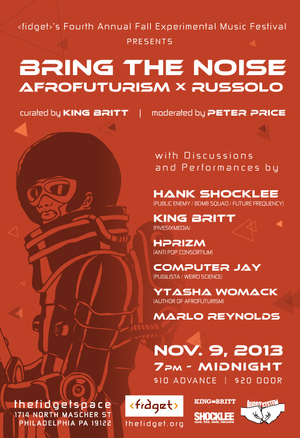 A year or so later, I ran into Shocklee again when he was in Philadelphia for King Britt’s Afrofuturism event with mutual friend artist HPrizm. By this time I had already recorded the “Me and My Rhythm Box” cover. Serendipitously, HPrizm ended up dropping a sample from it in the midst of his set that night. A month or so later, HPrizm and I met up in the studio with longtime collaborator Takuma Kanaiwa to record a live set on which I played my drmcrshr instruments.
Not too long after, I received an email from NYC-based electronic musician Elucid, saying he was digging for samples on this awesome soundtrack. . .Liquid Sky.
The final convergence point had been hanging over my head for a while. Having finished the first part of my “Toward a Practical Language series on Live Performance” series, I knew I wanted the next part to focus on electronic instruments, but wasn’t yet sure how to approach it. I had an inkling about a practicum on the actual design and development of an electronic instrument, but I didn’t yet have a project in mind.
As all of these things, people, and sounds came together–Liquid Sky, Shocklee, HPrizm, Elucid–it became clear that I needed to build a rhythm box.
The History
What stands out in Paula Sheppard’s performance from Liquid Sky is the visual itself. She stands in the warehouse performance space surrounded by 80’s scenesters posing with one hand in the air, mic in the other while strapped to her side is her rhythm box, the Roland CR-78, wires dangling from it to connect to the venue’s sound system. She hits play to start the beat launching into the ode for the rhythm machine.
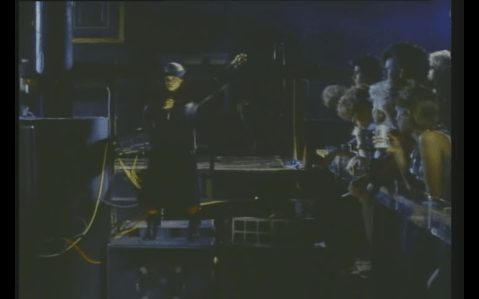
Contextually, it’s far more performance art than music performance. There isn’t much evidence from the clip that the CR-78 is any more than a prop, as the synthesizer lines indicate the use of a backing track. The commentary in the lyrics however, hone in on an intent to present the rhythm box as the perfect musical companion, reminiscent of comments Raymond Scott often made about his desire to make a machine to replace musicians.
My rhythm box is sweet
Never forgets a beat
It does its rule
Do you want to know why?
It is pre-programmed
Rhythm machines such as the CR-78 were originally designed as accompaniment machines, specifically for organ players. They came pre-programmed with a number of traditional rhythm patterns–the standards being rock, swing, waltz and samba–though the CR-78 had many more variations. Such machines were not designed to be instruments themselves, rather musicians would play other instruments to them.
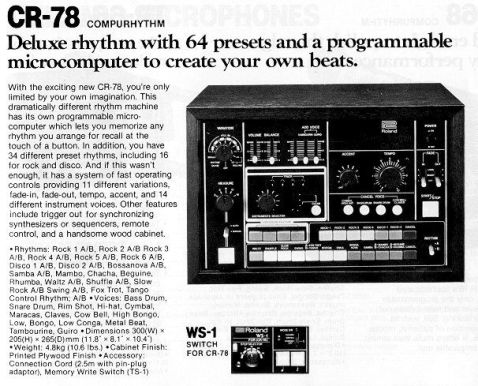
In 1978 when the CR-78 was introduced, rhythm machines were becoming quite sophisticated. The CR-78 included automatic fills that could be set to play at set intervals, providing natural breaks for songs. As with a few other machines, selecting multiple rhythms could combine patterns into new rhythms. The CR-78 also had mute buttons and a small mixer, which allowed slight customization of patterns, but what truly set the CR-78 apart was the fact that users could program their own patterns and even save them.

TR-808 (top) and TR-909
By the time it appeared in Liquid Sky, the CR-78 had already been succeeded by other CR lines culminating in the CR-8000. Roland also had the TR series including the TR-808 and the TR-909, which was released in 1982, the same year Liquid Sky premiered.
In 1980 however, Roger Linn’s LM-1 premiered. What distinguished the LM-1 from other drum machines was that it used drum samples–rather than analog sounds–giving it more “real” sounding drum rhythms (for the time). The LM-1 and its predecessor, the Linn Drum both had individual drum triggers for its sounds that could be programmed into user sequences or played live. These features in particular marked the shift from rhythm machines to drum machines.
In the post-MIDI decades since, we’ve come to think less and less about rhythm machines. With the rise of in-the-box virtual instruments, the idea of drum programming limitations (such as those found on most rhythm machines) seems absurd or arcane to modern tastes. People love the sounds of these older machines, evidenced by the tons of analog drum samples and virtual and hardware clones/remakes on the market, but they want the level of control modern technologies have grown them accustomed to.
Controlling the Roland CR-5000 from an Akai MPC-1000 using a custom built converter
The general assumption is that rhythm machines aren’t traditionally playable, and considering how outdated their rhythms tend to seem, lacking in the modern sensibility. My challenge thus, became clearer: I sought out to build a rhythm machine that would challenge this notion, while retaining the spirit of the traditional rhythm box.
Challenges and Limitations
At the outset, I wanted to base my rhythm machine on analog circuitry. I had previously built a number of digital drum machines–both sample and synthesis-based–for my Heads collection. Working in the analog arena allowed me to approach the design of my instrument in a way that respected the limitations my rhythm machine predecessors worked with and around.
By this time I had spent a couple of years mentoring with Jeff Blenkinsopp at The Analog Lab in New York, a place devoted to helping people from all over the world gain “further understanding the inner workings of their musical equipment.” I had already designed a rather complex analog signal processor, so I felt comfortable in the format. However, I hadn’t truly honed my skills around instrument design. In many ways, I wanted this project to be the testing ground for my own ability to create instruments, but prior experience taught me that going into such a complex project without the proper skills would be self defeating. Even more, my true goal was centered more around functionality rather than details like circuit board designs for individual sounds.
To avoid those rabbit holes–at least temporarily, I’ve since gone full circuit design on my analog sound projects–I chose to use DIY designs from the modular synth community as the basis for my rhythm box. That said, I limited myself to designs that featured analog sound sources, and only allowed myself to use designs that were available as PCB only. I would source all my own parts, solder all of my boards and configure them into the rhythm machine of my dreams.
Features
The wonderful thing about the modular synth community is that there is a lot of stuff out there. The difficult thing about the modular synth community is that there’s a lot of stuff out there. If you’ve got enough rack space, you can pretty much put together a modular that will perform whatever functionality you want. How modules patch together fundamentally defines your instrument, making module selection the most essential process. I was aiming to build a more semi-modular configuration, forgoing the patch cables, but that didn’t make my selection any easier. I wanted to have three sound sources (nominally: kick, snare and hi-hat), a sequencer and some sort of filter, which would all flow into a simple monophonic mixer design of my own.
For the sounds I chose a simple kick module from Barton, and the Jupiter Storm unit from Hex Inverter. The sound of the kick module was rooted enough in the classic analog sound while offering enough modulation points to make it mutable. The triple square wave design of the Jupiter Storm really excited me as It had the range to pull off hi-hat and snare sounds in addition to other percussive and drone sounds, plus it featured two outputs giving me all three of my voices on in two pcb sets.
Filters are often considered the heart of a modular set up, as they way they shape the sound tends to define its character. In choosing one for my rhythm machine the main thing I wanted was control over multiple frequency bands. Because there would be three different sound sources I needed to be able to tailor the filter for a wide spectrum of sounds. As such I chose the AM2140 Resonant Filter.

I had no plans to include triggers for the sounds on my rhythm machine so the sequencer was going to be the heart of the performance as it would be responsible for any and all triggering of sounds. Needing to control three sounds simultaneously without any stored memory was quite a tall order, but fortunately I found the perfect solution in the amazing Turing Machine modules. With its expansion board the Turing machine can put out four different patterns based on it’s main pattern creator which can create fully random patterns or patterns that mutate as they progress.
The Results
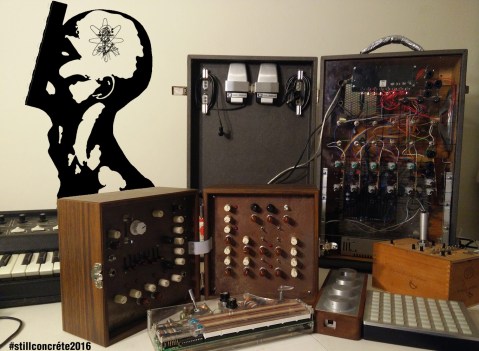
I spent a couple of weeks after getting all the pcb’s parts and hardware together, wiring and rewiring connections until I got comfortable with how all of these parts were interacting with each other. I was fortunate to happen upon a vintage White Instruments box, which formally housed an attenuation meter, that was perfect for my machine. After testing with cardboard I laid out my own faceplates, which and put everything in the box. As soon as I plugged it in and started playing, I knew I had succeeded.
Early test of RIDM before it went in the Box
I call it the RIDM Box (Rhythmically Intelligent Drum Machine Box). I’ve been playing it now for over two years, to the point where today I would say it is my primary instrument. Almost immediately afterward I built a companion piece called the Snare Bender which works both as a standalone and as a controller for the RIDM Box. That one I did from scratch hand wired with no layouts.
While this is by no means a standard approach to modern electronic instrument design (if a standard approach even exists), what I learned through the process is really the value of looking back. With so much of modern technology being future forward in its approach, the assumption is that we’re at better starting positions for innovation than our predecessors. While we have so many more resources at our disposal, I think the limitations of the past were often more conductive to truly innovative approaches. By exploring those limitations with modern eyes a doorway opened up for me, the result of which is an instrument like no other, past or present.
I will probably continue playing the two of these instruments together for a while, but ultimately I’m leaning toward a new original design which takes the learnings from these projects and fully flushes out the performing instrument aspect of analog design. In the meantime, my process would not be complete if I did not return to the original inspiration. So I’ll leave you with the RIDM Box version of “Me & My Rhythm Box”—available on my library sessions release for the instrument.
—
Primus Luta is a husband and father of three. He is a writer and an artist exploring the intersection of technology and art, and their philosophical implications.
—
REWIND!…If you liked this post, you may also dig:
Heads: Reblurring The Lines–Primus Luta
Into the Woods: A Brief History of Wood Paneling on Synthesizers*–Tara Rodgers
Afrofuturism, Public Enemy, and Fear of a Black Planet at 25—andré carrington
Share this:


Current Top Posts





April 2021

January 2020

November 2019

October 2019

August 2019

April 2014

November 2017

March 2015

December 2017

October 2015
 Sounding Out!
Recent Comments