
Impaulsive: Bro-casting Trump, Part I
But first. . .
An Introduction to Bro-casting Trump: A Year-long SO! Series by Andrew Salvati
“The Manosphere Won.”
That is how Wired succinctly described the results of the 2024 election the day after Americans went to the polls.
Among the several explanations offered for Donald Trump’s stunning victory over Kamala Harris, the magazine’s executive editor Brian Barrett argued, one surely had to acknowledge the crucial role played by that “amorphous assortment of influencers who are mostly young, exclusively male, and increasingly the drivers of the remaining online monoculture.”
Sure, there might be some validity in saying that Trump’s election had to do with inflation, with immigration policy, or with Joe Biden’s “doomed determination to have one last rodeo.” But his appearance on several popular male-centered podcasts in the months and weeks leading up to November 5 likely did much to mobilize support for his candidacy among their millions of viewers and listeners. Talking to Theo Von, the Nelk Boys, Andrew Schulz, and Shawn Ryan “cement[ed Turmp’s] status as one of them, a sigma, a guy with clout, and the apex of a model of masculinity that prioritizes fame as a virtue unto itself,” Barrett wrote.
Indeed, during the president-elect’s victory speech, given in the early morning hours of the 6th, his longtime friend and ally Dana White, president of the UFC, took to the speaker’s lectern to acknowledge the contributions that these podcasters and their audiences had evidently made in elevating Trump to the presidency for the second time. “I want to thank the Nelk Boys, Adin Ross, Theo Von, Bussin’ with the Boys, and last but not least, the mighty and powerful Joe Rogan,” he said.
As a media strategy, this was something of an evolution of Trump’s approach in 2016, in which the former reality TV star had used Twitter to such great effect to bypass legacy media institutions and bring his unfiltered message directly to voters. This time around, and reportedly at the direction of his 18-year-old son Barron, Trump again leveraged the massive reach of new media platforms to speak directly to his target demographic of Gen-Z men.
But the strategy was also of a piece with Trump’s frequent assaults on the press, which he typically characterizes as the “enemy of the people.” Appearing in some of the friendlier precincts of the podosphere allowed Trump to skirt around mainstream journalists with their “nasty” questions and cumbersome norms of neutrality and objectivity, and to bask in the mutual admiration society that some of these interviews became. Indeed, as Maxwell Modell wrote in The Conversation not long after the election, podcasters, in contrast to professional journalists, “tend to opt for more of a friendly chat than aggressive questioning, using what research calls supportive interactional behavior … this ‘softball’ questioning can result in the host becoming an accomplice to the politicians’ positive self-presentation rather than an interrogator.”
Podcasts, in other words, provided Trump with a congenial space to self-mythologize, to ramble, and whitewash some of his more extreme views.
In total, Trump appeared on fourteen podcasts or video streams during his 2024 campaign (Forbes compiled a full list, including viewership numbers, which can be found here), which together earned a combined 90.9 million views on YouTube and on other video streaming platforms (it should be noted, first, that these are not unique views – there is likely an overlap between audiences; second, that these numbers do not include audio podcast listens, which, because of the decentralized nature of RSS, are notoriously difficult to pin down).
For her part, meanwhile, Kamala Harris also made the rounds on podcasts popular with women and Black listeners – key demographics for her campaign – including Alex Cooper’s Call Her Daddy, former NBA players Matt Barnes and Stephen Jackson’s All the Smoke, and Shannon Sharpe’s Club Shay Shay. It has been suggested, however, that the Harris camp’s failure (or perhaps unwillingness) to secure an appearance on The Joe Rogan Experience was a significant setback, and could have provided an opportunity to reach the young male demographic with whom she was struggling. In any event, while the counterfactual “what-if-she-had-done-the-show” will likely be debated for years to come, Rogan eventually endorsed Trump on November 4, throwing his considerable clout behind the once and future president.
While a comparison between Trump and Harris’s podcast strategy during the 2024 campaign would make for an interesting academic study, in the following series of posts, I will be particularly concerned with Trump’s success with the so-called podcast bros – partially because my own research interests are in the area of mediated masculinities, but also because they may have put him over the edge with a key demographic – with Gen-Z men.
Over the next few posts, I will examine several of Trump’s appearances on largely apolitical “bro” podcasts during the 2024 campaign season, including his interviews with Logan Paul, Theo Von, Shawn Ryan, Andrew Schulz, the Nelk Boys, and Joe Rogan. In the course of this examination, I will pay attention not only to what Trump said on these shows, but also to the way in which they established a sense of intimacy, and how that intimacy worked to underscore Trump’s reputation for authenticity. Along the way, I will also discuss the podcasts and podcasters themselves and attempt to locate them within the broader scope of the manosphere. Finally, given the passage of time since Trump’s appearances, I will consider to what extent, if any, individual hosts have become critical of his administration’s policies and actions – as Joe Rogan famously has.


Before I begin, however, I want to make a quick note about the sources: Following what is quickly becoming standard practice in the field, each of the “podcasts” that I analyze in this series has a video component, and in fact, may very well have been conceived of as a video-first project with audio-only feeds added as a supplement, or afterthought. For this series, though, my interest has centered on podcasting as a listening experience, and so the reader may assume that when I discuss this or that episode of Theo Von’s or Andrew Schulz’s podcast, I am referring specifically to the audio version of their shows. This is also why Trump’s interview with Adin Ross will not appear in this series – it was livestreamed on the video sharing platform Kick, and was subsequently posted to Ross’s YouTube channel (and thus is it technically not a podcast).
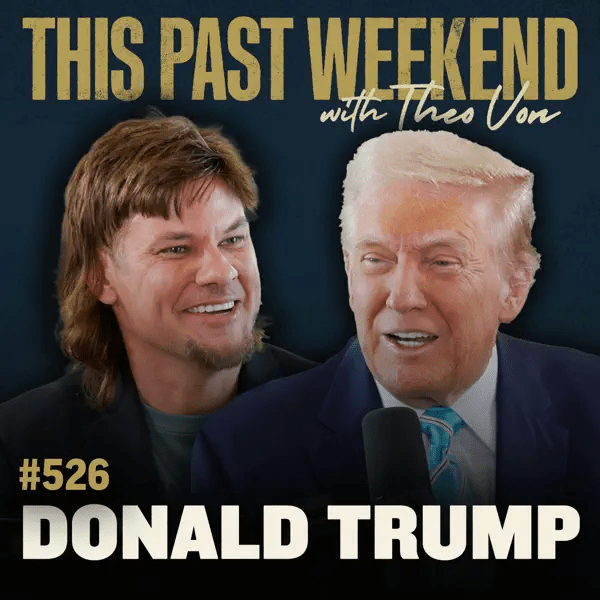
With that being said, let’s dig in. I will proceed chronologically, with Trump’s first podcast appearance on the boxer/professional wrestler Logan Paul’s show, Impaulsive, which dropped on June 13, 2024.
****
With about 13 minutes remaining in Logan Paul’s roughly hour-long interview with Donald Trump, the conversation turned to aliens. “UFOs, UAPs, the disclosure we’ve seen in Congress recently,” Paul explained, “it’s confusing and it’s upsetting to a lot of Americans, because something’s going, there’s something happening. There are unidentified aerial phenomena in the sky, we don’t know what they are. Do you?”
For his part, Trump responded gamely, and after respectfully listening to Paul, proceeded to tell a story about how, as president, he had spoken with Air Force pilots, “perfect people,” who weren’t “conspiratorial or crazy,” who claim that “they’ve seen things that you wouldn’t believe.” Still, Trump admitted that he had “never been convinced.”
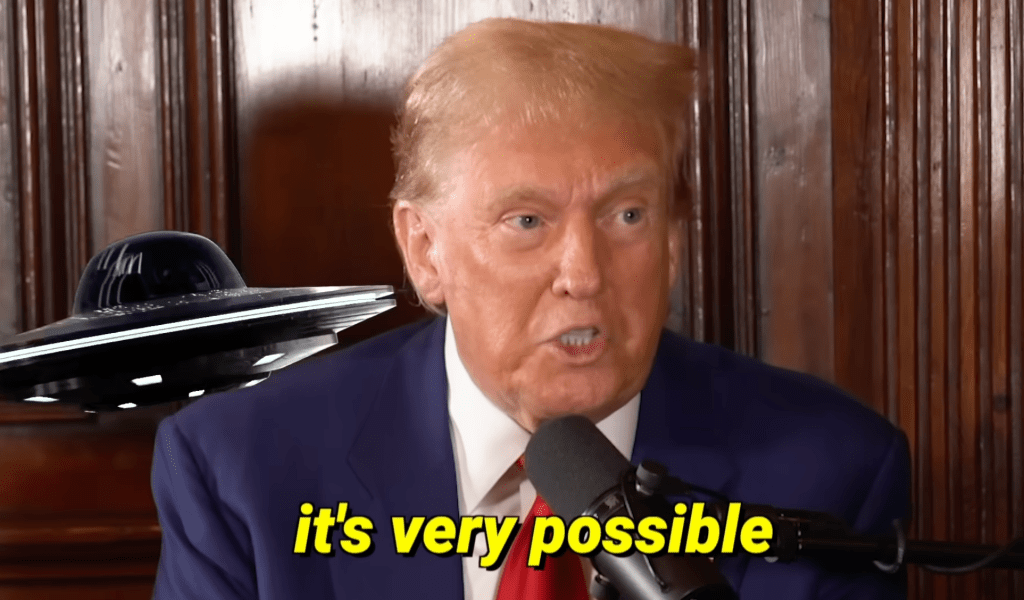
I start with this turn in the conversation not necessarily to dismiss the 29-year-old Paul as a conspiratorial thinker or an unserious interviewer, but rather to highlight the overall tone of the Trump episode, which was overwhelmingly chummy and fawning. It was clear from their deferential posture that Paul and his co-host Mike Majlak were in awe of the former president, and asking such questions was a way of keeping it light and easy.
Logan Paul, after all, is not known for his incisive political commentary. Indeed, in the 17 episodes of Impaulsive that were released in the six months preceding the Trump interview (all of which I have listened to for this piece), political issues hardly featured at all. One exception came during the December 19, 2023 episode with his brother Jake Paul (also a professional boxer, who was recently knocked out in a fight against Anthony Joshua), in which Logan and Majlak discussed the prevalence of right-wing or MAGA content and signifiers as the inevitable backlash to the excesses of the left and the “woke mind disorder,” as Majlak put it. Another example was the January 31, 2024 episode with former co-hosts Mac Gallagher and Spencer Taylor, in which Majlak went on a self-described “rampage” about the problems at the U.S. southern border (in particular, he referenced the Shelby Park standoff, though without naming it), and in which Paul’s father, Greg Paul, got on the mic to declare his support for “Trump 2024.” But other than these incidental moments and superficial takes, the show is not really the place for nuanced discussions of public policy or electoral politics. (Indeed, in the January 31 episode, Paul even attempted to stop Majlak’s rant by noting that listeners didn’t really tune into the show for political discussion).
Nor does Impaulsive, despite all its testosterone-fueled bro-iness, seem to fit comfortably within the manosphere, as I understand that term and what it signifies. Indeed, though Paul and Majlak seem to have fixed ideas about gender and about the differences between men and women, absent from their discussions (at least during the six month sampling of episodes that I listened to) is the kind of misogynistic and reactionary “Red Pill” rhetoric that characterizes manosphere discourses.
This isn’t Andrew Tate, after all, and it’s important that we keep track of the distinction.

Impaulsive, rather, serves as a venue for Paul and Majlak to have informal, free-wheeling conversations with their guests – which have included fellow wrestlers, sports stars, internet personalities, rappers, pastors, and even Chris Hansen – on a range of other topics of interest to the hosts. If there is a throughline in all of this (aside from Paul and Majlak’s interest in how guests navigate their social media presence), it is certainly the relationship between the two co-hosts, their similar immature (we might more charitably say “goofy”) sense of humor, their mutual interest in combat sports, and their past history of online and offline hijinks all providing the basic framework for much of their conversation. It also gives Impaulsive listeners a sense of intimate connection with the pair, a sense that they are in the room as a silent participant in the hang.
And Paul has had a decade’s worth of experience in making comedic content. Having first earned a following by posting short videos on Vine as a college freshman in 2013, he dropped out of school and moved to Los Angeles to pursue a full-time career as a social media content creator. Fortunately for him, the gambit worked, and his content was soon reaching hundreds of thousands of followers across Twitter, Instagram, and Facebook in addition to Vine, and a compilation of his videos posted to YouTube amassed more than 4 million viewers in its first week. A number of TV and movie appearances followed, and in 2018, Paul began what would eventually become a professional boxing career with a white-collar match against the British influencer KSI.
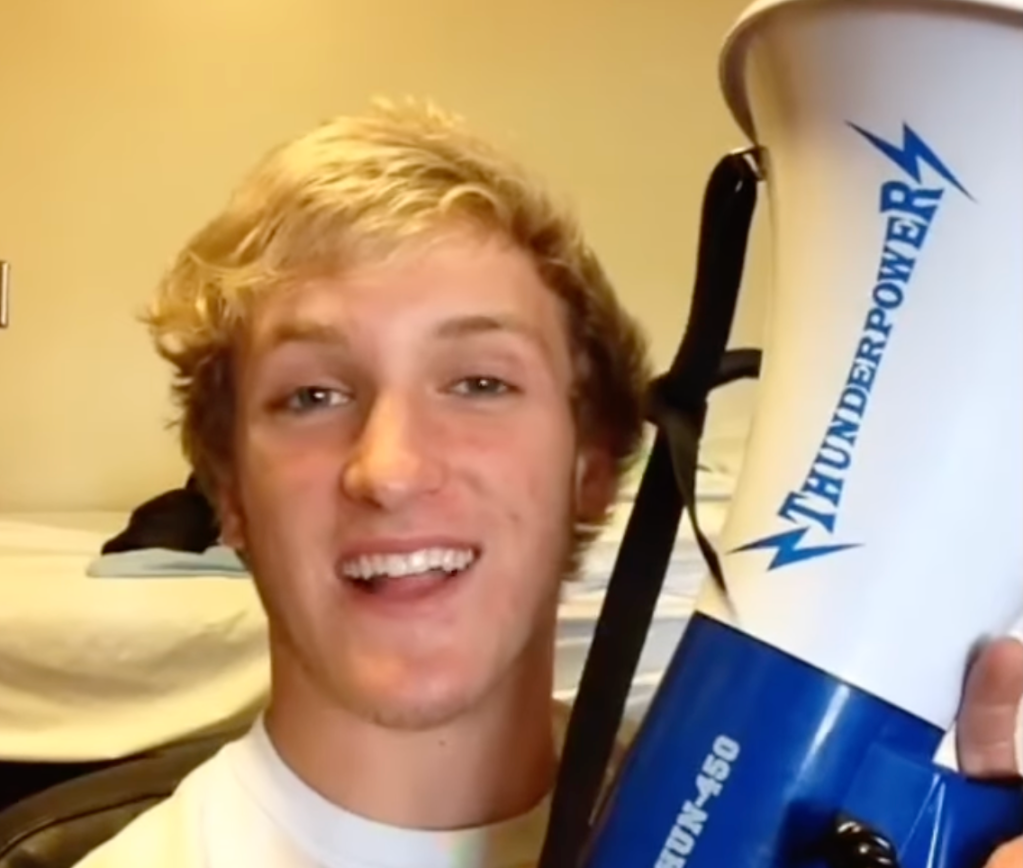
Paul’s rise to notoriety wasn’t unmarked by controversy, however. In late December 2017, at a time when he had something like 15 million YouTube subscribers, Paul earned widespread condemnation for his insensitivity after he posted a video to the site showing the body of an apparent suicide victim in Japan’s infamous Aokigahara Forest, and making light of the situation. As a result of the backlash on social media – which included a Change.org petition urging YouTube to deplatform the creator that garnered over 700,000 signatures – Paul removed the video and issued an apology for his actions (this apology was itself criticized for being disingenuous and self-serving, and Paul was later compelled to issue another). For their part, YouTube took disciplinary measures against Paul, which included removing the creator’s channel from the Google Preferred advertising program, and removing him from the YouTube Red series Foursome, among other things.
But that wasn’t all. About a month later, YouTube announced that it would temporarily suspend advertisements on Paul’s channels (the revenue was estimated to be about a million dollars per month) due to a “recent pattern of behavior,” which, in addition to the Aokigahara Forest controversy, now included a tweet in which he claimed that he would swallow one Tide Pod for every retweet he received, and a video in which he tasered a dead rat. The suspension seemed to be little more than a slap on the wrist, however, and two weeks later, in late February of 2018, ads were restored on Paul’s channels.
The controversies continued after the launch of Impaulsive in November 2018. In an episode released the following January, as Paul and Majlak and their guest, Kelvin Peña (aka “Brother Nature”) were discussing their resolutions to have a “sober, vegan January” followed by a “Fatal February” (vodka and steaks), Paul chimed in and suggested that he and Majlak might do a “male only March.” “We’re going to go gay for just one month,” he announced. “For one month, and then swing … and then go back,” Majlak concurred. The implication that being gay was a choice drew sharp criticism online, including a tweet from the LGBTQ+ organization GLAAD, which pointed out, “That’s not how it works @LoganPaul.”
We could continue. But it’s also worth mentioning that in early 2019, Paul underwent a brain scan administered by Dr. Daniel G. Amen, which revealed that a history of repetitive head trauma from playing football in high school had damaged the part of his brain that is responsible for focus, planning, and empathy. Such a revelation may explain some of Paul’s poor decision-making. But it has also been suggested that this may be an excuse for the creator to not own up to his shortcomings. And the diagnosis hardly stopped him from starting a boxing career, which he freely admitted “is a sport that goes hand-to-hand with brain damage.”
But even while Paul’s head injuries may have, to some extent, affected his ability to form human connections, it hasn’t completely severed the possibility. On Impaulisve, Paul often shows a genuine curiosity about his guests, a desire to understand their perspectives, and displays a sense of esteem for those, like the WWE superstars Randy Orton and John Cena, whom he knows personally and professionally outside of the context of the podcast. Even amid the raucous Morning Zoo atmosphere of the show, Paul’s tone when speaking to his guests is usually deferential and flattering, and creates a space not only for sharing intimate revelations about, say, the challenges creators face while living so much of their lives in public (a common topic), but also allows guests an opportunity to present themselves and their work in the best possible light.

This kind of dynamic was at play during the Donald Trump interview, in which Paul and Majlak offered the former president plenty of opportunities to boast about the historic accomplishments of his first term and of his 2024 campaign, and to air his many grievances – against Joe Biden, the media, the Democratic Party, and the lawyers prosecuting the many cases against him. Impaulsive, in other words, became a platform for Trump to remediate his typical campaign rhetoric, a means of delivering familiar content in a way that privileged quiet intimacy rather than grandstanding performances.
This sense of intimacy derived, in large part, from the setting in which the episode was recorded: Paul and Majlak were sat close to Trump in a wood-paneled room at his Mar-a-Lago estate. But it also stemmed from the kinds of questions that the co-hosts asked Trump. At one point in particular, the conversation turned, as it often does on Impaulsive, to combat sports, and to Trump’s love of the UFC. Opening up on this non-political and heavily masculinized subject – and casually mentioning the cheers he receives when he attends UFC events in person – likely increased the former president’s appeal among Impaulisve listeners, who, according to Paul and Majlak, are mostly wrestling and UFC fans themselves.
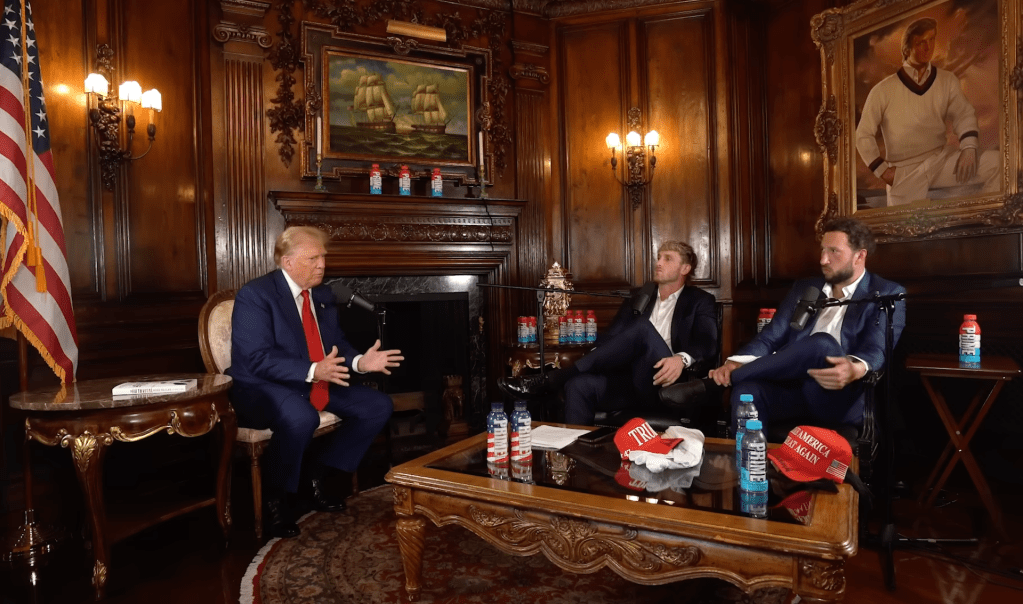
Other questions about combat sports – like whether Paul’s brother Jake could win an upcoming fight with Mike Tyson – further cemented the sense that Trump was a fan among fans, and thus created conditions for what podcast researcher Alyn Euritt calls “recognition,” moments in which listeners may feel a sense of intimate connection with a speaker/host and with the larger listening audience.
But what stuck out to me when listening to the episode and thinking about intimacy and podcasting, was the way in which the calm and deliberate pacing of the conversation, with help from the co-host’s gentle guidance, largely prevented the former president from straying into the kind of stream-of-consciousness delivery that characterizes much of his public discourse, and which has come to be known as the Trump “weave.” Kept on course by a friendly interlocutor pitching softball questions, Trump can sound lucid, even rational – and one can see how, in listening to this, his supporters, and even those apolitical listeners in the Impaulsive audience, can get swept up and taken along for the ride.
This is perhaps true for those moments, which occur often, where Trump touts his own successes and popularity. At the beginning of the episode, for instance, after Trump gave Paul a shirt emblazoned with his famous mugshot (which Paul called “gangster” and said “it happened, and might as well monetize it”), the former president launched into a string of familiar complaints about how his prosecution in that case had been an “unfair” miscarriage of justice, and how it had nevertheless resulted in a fundraising boon for his campaign. “I don’t think there’s ever been that much money raised that quickly,” he declared. Uncritically accepted by the co-hosts – and even encouraged by their muffled chortling – such defiant but matter-of-fact posturing may have seemed reasonable to Impaulsive listeners, an understandable response to what was presented as a blatant act of political persecution.
But the apparent honesty and reasonableness of Trump’s views even seemed to extend to his inevitable criticisms of Joe Biden and the American news media, criticisms which were likewise encouraged by Paul and Majlak’s laughter. When Majlak, for instance, asked Trump whether he was “starting to come around or soften your views on some of the networks that you may have not gotten along with in the past?” Trump’s blunt response, “no, they’re fake news,” was met with legitimating chuckles, and with Paul’s concurring statement, “yeah, fake news.” It was Trump’s follow-up, however, in which he put special emphasis on his May 2023 town hall with CNN’s Kaitlan Collins, that he elaborated his position, revealing that though he had thought the network had turned a corner in terms of its friendliness, or at least neutrality, toward him, they were instead “playing hardball.” Delivered almost in a tone of resignation, Trump seemed to give the impression that his poor (in his eyes) treatment by the press was a given, that their hostility, though unfair, was something that simply had to be endured. Again, this explanation, communicated in such an intimate conversational setting, seemed to suggest a cool and reasonable assessment of the situation and prepared listeners to later accept his more extreme view, expressed less than a minute later, that CNN was “the enemy.”
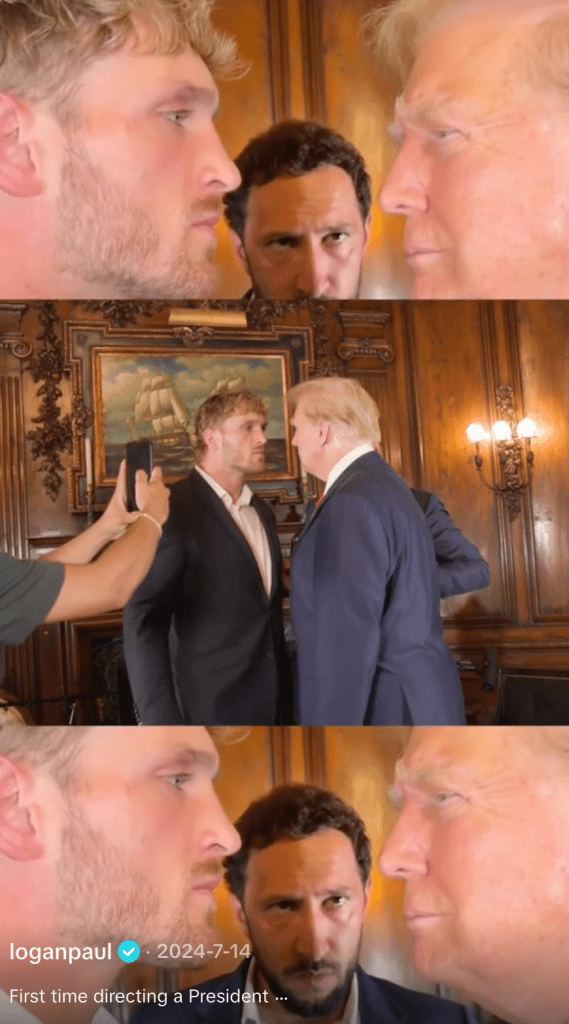
Overall, then, the episode, which ended with Paul, Majlak, and Trump filming a TikTok video in which the podcaster and presidential candidate squared off face-to-face as if shooting a fight promo, offered Trump a platform to connect with other combat sports fans, to burnish his reputation for authenticity, and to legitimize his many grievances. And while the number of new MAGA converts his appearance earned is an open question, what is clear is that Impaulsive afforded Trump an opportunity to directly speak to a demographic that was increasingly important to both campaigns.
—
Series Icon Image Adapted from Flickr User loSonoUnaFotoCamera CC BY-SA 2.0
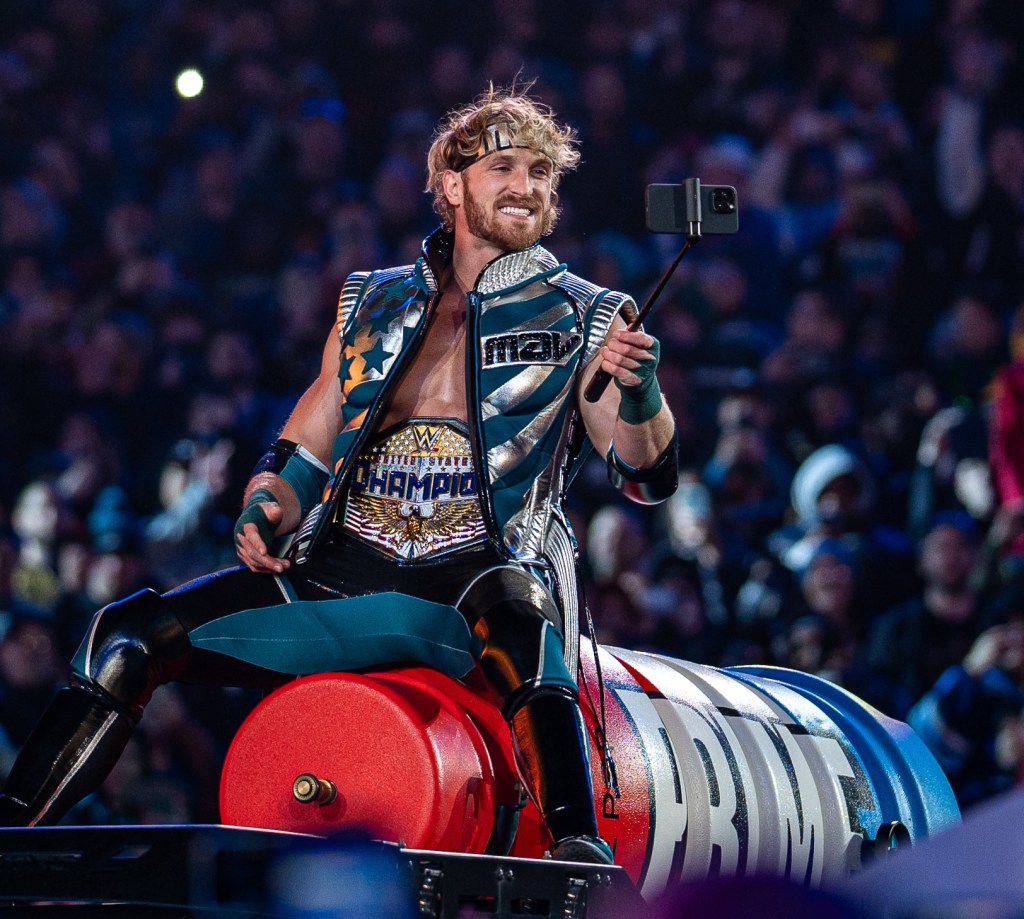
Featured Image: Paul making his entrance as the WWE United States Champion at WrestleMania XL, CC BY-SA 2.0
—
Andrew J. Salvati is an adjunct professor in the Media and Communications program at Drew University, where he teaches courses on podcasting and television studies. His research interests include media and cultural memory, television history, and mediated masculinity. He is the co-founder and occasional co-host of Inside the Box: The TV History Podcast, and Drew Archives in 10.
—
REWIND! . . .If you liked this post, you may also dig:

Taters Gonna Tate. . .But Do Platforms Have to Platform?: Listening to the Manosphere—Andrew Salvati
Robin Williams and the Shazbot Over the First Podcast–Andrew Salvati
“I am Thinking Of Your Voice”: Gender, Audio Compression, and a Cyberfeminist Theory of Oppression: Robin James
DIY Histories: Podcasting the Past: Andrew Salvati
Listening to MAGA Politics within US/Mexico’s Lucha Libre –Esther Díaz Martín and Rebeca Rivas
Gendered Sonic Violence, from the Waiting Room to the Locker Room–Rebecca Lentjes
Share this:

Faithful Listening: Notes Toward a Latinx Listening Methodology

**This piece is co-authored by Wanda Alarcón, Dolores Inés Casillas, Esther Díaz Martín, Sara Veronica Hinojos, and Cloe Gentile Reyes
For weeks, we have been inundated with executive orders (220 at last count), alarming budget cuts (from science and the arts to our national parks), stupendous tariff hikes, the defunding of DEI-anything, the banning of transgender troops, a Congressional renaming of the Gulf of Mexico, terrifying ICE raids, and sadly, a refreshed MAGA constituency with a reinvigorated anti-immigrant public sentiment. Worse, the handlers for the White House’s social media publish sinister MAGA-directed memes, GIFs across their social channels. These reputed Public Service Announcements (PSAs), under President Trump’s second term, ruthlessly go after immigrants.
It’s difficult to refuse to listen despite our best attempts.
“The ASMR video was true.”
On February 18, 2025, the official White House social media account, @WhiteHouse, shared a 40-second video showing a group of detained immigrants boarding a military aircraft for deportation. The video was captioned: “ASMR: Illegal Alien Deportation Flight.” ASMR, or autonomous sensory meridian response, features gentle, soothing sounds—such as whispering, tapping, or brushing—which can evoke pleasurable tingling sensations. In this satirical ASMR-style post, however, the sounds include the clinking of metal shackles on concrete floors, the jangle of handcuffs against bodies, and the grating of metal on metal as detainees slowly ascend the aircraft’s steps. By framing these distressing noises within the ASMR genre, the video invites listeners to consume them as aesthetically pleasing; encouraging a visceral embodiment where the sounds of violence toward migrants elicit an uncontrollable physical pleasure that seeps through the body. This effectively turns state violence into an unsettling sonic spectacle. Cruelty towards migrants, according to Cristina Beltrán, is not a failure of democracy but an expression of it. The (sonic) spectacle of migrant cruelty functions as a political practice meant to sustain white democracy as both a racial and political category.

Framed within ASMR, Trump’s official message is unmistakably “saying the quiet part out loud.” But not all that well. A closer listen reveals that the roar of the jet engine drowns out more intimate, human sounds: footsteps on the tarmac, the rustle of police pat-downs, and the deep, rhythmic breaths—proof of life—condemned. Listening to this disturbing post, we become attuned to our own internal pleads; our refusal to believe until the unsettling truth confirms: this isn’t a parody or a hoax—it’s real.
How does a sonic social media trend—built around such sounds as the crinkling of chip bags, the crunches of eating, the tap-tap of acrylic nails, the gentle clinks of typing or espresso-making—become a soundboard for the forced removal of immigrants? Indeed, the video has amassed nearly 105 million views on X alone. Clearly, the post broadcasts a pedagogy of cruelty—a lesson in how to aestheticize suffering—and we are left questioning just how far that message both travels and resonates. For many, the video is neither entertaining nor soothing, but rather shocking, offensive, and deeply disturbing.
Written comments show more revulsion than support, with many users openly challenging the video. In doing so, their protest, contained in the comments, starts to dismantle the ASMR aesthetic, undercutting its intended sense of calm. After all, the video isn’t particularly convincing as ASMR to begin with! These are echoes of dissent, outrage, and refusal, that accompany the in-person collective actions that have taken place across the nation rallying against Trump’s broader white-supremacist and anti-democratic agenda.

“What was louder was the screaming and cursing inside my head.”
History shows us that abolitionist efforts often relied on the sounds and images of chains to evoke empathy for enslaved Africans—making their suffering and humanity visible to a broader public. Yet, as Saidiya Hartman’s Scenes of Subjection makes clear, such representations can easily devolve into a spectacle of suffering, where the emphasis shifts from the enslaved person to the emotional response of the white witness. Today, that same auditory imagery—clinking metal, mechanical restraints—resurfaces, but in a profoundly different register. No longer stirring empathy, they risk desensitizing listeners to the pain and struggle of Latinx migrants. This ASMR instance, directed at MAGA-listeners, prioritizes a cruel-yet-gleeful response without any compassion whatsoever towards immigrants.
The word “Illegal” in the caption further amplifies the discourse of criminality, evoking a long legacy of racialized policies and media portrayals that cast mexicanos and Chicanos as perpetually deportable. Note the hypocrisy in naming the people as illegal, when their forced removal without legal due process, is itself illegal. U.S. immigration policy—think Operation Wetback and the Bracero Program, have long simultaneously expelled and depended on Mexican labor. The enduring power of these tropes lies not just in law, but in sentiment—in the way migrants are imagined, portrayed, and ultimately policed in the public eye. Just as Hartman argues that the end of slavery did not mean the arrival of true freedom for Black Americans, so too have U.S. immigration policies failed to fully embrace immigrants as residents or neighbors and much less citizens. In both cases, legal status did not equate to genuine belonging or liberation.
What is notable in the current deployment of “illegality” in the @WhiteHouse post is its expanded scope: whereas earlier rhetoric primarily targeted Mexicans and Mexicanness this framing now extends to encompass all Latinx peoples, which always includes Black, Indigenous, Trans and Queer. This further intensifies prior waves of anti-Mexican sentiment while broadening the reach of criminalizing discourse. In doing so, it reinforces a racialized logic of illegality that casts an ever-widening net of suspicion and exclusion.

The MAGA White House’s broader propaganda – from the self-deport ads on Spanish-language media and Kristi Noem’s pinche photo-ops from CECOT (El Salvador’s infamous mega-prison) to SCOTUS attempts to revoke birthright citizenship – raises the stakes of listening, rendering our response—and our work as Latinx sound studies scholars—urgent.
Like it or not, this video reshapes the contours of our field in real time. Using the ASMR video as a point of departure, we offer a mode of listening on the side of resistance—a practice that affirms our solidarity with migrants and their right to move, work, and live with dignity. Drawing on the work of the late María Lugones, we advocate for a practice of faithful witnessing—a listening attuned not only to sound, but to histories, structures, and acts of refusal that resist dehumanization.

Ofrenda
From Lugones’s book Pilgrimages/Peregrinajes: Theorizing Coalition Against Multiple Oppressions, she teaches that a collaborator witnesses from the side of power; a faithful witness stands with resistance even when it entails risk. And, to witness faithfully is to recognize and honor acts of resistance—even when doing so defies common sense of what we recognize as political acts/sounds. In Decolonizing Diasporas, Yomaira Figueroa-Vásquez reminds us of the important coalitional sociality Lugones envisions in practicing faithful witnessing. For Figueroa, “the practice of faithful witnessing is one that oppressed and colonized peoples have deployed since time immemorial as a method of bearing witness to each other’s humanity even as they faced myriad forms of violence” (156).
Faithful witnessing entails centering the plight of all MAGA political scapegoats, migrants in precarity, pro-Palestinian student activists, the still separated children, trans youth, women, and who ever is next on the Project 2025 agenda. Faithful witnessing is not about centering our own emotional response, but about coming together to listen, to bear witness, and to protect. In response to these distorted public signals, we present a suite of countersonics, shared in a lo-fi listening mode that enacts faithful witnessing and affirms our roles as co-resisters to sonic oppression. We conclude with a noise-filled, healing artifact: a sonic limpia for deep listening and a playlist to sustain the good fight.
FOR THE FULL PLAYLIST CLICK THIS LINK, OR START BELOW!
—
Featured Image: Philly Immigrant May 1st, 2025 march for Justicia. Migrant workers and supporters rallied at 4th & Washington and marched in the streets to the AFL-CIO Mayday rally and march. Image by Joe Piette, cropped by SO! CC BY-NC-SA 2.0
—
Wanda Alarcón is an Assistant Professor of Gender and Women’s Studies at the University of Arizona. Her research takes up sound as a generative site and method for hearing and amplifying resistant grammars in Chicana narratives. She is currently working on her first book manuscript, Chicana Soundscapes, which listens closely to sound, noise, language, songs, echoes, and silences, and proposes decolonial feminist ways of hearing Chicana and queer Chicana worlds.
Dolores Inés Casillas (she/her/ella) is Director of the Chicano Studies Institute (CSI) and Professor of Chicana and Chicano Studies at UC Santa Barbara. Her research focuses on immigrant engagement with U.S. Spanish-language and bilingual media. She is the author of Sounds of Belonging: U.S. Spanish-language Radio and Public Advocacy (NYU Press, 2014), co-editor of The Companion to Latina/o Media Studies (Routledge Press, 2016) and Feeling It: Language, Race and Affect in Latinx Youth Learning (Routledge Press, 2018).
Esther Díaz Martín (she/her/ella) is an Assistant Professor of Latin American and Latino Studies and Gender and Women’s Studies at the University of Illinois Chicago. Her book, Radiophonic Feminisms: Latina Voices in the Digital Age of Broadcasting, (UT Press, 2025) theorizes Chicana feminist listening and attends to the political work of Latina voices in contemporary sound media.
Sara Veronica Hinojos (she/her/ella) is an Assistant Professor of Media Studies at Queens College, CUNY. Her research critically engages popular representations of Chicanxs and Latinxs as racialized, “accented” speakers. Her current book project, The Racial Politics of Chicana and Chicano Linguistic Scripts in Media (1925-2014), intentionally brings together language politics, digital media, humor studies and sound studies.
Cloe Gentile Reyes (she/her/ella) is a queer Boricua scholar, poet, and perreo profa from Miami Beach. She is a Faculty Fellow in NYU’s Department of Music and has a PhD in Musicology from UC Santa Barbara. Her writing focuses on how Indigenous Caribbean femmes navigate intergenerational trauma and healing through decolonial sound, fashion, and dance. Her pieces have been featured in Sounding Out!, Intervenxions, and the womanist magazine, Brown Sugar Lit.
—
Thank you to Daimys Ester García for care in the form of editorial labor.
—

REWIND!…If you liked this post, you may also dig:
“Oh how so East L.A.”: The Sound of 80s Flashbacks in Chicana Literature–Wanda Alarcón
Echoes in Transit: Loudly Waiting at the Paso del Norte Border Region–José Manuel Flores & Dolores Inés Casillas
Xicanacimiento, Life-giving Sonics of Critical Consciousness–Esther Díaz Martín and Kristian E. Vasquez
Listening to Digitized “Ratatas” or “No Sabo Kids”–Sara Veronica Hinojos and Eliana Buenrostro
Ronca Realness: Voices that Sound the Sucia Body–Cloe Gentile Reyes
Latinx Soundwave Series–Edited by Dolores Inés Casillas
Share this:


Current Top Posts





April 2021

January 2020

November 2019

October 2019

August 2019

April 2014

November 2017

March 2015

December 2017

October 2015
 Sounding Out!
Recent Comments