
My Music and My Message is Powerful: It Shouldn’t be Florence Price or “Nothing”
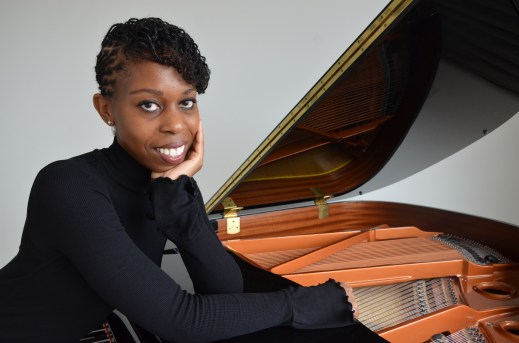
Flashback to the second day of the recent Gender Diversity in Music Making Conference in Melbourne, Australia (6-8 July 2018). In a few hours, I will perform the first movement of the Sonata in E minor for piano by Florence Price (1887–1953). In the lead-up, I wonder whether Price’s music has ever been performed in Australia before, and feel honored to bring her voice to new audiences. I am immersed in the loop of my pre-performance mantra:
My music and message is powerful, my music and message is powerful.
Repeating this phrase helps me to center my purpose on amplifying the voice of a practitioner who, despite being the first African-American woman composer to achieve national and international success, faced discrimination throughout her life, and even posthumously in the recognition of her legacy.
In Price’s time, there were those in positions of privilege and power who listened to her music and gave her a platform. One such instance was Frederick Stock of the Chicago Symphony Orchestra and his 1933 premier of her Symphony in E minor. But there were times when her musical scores were met with silence. For example, when she wrote to Serge Koussevitzky of the Boston Symphony Orchestra requesting that he hear her music, the letter remained unanswered. There was a notable intermittency in how Price was heard, which continues today. It seems most natural for mainstream platforms to amplify her voice in months dedicated to women and Black history; any other time of the year appears to require more justification. And so, as I am repeating this mantra—my music and message is powerful—I am attempting to de-centre my anxieties, and center my service to amplifying Price’s voice through an assured performance.
I applied to the conference a few months ago. I was keen to bring my research to new audiences. Upon seeing that the conference was in Australia, I knew this would be a fantastic opportunity to gain transnational insight into the ongoing work around representation and inclusion in music. Fast-forward to July: here I am, in Australia for the first time. The venue is unfamiliar and I have not met anyone here before this visit. However, this is what I do know: I have fifteen minutes for my performance; hence, I have only prepared the first movement of the sonata. Looking in the program, I noticed there will be a paper taking place at the same time as my performance, given by an academic who identified himself in his printed abstract as “a white, old, straight man with power and privilege.”
The title of his paper? “I Have Nothing to Say.” While gender diversity was the overarching theme of the conference, the goal towards inclusion negated the fact that not all platforms are created equal. The speaker’s proposed topic advertised the ease with which the dominant voice may access a space for its mere presence, regardless of what will be said. Conference logistics then set this voice and its contribution against the radically diverse sounds of our time slot. In addition to my lecture and performance, there are several other events taking place simultaneously. The subjects include: mentoring women composers, creative realizations of parenthood in composition, gender balance in Australian jazz, interpretative approaches to the music of Kaija Saariaho, music as a vehicle for navigating the challenges around non-binary and transgender identity, and a cis-gendered white man’s exploration of ceding power and listening.
I remember a casual conversation the night before in which the joke arose of the speaker being “the token white man.” Of course it was a joke; the very notion is absolutely ridiculous. I remember reflecting on tokenization earlier that day and tweeting to that effect:
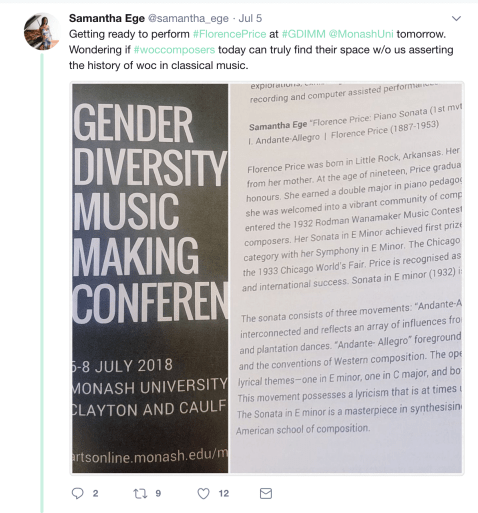
I knew the joke was light-hearted, but there is nothing light-hearted about being a token, nothing light-hearted about knowing your excellence, yet wondering if it will even factor into the decisions around your involvement. Anyway, I did not want to prioritize thoughts about the token white man over my purpose at the conference because that would take up time, space and energy, and in my pre-performance rituals, that time, space and energy belongs exclusively to the women that I seek to honour.
When it is time to perform, I bow, then sit, then sink into the first sound, which is this rich e minor chord that engages almost all of my fingers. I relish the rich tones in the grandeur of the introduction. But as the first theme comes in, conjuring up the soundworld of plantation songs, I calm the mood down to ensure that the lyricism of the top melody really sings.
My music and message is powerful.
The performance is followed by a presentation where I talk more about the sonata, who Price was, and what she achieved. I make sure to highlight her Arkansan roots and her Chicago successes, particularly around the Symphony in E minor. I speak about the influence of the spirituals within the classical frameworks of her compositions. I also speak about the privilege and the incredibly moving significance of being able to present and perform her music for an audience, largely of African descent, at the Chicago Symphony Center.
I play excerpts from the rest of the sonata off my recent album Four Women on Spotify and struggle to find the best time to pause the track because there is so much that I want the audience to hear: from the development of spiritual themes in the second movement, to the virtuosic whirlwind that is the final movement.
A dynamic discussion ensues, weaving in the narratives of Nina Simone, African-American folk tradition and my passion for this repertoire. I elaborate upon the ways in which exploring classical music by women has been an empowering personal journey. I articulate how the perception of men achieving “firsts” renders them gods while women achieving “firsts” are miracles that were never supposed to happen, that may never happen again. I express my role as a musicologist-pianist as demonstrating a long and rich history of women music-makers and, therefore, evidencing precedents—her-stories—for the creative contributions of women now. My time comes to an end and I am left feeling proud to have represented Price’s music and legacy here, today.
After my performance, I tweeted the following thought-through (but clearly not proof-read) thread expressing my disappointment:
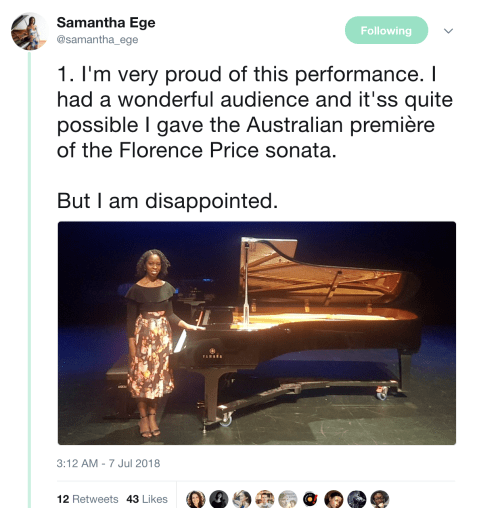
My goal with this post was to juxtapose this paper with Price’s music and career, spotlighting the implications of uneven power and access therein.
3. His talk was called “I have nothing to say.”
Some people therefore chose to listen to a man who has “nothing to say” over the music of an African American woman composer who has historically been silenced and is barely heard in this current day.
Let that sink in.
— Samantha Ege (@samantha_ege) July 7, 2018
Wrapped up in my post was the criticism of the fact that, being a university professor, the speaker of “I Have Nothing to Say,” has access to this kind of platform year-round, while marginalised voices only get amplified in the specific and limited spaces that society has carved out for them.
My critique is not about the individual, but about the systemic and institutionalized undermining of underrepresented voices, even at a conference designed to amplify them. The fact that such a work was placed on such a program evidences the extent to which we are so conditioned to ensuring the most powerful and privileged voice speaks in every single space, even when they acknowledge they have nothing to say.
Since posting that evening to both Twitter and Facebook, I have received a backlash on the latter, one that is, at present, unaffiliated with the organisers of the event. It has, however, attempted to derail the conversation. Apparently I was only upset because my program faced competition from other papers. Maybe I should have looked into the scheduling to make different arrangements. Or I should have found out what the speaker’s talk was about because there is a chance that I would have enjoyed it. Repeatedly, the onus was placed on me to reach out to the “token white man” and better understand his position. I also learned something new: passing judgement on a presentation because of its title is no better than passing judgement on a composer because of their gender. However, I was under the impression that the paper title was a choice and that Price’s identity as a black woman was not.
Anyway, I did not judge by the title. I judged by the abstract:
When one of the organisers of this conference suggested in a Facebook exchange on someone else’s post that I should submit an abstract for a paper, I was surprised. And a little frightened. What could I possibly contribute to such an event? I am the problem. I am a white, old, straight man with power and privilege. Surely my voice could only be heard by others as a violence in this context. Surely, my job is to get out of the way, to shut up, to not be heard. Surely, the only thing I could ethically and honourably bring to this is my listening. But then I felt that this is what needs to be said. I am and old straight white man who says that the job of people like me is to actively get out of the way, actively cede power and authority, actively be told, actively shut the fuck up. So I decided to use the occasion to practice a way of speaking that does those things, gets out of the way, cedes power and authority, gets told, shuts the fuck up. To practice speaking which listens. A listening-speaking. So that’s what I am trying to do in this paper. To enact a listening-speaking that gets out of the way, cedes power and authority, gets told, shuts the fuck up.
The speaker’s participation was invited and his proposal both encouraged and evidently accepted by the organizers. The abstract presents a sense of knowing better. “Surely my voice could only be heard by others as a violence in this context.” Yes. “Surely, my job is to get out of the way, to shut up, to not be heard.” Yes. “Surely, the only thing I could ethically and honourably bring to this is my listening.” Yes! “But…”
Ultimately, what needed to be said, actually needed to be done. The enacting of a listening-listening with neither platform nor audience would have been a powerful statement, quietly powerful, but powerful nonetheless. To reiterate, not all platforms are made equal—could I, realistically, have told him to shut the fuck up? How would that have sounded? How would I have sounded?
The derailing responses I have received pointedly ignore how the very presence of this paper disrupted the multiple and intersectional conversations happening in that moment. It distracted from the rarity of these subjects and their platform, and quite materially, culled an audience who could and should have been doing the very listening the abstract advertises. Scheduling this paper restored the speaker’s position to the center, and re-centered his power and authority to speak about everything and “nothing.” His privilege remained intact. In the midst of the most diverse and pertinent themes was the voice that has, both historically and to this day, spoken over the top of so many others.
“Trocadero Piano Player” by Flickr User Pierre Metivier (CC BY-NC 2.0)
I chose not to reach out directly to the institution nor its organisers because of the emotional labor this would entail. To put the issue forward in a quiet behind-the-scenes way that is sensitive to those who created the issue, is to chip away at my voice and its power. On the otherhand, to project the issue with a loud “shut the fuck up” is to perform a type of power and privilege on a platform that I do not have. I enact a public conversation here via Sounding Out! so that this experience may inform wider work towards diversity and representation. I enact this conversation in order to progress definitions of inclusion to a point where the choice to engage the dominant voice factors in a listening-listening as an exceedingly valuable contribution to the narratives offered by lesser heard voices.
I have since received a written acknowledgement from the organizers of this problematic programming, with a formal apology for the impact. But I must bring to light the important action of two allies, in particular, who recognised the emotional work required of me to bring this forward institutionally. They offered to continue the conversation on my behalf. We talked about the way in which the ensuing discussion must center listening. We shared that the process towards inclusivity may result in mistakes being made along the way. We discussed that while compassion and sensitivity can be important parts of the dialogue, I cannot afford to extend that compassion and sensitivity without becoming emotionally drained. And so, they wrote to the institution with the message of actively learning and making efforts towards change. I am so grateful for that allyship because while I knew that my voice would be heard, I could not guarantee how it would be heard. After all, if there is one take away to be had from this experience, it is that regardless of intention—and regardless of occasion—the dominant voice is very much conditioned to speak up, and speak over. And the dominant ear cannot help but listen.
So, how do I move forward?
My music and my message is powerful.
—
Featured Image: Courtesy of Author
—
 Samantha Ege is a British musicologist, pianist and teacher based in Singapore. She is a Ph.D. candidate in Music at the University of York, UK. Her research focuses on the aesthetics of Florence Price. As a pianist, her focus on women composers has led to performances in Singapore (supported by the British High Commission and International Women’s Day), and lecture-recitals at the University of York, the Chicago Symphony Center and the Women Composers Festival of Hartford, USA. Her album Four Women: Music for Solo Piano by Price, Kaprálová, Bilsland & Bonds reflects her journey into a rich and unrepresented repertoire.
She would like to thank Deborah Torres Patel for the gift of this mantra.
—
 REWIND! . . .If you liked this post, you may also dig:
Spaces of Sounds: The Peoples of the African Diaspora and Protest in the United States–Vanessa Valdes
becoming a sound artist: analytic and creative perspectives–Rajna Swaminathan
Sounding Out Tarima Temporalities: Decolonial Feminista Dance Disruption–Iris C. Viveros Avendaño
Gendered Soundscapes of India, an Introduction –Praseeda Gopinath and Monika Mehta
On Whiteness and Sound Studies–Gustavus Stadler
Share this:

They Can Hear Us: Surveillance and Race in “A Quiet Place”
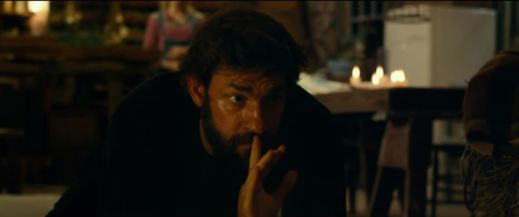
The family in A Quiet Place (2018) lives a life marked by incessant trauma. Invisible to the hunters who are far more powerful than they are, the family remains safe from direct assault as long as they remain unheard by the hunters, who can’t see them. But that same invisibility means the everyday mundanities of life become a constant struggle marked by the terror of the horrific death that will claim them should they make an errant sound. A trip to the pharmacy could prove fatal; a hungry child could summon the hunters and put in danger the entire family. When sketched out in these broad strokes, A Quiet Place, as Kathryn Adams Burton pointed out to me when we left the theater, summons terror from its viewers by depicting the kind of institutional surveillance and violence that endanger Black lives in the US, without one person of color in the entire movie. Thinking with Simone Browne’s Dark Matters (2015), Jennifer Stoever’s The Sonic Color Line (2016), and Jared Sexton’s Amalgamation Schemes (2008), I argue here that A Quiet Place places white characters in a non-white relationship with surveillance, which they overcome in a way that projects white ingenuity and strength and reinforces the centuries-old notion that those who live under the eye and ear of hyper-surveillance tactics do so because they deserve to and because they are not exceptional enough to evade those tactics.
 The Quiet family’s invisibility is literal: the creatures who hunt them have no sense equivalent to human vision and instead track their prey using hyper-developed listening abilities. They remain vigilant for the audible traces of their victims; sound is the thing that can put the family in trouble. Simone Browne highlights in Dark Matters the significance of visibility and invisibility in the history of antiblack surveillance in the US. Lantern laws in 18th century New York City stipulated that enslaved black and indigenous people must carry a lit lantern if they were in the streets after dark, a regulation that Browne understands as an act of “racializing surveillance,” a “form of knowledge production about the black, indigenous, and mixed-race subject” (79). Specifically, the knowledge created through the lantern laws marked bodies of color as “un-visible,” in need of illumination in order to be properly seen. And here “seen” slips into a couple of different meanings, encompassing not only the ocular but also the notion of “seeing” that connotes understanding and discernment.
The early technology of lantern surveillance, as well as the boundaries delineated by sundown towns, marked black, indigenous, and mixed-race bodies as untrustworthy, scheming, and therefore in need of ongoing surveillance that would make these bodies visible to the eye. At the heart of Dark Matters is Browne’s contention that the history and techniques of surveillance cannot be understood separate from their racializing work: “surveillance…is the fact of antiblackness” (10). So while the Quiet family is white, their relationship to the powerful beings that hunt them–an existence unseeable and unknowable apart from heightened measures of surveillance–appropriates signifiers of racialized surveillance in order to heighten the stakes of the movie’s characters.

The family walks on sand in order to muffle their footsteps.
While Browne focuses primarily on acts of looking as mechanisms for violently enforcing the color line in Dark Matters, Jennifer Stoever traces the history of that same color line through listening practices. Stoever isn’t explicitly engaging surveillance studies the way Browne is, but her theorization of the “listening ear”–the social and political norms that shape how we hear race–includes surveillance acts that, like lantern laws, mark voices perceived to be non-white as always already ready to be monitored, bounded, and eliminated should they exceed their boundaries (13). For both Browne and Stoever, the act of surveilling uncovers a racializing sleight of hand: non-Whiteness is held up as that which stands out, though this racialization is proven backwards if we look and listen a bit closer. US looking and listening norms condition people to organize blackness and brownness and noise as aberrations against natural, invisible, inaudible whiteness, but it takes a good deal of white supremacist work to create this illusion (by “white supremacy,” I mean the social and political practices and institutions that reify and reward whiteness). Looking through brighter lights and sharper camera lenses at non-White subjects and listening through amplification devices and ubiquitous bugs to non-White subjects are both ways of drawing attention away from whiteness–the racialized construct that fuels US social, legal, and political praxis–and toward non-whiteness.
Stoever opens The Sonic Color Line by considering the violence visited upon Jordan Davis, Sandra Bland, and a Spring Valley High School student when each was considered too loud and unruly by white listening ears trained to surveil blackness. The Quiet family is listened to in the same way Davis, Bland, and the Spring Valley student were, in the same way non-whiteness has been surveilled in the US: with dire consequences for being too loud. But, by erasing black and brown bodies and histories from the screen, A Quiet Place divorces these surveillance tactics from their real-world context, where they work as tools of white supremacist systems to “fix and frame blackness as an object of surveillance” (Browne 7). Part of the fantasy of A Quiet Place involves “fixing and framing” whiteness as the objects of sonic surveillance practices that have historically worked to preserve and reward whiteness, not target it.
 While the Quiet family is subjected to antiblack surveillance techniques, they are otherwise marked as white–and not just based on what their skin color looks like. Farmers in a rural, hilly region of Upstate New York, the Quiet family navigates the apocalypse with a libertarian aplomb. They’re stocked and loaded when the government fails to protect its citizens, and they’re also aware of but not in collaboration with other survivors in the surrounding area. Operating outside the bustle of urban noise, which Stoever notes is marked as non-White by the listening ear, the Quiet family likely boasts generations of working class whites who benefited from the kind of social safety nets built by the New Deal, only to mistake the wealth those social programs built to be fully the fruits of their own hard work.

The father, played by John Krasinski, looks over their plot of land.
The independence and autonomy that the Quiet family demonstrates is not on its own a marker of whiteness, but the kind of wealth accumulation that makes non-collaborative survival possible is the kind that’s historically been more readily available to white folks in the US. It’s a history that is flattened, as is the history of the surveillance that shapes their lives. Their wealth simply exists, and viewers aren’t meant to wonder where it came from or at whose expense. Likewise, viewers learn very little about what the hunters are, where they came from, and why they’re here. The hunters just appear, terrifying sonic surveillers who carry signifiers of antiblack listening practices but who remain detached from the antiblack history of surveillance.
The racialized terror at the heart of A Quiet Place grows from the fear of being denied one’s whiteness, being subjected to the same controlling surveillance measures that have helped maintain the color line for centuries in the US. It’s a standard white sci-fi nightmare scenario where technologies spin out of control and subjugate all of humanity, white people included. It’s also a white exceptionalist fantasy, where whiteness–not just white people but the wealth and freedom created for white people by white supremacist systems–conquers the unconquerable. Jared Sexton’s Amalgamation Schemes can prove helpful here, as he outlines the way racial ideology has shifted in recent decades to permit multiculturalism so long as it preserves whiteness. While systems like slavery and segregation were buttressed by explicit white supremacy, where whiteness = good and non-whiteness = bad, contemporary racial hierarchies are maintained by conceding that multiculturalism = virtuous and race-based solidarity = problematic. Here, white supremacy cloaks itself in diversity, hybridity, mixedness and points to any group that coheres around racial identity as regressive.
 Flattening history is crucial to that ideological shift. In order to maintain a racial hierarchy that tips in favor of whiteness, past violence and kleptocratic seizures of money, resources, and lives must be removed from the equation so that the kind of multiculturalism that Sexton critiques can proceed as if all who participate do so on a level playing field. Whiteness becomes “something equivalent to the…ethnicities and cultures of nonwhite immigrants and American Indians” (Sexton 66). The field, of course, isn’t level when white supremacy has funneled centuries of ill-gotten gains to whiteness, so this kind of multiculturalism is a way of gaming the system, mixing up racial signifiers so that white folks can take on just enough racial signifiers to blend into a racially diverse society without giving up the power and privilege that continues to give them a leg up.
A Quiet Place follows a calculus similar to the multiculturalism Sexton describes. First, the movie extracts emotional responses of terror and dread through a mixture of racial signifiers, subjecting white characters to forms of surveillance rooted in antiblackness. With no historical context to explain the forms of surveillance the hunters use or the characters’ previous relationships to surveillance, the Quiet family’s whiteness becomes just another ethnicity, a flattened way of being in the world divorced from the white supremacist context that funnels resources their way. Their privilege and power become as invisible to viewers as they are to the hunters. By masking that privilege, A Quiet Place clears space for a fantasy world where the white heroes have survived by virtue of being simply more clever, more resourceful, more brave, more everything than all the black and brown people who have, by implication of their absence from the film, been killed off by the hunters.
 A Quiet Place, then, takes a family of multiculturally white characters and positions them in roles white characters have become accustomed to occupying: that of world saviors–some of them even martyrs. Here, hyper-surveillance is simply a fact of life, and those who are able to live life free of the dire consequences of that hyper-surveillance are able to do so because they are exceptional. By this logic, what protects you from the police is either your innocence or your guile, not your whiteness. What guarantees your safety when you publicly challenge government policies is the righteousness of your cause, not your whiteness. What allows you to move in the dark without a lantern or to listen to your music loudly in public spaces without being shot or to cross borders without fear is your inherent virtue, not your whiteness. And when surveillance is positioned as a fact of life, and when those who avoid the crushing consequences of surveillance are understood to do so because they are virtuously exceptional, then those who are targeted, hunted, and killed using hyper-surveillance tactics are understood to be deserving of their fate because they are not virtuous or exceptional enough to avoid it. This is the logic that frames slavery as a choice, that cages children at the border, that influences and fixes elections across the globe but takes umbrage when subjected to the same tactics.
One terrible irony of a movie like A Quiet Place is that its flattened hyper-surveillance context makes it incapable of seeing and hearing the deep and rich history of black and brown evasion of hyper-surveillance. There’s an ingenuity coursing through activities of evading surveillance–“looking back,” marronage, and fugitivity chronicled by writers including Sylvia Wynter, Franz Fanon, Katherine McKittrick, and Simone Browne, among others–an ingenuity that evades hyper-surveillance and simultaneously exposes hyper-surveillance as antiblack while arguing against the notion that it is simply a fact of life and signalling avenues to freedom. Instead of those stories, though, the white Quiet family whispers to us a familiarly unsettling refrain: the white Quiet family, alone, can eradicate these terrors. The white Quiet family, alone, can fix this. The white Quiet family, alone, are exceptional.
—
Featured image, and all images in this post are screenshots from “A Quiet Place ALL TRAILERS – Emily Blunt & John Krasinski 2018 Horror Movie” by Youtube user Flicks And The City Clips.
—
Justin Adams Burton is Assistant Professor of Music at Rider University. His research revolves around critical race and gender theory in hip hop and pop, and his book, Posthuman Rap, is available now. He is also co-editing the forthcoming (2018) Oxford Handbook of Hip Hop Music Studies. You can catch him at justindburton.com and on Twitter @j_adams_burton. His favorite rapper is one or two of the Fat Boys.
—

REWIND! . . .If you liked this post, you may also dig:
Teach Me How To Dougie Like A Mediocre White Man–Justin Burton
Resounding Silence and Soundless Surveillance, From TMZ Elevator to Beyoncé and Back Again–Priscilla Peña Ovalle
Quiet on the Set?: The Artist and the Sound of a Silent Resurgence– April Miller
Share this:


Current Top Posts





April 2021

January 2020

November 2019

October 2019

August 2019

April 2014

November 2017

March 2015

December 2017

October 2015
 Sounding Out!
Recent Comments