
The Firesign Theatre’s Wax Poetics: Overdub, Dissonance, and Narrative in the Age of Nixon

The Firesign Theatre are the only group that can claim among its devoted fans both Thom Yorke and John Ashbery; who have an album in the National Recording Registry at the Library of Congress and also coined a phrase now used as a slogan by freeform giant WFMU; and whose albums were widely distributed by tape among U.S. soldiers in Vietnam, and then sampled by the most selective classic hip hop DJs, from Steinski and DJ Premier to J Dilla and Madlib.
Formed in 1966, they began their career improvising on Los Angeles’s Pacifica station KPFK, and went on to work in numerous media formats over their four-decade career. They are best known for a series of nine albums made for Columbia Records, records that remain unparalleled for their density, complexity, and sonic range. Realizing in an astonishing way the implications of the long playing record and the multi-track recording studio, the Firesign Theatre’s Columbia albums offer unusually fertile ground for bringing techniques of literary analysis to bear upon the fields of sound and media studies (and vice versa). This is a strategy that aims to reveal the forms of political consciousness that crafted the records, as well as the politics of the once-common listening practices binding together the disparate audiences I have just named. It is no accident that the associative and referential politics of the sample in “golden age” hip hop would have recognized a similar politics of reference and association in Firesign Theatre’s sound work, in particular in the group’s pioneering use of language, time, and space.

The Firesign Theatre (wall of cables): John Rose, Image courtesy of author
The Firesign Theatre is typically understood as a comedy act from the era of “head music” — elaborate album-oriented sounds that solicited concerted, often collective and repeated, listening typically under the influence of drugs. But it may be better to understand their work as attempting to devise a future for literary writing that would be unbound from the printed page and engaged with the emergent recording technologies of the day. In this way, they may have crafted a practice more radical, but less recognizable, than that of poets —such as Allen Ginsberg or David Antin, both of whose work Firesign read on the air — who were also experimenting with writing on tape during these years (see Michael Davidson’s Ghostlier Demarcations: Modern Poetry and the Material Word, in particular 196-224). Because their work circulated almost exclusively on vinyl (secondarily on tape), it encouraged a kind of reading (in the strictest sense) with the ears; the fact that their work was distributed through the networks of popular music may also have implications for the way we understand past communities of music listeners as well.
The period of Firesign’s contract (1967-1975) with the world’s largest record company parallels exactly the recording industry’s relocation from New York to Los Angeles, the development of multitrack studios which made the overdub the dominant technique for recording pop music, and the rise of the LP as a medium in its own right, a format that rewarded, and in Firesign’s case required, repeated listening. These were all factors the Firesign Theatre uniquely exploited. Giving attention to the musicality of the group’s work, Jacob Smith has shown (in an excellent short discussion in Spoken Word: Postwar American Phonograph Cultures that is to date the only academic study of Firesign) how the group’s attention to the expansion of television, and in particular the new practice of channel-surfing, provided both a thematic and a formal focus for the group’s work: “Firesign […] uses channel surfing as the sonic equivalent of parallel editing, a kind of horizontal or melodic layering in which different themes are woven in and out of prominence until they finally merge. Firesign also adds vertical layers to the narrative in a manner analogous to musical harmony or multiple planes of cinematic superimposition” (181). But more remains to be said not only about the effect of the Firesign Theatre’s work, but about its carefully wrought semantics, in particular the way the “horizontal” and “vertical” layers that Smith identifies were used as ways of revealing the mutually implicated regimes of politics, culture, and media in the Vietnam era — at the very moment when the explosion of those media was otherwise working to disassociate those fields.
The group’s third album, Don’t Crush That Dwarf, Hand Me the Pliers is typically understood as their first extended meditation on the cultural phenomenology of television. Throughout the record, though there is much else going on, two pastiches of 1950s genre movies (High School Madness and a war film called Parallel Hell!) stream intermittently, as if through a single channel-surfing television set. The films coincide in two superimposed courtroom scenes that include all the principal characters from both films. By interpenetrating the school and the war, the record names without naming the killing of four students at Kent State and two students at Jackson State University, two events that occurred eleven days apart in May 1970 while the group was writing and recording in Los Angeles. Until this point rationalized by the framing fiction of a principal character watching both films on television, the interpenetration of the narratives is resolvable within the album’s diegesis—the master plot that accounts for and rationalizes every discrete gesture and event—only as a representation of that character’s having fallen asleep and dreaming the films together, a narrative sleight of hand that would testify to the group’s comprehension of literary modernism and the avant-garde.
The question of what may “cause” the interpenetration of the films is of interest, but the Firesign Theatre did not always require justification to elicit the most outrageous representational shifts of space (as well as of medium and persona). What is of more interest is the way rationalized space — the space implied by the “audioposition” of classic radio drama, as theorized by Neil Verma in Theater of the Mind— could be de-emphasized or even abandoned in favor of what might instead be called analytic space, an aural fiction in which the institutions of war and school can be understood as simultaneous and coterminous, and which more broadly represents the political corruptions of the Nixon administration by means of formal and generic corruption that is the hallmark of the Firesign Theatre’s approach to media (35-38).
While the techniques that produce this analytic soundscape bear some resemblance to what Verma terms the “kaleidosonic style” pioneered by radio producer Norman Corwin in the 1940s — in which the listener is moved “from place to place, experiencing shallow scenes as if from a series of fixed apertures” — even this very brief sketch indicates how radically the Firesign Theatre explored, deepened, and multiplied Corwin’s techniques in order to stage a more politically diagnostic and implicative mode of cultural interpretation. Firesign’s spaces, which are often of great depth, are rarely traversed arbitrarily; they are more typically experienced either in a relatively seamless flow (perspective and location shifting by means of an associative, critical or analytical, logic that the listener may discover), or are instead subsumed within regimes of media (a radio broadcast within a feature film which is broadcast on a television that is being watched by the primary character on the record album to which you are listening). According to either strategy the medium may be understood to be the message, but that message is one whose horizon is as critical as it is aesthetic.

Firesign Theatre (pickup truck): John Rose, Image courtesy of author
The creation of what I am terming an analytic space was directly abetted by the technological advancement of recording studios, which underwent a period of profound transformation during the years of their Columbia contract, which spanned the year of The Beatles’s Sergeant Pepper’s Lonely Hearts Club Band (arguably the world’s first concept album, recorded on four tracks) to Pink Floyd’s Wish You Were Here (arguably that band’s fourth concept album, recorded on 24 tracks). Pop music had for years availed itself of the possibilities of recording vocals and solos separately, or doubly, but the dominant convention was for such recordings to support the imagined conceit of a song being performed live. As studios’ technological advances increased the possibilities for multitracking, overdubbing, and mixing, pop recordings such as Sgt. Pepper and the Beach Boys’ Pet Sounds (1966) became more self-evidently untethered from the event of a live performance, actual or simulated. In the place of the long-dominant conceit of a recording’s indexical relation to a particular moment in time, pop music after the late 60s came increasingly to define and inhabit new conceptions of space, and especially time. Thus, when in 1970 Robert Christgau asserted that the Firesign Theatre “uses the recording studio at least as brilliantly as any rock group” (and awarding a very rare A+), he was remarking the degree to which distortions and experiments with time and space were if anything more radically available to narrative forms than they were to music.
The overdub made possible much more than the simple multiplication and manipulation of aural elements, it also added depth and richness to the soundfield. New possibilities of mixing, layering, and editing also revealed that the narrative representation of time, as well as spatial element I’ve just described, could be substantially reworked and given thematic meaning. In one knowing example, on 1969’s How Can You Be in Two Places at Once When You’re Not Anywhere at All, an accident with a time machine results in the duplication of each of the narrative’s major characters, who then fight or drink with each other.
This crisis of the unities is only averted when a pastiche of Franklin Delano Roosevelt interrupts the record’s fictional broadcast, announcing the bombing of Pearl Harbor, and his decision to surrender to Japan. On a record released the year the United States began secret bombing in Cambodia, it is not only the phenomenological, but also the social and political, implications of this kind of technologically mediated writing that are striking: the overdub enables the formal representation of “duplicity” itself, with the gesture of surrender ironically but pointedly offered as the resolution to the present crisis in Southeast Asia.
To take seriously the Firesign Theatre’s experiments with medium, sound, and language may be a way of reviving techniques of writing — as well as recording, and of listening — that have surprisingly eroded, even as technological advances (cheaper microphones, modeling software, and programs from Audacity and Garage Band to Pro Tools and Ableton Live) have taken the conditions of production out of the exclusive purview of the major recording studios. In two recent essays in RadioDoc Review called “The Arts of Amnesia: The Case for Audio Drama Part One” and “Part Two,” Verma has surveyed the recent proliferation of audio drama in the field of podcasting, and urged artists to explore more deeply the practices and traditions of the past, fearing that contemporary aversion to “radio drama” risks “fall[ing] into a determinism that misses cross-fertilization and common experiment” (Part Two, 4). Meanwhile, Chris Hoff and Sam Harnett’s live performances from their excellent World According to Sound podcast are newly instantiating a form of collective and immersive listening that bears a resemblance to the practices that were dominant among Firesign Theatre listeners in the 1960s and 70s; this fall they are hosting listening events for Firesign records in San Francisco.
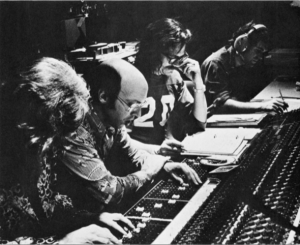
The Firesign Theatre (mixing board): Bob & Robin Preston, Image courtesy of author
It is tempting to hope for a wider range of experimentation in the field of audio in the decade to come, one that either critically exploits or supersedes the hegemony of individualized listening emblematized by podcast apps and noise-cancelling headphones. But if the audio field instead remains governed by information-oriented podcasts, leavened by a subfield of relatively classical dramas like the very good first season of Homecoming, a return to the Firesign Theatre’s work can have methodological, historical, and theoretical value because it could help reveal how the experience of recorded sound had an altogether different political inflection in an earlier era. Thinking back to the remarkably heterogeneous set of Firesign Theatre fans with which I began, it is hard not to observe that the dominant era of the sample in hip hop is one where it was not the Walkman but the jambox — with its politics of contesting a shared social space through collective listening — was the primary apparatus of playback. However unwished- for, this determinist line of technological thinking would clarify the way media audiences are successively composed and decomposed, and show more clearly how, to use Nick Couldry’s words in “Liveness, ‘Reality,’ and the Mediated Habitus from Television to the Mobile Phone,” “the ‘habitus’ of contemporary societies is being transformed by mediation itself” (358).
—
Featured Image: The Firesign Theatre (ice cream baggage claim): John Rose, courtesy of author.
—
Jeremy Braddock is Associate Professor of English at Cornell University, where he specializes on the production and reception of modernist literature, media, and culture from the 1910s throughout the long twentieth century. His scholarship has examined the collective and institutional forms of twentieth-century authorship that are obscured by the romanticized figure of the individual artist. His book Collecting as Modernist Practic— a study of anthologies, archives, and private art collections — won the 2013 Modernist Studies Association book prize. Recent publications include a short essay considering the literary education of Robert Christgau and Greil Marcus and an essay on the Harlem reception of James Joyce’s Ulysses. He is currently working on a book on the Firesign Theatre.
—
REWIND! . . .If you liked this post, you may also dig:

“Radio’s “Oblong Blur”: Notes on the Corwinesque”–Neil Verma
The New Wave: On Radio Arts in the UK–Magz Hall
This is Your Body on the Velvet Underground–Jacob Smith
Share this:

SO! Reads: Damon Krukowski’s The New Analog

 Analog revival has gained traction across many media in recent years, but perhaps nowhere so strikingly as in sound. The shifting formats and fortunes of a digitally reshaped music industry invite, for many, the counterposition of a bright nostalgic picture. Yet artists and engineers whose work has spanned the transition from analog to digital sound find that the romanticization of the former can have a weird overreach. For example, when Dave Grohl produced a digital-decrying documentary on the LA studio Sound City, engineer Larry Crane was bemused that “Grohl seems to be attributing the arc of his career to the magic in a Neve console.” Recordists like Crane find themselves in between the Scylla and Charybdis of digital-era music: on one side, the embrace of new tools that are as entangled with corporate control structures as they are convenient; on the other, a skepticism that overshoots its mark, fetishizing old technologies and cementing a previous generation’s in-crowd as gatekeepers. Decades after digital media triggered one of the most momentous transitions in sound recording, the debate around their use is anything but settled. Tied up in this contest are questions of how and what pre-digital media will be preserved, but also problems like whose use of technology in music-making constitutes authentic talent and who has authority in the determination.
 When Damon Krukowski steers into these waters with The New Analog: Listening and Reconnecting in a Digital World (The New Press: 2017), he is quick to qualify that his memorializing of pre-digital practices “is hardly a Luddite’s call” (12). Noting the “all-or nothing response” that “dominates popular discussion of the many anxieties provoked by the digital revolution” (9), Krukowski contrasts the disruption-embracing “clean break” with life on the “technological island” (8) of confining one’s practice to outmoded materials. Addressing a reader who lives more or less contentedly in a contemporary media world, he speaks as a kind of expatriate of the analog island. He, too, lives in the digital present, but he sees it through the lens of decades spent working with and listening through analog machines. His project of defending analog listening practices takes inspiration from the efforts of urbanist Jane Jacobs, who labored to turn back the tide of redevelopment and suburbanization by celebrating the organic functionality of city life. His central argument for preservation is that “what we are losing in the demolition of analog media is noise” (197, emphasis original). Noise becomes a character in The New Analog akin to the city block in Jacobs’s work: a wrongly maligned figure that has quietly formed the basis of experience and utility in the old mode.
Though Krukowski’s definition of noise is flexible in some ways, he casts the digital as its uncompromising antithesis. This position precludes what could make the book more forward-looking in its aim: a consideration that noise might become a new kind of character in the digital realm rather than disappearing at its edge. Noise shows up in analog media as buzzing undercurrents and as modes of distortion when electrical signals exceed their ranges; digital media, while lacking these, are replete with moments of failure when a system is fed the wrong kind of information or pushed beyond its intended bounds. In their repetition, these moments of error become a new kind of noise that, just like analog noise, forms an unremovable layer of our experience in mediated environments. By declining to look for digital noise and instead focusing so squarely on noise as something lost to the digital transition, Krukowski misses a chance to center a more significant linkage with Jacobs: many of the problems he sees in digital-era sound are not due to the inherent nature of digital media but rather to the same motives of control and segregation underpinning the drive toward suburbanization.
Yet his original and thoughtfully cast historical route points us toward these culprits, even when the language drifts toward a more technologically deterministic stance. It is thus that his book still provides a vibrant body of historical consideration we can leverage in using noise to reshape our digital ways of listening. The moments when Krukowski lets technology stand in for the human motives that construct it give unfortunate cover to what should be the targets of such a critique. But his real concern toward the digital era arises from specific changes in the landscape of aural awareness, and he ultimately succeeds in the task of elevating his argument above the cliché of deterministic digital-bashing by setting its true focus not on the digital but on the era.

headphones by Flickr user Chris, (CC BY-NC-ND 2.0)
Readers might be surprised, for instance, to discover that The New Analog’s first chapter covers a development in sound — the transition from mono to stereo — that has nothing to do with digitization at its outset. The chapter narrates the release of Pink Floyd’s The Dark Side of the Moon as a critical moment in consumer audio’s treatment of headphones as the ideal listening space. This movement toward individualized experience becomes a crucial part of setting the stage for the actual entrance of the digital. The design of digital media, Krukowski demonstrates, has not just carried forward this trend but absorbed it as a guiding principle, and has effected the same transformation not just in listening to music but across all kinds of daily situations. “The stream of digital information can put each of us in a different space than the others, even as we hurtle together through a tunnel on fixed tracks,” (49) Krukowski observes of the changed social experience of riding a subway. The comment makes an easy metaphoric return to music: digital design is now funneling sonic experience into a small number of streaming platforms, each promoted on the appeal of moving out of a collective listening space into one of personal curation. Claiming that a dangerous disorientation can arise in the separation of such neatly personalized spaces from their messier surroundings, the chapter closes with a cautionary tone: bad things can happen when we follow along with the digital logic of turning a once noisy situation into “a stream that is signal only” and when we stop “paying attention to noise.” (51, emphasis original).
Noise closes out each chapter, constituting the shared floor on which the book’s arguments stand. This construction calls for scrutiny, because noise is a notoriously slippery figure. As Marie Thompson notes in her recent interview with SO!, subjective and objective definitions both lay claim to noise, bringing along problems of politicized value judgment and erased context. At the same time, the term’s many meanings (electrical, legal, musical, etc.) serve as useful bridges. In Sound Ideas: Music, Machines, and Experience, Aden Evens uses noise as a primary example when he suggests a “productive ambiguity” can prompt connections that help different disciplines approach meeting points. Krukowski would, it seems, endorse this idea. He couples his formulation of noise to that of analog — an analog medium is identifiable by its noisiness, and noise is the substrate by which meaning takes hold in an analog medium.
Is it fair, though, to chain the figure of noise so tightly to analog recording that we must say it is wholly lost in the move to digital? In arguing that digitally mediated communication lacks the analog mode’s quality of perceivable distance, Krukowski lists perceptual coding — the application of “psychoacoustic research to digital sound processing” (75) — as one culprit. Jonathan Sterne, in MP3: The Meaning of a Format, points to perceptual coding’s advent as a moment when noise was domesticated. Where engineers had long sought to minimize noise, perceptual coding meant that “communication engineering exhibited a new attitude toward noise. Once you can use signal to hide noise, the game is up. Noise ceases to matter as a perceptual category.” This change in noise’s status does not eradicate it or lessen its importance, though. According to Sterne, this domestication made noise more available as a site for artistic exploration and subversion. But if noise is a key foundation on which we find meaning through listening, as Krukowski compellingly argues, and noise has been subjected to a great domestication, what does that say about the forces at work upon our listening?
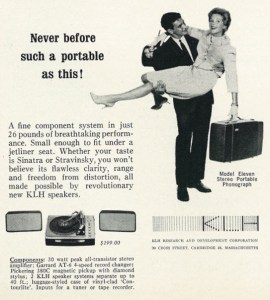 A fascinating answer emerges in a thread that pops up multiple times across Krukowski’s anecdotes: the relationship between patriarchal domesticity and the shaping of digital sound. In the chapter on stereo, he includes an ad from a 1962 Playboy issue where a man carries a woman as if across a threshold; she, in turn, holds a stereo set in its portable case. The ad pairs the stereo and the wife as two laudable choices in the man’s domestic assemblage. Both are manageable enough for him to carry home, yet both promise to extend his control — Krukowski notes that such marketing material touted stereo products as letting their owners occupy “the producer’s chair” (28) by granting listeners new agency over the mix. That focus on idealized male consumers echoes still through gendered suppression in musical exchange: as Elizabeth Newton writes, “Though women have collected vinyl since the inception of the medium, female collectors, like the women musicians being collected, often lack representation in public space that is commensurate with their actual involvement.”
True to the analogy with Jane Jacobs’s struggle against the developer Robert Moses, the patriarchal force that has ingrained itself so thoroughly in digital audio is also a suburbanizing one, keyed to a politics of racial segregation that frequently cites noise as a justification. In “‘Just Be Quiet Pu-leeze’: The New York Amsterdam News Fights the Postwar ‘Campaign against Noise,’” Jennifer Stoever documents how “white press discourse on Puerto Rican migration firmly attached ‘noise’ to the voices, bodies, and neighborhoods of Puerto Rican migrants — portraying white flight to the suburbs as a justifiable escape to suburban refuges of peace and quiet and targeting urban areas such as Harlem in ‘antinoise’ campaigns” (PAGE). Regina Bradley traces this “connection between whiteness and quiet” through to a contemporary moment in her SO! post “Fear of a Black (in the) Suburb.” The history of racially targeted noise ordinances intersects Krukowski’s narration of the proto-digital movement toward private listening. He quotes LL Cool J’s “I Can’t Live Without My Radio” as a noise-ordinance-defying affirmation of boombox listening, the antithesis of headphones and their sonic compartmentalization. Dwelling on the song’s line “Terrorizing my neighbors with the heavy bass,” he points to the artist’s intentional use of noise as a political implement, bound up jointly in his listening and his music making.
For Krukowski, the song is noteworthy in demonstrating a practice lost to the wave of noise-eradicating digital development in sound. If we approach it with the consideration that noise might not have been lost but rather domesticated, however, it serves more as a guidepost. Were he looking to LL Cool J’s example as one in need of a digital-era parallel, Krukowski might arrive at a different treatment of Kanye West’s post-release revisions of his album The Life of Pablo than he gives later in the book. Rather than describing West’s changes as “art severed from its own history” (169), he could instead credit the album’s uniquely digital instability as a moment of usurping the corporate platform as the arbiter of a record’s final version — an instance of harnessing digital noise within a digital environment to reorient its assumed parameters of authority and a prompt for listeners to consider their own role in deciding what version of the text should prevail.
Though Krukowski declines to bring it to the forefront, the involvement of a domesticating and segregating force lends further weight and precision to The New Analog’s historical argument. Returning to his invocation of Jane Jacobs, Krukowski analogizes the dichotomy of street and home with that of analog and digital. “Noise has a value of its own—the value of shared space and time,” he writes. “The urban spaces we occupy are built on that commonality. The street is a noisy place. And the street has value, as Jane Jacobs pointed out” (207, emphasis original). The contrast between analog street and digital home reaches back to rescue the book from the flawed pronouncement that digital tools themselves are the problem. We are left to consider a much richer historical argument about the alarming success that efforts of domestication and power-consolidation have found in intertwining themselves with digital media.
In that light, readers looking for an actionable takeaway from The New Analog shouldn’t just unsubscribe from streaming services and start (or resume) buying vinyl records. They should redirect their attention toward the very thing of whose existence Krukowski seems skeptical: digital noise. Even though the digital home is built to confine, there are new noisy streets outside it to be explored. Krukowski recounts how the band Can endeavored to let their recording studio “compose on its own” and to become an activating, curating conduit for the sounds of tape machines. “In Can’s studio technique,” he writes, “noise and signal are equally significant materials…. the noises in it are no less human than the signals” (138). If we look for digital noise, we will see that it bears no less potential for meaning and beauty than Can’s analog noise, as artists are already proving with techniques like glitch and sampling. We as listeners can do more to help realize that aim by celebrating digital noise, by recognizing what it reveals and critiques. For a project that with less care could have steered off into the welcoming terrain of nostalgic grievance, The New Analog offers a surprising amount to point our way forward.
Holly Herndon’s “Home” uses sonic and visual sampling to turn the surveillant gaze of an intimate digital space back on itself.
—
Featured image: “Scenes From The Recording Studio” by Flickr user G. Dawson, CC BY-NC-ND 2.0
—
Andy Kelleher Stuhl is a writer, sound artist, and software developer focused on creative infrastructures and the politics of mediated sonic exchange. His work looks to musicians for inspiration and aims to apply musical creativity as a model for new paths in such domains as digital humanities and the critique of technology. His research has investigated the phenomenon of analog fetishism from the perspective of sound engineer communities and, more recently, the process and aspirations behind interactive musical works. He holds a master’s degree in Comparative Media Studies from the Massachusetts Institute of Technology and a BA in Science, Technology, and Society from Stanford University.
—
 REWIND! . . .If you liked this post, you may also dig:
SO! Reads: Susan Schmidt Horning’s Chasing Sound: Technology, Culture and the Art of Studio Recording from Edison to the LP— Enongo Lumumba-Kasongo
SO! Reads: Jonathan Sterne’s MP3: The Meaning of a Format–Aaron Trammell
Digital Analogies: Techniques of Sonic Play–Roger Moseley
Evoking the Object: Physicality in the Digital Age of Music–-Primus Luta
Share this:


Current Top Posts





April 2021

January 2020

November 2019

October 2019

August 2019

April 2014

November 2017

March 2015

December 2017

October 2015
 Sounding Out!
Recent Comments