
SO! Reads: Jace Clayton’s Uproot


DOI: https://doi.org/10.59350/zcng1-v6y23
“Music has always confounded value,” writes interdisciplinary artist and writer Jace Clayton in Uproot: Travels in 21st-Century Music and Digital Culture (FSG Originals, 2016, 22). Recounting his extensive international travels performing as DJ /rupture, Clayton presents a flow of cosmopolitan musical experiences that illustrate complex collisions between music and value around the world. Whether writing about homemade sound-systems in tropical clubs in Brooklyn, or about shellac preservation at the Arab Music Archiving and Research Foundation in Beirut, Clayton considers the technologies by which we make — and place value on — musical sounds in “a world where worth is created in radically different ways from what the market teaches us” (24).
Uproot is a narrative about the ways working musicians experience globalization. “Our music seems to sound the way global capital is — liquid, international, porous, and sped up,” the author writes (16). This homology between sound and economic processes echoes the theories of sociologists like Anthony Giddens and the late Zygmunt Bauman, both of whom argue that modern life is characterized by fluidity and fragmentation: employment is precarious, experience is mediated, and ethical decisions are full of ambiguity. These ideas clearly inspire Clayton’s narrative; that said, Uproot is not an academic publication. As Atossa Araxia Abrahamian writes at the Nation, the book evades genre, “at once travelogue and cultural ethnography, pop philosophy and memoir, a guide to contemporary music and a fanzine.”

The book begins with a discussion of the history of Auto-Tune. While Clayton’s claim that Auto-Tune was the “first truly new sound effect of the internet era” might be overstated, his distinction between “corrective Auto-Tune” and “cosmetic Auto-Tune” is useful, the first of many moments of clarity in parsing the ways we use and mis-use musical media today. “The robot voice signifies differently everywhere you go,” he writes, an observation that becomes central to the book (49). By refusing to take a deterministic stance toward technology, Clayton empowers the musicians he writes about, acknowledging the ways in which artists mold trends to their own regional and local purposes. Of collaboration with a violinist in Morocco, Clayton writes: “We may have thought similarly, yet our ‘default settings’ were so far apart as to be almost incompatible” (185).
Uproot offers intimate insights into a range of tools and techniques of production, such as compression artifacts, “refixes,” and dozens of music-making interfaces, including Clayton’s own “music software-as-art project,” Sufi Plug Ins.
.
Even language itself is conceived as a form of technological mediation, as when Clayton compares Arabizi — a phonetic spelling of colloquial Arabic — to the hybrid sounds of mahraganat music that the language is used to describe. Of these “wandering genealogies” that emerge from international conversations, Clayton suggests that any hybrid genre we can imagine likely already exists: “Accordions and African techno? It’s called funaná” (102). The book describes at least a dozen other music traditions and microgenres–some very old, some just coalesced–from dabke to zar, each the product of a unique fusion of vocabularies.
Clayton on Mazaher (182): “Umm Sameh, Umm Hassan, and Nour el Sabah: these three women are some of the only people in Egypt keeping zar alive.”
Clayton’s own prose style, replete with metaphor and fluent in informal language, mirrors the ethos of music production he explores in the book: eclectic, energetic, and bursting with detail. What better way to describe Auto-Tune’s effect than as liquification of sound into a “bright neon stream, as if a dial-up modem and a river have fallen in love” (53)? Clayton’s technological travelogue extends beyond aural sensation alone. This is a story of “sidewalk vendors, radios, mosque loudspeakers,” (106) but it is just as much about “jerk chicken, fish tea, goatskin soup” (73). When Clayton describes his surroundings, we can touch the orange blossoms and smell the cigarettes.
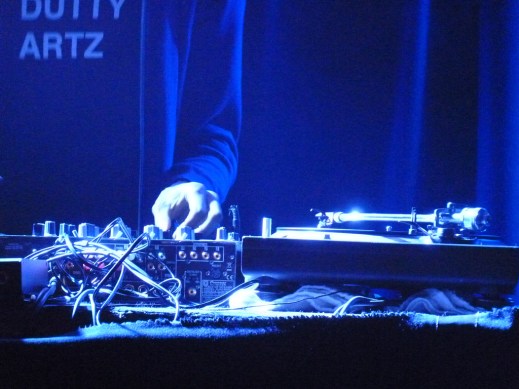
The book’s recurrent question is how DJ practices in different locations are both constrained and inspired by financial flows. In any context, Clayton argues, “[m]oney runs to the people with the least imagination” (24). Early on, he establishes this view that musical experience is priceless, more valuable than any profit derived from rhythms of supply and demand, which reward the wrong people. That said, Clayton isn’t naive about musicians’ inevitable need for income, and throughout the text, readers are asked to inhabit ethical dilemmas that artists encounter throughout the world. At one point, Clayton describes his own moral quandary when asked to perform in front of a giant Red Bull logo, a “glowing lump of techno-fascist DJ furniture.” Later, Clayton critiques the hegemony of “Red Bull patronage” and similar systems of support for artists who are desperate for funding (121). He makes clear his disdain for corporate sponsors, companies that “appear generous as they let us know that our music is literally worthless to them” (123).
A tradeoff emerges between pragmatism and idealism. Clayton pokes holes in the empty rhetoric of “authenticity” that marketers encourage and exploit, even as we sense that he hasn’t yet relinquished his belief in something essentially good about the human spirit. Listening is a powerful social practice that, in Clayton’s view, gives true meaning to music in a global economy that otherwise undervalues it. “The heavier the workaday grind to escape from, the more a party transports us” (73), he writes, suggesting that listeners extract their own surplus value.
At times, Clayton’s observations could benefit from an engagement with ethnographic methods that can help mitigate fieldwork biases. For example, although the book does involve open discussions of gendered inequalities, they are limited in scope. At one point Clayton calls attention to “macho wrangling over propriety and womanhood” among managers and producers in Agadir, Morocco (52); he describes his own futile attempt to acquire a frank interview with female singers amid the patriarchal structure there. But despite Clayton’s awareness of gendered power dynamics, he does not critique the male musicians and producers who propagate such imbalances.
When female figures do appear, they are often treated as side characters. Rihanna, for example, is presented as exemplary of the business model of “singer as mouthpiece” (50), a person for whom others do the work. Clayton isn’t wrong to call attention to the large networks of employees that work behind any celebrity brand, but it is risky to do so at the expense of female workers, especially in the midst of a book that elsewhere describes women as decoration for the musical environments in which men perform what are presumably more important tasks. “Naked girls on pedestals [who] got their bodies painted” (19), “photoshopped young women” (49) and “demure girls” (49) all set scenes for tales of male creativity. This is not to critique how some women may choose to participate in music scenes, but rather to point out that women’s concerns and perspectives are not Clayton’s focus in these passages, nor in much of the book.
On Berber Auto-tune star Saadia Tihihit (49-50): “Like Justin Beiber or any child groomed to be a media star, Saadia Tihihit occupies a place at least initially defined more by the commercial strategies of those around her than by any desire for artistic autonomy.”
Comparably, Clayton’s conception of music and global inequality is sometimes uneven. Drawing stark divisions between the “civilized” and otherwise, he resorts to clichéd language when he writes of “backwater Uzbekistan” (31) and “war-torn Africa” (81). When he describes towns and villages near Casablanca where “ancient rhythms of life still hold sway” (33), he reproduces exoticizing tropes of African music. Elsewhere in the book, Clayton addresses musical accusations of fetishism, stating: “I know that Africans and blacks have been fetishized for centuries now, perhaps millennia. Who cares? You simply exist in all your complexity and let them deal with it. Fetishism is so vague” (84). He also critiques what he calls the “spectacle of a so-called ancient culture” (99) that is often at the heart of “world music” scenes, but then describes Appalachian musical performance as “the old-timey way with banjos and fiddles and washtub percussion” (32), opposing these practices against technological advancement, a false dichotomy that ethnomusicologists work to complicate, if not avoid.
Clayton brings these issues to a head during the book’s extensive discussion of “world music” as a marketing category. His commentary on the conundrums of appropriation surrounding figures such as Paul Simon, M.I.A., and Moby feels familiar, but he surpasses the usual analysis of these common case studies with more personal insights into “world music,” beginning with crate-digging excursions at record shops with deep international selections, such as the now-defunct RRRecords in Lowell, Massachusetts. Clayton contrasts his own on-foot exploration of foreign sounds with what he calls “World Music 2.0,” an internet-driven network of musical discovery based around the commodification of information and attention, in which middlemen reign supreme. His ambivalence is exemplified by this claim: “At its worst, World Music 2.0 offers the clubland equivalent of a package vacation. At its best, it propels some of the most exciting music in the world” (104-105).
The book’s ideas occasionally undermine themselves, but there is no question that the author ultimately intends to advocate for people on the margins. As Max Pearl has noted at the LA Times, Clayton consistently defends lo-fi, lo-tech, and lo-res sonic expression — that which is “distorted, homespun, libidinous” (80) — as valuable in its own right. Further, Sukhdev Sandhu has suggested at the Guardian that the book’s attention to homologies between “the movement of sounds and of migrant bodies” serves to recognize the struggles of global refugees and affirm their humanity.
Among Uproot’s many mentions of transport, readers never receive a clear statement about what, precisely, the relationship between music and motion is, or how exactly value emerges from that pairing. Rather than a weakness of the book, however, maybe such equivocation should be taken as an accurate reflection of the nebulous circumstances in which many of us find ourselves — creators and listeners who are regularly uprooted, usually at the mercy of those whom the money follows. Faced with this precarity, let Clayton’s enthusiasm for all sounds ground you.
Uproot is accompanied by an online Listening Guide that includes audio and visual examples of music from the book: http://www.uprootbook.com.
—
Featured Image: DJ /rupture performing at the Fórum Eletronika de Mídias Expandidas 2005 by Flickr user Brayhan Hawryliszyn (Attribution-NonCommercial 2.0 Generic (CC BY-NC 2.0)
—
Elizabeth Newton is a doctoral candidate in musicology. She has written for The New Inquiry, Tiny Mix Tapes, Real Life Magazine, the Quietus, and Leonardo Music Journal. Her research interests include musico-poetics, fidelity and reproduction, and affective histories of musical media. Her dissertation, in progress, is about “affective fidelity” in audio and print culture of the 1990s.
—

REWIND!…If you liked this post, you may also dig:
SO! Reads: Dolores Inés Casillas’s ¡Sounds of Belonging!–Monica De La Torre
SO! Reads: Roshanak Khesti’s Modernity’s Ear–Shayna Silverstein
Lokananta: Sounds of Crisis and Recovery from Indonesia’s National Record Company — Ian Coss
—
Share this:

Listening to the City of Light: An interview with Sound Recordist Des Coulam

DOI: https://doi.org/10.59350/kp68c-7p206
How should we take account of, question, describe what happens every day and recurs every day: the banal, the quotidian, the obvious, the common, the ordinary, the infra-ordinaire, the background noise, the habitual?
I’m meeting with the British sound recordist Des Coulam at the brasserie La Coupole on the Boulevard de Montparnasse in Paris. “Just imagine…this place opened in 1927. If you installed a microphone in the middle of this room in 1927 and if it was still there today, how many interesting things could you have recorded in this place? It just begs belief, doesn’t it? François Mitterrand, Picasso, Ford Maddox Ford, Beauvoir, Man Ray, they were all here. They all echo in these walls.”
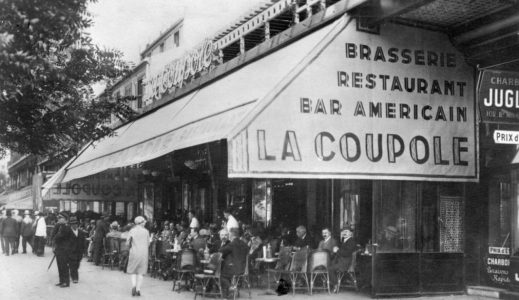
The sound inside La Coupole by Des Coulam
Des Coulam has been capturing the urban soundscape of Paris for almost ten years. Paris is a city full of mirrors, replicating itself through various mediums. A great archive of the city and its streets, boulevards, arcades and cafés has been written, painted, filmed and photographed throughout the 19th and 20th centuries. However, its aural history is less documented.
“All the archival sounds you find of Paris are adjunct to pictures, so you’ve got television pictures, you’ve got film, you’ve got very few actual recordings of Paris, and I wanted to capture the contemporary soundscape of the city and archive it for future generations to explore, study and enjoy,” explains Coulam. “It’s only on the last few seconds on our historical clock that we’ve been able to capture and archive sounds, so most of our sonic heritage is passed by completely unrecorded. We can get an idea of what nineteenth, eighteenth, and seventeenth century sounds were like from literature and from art in some cases. But the fact is we can’t actually listen to them. All the sounds we hear came from somebody’s imagination.”

Coulam’s methodical approach and commitment to the task of recording the sounds of Paris, almost on a daily basis, is helping to create the first comprehensive sound archive of the city. These sounds constitute the Paris Soundscapes Collection and are being archived in the British Library of London.
“Memorable recordings are not limited by your equipment, only by your imagination”
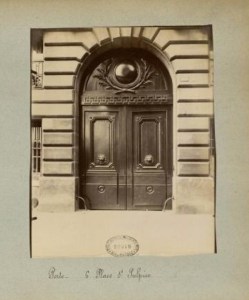
“And people forget that,” laments Coulam. “I mean, listening is an art and it’s an art that must be learned. You have to practice, practice, practice to listen. But once you master the art it opens up an all-new world. Because for me, if you give sounds the opportunity to breathe and to speak, they all have a story to tell. We walk along the street and hear a sound and you think: what is that? And you can create a story the sound is telling you. You might hear one of these big Parisian doors bang. What’s behind that door? How many interesting people have walked through that door? And you start to see or experience the place differently.”
Sounds inside l’Eglise Saint-Gervais-Saint-Protais (w/creaking wooden door) by Des Coulam
Des Coulam is of the opinion that the ability to tune into sounds with an inquisitive and imaginative mind can provide better recordings than the most expensive equipment. It’s a skill that he has been developing for over 50 years. “I can tell you the exact day. It was the 25th of December, 1958 when I woke up on Christmas morning and found a tape recorder. And if you had asked me to write a list of 100 things I wanted for Christmas, the tape recorder would not have featured in it. But there it was and I fell in love with it instantly and stayed in love with it ever since. It turned something on in my head that stayed with me all my life. I was 10 years old and now I’m almost 70 years old…I don’t know what I would do without it. I would probably just curl up and die or something…Because now it consumes all of my life. I work seven days a week, but it never feels like work. It’s just fun.”
An aural flâneur in a changing city
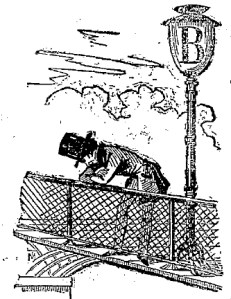
“Some of my best recordings have come serendipitously when they are not planned.” Most of the time Coulam doesn’t adhere to a strict pathway through the streets of Paris. He follows the background city sounds as someone who follows a river stream. He describes himself as an aural flâneur. The term flâneur (stroller, idler, walker) dates back to the 16th century and was made popular by Walter Benjamin in his 1935 essay “Paris, Capital of the Nineteenth Century” in The Arcades Project. “I’m doing exactly what the 19th century flâneurs did. Observing, that’s all I do. But I observe through sound rather than visually,” says Coulam. “The one thing the flâneur had was time. They had the time to stroll around the streets and observe the everyday life. But in my case I observe listening.” According to Aimée Boutin, the author of City of Noise: Sound and Nineteenth-Century Paris, it is in the writings of Balzac, Louis Huart and Victor Fournel that the flâneur emerges as an attentive listener, an eavesdropper and collector of stories who views the city as a musical score and as a cacophonous/harmonious concert.
19th century images of the flâneur predominately evoke a white male figure of means and privilege who observes and listens to the city from a position of detachment towards the crowd. He is invested in his own anonymity and imagines himself cultivating a sense of neutrality and “objectivity.” Coulam’s active listening practices depart from this perspective by challenging his perspectives and owning the subjectivity of the recording and archiving process. “The way you hear sound changes depending on the circumstances and also the way you interpret sound is different. You and I could walk down the same street and hear it differently. I can walk down the same street twice and hear it differently. There are lots of sounds that I will hear and there are lots of sounds that I won’t hear.” In a recent blog entry Coulam writes that while being “aware that sounds don’t exist in a vacuum, I am always thinking about the social, cultural and historical context of the sounds I find and that has taught me how to explore and appreciate the rich history, complexity and diversity that is Paris.”
Besides his own recordings of the Parisian soundscapes, Coulam has been adding new aural narratives of the city in the series “Paris – A Personal View” inviting guests who live in Paris to visit a place in the city that has a special meaning for them. In this series, Coulam often features the city of the contemporary flâneuse, a radically different form of flâneurie through the steps of the walking woman. In the audio bellow, Monique Wells, an expert on African Diaspora in Paris and founder of the non-profit association Les Amis de Beauford Delaney, explores her favorite place in the city – the Jardin du Luxembourg.
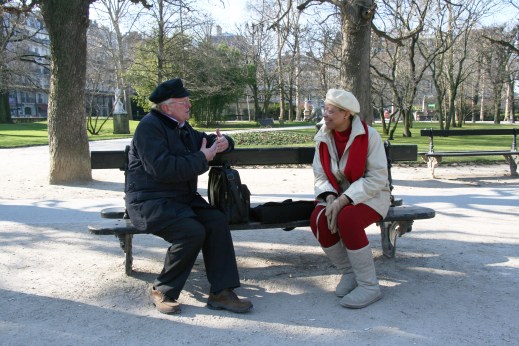
Monique Wells, Jardin du Luxembourg, “Paris – A Personal View” Series by Des Coulam
This is a particular time to be listening to the city as a new plan to expand the metropolis of Paris is on its way. “Paris is on the cusp of a huge change. If we look at the history of Paris, it is a history of circles. So you get start with the Romans who invaded and camped out on the Île de la Cité. What did they do? They built a wall around it. And over the years as Paris expanded more walls have been built around the city until today. Now, you’ve got this wall of traffic – the périphérique – and everything within that is Paris and everything without is the suburbs. Nicolas Sarkozy decided, when he was president, that he was going to demolish this invisible wall between Paris and the suburbs. So he gave birth to the Greater Paris Project which is now going ahead. So over the next 10, 20 or 30 years the visual landscape of the city will change and also its sound landscape. And this is a perfect time to capture that change. I won’t live long enough to see it all but I’m already seeing some of it. And what you have right now is that some sounds of Paris are actually disappearing, some are about to disappear, some have stayed remarkably the same and new sounds have appeared.”
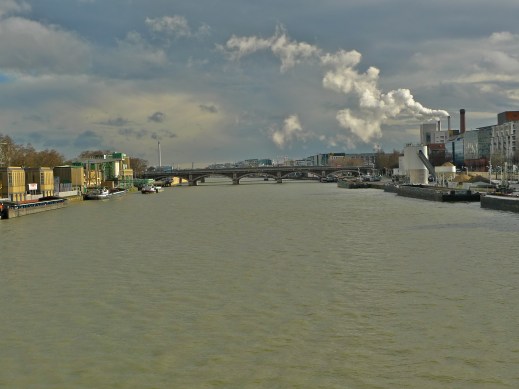
Sounds around the Pont National (near Boulevard Périphérique) by Des Coulam
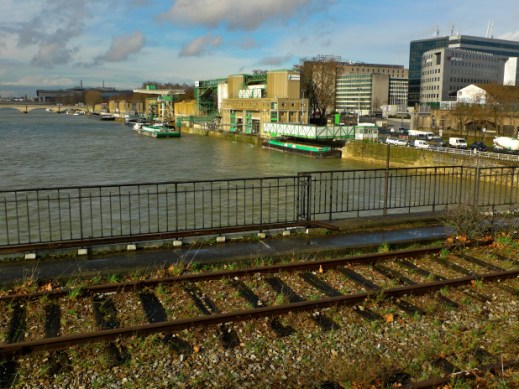
The Vanishing Sounds of Paris
The changes in the visual landscape of Paris and the modernization of its infrastructures will cause a significant change in its soundscape. For instance, Coulam dedicates a lot of his time to recording the changes of the subterranean and aerial soundscape of the Parisian metro lines. “The sounds of the Metro are changing dramatically. If you imagine the sounds of the Paris Metro, you immediately get this picture of the sort of 1950s black and white film, you can hear the sounds of the train rattling over the lines. It’s gone, it’s all completely gone. The last of those trains disappeared in 2012. And I knew this was happening so I recorded a lot of metro line 5 where the old trains were. So I’ve got a stack of recordings of those because nobody else was doing it.”
Sounds of Line 5 at Quai de la Rapée by Des Coulam
“That lovely rattle, these clanking rattling sounds. Just what you imagine it to be!” The old trains on line 5 are now being replaced by modern models with a quieter sound. Also, the trams that covered the city in the 1930s were later substituted by motorized buses. “There are no trams in the center of the city but you’ve got them on the periphery now. There are 8 tram lines. On a lot of the routes they actually go through lot of pains to reduce the amount of noise the tram makes by putting grass down between the tram lines to absorb the sound. So that’s a completely different soundscape than you would have had in this case in the 1930s.”
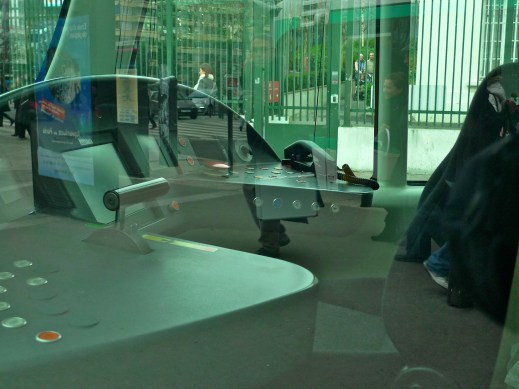
Inside a tram on Line T2 from the station Henri Farman to Porte de Versailles by Des Coulam
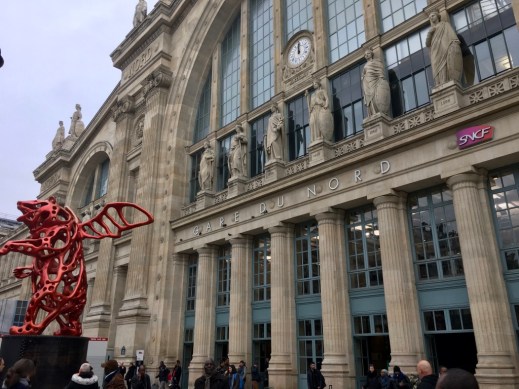
Coulam has been recording the sounds of the Gare du Nord, one of the six main railway stations in Paris, that is going through some transformations right now. A sign outside the station in the construction zone promises “a brighter and more practically designed hall for enlightened travelling”. The distinctive soundscape of the Gare will certainly change. A new type of pavement is enough to alter the echoing sounds made by footsteps and rolling suitcases.
Inside the Gare du Nord; October 2016
“But on a more human level,” says Coulam, “the street criers, the vagabond man, the knife grinders, people like that who used to come around shouting in the street are completing gone. The only thing you find now are the market traders in the market stores, but you don’t find any of these tradesmen in the streets of Paris.”
“An attempt to exhaust a place in Paris” in sound
“The only time you really notice the urban soundscape is when isn’t there,” remarks Coulam. On the day we meet, Montparnasse is eerily quiet. There is little traffic and only a few pedestrians are strolling along the Boulevard. “The soundscape you hear is not the normal Montparnasse because this is August and everybody is away on holiday, so you are immediately struck by the relative quiet around here.” It might be difficult to find places of quiet in a city like Paris during the other eleven months of the year.
But even the noise, the chatter and the rumble are important parts of the urban soundscape. “The biggest challenge I face recording the soundscape of Paris is the sound of traffic, and I long ago decided that you couldn’t ignore it. And in a sense, why should you? Because it’s an integral part of the soundscape, so to ignore it is a sort of cheating, really. So, I decided to embrace it and I started to deliberately record traffic and it was absolutely fascinating!”
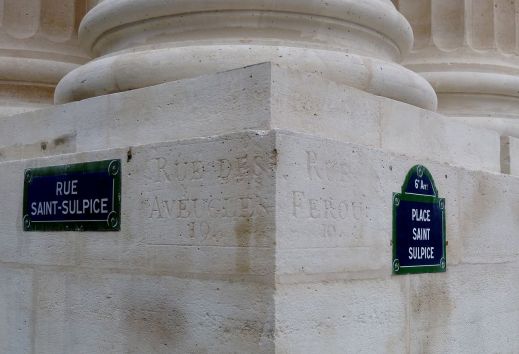
The author and filmmaker George Perec once sat down for three days in Saint-Sulpice Square to write down all the non-events around him. “What happens, when nothing happens other than the weather, people, cars, and clouds?” asked Perec. In the same vein, Coulam continues recording the sounds that constitute the backdrop to everyday life and through attentive listening, he weaves the sound tapestry of the city of Paris. “You sit on a Parisian green bench in a busy narrow pavé street and just let the street walk past you. You will hear fabulous sounds.”
“An attempt to exhaust a place in Paris” in sound (Café de la Mairie, Place Saint-Sulpice) by Des Coulam
You can hear Des Coulam’s collection of Parisian soundscapes at Soundlandscape or follow him on twitter.
—
Featured Image: Line 5 at Quai de la Rapacca, Image by Des Coulam
—
Carlo Patrão is a Portuguese radio artist and producer of the show Zepelim. His radio work began as a member of the Portuguese freeform station Radio Universidade de Coimbra (RUC). In his pieces, he aims to explore the diverse possibilities of radiophonic space through the medium of sound collage. He has participated in projects like Basic.fm, Radio Boredcast, and his work has been featured in several international sound festivals and has also been commissioned by Radio Arts (UK). He is currently working on a radio show for the Portuguese national public radio station RTP. In addition to his work in radio, he has a master’s in clinical psychology
—

REWIND! . . .If you liked this post, you may also dig:
Playing with Bits, Pieces, and Lightning Bolts: An Interview with Sound Artist Andrea Parkins — Maile Colbert
(Sound)Walking Through Smithfield Square in Dublin— Linda O’Keeffe
Sounding Our Utopia: An Interview With Mileece— Maile Colbert
—
Share this:




Current Top Posts





April 2021

January 2020

November 2019

October 2019

August 2019

April 2014

November 2017

March 2015

December 2017

October 2015


Recent Comments