
The Sounds of Writing and Learning
Welcome back to Sounding Out!‘s fall forum on “Sound and Pedagogy.” Developed to explore the relationship between sound and learning, this forum blends the thinking of our editors (Liana Silva), recruited guests (D. Travers Scott), and one of the winners of our recent Call For Posts (Jentery Sayers) to explore how listening impacts the writing process, the teachable moment, and the syllabus (and vice versa). Sharpen your pencils and/or give your typing fingers a good stretch, because today’s offering from Liana Silva asks you to exercise unexpected writing muscles—your tongue, mouth, and vocal chords! If you need a make-up assignment for last week’s post by D. Travers Scott, “Listening to #Occupy in the Classroom,” click here. And don’t forget–same class time next week!–JS, Editor in Chief
—
DOI: https://doi.org/10.59350/cer6q-stk88
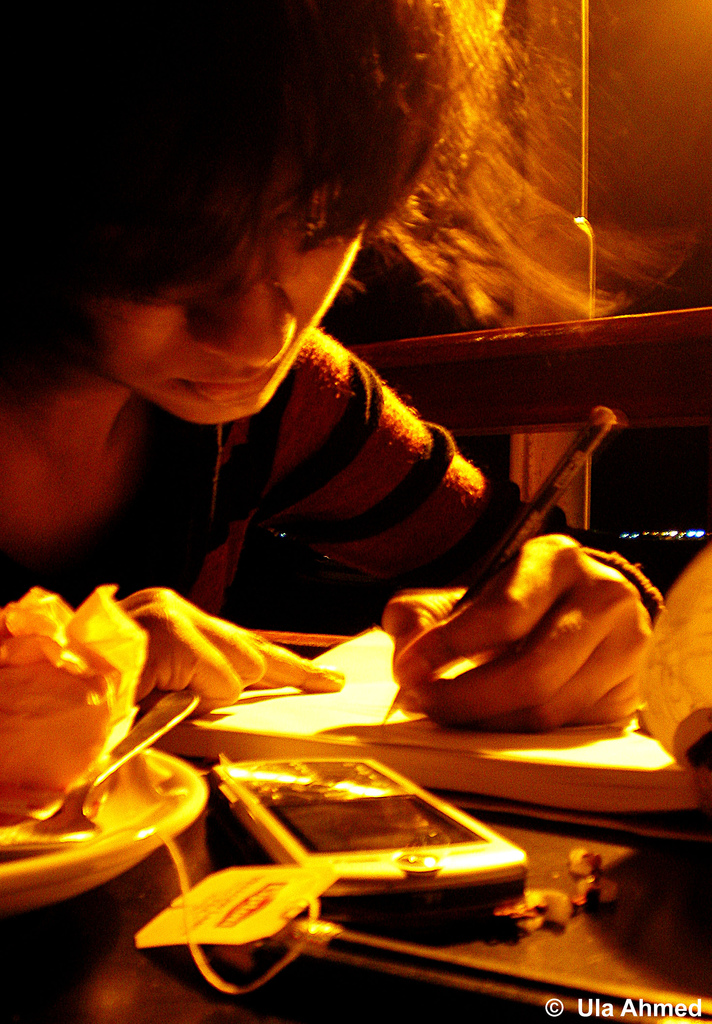
When I started this draft, I sat in an office that is not mine, next to an old, whirring Westclox Dialite electric clock. When I write, I usually pop my headphones on and blast my “Writing” playlist on my iPhone. But that day, I was soothed by the sounds of a whirring clock and the air blasting through a wall vent. On another day I worked on my draft while I listened to sports talk radio, a big part of my morning routine; toward the end of the drafting process I shared this blog post with a writing consultant at the writing center where I work.
For me, writing is always connected to sound. Sound inhabits the spaces where I write, either in the shape of music, typing, or voices. These sounds are never far from my writing process. In fact, something so small as the typing of the keys as I write this can be construed as the soundtrack to my writing. Sounding Out! guest blogger and author Bridget Hoida made a case for how sound is part of the texts she reads and how she weaves sound into her own writing; in my case, I can’t think of writing without sound. It is my soundtrack/sound track, in the sense that sound is the track on which I lay my writing process, like the lines of a ruled notebook.

However, many writers and educators tend to think of writing as a solitary, lonely, quiet endeavor. Last month, at an orientation where I was speaking, I heard someone refer to the “quiet activity of writing and learning.” As I looked around me, stunned, I seemed to be the only one surprised at this assertion. Although it is a common perception, as a writer, ex-writing instructor, and writing center staff member, this did not make sense to me. Both writing and learning, for me, are connected to sound, whether it was listening to music while editing or talking through my ideas during class discussion. If, to paraphrase Brandon Labelle in Acoustic Territories, places configure what sounds are deemed acceptable and unacceptable, do schools configure what are the appropriate sounds of learning?
I approach this question about the sounds of learning from the angle of my work at the writing center. For years I taught first-year composition, and later on in my academic career I started working at a writing center (where I currently work). At the Writing Center we are surrounded by the sounds of writing and learning. A student will walk up to one of our locations and meet with a writing consultant. They will discuss the writer’s text, in the case that the writer brings a draft. After this discussion, the consultant will read the writer’s text aloud, a practice that all of our writing consultants must adhere to. The text comes alive in the voice of the consultant; the good, the bad, and the ugly are made audible, concrete in the voice of the consultant. This enables both parties to hear the paper, but also to listen to the paper and, ideally, understand it better. The consultant and the writer then talk about what works, what doesn’t, what could be improved and how. Learning takes place through a conversation. It is at the writing center where writing and learning processes are no longer silent, but actually audible. The value for a writer of hearing their text aloud is not new; in 1967, Anthony Tovatt and Ebert L. Miller did a three-year study on how listening to their writing helped high-school writers improve their writing skills (see their article “The Sound of Writing”). My concern is how learning is coded as silent, despite evidence to the contrary.
I wonder about the implications of describing learning and writing as “silent” processes. Silence already has a domesticating quality: it is portrayed as the gift of the restrainted, of the eloquent, of the elite, and these ideas about silence and noise emerge from 19th Century ideas about respectability and middle-class values. As an example, American Studies scholar Daniel Cavicchi states in Listening and Longing: Music Lovers in the Age of Barnum,
“In fact, both in the North and the South, genteel people came to value the quietude of silent reading and listening as a form of ‘productive leisure’ that was explicitly opposed to the louder, more boisterous pastimes of slaves, immigrants, and workers. As in the days when European colonists and Native Americans struggled to understand each other’s sound worlds, aural difference now became a wedge that allowed those in power to place certain groups figuratively and literally outside the bounds of civilization” (52).
Ideas of learning as silent are coded in broader discourse about silence (or, to use Cavicchi’s more accurate terminology, quietude) and noise, about what is respectable and what is not. How do these common connotations of quietude as dignified and sound/noise as unpleasant carry over to descriptions of of learning? It is possible that society has normalized these types of learning (the “silent” types) as of a higher caliber, and schools have a major part in that: reading to one’s self in silence, filling out exam questions and not talking to anyone, typing in a quiet library at a computer station fit for only one. Even a lecture dignifies silence, in a way: students sit down and listen to what the teacher/professor has to say while they digest, quietly, what is being taught. In opposition, the sounds of learning can be associated to the sounds of collaboration, as it were: tutorials, consultations, advising sessions, discussion sections, movie viewings. Although talking is not the only way to collaborate in order to learn, I posit that these learning activities that are usually non-silent fall prey to hierarchies of sound and silence.

These hierarchies of sound and silence tell listeners that the learning activities that are portrayed as silent are more legitimate than those that are portrayed as boisterous, loud, animated—in other words, activities producing sound. In fact, it doesn’t have to be either/or. The fact that they are set in opposition to themselves is in itself problematic. Isolating sound from the learning process acts as a way of emphasizing writing as the main component of learning. Jody Shipka in “Sound Engineering: Toward a Theory of Multimodal Soundness” describes how writing is thought of as “the communication of scholarly, rigorous arguments or ideas, something more often associated with the production of linear, print-based texts” (356, emphasis in original). This dichotomy of rigor versus play can be portrayed also as visuality (as embodied in the written text) versus aurality. The writing center can be the place where these ideas are tested, in the sense that it is a location of collaborative learning where some learn by writing and others benefit from talk while others benefit from listening. By privileging quietude and solitude as the ideal modes for learning, we miss out on other important vehicles for learning, such as sound.
***
If I started this post with the whirring of the Westclox clock, how did I end this post? I ended it on a busy Sunday evening, while my daughter slept and my boyfriend talked on the phone. I finished it with the chatter of the air conditioner, the clack of baseballs against bats coming from the living room, and the click click click of the keyboard keeping me company.
—
Liana M. Silva is co-founder and Managing Editor of Sounding Out!
—
Share this:

The Sound of Radiolab: Exploring the “Corwinesque” in 21st Century Public Radio

Editor’s Note: Today, radio scholar Alex Russo, author of Points on the Dial: Golden Age Radio Beyond the Networks , continues our summer series “Tune In to the Past,” which explores the life and legacy of radio broadcaster Norman Lewis Corwin, the “poet laureate of radio” who died last summer at the age of 101. Sounding Out!‘s three-part exploration of his legacy by radio scholars Neil Verma (June), Shawn VanCour (July), and Russo (August) not only gives Corwin’s work new life (and critique), but also speaks to the growing vitality of radio studies itself. And now, hey everyone, you are listening to . . .Alex Russo Alright? Okay? Alright?–JS
P.S. Look for a special bonus fall installment of the Corwin series in September!
—
DOI: https://doi.org/10.59350/y4ppp-xsm84
Voice 1: What if you were the best in the world at something…
Multiple Voices: [background] He is the greatest….most stupendous…. most thrilling…most inventive
Voice 1: and then your entire industry collapsed.
Voice 2: [continuing and fading out] Radio[?] Writer.
Voice 1: But you kept on working?
SFX: Typewriter, continuing until coming to a dead stop when return bell rings and the carriage returns with a clunk on “pass away”
Voice 1: Outliving all your peers, until, 77 years later, you pass away?
Voice 3: Norman Corwin? Never heard of him. He defined a generation’s engagement with sound?
Voice 1: And there is no one left to eulogize you? What is your legacy?
This post is the third in a series that engages with the legacy of Norman Corwin, a – perhaps the – preeminent radio writer and producer of the late 1930s and 1940s. Specifically, it picks up on Neil Verma’s challenge back in June to consider the legacy of the “Corwin-esque.” Verma devotes considerable space to mapping the aesthetic syle of Corwin in his post and his incredibly insightful and astute book, Theater of the Mind.
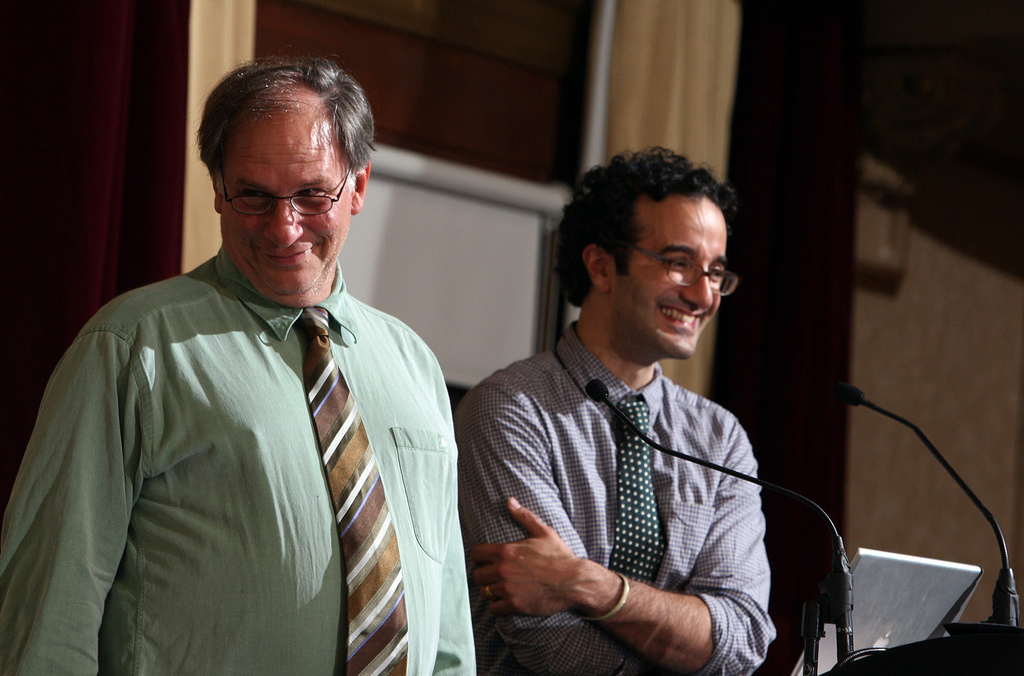
The analysis that follows leans on Verma’s argument with a caveat. The question of legacy stems in part from Verma’s assertion that Corwin lived for so long, few were left to speak for his legacy. Corwin may not have the name recognition that he should within the broader public, but for radio practitioners, he is regarded with considerable reverence. In this sense, the Corwinesque style lives on by inspiring contemporary radio producers, especially, I will argue, in the aural style of the syndicated WNYC public radio program Radiolab, hosted by Jad Abumrad and Robert Krulwich. Radiolab describes itself as “a show about curiosity. Where sound illuminates ideas, and the boundaries blur between science, philosophy, and human experience.” While ostensibly a science program, designed to make complicated scientific phenomena comprehensible to a general audience, the show engages in fundamental questions about nature, being, and experience in creative ways.

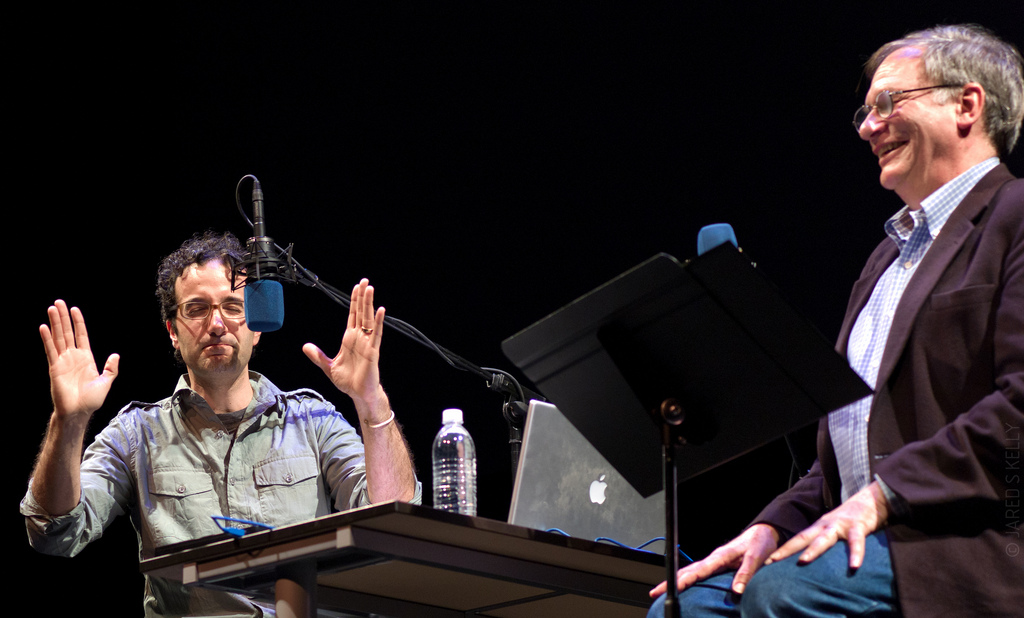
Certainly, Abumrad and Krulwich regard Corwin as an inspiration, such as when Krulwich responded to a claim by This American Life‘s Ira Glass that the turn of the 21st century is the true Golden Age of Radio, by describing Corwin as “Homer in a modern form. . .a lyrical reporter who wrote and spoke like he was wearing a toga and sometimes was so spectacular you’d get dizzy listening and sometimes seems a little too old fashioned and oratorical.” In his earlier post, Verma defines Corwin’s aesthetic style through a number of formal elements, including what he describes as a kind of “overworked literary calisthenics.” Putting their own spin on Corwin’s dizzy oratory, Abumrad and Krulwich mark Radiolab with complicated and intentionally convoluted speech patterns. The program features Abumrad and Krulwich in rapid fire banter – far faster than typical public radio fare. Often, this onslaught of language crowds and overlaps, producing a highly staged simulation of conversational flow. Often, Abumrad is a voice of enthusiastic discovery, while Krulwich plays the role of skeptic, particularly in the early seasons. Abumrad’s voice is more nasal, higher pitched and, notably, recognizably younger than that of grizzled veteran Krulwich, creating a contrapuntal effect.
These voices usually interact with a third voice, what typically radio documentary calls the “actuality.” However, instead of than separating “the real” from the narration’s voice of authority, Radiolab juxtaposes sentence fragments from all the voices (analysis, counter-argument, evidence) to create a conversation that proceeds dialectically, on parallel parts that intersect at points to lead to a thematic conclusion. While Radiolab’s dialogic style has been explored by other radio scholars, like Andrew Bottomley and Eleanor Patterson, its link to Corwin’s model of radio drama deserves more attention. While not exactly the same as Corwin’s signature “choral” vocal style, with voices chiming in from all directions, it performs a similar function, aurally representing a multiplicity of viewpoints.
Furthemore, Abumrad and Krulwich work hard to create a feeling of liveness and connection with Radiolab‘s listeners, much like Corwin did. Radiolab is certainly not a live program, but we must also remember that much of Corwin’s work was also developed to be recorded and sold–as Shawn VanCour discussed in his offering to this series. Although violating typical news protocols, mangled sentences, mis-matched vocal levels, and cross-talk are not removed during Radiolab‘s editing process; rather they are left in to create the feeling of spontaneity. Krulwich and Abumrad as quite conscious of this effect, with the latter noting in a New York Times profile, “It’s a funny thing, when you find yourselves laboring for weeks to create what you felt at that first moment.”
A final connection, Abumrad and Krulwich blend two aural styles, “intimate” and “kaleidosonic,” descriptors Verma coins in Theater of the Mind as the hallmark of Corwin’s formal mastery. Verma defines broadcast intimacy through radio’s address to the listener as an individual, its placement of a program’s “audioposition” alongside the narrator, as well as its emphasis on place-centered narratives. Kaleidosonic style addresses the listener as a public, uses a multiplicity of auditing positions, and creates a broad model of engagement with narratives centered on events (70). A wonderful representative example of this combination of styles on Radiolab can be heard at several points in season two’s episode, “Detective Stories.” First, the end of the opening beat features the stylized repetition of a New York Sanitation official describing the Fresh Kills sump as a “time capsule.” As the phrase “time capsule” echoes eight times, Krulwich begins to chant “time capsule” in a lightly mocking and metallic sounding tone. Abumrad tells him, “You can stop that now.”
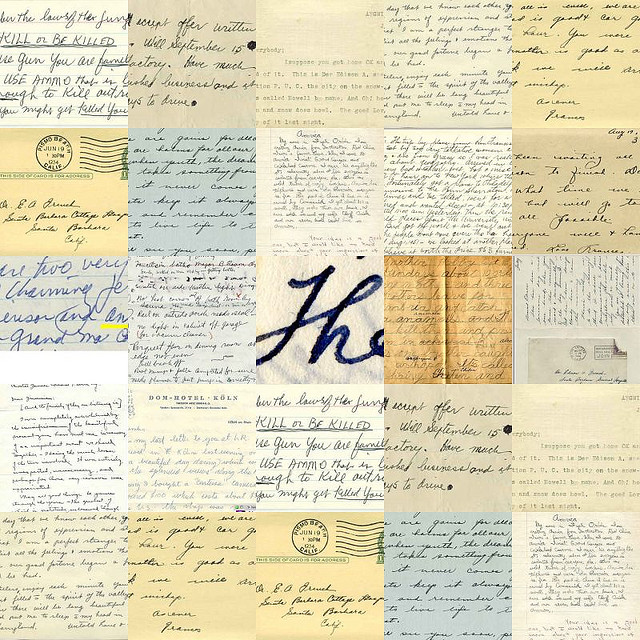
Later in that episode, a segment entitled “Goat on a Cow,” follows Laura Starcheski across the country as she investigates the twelve-year story behind of a box of old letters found by the side of the road.
This segment takes place at different locations, a hallmark of the intimate style. At the same time, it also uses elements of the kaleidosonic style because the narrative turns on particular events, moments where new evidence is found and new theories of the story of Ella Chase, the letters’ recipient. Throughout this segment Starcheski’s voice fades in and around those of her actualities. When she intervenes to provide context, the other voices are not stopped, they continue, telling their story under hers until at specific moment both voices say an identical phrase. This juxtaposition suggests that the letters hold different meanings for the individuals who come in contact with them: For Starcheski they are a reminder of her childhood desire to invent life stories of strangers; For Erick Gordon, an English teacher who found the letters, they are a great mystery on which he can project his own imagined histories and build a teaching curriculum; Finally, for Robert Chase, they represent a relief that he is no longer the archivist of his grandmother’s life. Like Corwin’s work, “Goat on a Cow” combines intimate and kaleidosonic styles, creating pleasures that are linked not to narrative closure but to the process of sonically representing investigation and theorization.
In allowing the pleasures of aural storytelling to enable the show’s narrative, Radiolab’s Corwin connection expands conceptions of the imagination. Like Corwin (and radio writers of the network-era), Abumrad sees radio as both an act of “co-authorship” and “co-imagining” between the writer/performer and the listener. However, he also sees his “job” as “put[ting] certain images and feelings in your head.” This link to discourses of the imagination is clear in the series’ opening episode, “Who Am I?” One segment in this episode, “The Story of Me,” suggests that what defines humanity is “introspective consciousness,” the ability to abstract images or events into a story of self.
Citing neuroscientist Dr. V. S. Ramachandran, Krulwich notes: “Only humans can take images from the real world, pull them into their heads, divide them into parts, and take those parts and turn them into abstractions.” To demonstrate, Krulwich leads Abrumrad through an example where the latter conjures the image purple striped red canary in his head. Ramachandran follows, noting that only humans can rearrange and manipulate “tokens” of “bird,” “striped,” and “red” to “imagine” something that doesn’t exist. The “peculiar human muscle” is that “ability to experience things and abstract them into a story. This definition is telling, while ostensibly it is about human consciousness, I would argue it could just as easily be seen as a description of the job of radio writing, taking recognizable symbolic tokens, manipulating them, and turning them into story. By equating human consciousness with radio, Krulwich and Abumrad exemplify a final theme that Verma attributes to network-era radio drama, its evolution “from being a theater in the mind to being a theater about the mind” (3).
Indeed, the segment of “The Story of Me” finishes by noting that neural actions can only be understood in a group: “Even the thought ‘I am a one’ springs from a hundred million cells connecting through a trillion synapses and that all of this multiple activity paradoxically creates the you of this moment. You are always plural.” I imagine that Corwin, no stranger to celebrations of plurality, would completely agree.
—
Featured Image by Flickr User Jared Kelly
—
Alexander Russo is an Associate Professor in the Department of Media Studies at The Catholic University of America in Washington, DC. He is the author of Points on the Dial: Golden Age Radio Beyond the Networks (Durham, NC: Duke University Press, 2010) as well as assorted articles and book chapters. His research interests include the technology and cultural form of radio and television, the aesthetics of sound, the development of “old” new media, the history of music and society, the relationship between media and space, and the history of popular culture.
—
Share this:




Current Top Posts





April 2021

January 2020

November 2019

October 2019

August 2019

April 2014

November 2017

March 2015

December 2017

October 2015


Recent Comments