
SO! Amplifies: #hearmyhome and the Soundscapes of the Everyday

SO! Amplifies. . .a highly-curated, rolling mini-post series by which we editors hip you to cultural makers and organizations doing work we really really dig. You’re welcome!
—
Pause for a moment.
Listen.
What do you hear?
Is it the quiet hum of a furnace or fan? Perhaps the muffled chatter of your colleagues or children down the hall? Can you hear sirens or birds or the passing of a car or train? Likely, these are sounds that, over time, you have learned to tune-out. Perhaps you have even complained about such ‘noise’ as something that distracts you from your work or disrupts you from your sleep.
But are these sounds really just noise? What would it mean to move beyond hearing such sounds as noise and instead (re)learn to listen to these soundscapes of the everyday as representative of community?
From February to April of 2016, #hearmyhome encourages users to play, innovate, and compose soundscapes through a series of eight sonic events. In doing so, our goal is to help users ‘tune-in’ to their everyday surroundings. By (re)learning to listen to the sounds that surround them, participants may begin to better understand community. In other words, #hearmyhome considers how hearing difference and listening to community may (re)educate our senses by attuning to the rhythms and reverberations of culture.
Prefer an Audio Overview? Listen here and follow us on SoundCloud!
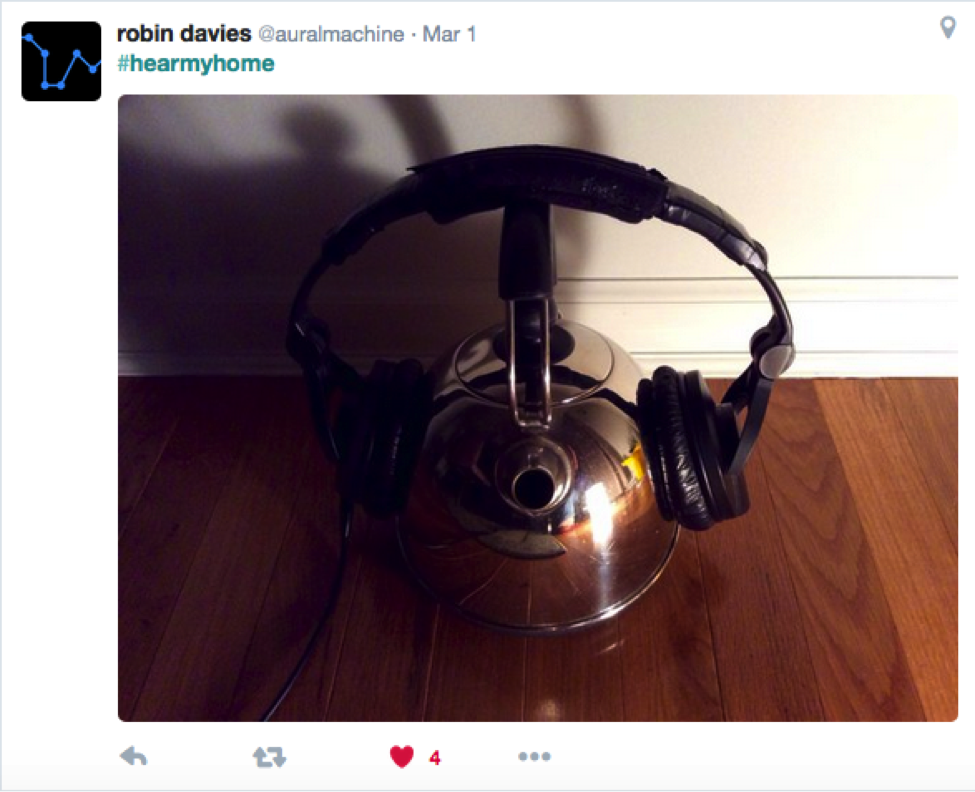
Currently in its earliest phases, #hearmyhome, led by Jon M. Wargo and myself, explores how choosing to ‘tune-in’ facilitates not only an increased awareness of the acoustic territories and rhythmic rituals which surround us, but also the impact of such sonic experiences on our bodies. In doing so, #hearmyhome interrogates how, with and through sound, people write and compose community.
Each of us became interested in studying soundscapes through different avenues. For Jon, his interest in sound and sonic composition emerged from his longitudinal ethnographic examination of LGBT youth writing with mobile media. Sound was a medium used by many of the young people to architect experience and write community. As a traditionally neglected mode, he was curious how historically marginalized youth (LGBT youth of color) used sound to compose counter-narratives of self and community.
Sparked by travels abroad, I first began capturing soundscapes while in Indonesia during Ramadan. Using Snapchat’s video tool, I not only captured the sounds of the call to prayer, but also sounds across Southeast Asia—from the busy streets of Jakarta to the dropping of coins into the 108 bowls within the Temple of Reclining Buddha in Bangkok, Thailand. Through these sonic experiences, I began to question how sound might be used by educators and youth to explore difference and diversity amongst local and global communities.
Developing materials on a multitude of scales—from local community asset maps in teacher education classes to the larger collaborative of networked sounds—each is created with the goal of hearing, recognizing, and sustaining community. #hearmyhome takes heed of the frequencies and rhythms of culture in hopes to architect, design, and teach towards equitable landscapes for learning. Refracted through the aural perspective, we see sound re-teaching the senses by working with participants to compose constructs like ‘home’ and ‘place.’ Geared towards PK-16 teachers and students, #hearmyhome is a pedagogical endeavor. Yet, as a research project, we are interested in examining the following research questions: What are the soundscapes of a networked collaborative? How do users and participants compose with sound, attune towards difference, and write with place?
Towards a Networked Vision for Tuning-In to Sound
#hearmyhome’s vision is guided by three central tenets: collaboration, pedagogy/praxis, and research
Collaboration
Focusing on “everyday” cultural heritage, #hearmyhome invites youth and adult participants to “earwitness” community through expansive personal learning networks (PLN). At the conclusion of the sonic events, participants’ soundscapes and ambient acoustics will be archived on an open-networked soundscapes map. We hope that these will be accessed as curricular resources for youth and teachers globally. #hearmyhome is an “affinity space” wherein participants share both knowledge and life experiences (hosted and inspired through their sonic events series). Through this map, for instance, a teacher in Montana may have access to the sounds of Chicago’s subway while simultaneously youth in Michigan may opt to write with the sounds of a kookaburra captured by second graders in Australia. Ideally, an “affinity space” helps to form interpersonal relationships and collaboratively create a fuller understanding of community and culture for participants. As the community expands through new partnerships and members, we hope it serves as a hub connecting participants with research opportunities, (g)local initiatives—integrating and making the more global knowledge local—and online resources and tools.
Pedagogy/Praxis
One of #hearmyhome’s larger goals is to develop curricular materials for teachers via the collaborative network and shared space on writing with and through sound. As an “open” project, resources will be shared widely via the #hearmyhome website as well as across our social media platforms as we hope to develop powerful practices of hearing, listening, and witnessing sound across communities. Interested in contributing? While our sonic events are available now, throughout the summer #hearmyhome’s homepage will be updated with additional curricular resources. If you are an educator, please consider contributing to this crowd-sourced effort. Join us by signing up for our weekly emails here or like our page on Facebook for more information on each sonic event, or simply ‘lurk and learn’ by following the #hearmyhome hashtag across Instagram, Facebook, and Twitter!
Research
Supported by the Cultural Heritage Informatics Fellowship and the National Council of Teachers of English’s Conference on English Education Research Initiative, #hearmyhome explores the sonic possibilities of writing with sound. We use sound to amplify what Steph Ceraso calls “multimodal listening,” or attending to the bodily, material, and contextual aspects of sonic interactions and relations. Sound allows for more expansive understandings of space, place, and self. We decided to hang our research on the hashtag, #hearmyhome, to aggregate data because it allows us to index user-produced soundscapes while attending to the wider goal of exploring the multiple homes of our global participants. The research component of the project investigates how the acoustic territories of the everyday write culture. For example, how might the writing of a ‘Where I’m From…’ poem shift if one does not choose to write using alphabetic print, but instead chooses to use sound? However, #hearmyhome by its very nature is open to everyone regardless of participation in the formal “research” study. Researchers will always seek members’ consent before sharing any work beyond the online community networked collaborative. For more on this, please see our standards of research statement.
Follow Along with #hearmyhome’s Sonic Events
Joining #hearmyhome is as simple as opting in to our sonic events. To do so, visit the #hearmyhome homepage and select “Sonic Events.” Then, after reading across the prompt, use your phone or another device to record the soundscapes that are the focus of the sonic event. You can easily upload and share your recording using Instagram, Twitter, or Soundcloud. By including the #hearmyhome hashtag as well as the appropriate hashtag for the sonic event you are responding to (ex. #SE5 for sonic event 5), your response will be indexed in the #hearmyhome stream. To later be included in our networked map, it is important to also turn on the geotag to demarcate your location. Your contribution will then be accessible to teachers and youth as they explore different communities and writing with and through sound!
While there is no right or wrong way to participate in #hearmyhome, we wanted to share an example from one of our participants, sound scholar Steph Ceraso. By clicking the Soundcloud link below, you can listen to how Steph responded to the prompt for our fifth #hearmyhome sonic event that asked participants to share the sounds of the ‘in-between’ moments of their day. We chose Steph’s example as it illustrates not only the beauty of noise, silence, and everyday hearings, but also for her ability to remix these sounds into a song all of their own.
Although the sonic events go “live” during the weeks listed on the homepage (February 7 to April 1 2016), we encourage you to use these sounds in any way and to join the #hearmyhome collaborative at any time. Reading across the soundscapes of networked participation, we ultimately believe attuning towards difference and “hearing” home and community will help (re)mediate learning about culture by voicing stories of the everyday, highlighting the rhythmic resonances of ritual, and attuning towards community difference.
—
Cassie J. Brownell is a Graduate Fellow in the Residential College in the Arts and Humanities and a doctoral student in Curriculum, Instruction, and Teacher Education at Michigan State University.
Jon M. Wargo, an International Literacy Association (ILA) 30 Under 30 awardee, is a University Fellow and doctoral candidate in Curriculum, Instruction, and Teacher Education at Michigan State University. In Fall 2016, Jon will join the Wayne State University faculty as an Assistant Professor of Reading, Language, and Literacy.
Follow #hearmyhome on Soundcloud, Twitter, and Instagram.
—

REWIND!…If you liked this post, you may also dig:
SO! Amplifies: Ian Rawes and the London Sound Survey–Ian Rawes
SO! Amplifies: Cities and Memory–Stuart Fowkes
—
Share this:

A Listening Mind: Sound Learning in a Literature Classroom

“Listening is little short of a synonym for learning.”
–Julian Henriques, Sonic Bodies
DOI: https://doi.org/10.59350/th0ht-v6j23
This is the third post in Sounding Out!’s July forum on listening in observation of World Listening Day on July 18th, 2013. World Listening Day is a time to think about the impacts we have on our auditory environments and, in turn, its affects on us. To read last week’s post by Maile Colbert click here and Regina Bradley’s discussion of listening, race, and Rachel Jeantel (and to read more about World Listening Day) click here.
—
How can listening, which I’ve come to understand as an essential way of knowing, enhance the learning experience? My pedagogical challenge over the past few years has been to develop a heightened awareness of the ways our ears are not necessarily, as Robert Frost asserts, “the only true reader and the only true writer,” but certainly an essential mode of reading and writing that is too often underdeveloped. As my high school students read works by Zora Neale Hurston, Ralph Ellison, Michael Ondaatje, Jonathan Safran Foer, James Baldwin, and Lucille Clifton, I want their ears to become increasingly attuned to the sounds, silences, vibrations, and other sonic significance embedded within printed words. I want them to experience how listening enhances their understanding of literature, that listening is learning.
I’ve taught A Listening Mind, a trimester course for high school juniors at Princeton Day School in New Jersey, for two years. Inspired by Toni Morrison’s 1996 National Book Award acceptance speech, “The Dancing Mind,” the course title signals my interest in challenging students to practice writing and reading in ways that are collaborative and cognitively (and otherwise) dissonant with their usual English classroom habits of mind. For my students, at least initially, writing is ruled solely by the mantra “Show. Don’t Tell.” This course, then, creates preconditions for a new kind of learning. It aims to heighten students’ aural attentiveness in general, and particularly in relation to the sonic life that inhabits the lower frequencies of the printed word. In many ways, the class resonates with Liana Silva’s discussion of sound as significant to writing and learning. In this course, we grapple with essential questions such as: How might we read and write with our ears? What happens when we take the risk to do so? As I design assessments and moderate the course, I keep in mind my own essential question as an educator: How can my scholarly interest in listening as a significant mode of cultural and social engagement translate into sound study learning opportunities for my students? The assignments students complete in A Listening Mind, a few of which I share next, are my response to these questions–a response that is in constant development.
CULTIVATING A LISTENING MIND
On the first day of class, I play Jason Moran’s “Cradle Song” from his most recent album, Artist in Residence. Moran plays the Carl Maria von Weber-composed lullaby on unaccompanied piano; the urgent scratching of a closely miked pencil on paper writes slightly ahead of the calming melody.
The song, a tribute to Moran’s mother who would stand over his shoulder taking notes as Moran practiced piano as a child, amplifies a sonic life that more often lingers within the printed word. Thus, it allows us to begin exploring the possibilities of listening as an approach to reading and writing.
In the first month of the course, students practice low stakes listening and writing: they go on short listening walks and record by hand what they hear in their sound journals. Rutger Zuydervelt’s Take a Closer Listen, an excerpt from the opening pages of Jonathan Safran Foer’s Extremely Loud and Incredibly Close, and the New York Times Magazine prose and audio essay, “Whisper in the Wind” are our inspirations for this assignment. They visit a space in which they feel most like themselves and tune into the space’s acoustics. They do the same in a space where they are less comfortable. Students also tune their attention to eco-listening – listening with intention to the natural or man-made environments in which we find ourselves. The idea is to notice the sounds our ears have become deaf to as we’ve become accustomed to a space. Their eco-listening results in their creating individual listening booklets that record the sounds we hear and our occasional reflections on them. By listening to various sounds and in various ways during the early weeks of the course, students exercise their ears and, along the way, some even realize that you need more than just ears to listen.
SONIC MATERIAL CULTURE
One of the assignments of the course involves work in what I call “sonic material culture.” According to the University of Delaware’s Center for Material Culture Studies, the study of material cultural objects “promotes the learning from and the teaching about all things people make and the ways people have acted upon the physical and visible world.” But, what about the ways in which material culture impacts the audible world? Sonic material culture looks at how material cultural objects help create cultural meaning through the sounds they make and the ways in which people use those sounds. Students explored an array of “sonic objects” that included, among others, a Tibetan singing bowl, steel drum, Shofar, typewriter, stethoscope, and a boom box. They then chose one of the items – an item that either makes sound (like a steel drum) or allows for access to sound (like a stethoscope), and began their research with a specific focus on how this item holds sonic cultural significance.
To research the stethoscope, for example, one student interviewed a cardiologist and a medical historian. She learned that sounds doctors hear through the stethoscope “comprise a language, spelling out diagnoses and prognoses” and provide “gateways to our understanding of the heart.” Another student chose the Steel Drum, an instrument developed in the 20th century in Trinidad and Tobago, and ended up discussing the innovation involved in reusing oil containers to produce a new cultural sound. Another student’s research on the Tibetan Singing Bowl led him back to a moment in Jonathan Stroud’s The Bartimaeus Trilogy: Book Three, Ptolemy’s Gate when the character Kitty Jones describes the ringing of a Singing Bowl that signals her transport into the world of magical spirits. Listening to the Singing Bowl made this student more attentive to this moment that he initially skimmed. And, one student’s love of all things vintage led her to her father’s manual typewriter and an essay combining family history and larger insights about education, workplaces, and mechanical writing. In each of these cases, the students realized that the sounds cannot be extricated from the material, social, and historical conditions that produce them.
SOUNDING HISTORY
The last time I taught the course, I designed a sound history mini-project. Students read excerpts from the work of Mark A. Smith and my work on historical listening in David Bradley’s The Chaneysville Incident, and considered these question: How might sound function as a way to narrate a specific historical moment? Students needed to choose a historical moment, locate a sound, and then create a museum card that, among others, answered the following key questions: What does this sound bring to our attention that we might not otherwise consider? What questions does this sound raise? What does it leave mute? Since students had watched Django Unchained recently, we discussed sounds of slavery in that film. If you write slavery through the crack of the whip, then your focus might be on violence and torture used during that peculiar past. If you tell slavery, though, from the code-laden singing enslaved persons used to send messages to flee, then you have a different frame, a different sonic way into the historical moment.
One student used the opening sounds from The Wizard of Oz to narrate the Dust Bowl. Another examined news reports and hip hop music to listen back to the Los Angeles Uprisings. One young woman interviewed her mother about her immigration experience from Guatemala; in her project, the sound of a train whistle signaled arrival to the United States and a new life. One of the most striking projects consisted in an inventive student engineering her own sound using a teakettle in order to recreate what she imagined as the sound inside a gas chamber in a concentration camp during World War II. As she explained during her presentation, the screeching teakettle captures for her both the sound of gas and the screaming of those persons trapped within a chamber. What an empathetic choice to make as a listening scholar: to imagine the voice of one in the midst of death.
Students worked on this assignment as part of their culminating assessment for the course. I assigned this work at the end of the course because it gave students an opportunity to delve into the work of a Sound Studies scholar: students drew on their skills as listeners developed over the term; returned to questions we asked regarding listening and interpretation of written and recorded texts; framed their own questions for inquiry; and used sound technologies such as Audacity and GarageBand to amplify their historical sound.
LISTENING BACK
As I tune my ears excitedly towards another World Listening Day (this year on July 18, 2013), I find myself remembering my students’ portfolio reflections of their learning in this course. Students mentioned that their time in the course helped them pay more attention to sounds around them: “my ears have been retrofitted by my experience in this class.” Some students became more in tune with their own sound: “The world is too noisy. I need to focus in, to tune in to myself.” Yet others found themselves “slowly opening [them]selves up to others” and becoming “more engaged with others’ opinions even if they were different from” their own. Even though some students entered the class resistant to, uncertain about, or “unnerved” by the thought of a listening English course, they felt by the end that, in the words of one student, “Now I leave this class with a purpose and clearer understanding of the importance of listening to my own echo.” In short, the two groups of students who have taken this class grow more “in tune” to multiple frequencies of reading, writing, and learning.
Lastly, while I hoped students would grow as listeners, I did not anticipate that their perceptions of themselves as readers and writers would also shift. Students who previously described themselves as “just not an English student” or who began writing and reading assignments with self-defeating “I’m just not good at this” comments, delved more deeply into the writing process and produced strikingly confident, nuanced pieces by term end. They have grown in their sonic literacy. In this, my students remind me of the most essential of questions: How, to borrow Carol Dweck’s language, do we help students develop a growth, rather than a fixed, mindset where learning is concerned? In my view, listening—practiced as a dynamic, tinkering, beta-type approach to the study of literature and writing—provides interesting answers.
—
Featured image photo credit: “Listen, Understand, Act” by Flickr user Steven Shorrock, CC-BY-NC-SA-2.0
—
Nicole Brittingham Furlonge earned her PhD in English from the University of Pennsylvania. Her dissertation, “On the Lower Frequencies: Listening and African American Expressive Culture,” marks the beginnings of her investment in sound studies as the field resonates with issues of race, class, gender and education. Her work has been published in the academic journals Callaloo and Interference, and in the publication St. Andrew’s Today. She also has published a cookbook for young children, Kitchen Passports: Trinidad and Tobago. She has taught in independent high schools and colleges for 16 years, including University of Michigan, UPenn, The Lawrenceville School, Holderness School and St. Andrew’s School in Delaware. She has extensive experience in the classroom and in administrative roles dealing with curriculum development, diversity issues, faculty development and issues regarding education, equity and access.Currently, Nicole chairs the English Department at the Princeton Day School in New Jersey and blogs at the Huffington Post. She lives in the green part of New Jersey with her spouse and their three young children.
—

REWIND! . . .If you liked this post, you may also dig:
“The Sounds of Anti-Anti-Essentialism: Listening to Black Consciousness in the Classroom“–Carter Mathes
“Deejaying her Listening: Learning through Life Stories of Human Rights Violations“–Bronwen Low and Emmanuelle Sonntag
“Audio Culture Studies: Scaffolding a Sequence of Assignments“–-Jentery Sayers
—
Share this:




Current Top Posts





April 2021

January 2020

November 2019

October 2019

August 2019

April 2014

November 2017

March 2015

December 2017

October 2015


Recent Comments