
And you will know us by the sound of vuvuzelas
DOI: https://doi.org/10.59350/sxsjy-mps85
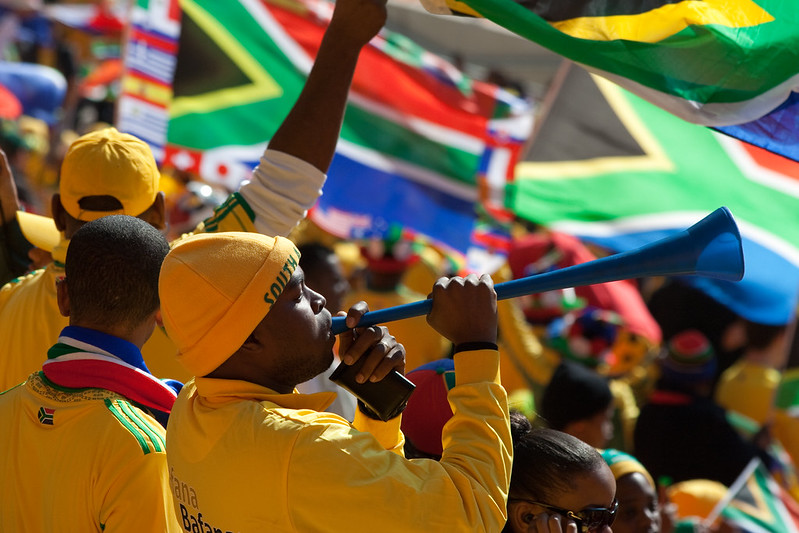
Despite some stunning matchups, the news story of the 2010 World Cup has undoubtedly been the vuvuzela. While there have been valiant efforts to the contrary (see Jennifer Doyle’s article in The Guardian about homophobia and sexual violence), not a newscycle goes by without some reference to this small plastic horn.
Designed in South Africa in the 1960s as a more portable facisimile of traditional kudu horns —and now mass-produced by the thousands in Chinese factories—the vuvuzela’s drone has been broadcast across the globe to the thrill of some and the annoyance of others. Non-African players have complained of headaches and difficulty playing because of the constant, loud sound; the BBC has created a special filter to block out some of the horn’s buzzing tones for at-home viewers. An oddly virulent backlash against the rising popularity of the horn outside of South Africa has effected bans against the vuvuzela at events as distant from South Africa and FIFA as one can get: the U.S. based Ultimate Fighting Championship, the Scottish T music festival, and, most recently, Nathan’s Coney Island Eating Competition, lest the horn “damage the competitive eating aesthetic.” The language used by many of these bans is that of contagion, like the sound of the vuvuzela is the herald of an infectious disease or a plague of locusts.
There have been many critiques of the horn at the level of decibels and hearing damage—the vuvuzela is reportedly 127 decibels, louder than a rock concert—although by that same logic the entire sport of NASCAR should be banned outright, as the New York Times reports it at a whopping 140 decibels. The pointed Nathan’s ban targeting “aesthetics” cuts to the quick of this heated debate. As an African instrument with its own particular history and cultural protocols, the vuvuzela seems to bother some people—namely members of Western and European nations—much more intensely than others, and for different reasons. Two of my husband’s coworkers, from the Ivory Coast and Grenada respectively, described the vuvuzela as a symbolic African diasporic sound of celebration that makes many white people uncomfortable; banning it outright would be not only an obvious pander to Western sensibilities—especially a preference for song over more random outbursts of sound—but also offensive, especially as South Africa is hosting the event. Or as the Botswana Voice Newsblog broke it down: “Hands Off the Vuvuzela!”
Dissenting voices have described the horn as annoyingly loud at best and disturbingly disruptive at worst. John Leicester, sports columnist for the Associated Press, managed to describe the sound of the horn as both “mindless” and “brainless” in his blog “Vuvuzela drone killing World Cup atmosphere,” as opposed to what he calls “football’s aural artistry”: the “ooohs,” “ahhhs,” and stadium chants of the “inventive” English who are “usually among the best-drilled noisemakers in football” but have been tragically drowned out by the “brainless” horns. After cultural comparisons like this—along the lines of the old racialized mind/body split concocted during the Enlightenment—it is difficult not to read Leicester’s closing plea, “Please, South Africa, make them stop. Give us a song, instead,” as a latent desire to control African people, not just their sonic output. At the very least, it is a tacit acknowledgement that the world is still divided along the lines of “us” and “them” and that sound plays a much larger role in facilitating these uneven power dynamics than previously thought.
It has also shown the world that struggles over the shifting border between sound and noise are rarely just that. It is precisely in such battles where sound studies can make an important intervention. . .so drop us a comment on the vuvuzela and the intense reactions it has elicited. What do you think? Has the vuvuzela been racialized? Is it a case of noise just being noise? Or is this phenomenon something else altogether? At the very least, blow one for yourself here and get a taste of what all the fuss is about.
JS
—
Share this:

Sounds Like a Baby
DOI: https://doi.org/10.59350/q7gem-11442
I am pregnant with my first child, and as any other first-time mother will tell you every step of this journey is littered with little discoveries. Something as simple as perusing a baby registry gets me thinking about all sorts of things that I probably would not have encountered ever in my academic career. (For example: what’s with all the bibs and outfits displaying “Daddy’s Little Princess” slogans? Gender studies, anyone?)
One of those new sites of discovery are my doctor appointments. At every appointment it seems like not much goes on: usually we discuss my overall health, new symptoms, and questions I may have. My doctor also monitors the baby through a Doppler instrument to make sure it is doing well inside the uterine home. For a few seconds, we are both very very quiet as we strain to hear a quickly beating heart. And then it’s there, clear as a bell: beatbeatbeatbeatbeat. Interestingly enough, very few people talk about this aspect of the pregnancy; they prefer to focus on the ultrasound, which is where you get to see a visual image of the baby. Is it because ultrasounds are so few and far apart in a pregnancy, or is it because the visual is the preferred representation of reality, of the concreteness of a thing?
My first encounter with my baby-in-the-making was the first trimester ultrasound. It was meant to certify the pregnancy; I had yet to see my OB at this point and didn’t know what to expect. It was certainly exciting to see this little kidney bean of a baby beating on the screen, and I couldn’t wait for the next one where I would see something resembling more a baby than a legume. In the meantime, at every monthly appointment my doctor and I would tune in to the little one’s heartbeat; every time I’d hear the quick palpitations I would secretly sigh in relief that the baby was still there. (I couldn’t feel the baby moving at this point, so the only evidence of the baby was my day-long nausea, tiredness, and belly popping out.) However, it wasn’t until drjsa told me I should record the baby’s heartbeat that I really thought about the magnitude of what was going on at each appointment. Sure, the ultrasounds are impressive (have you ever seen a baby on an ultrasound? It is beyond belief!) but listening to the baby’s heartbeat is the real indicator that all is well in there.
All of a sudden, it wasn’t the visual representation I was excited about, but rather tuning in every few weeks to that little heart beating inside of me. The ultrasound pictures are amazing and I’m looking forward to my third trimester ultrasound, but hearing that heartbeat at every appointment is the reassurance that the baby is still there. Sound becomes the manifestation of the baby. To hear is to know.
P.S.: I have yet to record the little one’s heartbeat, but I will soon find out how to do so and share it with you, the reader.
Liana Marie Silva
[Added by JS on 5-7-10: Here’s our recording of my kiddo’s heartbeat, made fittingly on 8-8-08]
01 8_8_08 1_34 PM_ Baby’s Heartbeat
Share this:




Current Top Posts





April 2021

January 2020

November 2019

October 2019

August 2019

April 2014

November 2017

March 2015

December 2017

October 2015


Recent Comments