
“KASPLASH! SLURPLOP… KPLUNK!” Charles Mingus’s Sound Effects and the Politics of Humor

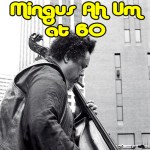 In his autobiography, Beneath the Underdog, jazz musician Charles Mingus recounts his hatred of being ignored during his bass solos. When it was finally his turn to enter the foreground, suddenly musicians and audience members alike found drinks, food, conversations, and everything else more important. However, this small, and somewhat ironic, anecdote of Mingus’s relationship with the jazz community has now become a foreshadowing of his current status in sound studies–but no longer! This series re/hears, re/sounds and re/mixes the contributions of Mingus for his ingenious approach to jazz performance and composition as well as his far-reaching theorizations of sound in relation to liberation and social equality, all in honor of the 60th anniversary of Mingus’s sublimely idiosyncratic album Mingus Ah Um this month. In the third piece of this series, Jessica Teague grapples with Mingus’s 1957 Atlantic recording of “The Clown.” Her analysis reveals one of Mingus’s most critical questions: Is the only way to escape exploitation to exploit another, or worse yet, yourself? You can catch up with the full series by clicking here. –Guest Editor Earl Brooks
When jazz bassist and composer Charles Mingus first set out to write his memoirs in the mid-1950s he told his wife Judy that he “wanted a chance to write about the true jazz scene that has made our masters millions and taken the most famed to their penniless graves as the only escape from the invisible chains on black jazz as an art” (Santoro 175). By the time Beneath the Underdog saw publication nearly two decades later in 1971, it was considerably slimmed down from the 800+ page manuscript Mingus had produced. Financially strained and evicted from his downtown loft, Mingus hoped that the book would be a best seller and offer economic freedom from the music industry.
But as many have noted, Beneath the Underdog is not your typical jazz autobiography (see Krin Gabbard, Nichole Rustin-Paschal, Gene Santoro, and Daniel Stein). Here, Mingus rejects standard notions of the self declaring in the first sentence of his book: “In other words, I am three.” By writing in a mode that wavers between the lurid world of popular pulp-heroes and psychological high-modernism, Mingus’s autobiography (like his music) treads a slender line between clowning and critique.
In one of the most infamous scenes from Beneath the Underdog, Mingus hyperbolically describes having intercourse with twenty-three prostitutes over the course of one night in Tijuana, Mexico. The incident follows the breakup of his marriage with his first wife Barbara and his affair with Nesa Morgan, the wife of a club owner. Recounting his superhuman exploits in the language of the comic book, Mingus turns what might have been a display of his sexual prowess into a clowning circus act, complete with zany sound effects and an off-kilter sense of rhythm. It’s a scene that simultaneously reinforces the stereotype of the African American male’s hypersexuality and deflates it with comedy:
KASPLASH! SLURPLOP!
“Me, señor!”
KPLUNK!
“No! Me, sir!”
SPLATT
“You like fooke?”
“Seventeen, eighteen, nineteen, twenty!”
SPASHOOSH!
“Two dollars, sir!”
(Beneath the Underdog 176-177)
There is a certain ambiguity to the poolside scene. Mingus the narrator is notably absent and the action proceeds without any visual clues—he gives the reader only fragments of dialogue that alternate between the prostitutes selling their wares and the side conversation between Mingus and his friend Hickey, who comments upon his sexual performance. What is more, the onomatopoetic sound effects employed are demonstrably silly and absurd. There are no moans or sighs of ecstasy here—each act is punctuated by a “BLAM! BLAM!” (178). Sex is transactional and performative for Mingus, but not pleasurable.
The pulpy, comic book quality of the Tijuana scene makes Mingus a superhuman like a character from The Fantastic Four, but it also makes him into a two-dimensional cartoon. This undercutting of the self and the performative body characterizes Mingus’s concept of the fractured self of the black jazz musician—a theme he takes up in his music as well as his writing (e.g. “Self-Portrait in Three Colors” from Mingus Ah Um). Interestingly, Mingus’s affinity for comics would surface again and in 1966 he collaborated with African American illustrator Gene Bilbrew to create a comic strip-style advertisement for the Charles Mingus Record Club that appeared in the Village Voice.

Cropped image from Dangerous Minds via Stupefaction. Click there for full strip.
Biographers have argued that Mingus included these likely fictionalized sex scenes as a way to sell more books and evade the exploitative economics of the music industry. However, the comic book sound effects that render Mingus’s sexuality humorously exaggerated comes at the expense of Latinx women. Despite having grown up in a multi-ethnic community in Los Angeles, his representation of the voices of the Mexican prostitutes flattens their identities and plays upon ethnic stereotypes. With each “Sí señor,” the women are presented as both sexually promiscuous and submissive. Mingus’s relationships with women were fraught, and his anxieties about his own sexuality were inevitably tied up with race. His tendency to treat women as sex-objects is similarly on display in the comic strip above, in which a suggestively-attired white female hipster acts as a narc, exposing a bootleg record dealer. “Uh, you got anything by Charlie Mingus? Uh-h, y’know, like uh… under the counter?” she asks, dripping innuendo.
And yet, these cringe-inducing scenes are often complicated by Mingus’s use of pimping and prostitution as metaphors for exploitation throughout his Beneath the Underdog. At various points he portrays himself as both prostitute and pimp, both masculine and feminine. When his friend Hickey seems to question Mingus’s extreme behavior, he responds: “In this white man’s society what else have I got” (178). Even in moments that indulge in humor, such as the Tijuana scene, Beneath the Underdog darkly implies a pimp or be pimped world.
Mingus would become known for writing music with a political edge—one might think of “Fables of Faubus” from Mingus Ah Um (1959)—but perhaps the closest musical relative to the satirical Tijuana scene is Mingus’s 1957 Atlantic recording of “The Clown.” In the liner notes for the album, penned by Nat Hentoff, Mingus describes that as he wrote the tune, he realized that it had two parts, and started to imagine it as the story of the clown. He then told the story to radio celebrity Jean Shepherd and allowed Shepherd to improvise the telling of the story during the recording. As Mingus described it to Hentoff, the story was
…about a clown, who tried to please people like most jazz musicians do, but whom nobody liked until he was dead. My version of the story ended with his blowing his brains out with the people laughing and finally being pleased because they thought it was part of the act. I liked the way Jean changed the ending; leaves more up to the listener.
Like the Tijuana story, “The Clown” also incorporates sound effects, and it opens with the hollow laughter of men and women in a nightclub. As auditory phenomena, sound effects are especially interesting because of their artificiality—they are performances of sound. In a cinematic or radio context, sound effects typically amplify an action. Even when sounded, rather than written, they seem to act onomatopoetically. Thus, the addition of the laugh track on “The Clown” is both performance and commentary.
But part of the genius of Mingus’s composition is the way he incorporates the logic of the sound effect into the music itself. The vocal quality of his bass, the wah-wahs of the horns, and the rim shots on the drums are but one piece of this totalizing sonic landscape. “The Clown” borrows stylistic elements from other recognizable genres (like, circus music) to evoke the playfully comedic and absurd, but a second, more serious and ironic story of exploitation runs concurrently and undercuts the first narrative’s simplicity. On the one hand, we hear the more jaunty, carnivalesque melody of the trombone (Jimmy Knepper) and the tenor saxophone (Shafi Hadi) that lilts in 6/8, but that melody is punctuated by moments of dissonance and free playing under the narration—stretching the space between comedy and tragedy. The question he seems to ask in both the Tijuana story from Beneath the Underdog and in “The Clown” is essentially the same: Is the only way to escape exploitation to exploit another, or worse yet, yourself?

Close up from the cover of Charles Mingus – The Black Saint and the Sinner Lady (1963)
Black musicians who pushed back were often called “angry,” even as music didn’t always sound that way. One might think of the contrast between seemingly jaunty, upbeat rhythm of Nina Simone’s “Mississippi Goddam” and its devastating lyrics. It is the sound of political and existential crisis. Both “The Clown,” and the Tijuana scene indicate Mingus’s heightened awareness that, as much as he was known for his music, he was also known for his explosive behavior at performances—the “angry man of jazz.” As Eric Porter has pointed out, Mingus’s “irrational behavior appealed to audiences at a moment when many members of American society (of whom Beat writers were emblematic) were looking to the oppositional aspects of black culture for solutions to their dissatisfaction with consumerism, conservative politics, repressed sexuality, constrictive gender roles, and other social ills” (130-131). 1957, the year Mingus recorded The Clown, was the same year that Norman Mailer published his infamous essay “The White Negro” and Jack Kerouac published On the Road. It was also the year that Governor Faubus of Arkansas attempted to halt the integration of Central High School in Little Rock.
Subtle they may be, but the use of comic sound effects in works like Beneath the Underdog and “The Clown” highlight the absurdity of the roles black jazz musicians had come to play within American culture. In worrying the line between the comic and the tragic, the explosive and the reflective, Charles Mingus refused to concede to the identity that had been shaped by the music industry, by the press, and by institutionalized racism.
—
Featured Image: Charles Mingus 1976, Courtesy of the Wikimedia Commons, Colorized by SO!
—
Jessica Teague is an Assistant Professor of English at the University Nevada, Las Vegas (UNLV) and specializes in 20th and 21st-century American Literature and Sound Studies. The intersections between literature, sound, and technology are the focus of her research, and her book, Sound Recording Technology and American Literature: from the Phonograph to the Remix, is under contract with Cambridge University Press. Her work has been published in journals such as American Quarterly and Sound Studies, and she has also been the recipient of research fellowships from the ACLS and the Harrison Institute at the University of Virginia. (PhD, MA, Columbia University; BA, UCLA)
—

REWIND! . . .If you liked this post, you may also dig:
SO! Amplifies: The Blues and Jazz Dance Book Club–Chelsea Adams
On Ventriloquism, Dummies, and Trump’s Voice–Sarah Kessler
Afrofuturism, Public Enemy, and Fear of a Black Planet at 25–André Carrington
Share this:

Charles Mingus, Rotary Perception, and the “Fables of Faubus”

In his autobiography, Beneath the Underdog, jazz musician Charles Mingus recounts his hatred of being ignored during his bass solos. When it was finally his turn to enter the foreground, suddenly musicians and audience members alike found drinks, food, conversations, and everything else more important. However, this small, and somewhat ironic, anecdote of Mingus’s relationship with the jazz community has now become a foreshadowing of his current status in sound studies–but no longer! This series–featuring myself (Earl Brooks), Brittnay Proctor, Jessica Teague, and Nichole Rustin-Paschal— re/hears, re/sounds and re/mixes the contributions of Mingus for his ingenious approach to jazz performance and composition as well as his far-reaching theorizations of sound in relation to liberation and social equality, all in honor of the 60th anniversary of Mingus’s sublimely idiosyncratic album Mingus Ah Um this month. In the first piece of this series, I offer a meditation on the audible imagery of The Little Rock Nine and the potency of Mingus’s ideas for sound studies and beyond. — Guest Editor Earl Brooks
Jazz composer and bassist Charles Mingus’s infamous protest song “Fables of Faubus,” (1959) channeled the anger and frustration of the Black community in response to the staunch racism of Orval Faubus, Governor of Arkansas, who refused to acknowledge the U.S. Supreme Court’s decision to support school integration in the 1954 case Brown v. Board of Education. Faubus infamously used the Arkansas National Guard to prevent Black students from attending Little Rock Central High School. The visual imagery of “The Little Rock Nine” walking to school, bombarded by riotous mobs and surrounded by cameras and military escorts, remains permanently seared into the American collective memory of the Civil Rights Movement.
What makes the imagery of “The Little Rock Nine” so sonically distinctive is the contrast between the silent procession of the students and the loud and intimidating screams from the white racist protestors. When images contain explicit visual references to particular sounds, there is an inescapable cognitive referent that allows one to experience that sound through the vehicle of one’s “sonic imagination”–or the mechanism that allows us to “hear” a song in our heads even when there is only silence. Listening involves an active–not passive–engagement with sounds real and imagined. In the same vein as comic books, which rely on visual sound-cues to enhance the experience of the text, the optical power of “The Little Rock Nine” invites viewers to process both the visual and aural data presented by the image. In other words, the image is empowered by its multimodality. When combined with related source material, such as “Fables,” we stand to gain a greater sense of its meanings and an awareness of why sound, especially music, is critical to the recording, or archiving of the kinds of lived experiences that exceed easy translation.
“Fables,” as well as the album on which it appears, Mingus Ah Um, invites questions about the sonics of racism in public and private spheres. Racism oscillates between modes of silence and silencing (unjust systemic processes, othering, isolation), subtle vibrations (micro-aggressions), as well as piercing, cacophonous noise that is as disorienting as it is terrifying. In many ways, this moment made audible (and public) the noise of racism so often confined to the personal encounters of African Americans with white institutions and Jim Crow segregation.
“Fables” ridicules the defense of segregation through its caustic, satiric edge. Listeners hear an early articulation of Terrence T. Tucker’s notion of comic rage, a mixture of pain, frustration, and fear encapsulated by humor and a burgeoning militancy and articulated by comedians such as Richard Pryor. Black musicians, such as Mingus, were not only in tune with the magnitude of the historical moment they were witnessing but also attuned to its sonic dimensions.
 Positioning Mingus within the evolving discussion of sonic studies opens productive inquiry into what it means to center musicians of color in relation to critical historical moments in the American soundscape. Mingus’s concept of “rotary perception,” mentioned in his autobiography Beneath the Underdog (1971), suggests one way this positioning can occur. Here’s how Mingus defines “rotary perception” and uses it to describe his musical evolution:
There once was a word used–swing. Swing went in one direction, it was linear, and everything had to be played with an obvious pulse and that’s very restrictive. If you get a mental picture of the beat existing within a circle, you’re more free to improvise. People used to think the notes had to fall on the center of the beats in the bar at intervals like a metronome, with three or four men in the rhythm section accenting the same pulse. That’s like parade music or dance music. But imagine a circle surrounding each beat–each guy can play his notes anywhere in that circle and it gives him a feeling he has more space. The notes fall anywhere inside the circle but the original feeling for the beat isn’t changed. (350)
The value of this “rotary”– or “circular”–orientation exceeds the technical, musical application discussed in the book. Mingus offered this explanation in response to claims that the music created by younger musicians was more innovative or distinctive than his generational counterparts. What the media and industry insiders were seeking to characterize as the “new” wave in jazz wasn’t all that new. In fact, as Mingus argued, one could hear the “avant garde” major sevenths over minor sevenths from Charlie Parker and free forms in Duke Ellington if they were paying attention.
However, “rotary perception” also correlates with the central ethos of Black cultural production Amiri Baraka referred to as “the changing same,” a phrase describing the cyclical return to the roots of Black music and culture as a source of futurity, innovation, and regeneration. Rotary perception, as a way of engaging experiential source material, is a useful tool for sound studies as it relates to centering the work of musicians, theorists, and scholars of color whose work contains untapped, or, in this case, unheard critical vistas from which to expand the enterprise of defeating the scourge of racism. The poetic disconsolance and biting jocularity of Mingus’s oeuvre challenges us all to do some soul searching.

Image by Flickr User Connor Lawless (CC BY 2.0)
As thematic motif, rotary perception renders Mingus Ah Um as a presentation of the sonics of Black life. The “head” or main melody of “Fables” is buttressed by bluesy, bebop, instrumental solos that–quite literally–translate the racism of those such as Governor Faubus into a canvas of rebellious, free expression. The gospel inflections of “Better Get It in Your Soul” emerge from Mingus’s exposure to the reservoir of traditional Black worship and performance styles preserved by the “Holiness” or “Sanctified” denominations within the Black church. What questions would emerge if current discussions of racism and political power in white evangelical communities began with such songs as hermeneutic tools to explore the relationship between theology and race?
As Mingus traces his roots, the musical themes on the album look back as much as their execution points toward a new era of soul-infused jazz through a series of homages paid to Lester Young (“Goodbye Pork Pie Hat”), Charlie Parker (“Bird Calls“), Jelly Roll Morton (“Jelly Roll“), and Duke Ellington (“Open Letter To Duke“). Mingus delineates the kind of fictive kinship Eric Pritchard theorizes as a mode of constructing community and resisting social isolation and historical erasure as a byproduct of the Black experience. While Mingus’s allegiance to continuity is clear, rotary perception encourages us to consider the expansive scope of heretofore unexplored frontiers of African diasporic subjectivities.
Sound is a unique and worthwhile vehicle to recover the lived experiences of black communities often marginalized or completely ignored by the archives. The value of such experiences lies with their potential transgression of ontological and phenomenological investments in conceptions of time, space, and identity that ultimately undergird the sterilized normativity of white supremacist thought. The idea that people of color contributed nothing to history and the march of progress, or that the lands of indigenous peoples hold no value outside of capitalist ends, form the foundations of white supremacy. Questions such as: Who owns time? How much is time worth? and Who has the power to grant or retain space? form the structures beneath structural racism. Yet, through black music, black musicians reclaim that time, (Maxine Waters reference intended) as responsive to the needs of the community and the occasion and also something powerful enough to be distributed equally. Such music creates space–ideologically, spiritually, mentally–for a broader humanity that accompanies differences, like a swinging rhythm section, instead of fearing them.

“Raided the new vinyl inventory” by Flickr User Magic Trax (CC BY-NC-ND 2.0
Although large portions are fictional, the authenticity of Mingus’s experience of racism as described in Beneath the Underdog illuminates the sonic qualities of the album including its innovative fusions of musical traditions. For example, Mingus characterized his father as a parent who preached racial prejudice and forbade him and his siblings from engaging children from his neighborhood with darker skin complexions. Additionally, Mingus’s youth was fraught with discriminatory incidents heightened by the irony of his light skin color: too dark to pass as white and too light to take any solidarity with his darker companions for granted. Mingus Ah Um represents an important waypoint on Mingus’s journey to political consciousness and Black identity. This was a journey constantly freighted by what would become a lifelong quest to reconcile the self he saw as fractured, or the “two-ness” that W.E.B. Du Bois famously described as the psychic consequences of life behind the “veil” within racially oppressive social order. Responding to this veil (or mask according to Paul Laurence Dunbar) became particularly complicated for Mingus. For musicians such as Louis Armstrong or Duke Ellington, the deference to white audiences belied a defensive posture and a recognition that the interiority of their lives would always remain—like Ralph Ellison’s proverbial protagonist–invisible.
However, the subversive “creative mockery,” that Mingus conjures in “Fables” coincided with the operationalization of Black Nationalist sentiment and discourse brewing within the Black community. What Mingus wanted more than money or fame from his music was to be taken seriously as an artist and for jazz to be seen as equal to classical music in terms of cultural stature. In many ways, Mingus’s music gave a sonority and texture to this tension. This search for artistic authenticity dovetails with the racial solidarity showcased on the album, expanding the scope of its introspection.
One of the great misconceptions of post-Civil-Rights-Era America is the assumption that the decline of such public and audible displays of racism includes a decline of such phenomena in private spheres. However, the recent barrage of viral videos depicting the weaponization of police toward Black bodies quickly dispels any such assumption. Rotary perception, beyond its use in sound studies, offers a critical tool useful for grounding current analyses of liberatory struggle against racial and social oppression. It reminds us of the value of returning to, and listening again, to songs like “Fables.” It also urges us to continue fingering what Ellison called “the jagged grain” of the “painful details and episodes of a brutal experience …” in order to squeeze from it a “near-tragic, near-comic” transcendence.
—
Featured Image: By Flicker user Matthew Venn, (CC BY-SA 2.0)
—
Earl H. Brooks is a saxophonist and Assistant Professor of English at the University of Maryland, Baltimore County. His research interests include jazz, rhetoric and composition, black popular culture, and media studies.
—
REWIND! . . .If you liked this post, you may also dig:
SO! Amplifies: The Blues and Jazz Dance Book Club–Chelsea Adams
SO! Reads: Tsitsi Jaji’s Africa in Stereo: Modernism, Music, and Pan-African Solidarity–Celeste Day Moore
Living with Noise–Osvaldo Oyola
“Music More Ancient than Words”: W.E.B. Du Bois’s Theories on Africana Aurality — Aaron Carter-Ényì
Share this:




Current Top Posts





April 2021

January 2020

November 2019

October 2019

August 2019

April 2014

November 2017

March 2015

December 2017

October 2015
 Sounding Out!
Recent Comments