
Make a Noise Joyful: Cirm in the Old English Exodus


Series co-editors Dorothy Kim and Christopher Roman
When the narrator of the Old English poem Exodus declares “Gehyre se ðe wille” (Let him hear who will), what sounds is he asking us to attend to? [Note: Text from Peter Lucas’s edition, 7b. All translations are author’s own.] This post argues that the Old English noun cirm (noise, shout, outcry) challenges our conceptualization of noise. In the Anglo-Saxon corpus, cirm most often refers to the indistinguishable, non-linguistic hum of a crowd, rather than the meaningful utterance of an individual. This accords with the popular view of noise in sound studies: whether medieval or modern, noise (as opposed to meaningful sound) is associated with alterity, disruption, and violence.
However, and strikingly, in the Old English Exodus, words for noise describe not only the terrible sounds of the drowning Egyptians as the roaring waters of the Red Sea rush over them, but also the survival of the Israelites. I argue that this cirm is a mark of the Israelites’ triumphal assertion of their continued presence and plenitude, a celebration of the fact that they can still be a multitude despite captivity. That cirm may not sit easily within our definition of noise should provoke not a redefinition of cirm’s joyful use, but a reconceptualization of Anglo-Saxon noise.

‘Amalek Attacks Israel and Is Defeated’, in the Old English Hexateuch, British Library, MS Cotton Claudius B IV
What is Noise?
“Noise” has a range of meanings, but most often implies “unwanted sound” as R. Murray Schafer argues in The Soundscape (73). Following the work of Jacques Attali and Jeffrey J. Cohen, noise has been associated with alterity, difference, and monstrosity. Noise, as opposed to sound, may be non-linguistic or disordered: nonsense, babble, the roar of a jet engine. According to David Novak’s contribution to Keywords in Sound, noise is not present in nature, but is created by modern technology (129). In the modern world, noise is often considered negative: cities have rules about noise pollution, apartment buildings set quiet hours, and airplane passengers don noise-cancelling headphones. In the pre-industrial age, noise was not exempt from criticism, though the word could also be applied to more pleasant sounds, like birdsong.
In the European Middle Ages, Valerie J, Allen argues in “Broken Air,” noise was often figured as violent, transgressing boundaries, inappropriately closing the distance between sound producer and sound receiver (310 and 317-318). According to Macrobius, it was not silence that was the opposite of sound, but noise (311). Grammar, which was “devoted to the pursuance of ratio through sound,” was ethical; noise was therefore considered “a kind of audible violence; corruption [wa]s something one can hear” (305). But some medieval noises were more ambiguous: the Old English word dream (joy, joyful sound) could also be applied to the terrible sounds of Hell or the terror of Judgment Day, as in Kazutomo Karasawa’s analysis in “OE dream for Horrible Noise in the Vercelli Homilies.” Likewise, “clamor,” which originated as a (mostly) negative noise, became an important legal instrument, as discussed by Richard Barton in “Making a Clamor to the Lord: Noise, Justice and Power in Eleventh- and Twelfth-Century France.” But in general, we tend to assume medieval noise is negative, or marks its producer as other.
Noises in Exodus
The Old English Exodus, found in the c. 1000 manuscript known as Bodleian MS Junius 11, is a notoriously difficult and complex poetic adaptation of the Old Testament Exodus 12-14. The author and date of composition are unknown, though it is often considered quite early, perhaps as early as the eighth century as Paul Remley and Lucas argue. Few institutions were rich enough to own a complete Bible. The author of Exodus may have had access to a written Latin version of Exodus, or may have been exposed to the text via the liturgy, especially the liturgy of the Easter Vigil.

The Junius Manuscript, Oxford, Bodleian Library, MS. Junius 11, pp. 84-5
Exodus delights in sensory details, but until recently, I had always thought of Exodus as primarily visual – the gleaming of war-gear, the glittering of Egyptian spoils washed up on the shore, tents and a pillar of cloud to protect the Israelites from the desert sun, and a pillar of fire to guide them. But the poet is also attentive to the larger sensory world, including the world of sound and noise. Those who accept the poet’s opening challenge to his audience (“Gehyre se ðe wille!” [Let him hear who will!]) will recognize that the poem is in fact filled with sounds – the battle trumpets that provide order and structure to the movements of the army, the rushing and later silencing of waters, the terrible evening songs of wolves eager for battle, the awful rasping of the blade Abraham draws to sacrifice Isaac in the poem’s digression on the patriarchs, the triumphant songs produced by Israelite men and women in praise of God after the Egyptians are defeated. In what follows, I focus on the multiple deployments of a single word for noise (cirm), applied to both Israelites and Egyptians, asking what this word can reveal about Anglo-Saxon conceptions of noise.
It has often been remarked that the poet resists easy distinctions between Israelites and Egyptians, applying similar vocabulary to both, and this is certainly illustrated by the poet’s sonic play. In a climactic scene near the end of the poem, the drowning of the Egyptians in the Red Sea is accompanied by horrible noises:
Storm up gewat
heah to heofonum, herewopa mæst;
laðe cyrmdon (lyft up geswearc)
fægum stæfnum. Flod blod gewod:
randbyrig wæron rofene, rodor swipode
meredeaða mæst. Modige swulton,
cyningas on corðre. Cyrm swiðrode
wæges æt ende; wigbord scinon.
[A storm went up high to the heavens, the greatest of cries of the army; the hostile ones cried out with doomed voices (the air grew dark above). Blood pervaded the water: ramparts were broken, the greatest of sea-deaths lashed the sky. The brave ones died, kings in a troop. The noise fell silent at the end of the water; battle-boards shone. (460b-467; emphasis added)]

The Junius Manuscript, Oxford, Bodleian Library, MS. Junius 11, p. 66.
Cirm occurs twice in this passage, first as a verb (cyrmdon) and then as a noun (cyrm). The manuscript reading in 466b is cyre (choice). Lucas emends to cyrm because cyre is not a poetic word, and I would argue that the echo with the Israelites’ cyrm (107) must be deliberate. Even if we accept MS cyre, the passage still includes the verb cyrmdon (462a), and other sonic vocabulary (herewopa, “army’s cries” [461], and fægnum stefnum, “doomed voices” [463]). The noun occurs roughly 60 times in the corpus; the verb 17 times (DOE).
In the Old English corpus, cirm is often negative, applied to the tortures of hell or the terror of Judgment Day, and indicates a particularly loud sound (DOE, Lucas). According to the DOE, the noun means “shout, cry, shriek” or “noise of non-human origin, clamour.” The Egyptian cirm is obviously threatening, the meaningless cries of men who, like a raging storm, lash out in terror as the waters close over their heads. Even the visual horror of blood mingling with water maintains sonic affiliations: this line is a rare example of internal rhyme in Old English poetry (flod blod gewod). The end of the Egyptian threat is marked by the silencing of their voices and cirm, metaphorically a silencing of the army’s advance against the Israelites.
Given the negative associations with noise in both medieval and modern sound theory, that the Egyptian defeat is accompanied by their terrible cirm may not seem particularly surprising. Strikingly, this is not the only such noise in the poem. Near the beginning of the poem, the Israelites celebrate their initial escape from Egypt by producing not just any noise, but cirm. On the third day, after the pillar of cloud has appeared, the Israelites awaken with trumpets, and seeing the pillar,
Folc wæs on salum,
hlud herges cyrm.
[The people were joyful, loud was the noise of the army. (106b-107a; emphasis added)]
If cirm is threatening, loud noise, associated with difference and violence, why would the Israelites produce it? I would like to suggest that cirm suggests not merely loud noise, but crowd noise. The Israelites’ cirm is not an assertion of difference, or the meaningless babble of a drowning, almost non-human army, but an assertion of triumphant plenitude. Their joyful cirm is a fulfillment of God’s covenant with Abraham, which the poet will remind us of later in the poem (435-442). Just as God promised Abraham innumerable offspring, his support of the Israelites in their exodus signals that they will continue to be a multitude (as they certainly are in this battle, in which they have 600,000 fighting men (224-233).
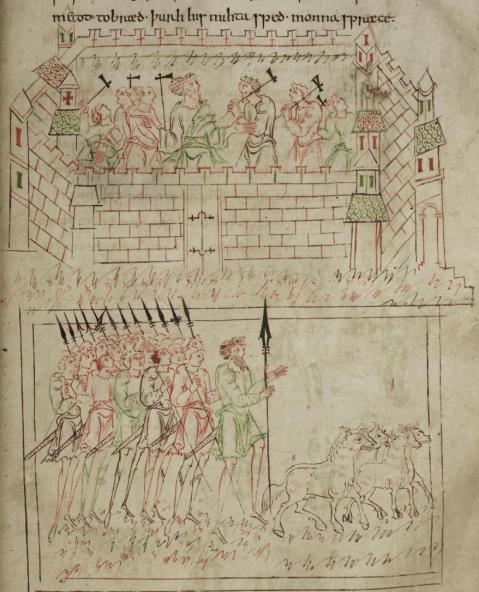
The Junius Manuscript, Oxford, Bodleian Library, MS. Junius 11, p. 81.
In fact, the Israelites’ triumphant crowd noise is echoed at the end of the poem as well. After the defeat of the Egyptians, who make terrible cirm as they perish in the Red Sea (460b-467), the Israelites issue more celebratory sound, this time transformed from crowd noise to harmonious music:
Æfter þam wordum – werod wæs on salum –
sungon sigebyman (segnas stodon),
fægerne sweg
[After these words – the troop was joyful – victorious trumpets sang a beautiful sound (battle-standards stood). (565-67a; emphasis added)]
The Israelites’ cirm (107), which they produced while on salum (joyful), is balanced and echoed by the celebratory sounds of the end of the poem, also produced by a people who are on salum (565). Whatever threat the Israelites’ assertion of plenitude and cirm may have made possible is mitigated by replacing that cirm (noise) with a beautiful sound (fægerne sweg), a harmonious, if also loud and multiple, expression.
According to Attali, music can be used to produce order, but “noise is violence: it disturbs. To make noise is to interrupt a transmission, to disconnect, to kill. It is a simulacrum of murder” (26). In this sense, the Israelites’ crowd noise in the desert is violent – it threatens the order of the Egyptians, or the hierarchy the Egyptians have sought to impose on the Israelites in their captivity. But because this story ends in the triumph of the Israelites, told from the point of view of their Christian descendants, it celebrates this assertion of communal power and communal violence without fully othering them. The true violence is inflicted on the Egyptians by God in the Red Sea, allowing the Israelites to reassert their normativity, their cohesion, their power, and their non-otherness. While the drowning Egyptians produce cirm, it is silenced because the cirm of the Israelites has conquered them. Noise, or at least cirm, is therefore not merely negative or disruptive; it is a powerful claim to be blessed by God, an assertion of belonging rather than a boundary crossing.
—
Featured Image:Detail of a miniature of the plague of hail (Exodus 9:22-25), Add MS 15277, f. 7r
—
Jordan Zweck is an assistant professor in the Department of English at the University of Wisconsin-Madison. She specializes in early medieval vernacular literature and culture, especially Old English, and is interested in documentary culture, media studies, and sound studies. She is currently completing a book on Anglo-Saxon epistolarity and early English media, examining the representation of letters in vernacular texts such as letters from heaven, hagiography, and poetry. She is also working on a second book on sound, noise, and silence in Anglo-Saxon England, a portion of which is forthcoming in Exemplaria. Zweck is a recipient of the University of Wisconsin-Madison Center for the Humanities’ First Book Award, has held a resident fellowship at the Institute for Research in the Humanities at UW-Madison, and has won several teaching awards.
—
REWIND!…If you liked this post, you may also dig:
‘A Clateryng of Knokkes’: Multimodality and Performativity in “The Blacksmith’s Lament”–Katherine Jager
Mouthing the Passion: Richard Rolle’s Soundscapes–Christopher Roman
Sounding Out! Podcast #54: The Sound of Magic-K.A. Laity
Share this:

How not to listen to Lemonade: music criticism and epistemic violence

With the premier last month of Lemonade, her second visual album, Beyoncé didn’t make the world stop so much as she make it revolve: around her, around her work, around black women. For all of the limitations of pop music as a medium (it’s inherently capitalist, for one) and Lemonade’s various feminist strategies (“Formation,” with its “Black Bill Gates” language, can be heard as a black parallel public to white corporate feminism), the album nevertheless re-centered mainstream media attention on black women’s cultural and creative work.
As the conversation about Lemonade revolved around black women and black feminism, two white men pop critics writing for major publications responded with “So What About The Music?” articles. The description to Carl Wilson’s Slate piece asks “But how is it as strictly music?,” and Kevin Fallon’s Daily Beast piece asks both “But is the music any good?” in the title and “But is the music worth listening to?” in the dec. Each time, the “but” sounds like the antecedent to its implied mansplainy consequent “actually…” And just as “but actually” recenters men as authorities and experts, these three questions decenter features prioritized in black women’s pop performance traditions, and in Lemonade itself. As posed in these two articles, the “so what about the music?” question frames “music” so narrowly that it both obscures or at best trivializes what the album does musically. Wilson and Fallon’s essays are good examples of how not to listen to Lemonade.

Borrowed from “Let’s Talk About Sex(ism)” from Twin Geeks
I want to read Wilson and Fallon carefully so we can think about when this question makes for both technically correct and ethically/politically responsible theory and criticism, and when it makes for technically incorrect and ethically/politically irresponsible theory and criticism. My aim here isn’t to argue that Wilson and Fallon are bad people. My focus is the definition or concept of “music” that’s at the heart of the method they use in these two articles (and methods are bigger than individual writers). In more academic terms, I’m asking about research ethics. If, as Wilson’s and Fallon’s articles prove, the “so what about the music?” question can be a power move that establishes the critic’s or theorist’s authority, how can we–especially the mainstream we–ask about the music parts of pop music without making that power move?
 Firstly, both articles apply fairly conventional European fine art aesthetics to the album. Wilson invokes pre-Enlightenment European aesthetics to argue that the “reality show aspect” of the album is somehow aesthetically inconsistent with great pop music. Prior to the 17th century, it was commonly thought that the status of a work’s form or medium ought to correspond to the status of its representational content: painting, the most highly regarded art form, should have subject matter of equal stature–gods and royalty. Wilson’s claim that “the other distraction is the way that the album’s central suite of music interacts with tabloid-style gossip (and a certain elevator video clip) about Beyoncé and her husband Jay Z” echoes that centuries-old sentiment, a sentiment which is about as alien to Lemonade’s aesthetic as, well, Boethius is.
Fallon begins his article with a genuflection to Prince (as does Wilson), scrunches its nose at the gossipy lyrical and narrative content, and then twice scoffs at the very idea of a visual album, “whatever that is,” as though we in the West don’t have precedents for this sort of Gesamtkunstwerky (the total artwork combining music, visuals, and lyrics) thing going back to Wagner and the Florentine Camerata (the collective attributed with inventing opera in the 17th century). He does talk more extensively about the sounds and music than Wilson does, but given the rapid turnaround he also faced, there’s not a lot of close listening to specific musical figures, performances, or compositional techniques, mostly just a survey of the different genres on the album.
Wilson says that the cheating story detracts from the album’s musical quality because it’s an unoriginal narrative:
a drama of jealousy, betrayal, and reconciliation, one of the most ancient and common of human experiences, and of songwriting fodder…that issue of thematic freshness may render some of the songs here less distinctive and invigorating than Beyoncé was.
I find this an odd criticism to level at a pop album, or even an artwork. Nobody would say that West Side Story or Romeo & Juliet were aesthetically diminished because they recycled that tired old theme of jealousy, betrayal, and (failed) reconciliation. Moreover, as Angela Davis argued in Blues Legacies and Black Feminism, these themes of jealousy, betrayal, and reconciliation are the foundation of black feminist pop music aesthetics in a personal-is-political kind of way. Both articles force a contextually incorrect definition of “politics” onto the album, one which sees the most intimate details of relationships, sex, and kinship as merely personal and apolitical. Fallon, for example, says “there’s no doubt that the music on the album is far more personal than it is political.” Both critics fail to consider it in terms established in black women’s pop performance traditions.
Even in Wilson’s attempt to focus strictly on the music, he spends most of the time talking about visuals and lyrics. He hears a wide range of sonic references in Lemonade, from Dolly Parton to Donna Summer to the Lomax recordings to calypso. But he thinks this makes it sound derivative: “as an aural album, Lemonade is a little less fascinatingly singular and eccentric than Beyoncé” (Wilson). Fallon makes an almost identical remark in his article: “Lemonade doesn’t hurl itself toward any genre in a statement of artistry. Instead it masters… um, all of them, but in turn doesn’t make the same powerful statement of Beyoncé’s artistic mission, like her last album did.” Contrast this with the way Jonathan Shecter talks about Diplo’s post-genre eclecticism as “fresh and cutting-edge,” part of an “ongoing artistic evolution.” As philosopher Christine Battersby has argued, the habit of thinking that flexibility is a sign of innovation when attributed to white men, but a sign of regression when attributed to anyone else, is a habit that goes back to the 19th century. It’s not surprising that Beyoncé gets dinged for the same thing that garners Diplo praise: in her case, what Fallon calls “the most daringly genre-hopping music she’s ever produced” is evidence of unoriginality, whereas in Diplo’s case post-genre eclecticism is evidence of his ability to distinctively transcend provincialism. Even when Wilson’s article does manage to talk about sounds and music, it trivializes Beyoncé’s other artistic achievements on the album.
Both articles rely on some gendered and racialized interpretive habits to address the song’s aesthetic value, lyrical content, and Beyoncé’s artistry. But what about their discussion of the music?

“listen” by Flickr user Robyn Jay, CC BY-SA 2.0
These same racialized, gendered habits tune Wilson and Fallon’s listening and mask the sonic dimensions of Lemonade that don’t fit their narrow concept of music. Both critics make a conceptual move that separates musical practice from black feminist practice. Fallon uses some parentheses and a “but…?” question to put rhetorical and grammatical space between Lemonade’s black femininity and its musical and sonic features: “(By the way, it’s powerful, and feminist, and unapologetically black, and transfixing, and gorgeous, and assured, and weird, and confusing, and dumb, and groundbreaking.) But hey: Is the music any good?” This framing defines “the music” as something distinct and independent of the album’s black femininity, as though black women’s and black feminist musical traditions didn’t infuse the album’s music…or, to the extent they do, they don’t count as “music.”

“Listening” by Jens Schott Knudsen, CC BY-NC 2.0
Wilson makes an identical move. Following the white liberal feminist aesthetics that influence lots of contemporary post-feminist pop, Wilson’s piece locates treats the black feminist message primarily in the video. “In video form…it’s more evident that [Lemonade] is equally the cyclical story of generations of black women dealing with men and balancing their struggle for R-E-S-P-E-C-T (as well as S-E-X) against the violations and injustices of race and gender.” He sees the politics in the visuals, but doesn’t consider the sounds as having anything to say or do about that story and that struggle.
This approach isn’t limited to well-meaning but ignorant white men pop critics: even bell hooks’ now (in)famous essay on Lemonade looks at but doesn’t listen for its politics. She argues that it is a “visual extravaganza” whose “radical repositioning of black female images does not truly overshadow or change conventional sexist constructions of black female identity.” Locating the politics entirely in Lemonade’s visuals, hooks’s essay treats black feminism as something contested solely in terms of images. (And divorcing the images from the sounds fails to consider the fact that the sounds impact how viewers interpret what they see.)

Screenshot from Lemonade
This is the wrong method to use for thinking about Lemonade and Beyoncé’s work as a whole (and pop music in general). Sounds on this album don’t operate independently of black femininity, black women’s performance traditions, or individual artists’ black feminist politics. On the one hand, thinking with Daphne Brooks and Regina Bradley, it’s more accurate to say that Beyoncé’s sound game has generally led the way and been more politically cutting-edge than her visual game. On the other hand, sound can also be what does the heavy lifting for patriarchy and other systems of domination, as I argue here. Separating the music itself out from the political content misrepresents what music is and how it works. And it is a particularly gendered misrepresentation: critics are not so eager to separate Kendrick’s sounds from his politics. In both white and black philosophical traditions, dominant concepts of politics and the political are normatively masculine (just think about the gendered public/private distinction, for example), so from these perspectives feminine and feminized sounds don’t feel or seem “political.”
But in these two cases the divorce between music and politics is also what lets white men pop critics have authority over black feminist music. If they can distill Lemonade down to its “solely musical” aspects, then they can plausibly present themselves as experts over generic, depoliticized sound, sounds disconnected from knowledges and values tied to particular lived experiences and performance traditions. Problem is, in the same way that there is no generic ‘person’ without a race or a gender, there is no generic, depoliticized sound. As Jennifer Stoever has argued, even though Western modernity’s occularcentric epistemology obscures the sonic dimensions of white supremacist patriarchy and the subaltern knowledges developed under it, sounds nevertheless work politically. Digging deep into the music on Lemonade or any other pop song does not involve abstracting the music away from every other aspect of the work and its conditions of production. Digging deep into the music part of pop music means digging deeper into these factors, too.
When Regina Bradley, Dream Hampton, Laur M. Jackson, Zandria Robinson, and Joan Morgan talk about how Lemonade makes them feel, what affects and knowledges and emotions it communicates, they are talking about the music–they just work in a tradition that understands music as something other than ‘the music itself’ (that is, they don’t think music is abstracted away from visual and cultural elements, from structures of feeling common to black women with shared histories and phenomenological life-worlds). As I have tried to show in my own work, the sounds and musical performance are central to Beyoncé and Rihanna’s work because they engage traditions of black women’s and black feminist knowledges. Aesthetic practices develop and emerge as types of implicit (i.e., non-propositional or non-verbal) knowledge, knowledge created in response to lived experiences in a particular social location. Aesthetic practices can communicate and perform knowledges that reinforce systems of domination, and they can also communicate and perform subordinate knowledges that map out strategies for survival amid domination. Dominant institutions (like the music industry) and people from dominant groups (like Iggy Azalea or Eric Clapton) separate the aesthetic practice from the implicit knowledges that make it meaningful, and thus neutralize those knowledges and make the aesthetic practice fungible and co-optable. Talking about “the music itself” or “solely music” does the same thing: it is a form of what philosophers call epistemic violence.

Screenshot from Lemonade
So, asking “but what about the music?” is a way to dig into those implicit knowledges to show where much of this epistemic work is happening. And that’s good analysis that isn’t (necessarily) epistemically violent. It demonstrates what Stoever calls “an ethical responsibility to hear African American cultural production with…assumptions about value, agency and meaning” (31) that are appropriate to them. But you can also ask “but what about the music?” in a way that abstracts away from these implicit knowledges. That’s what Wilson’s and Fallon’s pieces do, and that’s why they’re both epistemically violent and objectively poor methods of musical interpretation. But we can and do better when we write about and theorize the music part of pop music. And, to riff on Mariana Ortega’s argument in her article on the type of epistemic violence she calls “loving, knowing ignorance,” doing better means listening to and with black women, black women’s music, and black feminist aesthetics. You can’t divorce music or listening from politics; listening better can and will follow from practicing more just politics.
—
Robin James is Associate Professor of Philosophy at UNC Charlotte. She is author of two books: Resilience & Melancholy: pop music, feminism, and neoliberalism, published by Zer0 books last year, and The Conjectural Body: gender, race and the philosophy of music was published by Lexington Books in 2010. Her work on feminism, race, contemporary continental philosophy, pop music, and sound studies has appeared in The New Inquiry, Hypatia, differences, Contemporary Aesthetics, and the Journal of Popular Music Studies. She is also a digital sound artist and musician. She blogs at its-her-factory.com and is a regular contributor to Cyborgology.
—
 REWIND!…If you liked this post, you may also dig:
I Been On: BaddieBey and Beyoncé’s Sonic Masculinity-Regina Bradley
Listening to Sounds in Post-Feminist Pop Music-Robin James
Of Resilience and Men: How Bieber, Skrillex, and Diplo Play with Gender in “Where Are Ü Now”-Justin Burton
Share this:


Current Top Posts





April 2021

January 2020

November 2019

October 2019

August 2019

April 2014

November 2017

March 2015

December 2017

October 2015
 Sounding Out!
Recent Comments