
Listening to Tinnitus: Roles of Media When Hearing Breaks Down

 Editor’s Note: Welcome to the third installment in our month-long exploration of listening in observation of World Listening Day on July 18, 2012. For the full introduction to the series click here. To peep the previous posts, click here. Otherwise, prepare yourself to listen carefully as Mack Hagood contemplates how sound studies scholars can help tinnitus sufferers (and vice versa). –JSA
—-
One January morning in 2006, Joel Styzens woke up and life sounded different. Superimposed over the quiet ambience of his Chicago apartment was a cluster of sounds: pure, high-pitched tones like those of a hearing test. Loud, steady, and constant, they weren’t going away. He walked to the bathroom to wash his face. “As soon as I turned on the water on the faucet,” he told me in an interview, “the left ear was crackling… like, a speaker, you know, being overdriven.” Joel was 24 and a professional musician, someone who made his living through focused and detailed listening.
As days passed, he grew more fearful and depressed. For two months, he barely left the house. The air brakes of a city bus or a honking horn were painful and caused his heart to race. His sense of himself, his environment, and his identity as a musician were all undermined. This man who lived through his ears now faced the prospect of a life of tinnitus (ringing or other “phantom sounds”) and its frequent companion, hyperacusis (sound sensitivity sometimes accompanied by distortion). Joel could even identify the dominant pitch of his torment: it was A sharp.
We humanistic and qualitative sound scholars—particularly those of us focused on media and technology—can learn a lot from listening to tinnitus and the people who have it. Scholars of science and technology studies (STS) often utilize moments of technological breakdown to reveal the processes and mechanisms that constitute things we take for granted. Tinnitus and hyperacusis are, in the words of anthropologist Stefan Helmreich, “moments when hearing and listening break down” (629). Because sound scholars understand sound, hearing, and listening not only as the material effects of physics and physiology, but also as culturally and technologically emergent phenomena, we can potentially contribute much to the growing public conversation around tinnitus.
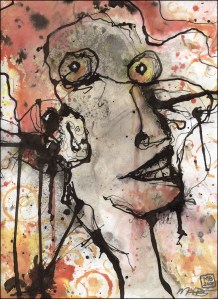
“Tinnitus” by Merrick Brown
And there is a lot at stake. Tinnitus affects 10-15% of adults and is the top service-related disability affecting U.S. veterans returning from Iraq and Afghanistan. Tinnitus and hyperacusis are also fairly common among musicians who work in loud performance and media production environments. It is perhaps ironic, then, that mediated sound and music are audiologists’ primary tools in helping people recover from these conditions.
My own study of tinnitus centers on its articulation with audio-spatial media—devices such as bedside sound machines, white noise generators, and noise-canceling headphones, all used to fabricate a desired sense of space through sound. People with tinnitus are among the most avid users of these devices, carefully mediating their aural-spatial relations as tinnitus becomes more evident in quiet spaces and hyperacusis flares up in noisy ones. During my fieldwork in audiology clinics and conferences, tinnitus support groups, and online forums, I observed that audio media were being deployed as medicine and technologies of self-care. Gradually, I came to the realization that the experience, discourse, and treatment of tinnitus is always bound up in mediation. In fact, I believe that tinnitus signals the highly mediated nature of our most intimate perceptions of sound and self. Below, I sketch just a few of the places I think aural media scholarship could go in conversation with tinnitus and hyperacusis.
The sound of media aftermath
Hearing experts do not consider subjective tinnitus to be a disease, but rather a condition in which individuals experience the normal, random neuronal firing of their auditory system as sound. Although it may be tied to various diseases and disorders, tinnitus itself is benign and does not inherently signal progressive hearing loss nor any other malignant condition.
Image by Flickr User Phil Edmonds
Nevertheless, research shows a frequent association between tinnitus and reduced auditory input, comparable to a sound engineer turning up the volume on a weak signal and thus amplifying the mixing board’s inherent noise. This “automatic gain control” theory neatly explains a classic 1953 study, in which 94 percent of “normal hearing” people experienced tinnitus in the dead silence of an anechoic chamber. Unfortunately, it also helps confirm the fear that the ringing heard after a night of loud music is due to hearing loss, known clinically as “temporary threshold shift.”
As Joel’s case suggests, when repeated, such threshold shifts lead to permanent damage. Audiologists increasingly see media-induced hearing loss and tinnitus as an epidemic, with ubiquitous earbuds often positioned as the main culprits. I have heard clinicians express dismay at encountering more young people with “old ears” in their offices, and youth education programs are beginning to proliferate. These apparent relations between aural pleasure and self-harm are an intriguing and socially significant area for sound and media scholarship, but they should also be considered within the context of moral panics that have historically accompanied the emergence of new media.
Objectifying phantom sound
For both clinicians and sufferers, one of the most frustrating and confounding aspects of tinnitus is how hard it is to objectify, either as a subject of research and treatment or as a condition worthy of empathy and activism. For both clinicians and sufferers, media are the primary tools for converting tinnitus into a manageable object.

Media marketed to protect musicians against Tinnitus, Image by Flickr User Jochen Wolters
Although media scholars haven’t yet studied it as such, the audiologist’s clinic is a center of media production and consumer electronics retail. Having audio production experience, I felt a sense of recognition on seeing the mixer-like audiometer in the control room of Joel’s audiologist, Jill Meltzer, separated by a pane of glass from the soundproofed booth where her patients sit. It was a studio where Meltzer recorded hearing rather than sound, as she attempted the tricky work of matching the pitch, volume, and sensitivity levels of tinnitus and hyperacusis. Since medication and surgery are not effective treatment options, the remedies for sale are media prosthetics and palliatives such as wearable sound generators, “fractal tone” hearing aids, Neuromonics, and sound machines that help distract, calm, and habituate patients to the ringing. Meltzer and other clinicians consistently told me that they have only two tinnitus tools at their disposal—counseling and sound.
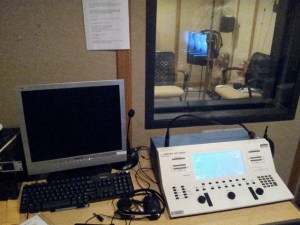
Audiometer and testing booth, Image by the author
The subjectivity of tinnitus is most frustrating for sufferers, however, who often encounter impatience and misunderstanding from family, friends, bosses, and even their doctors. Again, media serve to externalize and objectify the sound. Joel did this through music: “A Sharp,” Styzens’ first post-tinnitus composition, represents tinnitus with chordal dissonance and hyperacusis with a powerful change of dynamics on a guitar. He eventually recorded an entire album that explored his condition and raised awareness.
.
Other individuals, in an attempt to communicate the aural experience that drives their sleeplessness, depression, anxiety, or lack of concentration, create YouTube videos designed to recreate the subjective experience of tinnitus.
.
The American Tinnitus Association, an advocacy group, has used broadcast and social media to raise awareness and research funding, as we see in this PSA from 1985.
.
However, such dramatic uses of media may be in some ways too powerful. In fact, “raising awareness of tinnitus” might be as bad as it literally sounds.
Communicable dis-ease
In the process of externalizing their experience for others to hear, people with tinnitus can make their own perception of the sound grow stronger. They may also generate anxiety in others, encouraging them to notice and problematize their own, previously benign tinnitus.
Neuroscientist Pawel Jastreboff’s groundbreaking and influential neurophysiological model of tinnitus postulates that tinnitus becomes bothersome only when the auditory cortex forms networks with other areas in the brain, resulting in a vicious circle of increasing perception and fear. The implication of this model, now substantiated by clinical research, is that the way people think about tinnitus is a much greater predictor of suffering than the perceived volume of the sound. As Jastreboff told me in an interview, “Incorrect information can induce bothersome tinnitus.” Information, of course, circulates through media. It may be productive, then, to think of tinnitus suffering as a communicable dis-ease, one strengthened in circulation through networks of neurons, discourse, and media.
I think there is both a need and an opportunity in tinnitus for an applied sound studies, one that intervenes in this mediated public discourse, works against moral panic and hyperawareness, and suggests the quieting possibilities that open up when we grasp the constructed nature of our aurality. Listening to tinnitus as a networked coproduction highlights the ways in which our most subjective aural perceptions are also social, cultural, and mediated—perhaps the fundamental insight of sound studies. My hope is that by listening to tinnitus we can speak to it as well.
__
*Featured Image Credit: A representation of Tinnitus by Flickr User Jason Rogers, called “Day 642/365–Myself is against me”
Share this:

In the Flesh: Embodiment, Listening, and Transcription
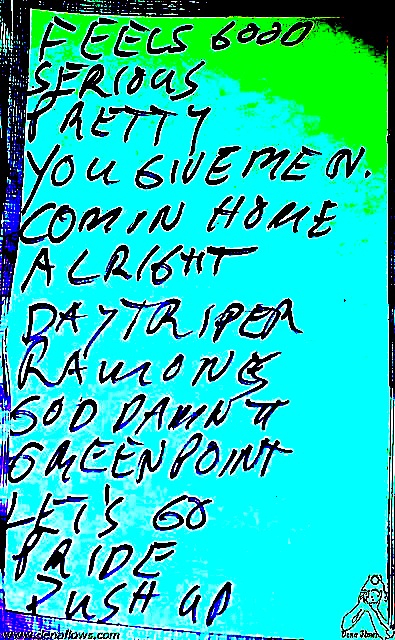
The Fleshtones Setlist, 9/11/12 show in Bilbao, Spain,
Editor’s Note: July 18th, 2012 has been designated as World Listening Day by the World Listening Project, a nonprofit organization founded in 2008 “devoted to understanding the world and its natural environment, societies and cultures through the practices of listening and field recording.” World Listening Day is a time to think about the impacts we have on our auditory environments and, in turn, its affects on us. This year, Sounding Out! has decided to observe World Listening Day by planning a month-long special forum of posts exploring several different facets of listening such today’s offering by SO!‘s Multimedia Editor Aaron Trammell on listening’s relationship to the body and next week’s discussion by novelist Bridget Hoida on the impact of listening on her writing process. We will also explore questions that we need to remember when we celebrate listening as a cultural, embodied act. What happens when listening is interrupted? distorted? A post on tinnitus by Mack Hagood will help us think through what happens when we take listening (and the able body) for granted as a universal, normative experience. We’ll also publish a special bonus multi-sensory post by our newest regular writer, Maile Colbert, on World Listening Day itself and we will launch our regular quarterly spring podcast for on July 12th, which will feature Eric Leonardson, director of the World Listening Project. In addition to being interesting as all hell, the podcast will suggest some ideas for how to get involved in WLD activities–or how to embark on a listening project of your own this July. Enjoy our ear-opening extravaganza and please keep those comments coming. We’d love to hear from you! –JSA, Editor-in-Chief
—
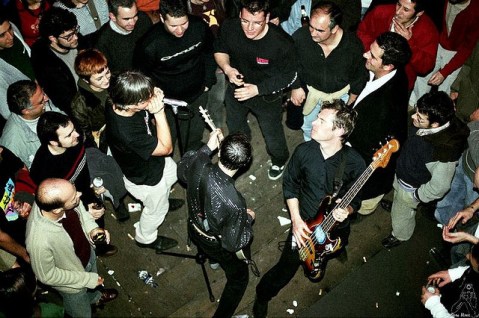
The Fleshtones, October 23, 2008, Image by Flickr User Dena Flows
What happens when the body translates sound from one medium to another? How is the body both affected by a song (when listening), and affecting it’s content (when writing)? In this post, I will relate my experience transcribing the lyrics of the song “Hexbreaker!” by The Fleshtones in an effort to answer these questions.
I love to sing. Often, I feel that it is only through singing that I feel that I can adequately relate to the emotions, ideas, and narrative of the songwriter. This relational practice is called embodiment. While psychologists such as Sigmund Freud and Carl Jung had at one point considered this sort of emotional relationship to be a libidinal drive – either to the phallus (in Freud’s case), or a unifying mythological symbol like the mandala (in Jung’s). These feelings, or drives, in classical psychoanalytic theory are part of our interior psyches, the unconscious mind.
Contemporary physiological research has departed from the sharp dichotomy of the conscious/unconscious mind. Instead, emotions are looked at as exterior phenomena – invisible links which form between bodies. As Lisa Blackman (2010) explains in her essay Embodying Affect: Voice-hearing, Telepathy, Suggestion and Modelling the Non-conscious: “The voices can be materialized through particular technologies of inscription such as neuro- imaging scans, and can even be located within the right temporal-parietal lobe, showing the capacity of the right brain not only for psychological attunement, but also for registering the affects of others” (166). Other theorists such as Sara Ahmed (2004) have argued that emotions float between and stick to bodies. Julian Henriques (2010) has even noted the ways that sonic vibrations work to activate reciprocal affective moods in others (75), a point very much in line with Blackman’s musings on the voice’s centrality to “psychic,”right brain, linkages. To these points, it is important to consider exactly what it means for the body to work as a medium of translation. What emotions can a song activate in my body, and how do these feelings become words, stored in the mnemonic confines of paper?
Because listening is central to the transmission and construction of emotional bonds, I will now detail my experience transcribing “Hexbreaker!”.
The Fleshtones are a band that I love. Their songs find the perfect balance of Animal House cool, Swinging Medallions style garage rock, and campy B-movie flavor. They have cred too, as they were a frequent act in the late-70s CBGB punk scene who shared a rehearsal space with The Cramps (a similar, but notably more famous band). Their song “American Beat” was key in the soundtrack of Tom Hanks’ shlocky 1984 film Bachelor Party. Peter Zaremba, the group’s singer, was a host on MTV’s interview based program, I.R.S. Records Presents the Cutting Edge. And, best of all, The Fleshtones have been largely eclipsed by bands with more visible albums, members, and histories. The band is all mine, and they serve as the perfect accent to any mixtape or conversation trivia at a mixer.
The digital footprint left by The Fleshtones is surprisingly sparse. Only a handful of key songs (from movie soundtracks) come up when a search for “fleshtones lyrics,” is queried on Google. A search for guitar notation or chord charts is completely fruitless, a rare feat in today’s search ecosystem. Even their vintage releases, 1982’s Roman Gods and 1983’s Hexbreaker!, were hard to pin down until the Australian label Raven re-released them on CD in 2011. For whatever reason, this sense of scarcity does nothing but excite me. It makes me feel an increased sense of intimacy and ownership. The Fleshtones, in this sense, are a knowledge commodity that has been underappreciated. By transcribing “Hexbreaker!”, and submitting it to the lyrics archive at lyrics.com (yet to be posted), I feel that I am laying claim to a space of knowledge and expertise neglected by many others.
Transcription is generally dull. Having transcribed many interviews in the past, I admit to regarding it as a job that requires patience more than practice: Press play. Listen for ten seconds. Jot down what was said. Forget half of what I was writing. Rewind five seconds. Listen again. Not quite enough to replace when I missed. Rewind eight seconds. Finish constructing the first sentence. Repeat. Hang in there for a few hours. Slow, repetitive, and monotonous is the work of interview transcription. In lieu of my previous experiences, I was happy to learn that the work of song transcription is notably more pleasurable. Although it came with its own share of frustrating and repetitive points, the presence of melody, cadence, and rhyme schemes made the entire process much more endearing and predictable.
One of the most engaging portions of song transcription came with the puzzling-out of unintelligible lyrics. The second verse of “Hexbreaker!” begins with a line that sounded like “With ____-____ mud and a hoodlum stack, finding fire in a mangled park” on first listen. It wasn’t until I had listened to each phrase five times in a row that I was able to revise to, “Well knee-high mud, and a moon lit shack, fightin’ flies in a mangled marsh.” Still not confident with that wording, I decided to do a dictionary search for similar words. To my elation after I had typed m-a-n-g into the dictionary the first word to appear was “mangrove,” the perfect word which I would never have guessed (it’s a weed-like tree found in coastal swamps!). Next I was spirited to discover that the following line evoked images of conquistadors sailing and exploring: “Well knee-high mud, and a moon lit shack, fightin’ flies in a mangrove marsh / Sendin’ sabres across the seven seas, or any foreign shores they may wash / I need a hexbreaker!”
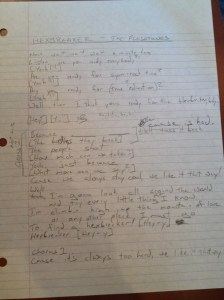
A transcript well done!
After I was able to get a gist of the overall narrative through transcription, I went back through the piece and was better able to make educated guesses about what the lyrics were. Although Zaremba often takes an unintelligible pitch when singing, the context of 17th century exploration helped me to piece together many of the tougher bits of the song. For instance, I revised the beginning of the chorus from “Well toss it back / [The bottles they break],” to fit the overall theme of colonial exploration, “The cause is had. / [The bodies they break].” Although, I’m not certain that these are the words to the song, I’m very confident because they match the overall theme. The practice of song-transcription has been fulfilling in the same way that figuring out a jigsaw, or tangram is exciting. It is a creative sort of problem solving, one that combines both analytic (left brain) and spatial, metaphoric (right brain) intelligence.
Emotionally, however, I did not feel the same satisfaction that I do when singing. Perhaps this has something to do with transcription alternate mode of embodiment. Transcription, and the pleasures associated – problem solving, precision, and permanence – are all of an analytical, and somewhat strategic sort. These are the pleasures of a conduit, processes associated more with the enduring construction of emotional bonds (belonging, and community), than the lucid enjoyment of them. It is my hope that one day another Fleshtones fan plumbs the depths of Google to find the lyrics of “Hexbreaker!” and that the fruit of my efforts, a completed transcript on lyrics.com, greets them and helps them to sing along and revel. Until then, it is enough to know that the work of transcription, for myself at least, is analytic and dry–definitely worlds apart from the euphoric mode of singing where my entire body vibrates in rhapsody to the melody, rhythm, and harmony of song.
—
Aaron Trammell is co-founder and multimedia editor of Sounding Out! He is also a Media Studies PhD candidate at Rutgers University.
Share this:


Current Top Posts





April 2021

January 2020

November 2019

October 2019

August 2019

April 2014

November 2017

March 2015

December 2017

October 2015
 Sounding Out!
Recent Comments