
Musical Objects, Variability and Live Electronic Performance

This is part two of a three part series on live Electronic music. To review part one, click here.
In the first part of this series,”Toward a Practical Language for Live Electronic Performance,” I established the language of variability as an index for objectively measuring the quality of musical performances. From this we were able to rethink traditional musical instruments as musical objects with variables that could be used to evaluate performer proficiency, both as a universal for the instrument (proficiency on the trumpet) and within genre and style constraints (proficiency as a Shrill C trumpet player). I propose that this language can be used to describe the performance of electronic music, making it easier to parallel with traditional western forms. Having proven useful with traditional instruments we’ll now see if this language can be used to describe the musical objects of electronic performance.
We’ll start with a DJ set. While not necessarily an instrument, a performed DJ set is a live musical object comprised of a number of variables. First would be the hardware. A vinyl DJ rig consists of at least two turntables, a mixer and a selection of vinyl. A CDJ rig uses two CD decks and a mixer. Serato and other vinyl controller software require only one turntable, a mixer and a laptop. Laptop mixing can be done with or without a controller. One could also do a cassette mix, reel to reel mix, or other hardware format mixing. Critical is a means to combine audio from separate sources into one uniform mix. Some of the other variables involved in this include selection, transitions and effects.
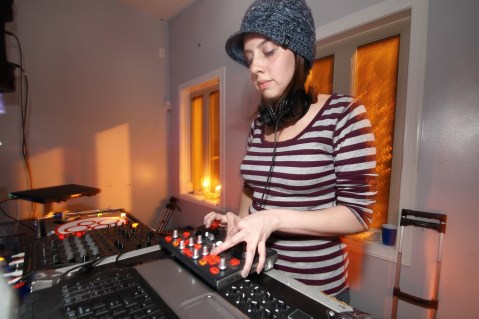
DJ Lush, FORWARD Winter Session 2012, Image by JHG Photography (c)
Because DJ sets are expected to be filled with pre-recorded sounds, the selection of sounds available is as broad as all of the sounds ever recorded. Specific styles of DJ sets, like an ambient DJ set, limit the selection down to a subset of recorded music. The choice of hardware can limit that even more. An all-vinyl DJ set of ambient music presents more of a challenge, in terms of selection, than a laptop set in the same style, because there are fewer ambient records pressed to vinyl than are available in a digital format.
Connected to selections are transitions, which could be said to define a DJ. When thinking of transitions there are two component factors: the playlist and going from one song to another. The playlist is obviously directly tied to the selection; however, even if you select the most popular songs for the style, unless they are put into a logical order, the transitions between them could make the set horrible.
One of the transitional keys to keeping a mix flowing is beat matching. In a turntable DJ set the beat mapping degree of difficulty is high because all of the tempos have to be matched manually by adjusting the speed of the two selections on the spinning turntables. When the tempos are synchronized, transitioning from one to the other is accomplished via a simple crossfade. With digital hardware such as the laptop, Serato and even CDJ setups, there is commonly a way to automatically match beats between selections. This makes the degree of difficulty to beat match in these formats much lower.
Effects, another variable, rely on what’s available through the hardware medium. With the turntable DJ set, the mixer is the primary source of effects and those until recent years have been limited to disc manipulation (e.g. scratching), crossfader, and EQ effects. Many of the non vinyl setups and even some of the vinyl setups now include a variety of digital effects like delay, reverb, sampler, granular effects and more.
With these variables so defined it becomes easier to objectively analyze the expressed variability of a live DJ set. But, while the variables themselves are objective, the value placed on them and even how they are evaluated are not. The language only provides the common ground for analysis and discussion. So the next time you’re at an event and the person next to you says, “this DJ is a hack!” you can say, “well they’ve got a pretty diverse selection with rather seemless transitions, maybe you just don’t like the music,” to which they’ll reply, “yeah, I don’t think I like this music,” which is decent progress in the scheme of things. If we really want to talk about live electronic performance however we will need to move beyond the DJ set to exemplify how this variable language can work to accurately describe the other musical objects which appear at a live electronic performance.

Joe Nice at Reconstrvct in Brooklyn NY on 2-23-2013, Photo by Kyle Rober, Courtesy of Electrogenic
Take for example another electronic instrument: the keyboard. The keyboard itself is a challenging instrument to define; in fact I could argue that the keyboard is itself not actually an instrument but a musical object. It is a component part of a group of instruments commonly referred to as keyboards, but the keyboard itself is not the instrument. What it is is one of the earliest examples of controllerism.
On a piano, typically fingers are used to press keys on the keyboard, which trigger the hammers to hit the strings and produce sound. The range of the instrument travels seven octaves from A0 to C8, and can theoretically have 88 voice polyphony, though in typical that polyphony is limited to the ten fingers. It can play a wide range of dynamics and includes pedals which can be used to modify the sustainabilty of pitches. With a pipe organ, the keyboard controls woodwind instruments with completely different timbre, range, and dynamics; the polyphony increases and the foot pedals can perform radically different functions. The differences from the piano grow even more once we enter the realm where the term “keyboard,” as instrument, is most commonly used: the synthesizer keyboard.
The first glaring difference is that, even if you have an encyclopedia of knowledge about keyboard synthesizers, when you see a performer with one on stage you simply cannot know by seeing what sounds it will produce. Pressing the key on a synthesizer keyboard can produce an infinite number of sounds, which can change not just from song to song, but from second to second and key to key. A performer’s left thumb can produce an entirely different sound than their left index finger. Using a keyboard equipped with a sequencer, the performer’s fingers may not press any keys at all but can still be active in the performance.

Minimoog Voyager Electric Blue, Image by Flickr User harald walker
When the keyboard synthesizer was first introduced, it was being used by traditional piano players in standard band configurations, like a piano or organ, with timbres being limited to one during a song and the performance aspect being limited to fingers pressing keys. Some keyboardists however used the instrument more as a bank for sound effects and textures. They may have been playing the same keys, but one wouldn’t necessarily expect to hear a I IV V chord progression. Rather than listening for the physical dexterity of the player’s fingers, the key to listening to a keyboard in this context was evaluating the sounds produced first and then how they were played to fit into the surrounding musical context.
Could one of these performers be seen as more competent than the other? Possibly. The first performer could be said to be one of the most amazing keyboard players in the piano player sense, but where they aren’t really maximizing the variability potential of the instrument, it could be said they fall short as a keyboard synthesizer performer. The second performer on the other hand may not even know what a I IV V chord progression is and thus be considered incompetent on the keyboard in the piano player sense, but the ways in which they exploit the variable possibilities shows their mastery of the keyboard synthesizer as an instrument.
Well, almost.
While generally speaking there isn’t a set of variables which define the keyboard synthesizer as an instrument, if we think of the keyboard synthesizer as a group of musical instruments, each of the individual types of keyboard synthesizers come with their own set of fixed variables which can be defined. Many of these variables are consistent across the various keyboards but not always in a standard arrangement.
As such, while the umbrella term “keyboard” persists it is perhaps more practical to define the instruments and their players individually. There are Juno 60 players, ARP Odyessy players, MiniMoog players, Crumar Spirit players and more. Naturally an individual player can be well versed in more than one of these instruments and thusly be thought of as a keyboardist, but their ability as a keyboardist would have to be properly contextualized per instrument in their keyboard repertoire. Using the MiniMoog as an example we can show how its variability as an instrument defines it and plays into how a performance on the instrument can be perceived.

Minimoog, Image by Flickr User Francesco Romito
The first variable worth considering when evaluating the MiniMoog is that it is a monophonic instrument. This is radically different from the piano; despite one’s ability to use ten fingers (or other extremity) only one note will sound at one time. The keyboard section of the instrument is only three and a half octaves long, though the range is itself variable. On the left-hand side there is a pitch wheel and a modulation wheel. The pitch wheel can vary the pitch of the currently playing note, while the modulation wheel can alter the actual sound design.
As a monophonic instrument, one does not need to have both hands on the keyboard, as only one note will ever sound at a time. This frees the hands to modify the sound being triggered by the keyboard exemplified via the pitch and modulation wheels, but also available are all of the exposed controls for the sound design. This means that in performance every aspect of the sound design and the triggering can be variable. Of course these changes are limited to what one can do with their hands, but the MiniMoog also features a common function in analog synths, a Control Voltage input. This means that an external source can control either the aspects of the sound design and/or the triggering for the instrument.
Despite this obvious difference from the piano, playing the MiniMoog does not have to be any less of a physical act. A player using their right hand to play the keyboard while modulating the sound with their left, plays with a different level of dexterity than the piano player. The right and left hand are performing different motions; while the right hand uses fingers to press keys as the arm moves it up and down the keyboard, the left hand can be adjusting the pitch or modulation wheels with a pushing action or alternately adjusting the knobs with a turning action. Like patting your head and rubbing your belly, controlling a well-timed filter sweep while simultaneously playing a melody is nowhere near as easy as it sounds.
At the same time playing the MiniMoog doesn’t have to be very physical at all. A sequencer could be responsible for all of the note triggering leaving both hands free to modulate the sound. Similarly the performer may not touch the MiniMoog at all, instead playing the sequencer itself as an intermediary between them and the sound of the instrument. In this case the MiniMoog is not being used as a keyboard, yet it retains its instrument status as all of the sounds are being generated from it, with the sequencer being used as the controller. Despite not having any physical contact with the instrument itself, the performer can still play it.

Minimoog in Live DJ Performance, Image by Fluckr Users Huba and Silica
Taking it one step further – if a performer were to only touch a sequencer at the start of the performance to press play and never touch the instrument, could they still be said to be playing the MiniMoog live? There is little doubt that the MiniMoog is indeed still performing because it does not have the mechanism to play by itself, but requires agency to illicit a sonic response. In this example that agency comes from the sequencer, but that does not eliminate the performer. The sequencer itself has to be programmed in order to provide the instrument with the proper control voltages, and the instrument itself has to be set up sonically with a designed sound receptive to the sequencer’s control. If the performer is not physically manipulating either device however, they are not performing live, the machines are.
From this we can establish the first dichotomy of electronic performance; the layers of variability in an electronic performance can be isolated into two specific categories: physical variability and sonic variability. While these two aspects are also present in traditional instrument performance, they are generally thought to not be mutually exclusive without additional devices. The vibrato of an acoustic guitar is only accomplished by physically modulating the strings to produce the effect. With an electronic instrument however, vibrato can be performed by an LFO controlling the amplitude. That LFO can be controlled physically but there does not have to be a physical motion (such as a knob turn) associated with it in order for it to be a live modulation or performance. The benefit of it running without physical aid is that it frees up the body to be able to control other things, increasing the variability of the performance.
In a situation where all of the aspects of the performance are being controlled by electronic functions, the agency in performance shifts from the artist performing live, to the artists establishing the parameters by which the machines perform live. Is the artist calling this a live performance a hack? Absolutely not, but it’s important that the context of the performance is understood for it to be evaluated. Like evaluating the monophonic MiniMoog performer based on the criteria of the polyphonic pianist, evaluating a machine performance based on physical criteria is unfair.

Daniel Carter on horn during Overcast Radio’s set at EPICENTER: 02, Photo courtesy of Raymond Angelo (c)
In the evaluation of a machine performance, just as with a physical one, variability still plays an important role. At the most base level the machine has to actually be performing and this is best measured by the potential variability of the sound. This gets tricky with digital instruments, as, barring outside influences, it is completely possible to repeat the exact same performance in the digital domain, so that there is no variation between each iteration. But even such cases with a digital sequencer controlling a digital instrument, with no physical interaction, are still a machine performances; they just exhibit very little variability. The performance aspect of the machine only disappears when the possibility for variability is completely removed, at which point the machine is no longer a performance instrument but a playback device as is the case with a CD player playing a backing track. The CD player if not being manipulated physically or by an external control is not a performance instrument as all of the sound contained within it can only be heard as one fixed recorded performance, not live. It is only when these fixed performances are manipulated either physically (ie a DJ set) or by other means, that they go from fixed performances to potentially live ones.

Mala and Hatcha in Detroit, Image by Tom Selekta
From all of this we arrive at four basic distinctions for live electronic performances:
• The electro/mechanical manipulation of fixed sonic performances
• The physical manipulation of electronic instruments
• The mechanized manipulation of electronic instruments
• A hybrid of physical and mechanized manipulation of electronic instruments
These help set up the context for evaluating electronic performances, as before we can determine the quality of a performance we must first be able to distinguish what type of performance we are observing. So far we’ve only dealt with a monophonic instrument, but even with its limitations can see how the potential variability is quite high. As we get into the laptop as a performance instrument that variability increases exponentially.
This is part two of a three part series. In the next part we will begin to exemplify the laptop as performance instrument, using this language to show the breadth of variability available in electronic performance and perhaps show that indeed, where that variability continues to be explored, there is merit to the potential of live electronic music as an extension of jazz.
—
Native Frequencies at the Trocadero 2013, Featured Image Courtesy of Raymond Angelo (C)
—
Primus Luta is a husband and father of three. He is a writer, technologist and an artist exploring the intersection of technology and art, and their philosophical implications. He is a regular guest contributor to the Create Digital Music website, and maintains his own AvantUrb site. Luta is a regular presenter for the Rhythm Incursions Podcast series with his show RIPL. As an artist, he is a founding member of the live electronic music collective Concrète Sound System, which spun off into a record label for the exploratory realms of sound in 2012.
—
 REWIND! . . .If you liked this post, you may also dig:
Experiments in Agent-based Sonic Composition–Andreas Pape
Evoking the Object: Physicality in the Digital Age of Music–-Primus Luta
Sound as Art as Anti-environment–Steven Hammer
Share this:

Wayback Sound Machine: Sound Through Time, Space, and Place
 This is the second post in Sounding Out!’s July forum on listening in observation of World Listening Day on July 18th, 2013. World Listening Day is a time to think about the impacts we have on our auditory environments and, in turn, its affects on us. To read last week’s post by Regina Bradley (and to read more about World Listening Day) click here.
—
When I travel to somewhere I’m unfamiliar with to create a work, I’ve become in the habit of bringing my VLF receiver, hydrophones, and underwater camera in order to explore. Whether what comes out ultimately becomes part of the work or not, my interest in these particular tools stems from a fascination with obscure events around me, real and happening, that I cannot perceive. But it also marks my wonder at events and elements in our world that have been, while changing, continuous in a time line extending much further than my own. Similar to the sense one may get when experiencing a desert, or an ocean, with time and patience, what might at first seem bleak, barren, or monotonous, begins to give hint to a rich world hidden from our day to day.

Photo by the author, Saint Michael’s Mound, Marazion, Cornwall
Two autumns ago, finding myself with a day off from a project I was working on near Penzance in Cornwall, I decided to take the day to hike the lesser known British arm of the Santiago Pilgrim Route: the St. Michael’s Way. Dating back tens of thousands of years, St. Michael’s Way enabled pilgrims and missionaries traveling from Ireland or Wales to choose to abandon their ships and walk across the peninsula, rather than navigating the treacherous waters around Land’s End. In the days of such pilgrimmages, the way was fraught with all sorts of dangers, and the path itself splits a few times, veering off towards a church near the harbor where they would get the boat to cross them. There they would meet a guide who would offer safe passage from the many thieves and pirates along the way. Still marked with the iconic scallop shell symbol of the pilgrim route, the path was nevertheless neglected, and overrun with all sorts of modern obstacles such as busy roads and farm irrigation systems.

Photo by the author, Gulval, Cornwall
As I got lost time and time again making my way towards Saint Ives, I found myself marveling at all sorts of new and heretofore unknown sensations. My ears tuned from the project I was there working on, I was especially taken by the sound. Toward the middle of the path–located at the top of the hills inland of the peninsula –the wind from both sides carried over pieces of the day to day from the villages; a tractor, grazing animals, bits of conversation in Cornish, and church bells wisping by as quickly as they came, like ghosts. It is fitting that St Michael, after whom the route was named, is the patron saint of high places.
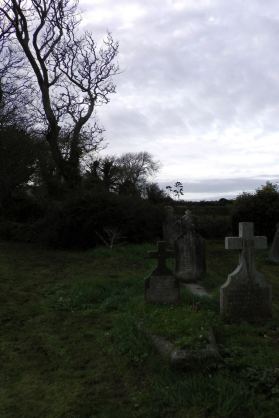
Photo by the author, Ludgvan, Cornwall
I began to wonder what this path may have sounded like back in the time of thieves and pirates, back when the occasion to use it was a shared occasion celebrated with the voices of people, priests, prayers, and the markets and fairs along the way to fuel all this activity. As I continued walking, I began to wonder how it may have sounded even before then, before the hills were blanketed with crops and cattle, before the many battles that must have been waged, and villages built and grazed. . .were there more birds then? Were there more trees? Were there more boar and foxes? What about even before these hills were hills, could there be a way to sonify these hills forming? I started to dream of a “wayback machine” for sound. What if as you walked this path, you could listen to time spinning back, listen to how it might have sounded, listen to its history? And what could you take from that experience? Could something be taken from this? In the two years since that happenstance, this idea has since stuck with me. Beginning tentative research and practice to apply these thoughts, I continue to unearth more questions than answers, so I began to seek others experimenting in a similar vein. While acoustic ecology is a growing field, I still have not found many researchers working with sound in/as time.
One person who has come close to this idea is acoustic ecologist, musician, and sound recordist Bernie Krause, whom last year I interviewed in an article on the sound of disaster about disappearing sounds as a signal of impending crises. The prelude of Krause’s book The Great Animal Orchestra: Finding the Origins of Music in the World’s Wild Places, is the beautifully written, “Echoes of the Past,” which takes a meandering listen to how the world might have sounded sixteen thousand years ago. With that trip in mind, perhaps something could come from working with people in various fields of statistical analysis to see what sounds are projected to go extinct from a soundscape with time, and what this could mean in terms of how the sound line will be extended into the future. In the section “First Notes,” Krause describes working with a graduate student, Kristin Junette, who reasoned that based on fossil records and the known sounds of insect species today, we might be able to re-create the insect ambience of about sixty-five million years ago. Then, based on acoustic physiology of the skull of a Hadrosaur, a dinosaur of the time, Krause and Junette were able to re-create a representative vocalization of its call to place in this early soundscape (for the Discovery Channel’s vision of how the hadrosaur might have sounded click here).

Hadrosaur skull, Image by Flickr user e_monk
I was also excited to learn of the research of Miriam Kolar, who has been working with various techniques and with people in various disciplines on a team studying and “recreating” the acoustic architecture of the Chavín de Huántar, a 3,000 year old ceremonial center, predating the Inca in the Peruvian Andes. Chavín de Huántar is a complex underground maze of rooms and twisting corridors connected by air-ducts. When they were being excavated, archeologists noticed the rooms played strange acoustic tricks on them. “This environment is not only a physical maze, but it’s a sound maze,” says Kolar. For one example, some rooms have interconnected spaces that multiply echoes and bounce them back to the ear so rapidly that the sounds appear to emanate from all directions at once, while other areas seem designed for absorption. The team has been using 3-D computer modeling and specialized recording equipment to try and recreate the auditory effect. “If you have archaeology and no acoustics, you’re deaf,” says archaeoacoustician David Lubman. “And if you have acoustics and not the other, you’re blind. You need both” to understand ancient places like Chavín.

Chavín De Huántar
Inspired in part by the research of Krause and Kolar, “Passageira em Casa/The Traveller at Home,” one of my projects from the two years since my walk in Cornwall, begins to explore the notion of the wayback machine with sound in geography. Passageira em Casa is an intermedia and interdisciplinary performance inspired by the journey to define the concept of home. The narrative is a partially fictionalized and personalized account of the Maritime history of Portugal, enacted by a dancer, vocal performer, live video, and live electronic sound composition that creates a geography through the narrative and space of the project. From a dawn chorus in Lisbon to underwater earthquakes in the Pacific, field recordings along a maritime navigation route flow throughout the performance, giving a soundscape to the narrative’s location.
.
The recent Australian version “Passageira australis” begings to explore sound in time. Recently developed at the iAir residency at RMIT, holds a focus on the debate behind whether the Portuguese were the first Europeans to arrive in Australia, based on the 16th century Dieppe maps of Jave la Grande and the myth/history of the Mahogany Ship. The soundtrack reveals a soundline based on the impact on flora, fauna, and overall soundscape on both countries.
.
A two channel composition, different then stereo, one speaker represents Europe, the other Australia. As the dancer, our sailor, moves from one end of the space to the other, the sound in each channel is changed based on her approximate location to each “country”. With this experience, my hope is the audience comes away thinking about interconnectivity of the world, and how we impact the places we touch. Although I will continue to research when I return to Australia, already the project had me working with a map historian at the Victoria State Library, as well as consulting the thesis of geologist Andrew Pickering on using GIS technology to search for the location and story behind the presumed mythological Mahogany Ship.
Based on hearing, listening (from an anthropological point of view) is the very sense of space and of time. . .By her noises, Nature shudders with meaning: at least this is how, according to Hegel, the ancient Greeks listened to her. The oaks of Dodona, by the murmur of their boughs, uttered prophecies, and in other civilizations as well. . .noises have been the immediate raw materials of a divination, cledonomancy: to listen is, in an institutional manner, to try to find out what is happening. –Roland Bathes, “Listening”
Sound has a special importance to emotion, instinct, and memory, both individual and historical.. Hitting the oldest part of our brain, sound provides immediate information telling us where we are, whether it is safe, and how we should feel about it. The wayback machine would function as a sonic database that would not only help us to remember and learn about the past, but also to create new experiences within the complexity of changing soundscapes over a period that usually defies our human comprehension. I see this tool being helpful to researchers in many disciplines as a new kind of living archive, but also having a place in libraries, museums, centers, and perhaps “in the field” along paths such as the Santiago’s Way, where one could download an audio file from the map online, then listen with wonder and unique sensation as they walk back through history.

Photo by the author, Saint Michael’s Mound, Marazion, Cornwall
—
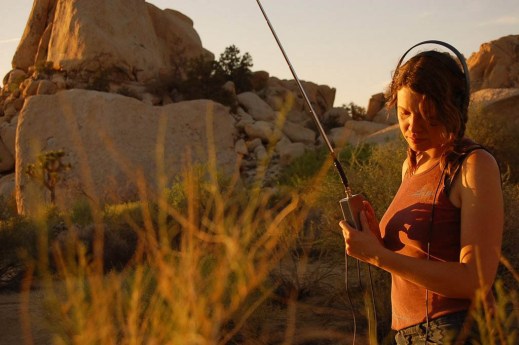
Featured Image photo credit: Vahid Sadjadi, Joshua Tree State Park, California
—
Author’s Note: A version of this post was presented at Musique et Écologies du Son/ Music and Ecologies of Sound: Theoretical and Practical Projects for the Listening of the World, Universitê Paris 8, May 2013. I slightly changed the original title of the paper to: “Sound through time, space, AND place.” Frank Vanclay said quite nicely in “Place Matters.” “‘Place” is generally conceived as being ‘space’ imbued with meaning. Thus, it refers more to the meanings that are invested in a location than to the physicality of the locality.” He goes on to state sometimes it’s the biophysical characteristics that make the foundation for those personal meanings.
—
Maile Colbert is a multi-media artist with a concentration on sound and video who relocated from Los Angeles, US to Lisbon, Portugal. She is a regular writer for Sounding Out!
—
REWIND! . . .If you liked this post, you may also dig:
“Listening to Disaster: Our Relationship to Sound in Danger”–Maile Colbert
“Within a Grain of Sand: Our Sonic Environment and Some of Its Shapers” –Maile Colbert
“Animal Renderings: The Library of Natural Sounds”--Jonathan Skinner
Share this:


Current Top Posts





April 2021

January 2020

November 2019

October 2019

August 2019

April 2014

November 2017

March 2015

December 2017

October 2015
 Sounding Out!
Recent Comments