
GLaDOS, the Voice of Postfeminist Control

Warning, spoilers ahead. Image borrowed from ElderGeek.
Much has been written about Portal, it has won at least seven “Game of the Year” awards and has been ranked as the “Best Game of all Time” by Gamesradar. Perhaps because both the hero and antagonist are women, it has also been the object of several cultural critiques. One blogger writes, “GLaDOS [the game’s villian] is the archetypical oppressed woman.” In an article published by GamePro (a mass-market game review magazine) GLaDOS is considered a “feminist icon.” Although “feminist icon” is a bit extreme, GLaDOS does have a lot to do with feminism. When seen in light of Rosalind Gill’s (2007) essay, “Postfeminist media culture,” GLaDOS, and her wry, disembodied voice, hold striking parallels to the immanence of surveillance in today’s world.

GLaDOS and Chell. Borrowed from gryphonworks @ deviantART.
At their core, the games in Valve Software’s Portal series are relatively straightforward: you are put in control of a female character named Chell, who is attempting to escape from the Aperture Science Laboratory complex. Equipped, mainly, with a portal gun (think Yellow Submarine, “Hole in My Pocket”), Chell traverses precipices, laser drones, acid pits and everything in-between. As she navigates and manipulates these obstacles, a disembodied Orwellian voice guides Chell from one puzzle to the next. This is the voice of GLaDOS (Genetic Lifeform and Disk Operating System), a self-aware computer who runs the joint (at least in Portal 1) and is keeping you around for further “testing.” Where Portal is claustrophobic, just you and GLaDOS, Portal 2 is a little more dynamic. A third character, Wheatley, is introduced. In both games, however; there is an inescapable feeling of surveillance and scrutiny. GLaDOS’s monotonous voice is everywhere, the robotic platforms of the Aperture complex are the only appendages of her body to be found.
What to make of the GLaDOS’s character? Although she is helpful at first when guiding Chell through the early tests, GLaDOS quickly adopts a sarcastic tone – putting Chell down, and belittling her mistakes. G. Christopher Williams of PopMatters reads into the backstory a bit. He points out that GLaDOS is modeled on the personality of the Aperture Science CEO, Cave Johnson’s, wife: Caroline. In the second game there is a tape of Johnson elaborating:
Brain Mapping. Artificial Intelligence. We should have been working on it thirty years ago. I will say this—and I’m gonna say it on tape so everybody hears it a hundred times a day: If I die before you people can pour me into a computer, I want Caroline to run this place.
Now she’ll argue. She’ll say she can’t. She’s modest like that.
But you make her.
Hell, put her in my computer. I don’t care.
GLaDOS, then, has a bit of a history. Within this history there is a glass ceiling. GLaDOS has had a dampening sphere installed to limit her “irrational thinking,” and curb her “misbehavior.” Tellingly, this sphere whispers terrible ideas to her in a babbling male voice. At the end of Portal 1, Chell destroys the dampening sphere, and GLaDOS is free to get revenge on the society that has caged her. At this key moment, the tonality of her voice shifts from accommodating to sultry.
This change in voice accompanies a change in disposition. As Chell continues her adventures in Portal 2, GLaDOS returns with a set of suspiciously cutting remarks. Several barbs are made about Chell gaining weight, being unintelligent, and being adopted. In the sequel, GLaDOS is especially critical of Chell’s body. These pot-shots figure perfectly into Gill’s (2007) hallmarks of postfeminism: 1) the increased self-surveillance of the female body, 2) the increase of surveillance in new social sectors, and 3) a focus on the psychological transformation of one’s self, or interior life. Chell, the avatar, isn’t being judged on her weight (or lack thereof). Instead, GLaDOS’s remarks cut to the player, who recognizes that neither they nor Chell fit GLaDOS’s ideal. Although, in the narrative, GLaDOS typifies an extension of invisible and disembodied surveillance into new spheres of life, her comments act to foster self-surveillance in the embodied player.
GLaDOS’s comments have even jarred some users in the Steam Users’ Forums (Steam is Valve’s online distribution platform). In a thread entitled, “Portal 2 Sexist,” one user, loodmoney, asked if anyone else found GLaDOS’s fat jokes off-putting. To this, another user, Killalaz replied, “GLaDOS is trying to discourage/dishearten the testers. Chell is a woman, what bothers a woman more than being called fat? Not much. . .psychological warfare so to speak.” Although Killalaz may be reading too literally into Portal 2’s narrative, he is right about one thing: to some extent, GLaDOS, and therefore Valve Software, is waging psychological warfare on us all. Later in the thread another user, BC2 Cypher, demonstrates the extent that attitudes of self-surveillance can work to mold one’s psyche, “I don’t see the issue he’re. I actually used to BE fat. Lost 72 pounds when I was 15. 232 – 160. It’s not like Chell is even fat. That is the joke.” The real joke, if there is one, is that so many players are content to reduce GLaDOS’s comments to a self-contained dialogue between fictional characters. What is heard, actually, relates directly to the way dialogue from Portal is internalized. In these forums, the voice of GLaDOS is reproduced; it mediates the bodies of some fans (by supposing an ideal weight), and surveils the bodies of others (by guiding the dialogue).
But, when I play Portal, I occasionally smirk at GLaDOS’s comments. They are cutting satire. If GLaDOS is a feminist icon, it is because she is a voice that everyone carries with them at all times. The voice in our heads, that causes us to judge and shape ourselves, while simultaneously passing unkind judgment on to others. GLaDOS is iconic of the postfeminist condition – a condition where surveillance is assumed and internalized. And, our bodies are shaped through the hyper-mediation of games like Portal, and characters like GLaDOS, as they replicate themselves in web forums, and in our own voices.
AT


Share this:

Genre in the Age of Convergence: Mario Paint Composer
DOI: https://doi.org/10.59350/rg065-mge82
It’s no secret that over the course of the twentieth century, aesthetic productions have drawn increasingly on recycled and re-appropriated materials. Perhaps, for this reason, the above video – a rendition of Michael Jackson’s Thriller on the newly minted Mario Paint Composer – sounds absolutely mundane. Nothing new, just another curiosity born out of the collective consciousness we cannily refer to as the Internets, which we understand jokingly as a series of tubes, notably Youtubes. Laffs aside, this phenomena complicates many traditional modes of interpretation.How do we hear the music of a convergence era when within it lies a devious set of connotations, each serving to reorient the listener to its own particular theme? What tactics do listeners take when interpreting this semiotic collision of sound, icon and song? These questions complicate the topic of genre, where a social consensus traditionally guides the collective organization of a medium. What social and sonic forms shape our understanding of Thriller as it was reproduced by Mario Paint Composer on Youtube in 2008?
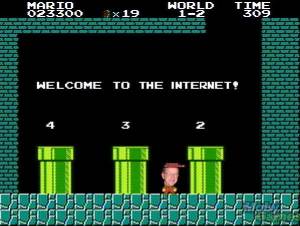
Before delving too deeply into a discussion of genre, it is important to situate the phenomena of convergence in a pre-digital context. Although the user-centric nature of web 2.0 has certainly helped to accelerate this process, one needs to look no further than Dick Hebdige’s “The Meaning of Mod,” in the anthology Resistance Through Rituals, to sense an earlier precedent to the mash-up culture we observe today. Drawn to the adventure of a dangerous soHo night-life culture, “The mod dealt his blows by inverting and distorting the images (of neatness, of short hair) so cherished by his employers and parents, to create a style, which while being overtly close to the straight world was nonetheless incomprehensible to it.” Although Hebdige is writing in 1974, long before computers would become mainstream, he makes a worthy point here about the appropriation of fashion. Constructing it as an act of distortion,Hebdige argues that early 1960s mods (understood here as a working class youth movement), through their stylistic appropriations were able to undermine the fabric of British society. By acting as criminals, but lauding the style of white collar workers – suits, short hair – mods help to show that semiotic convergence is not something new, instead it can be read as a stance of resistance.
In the case of Thriller, resistance is too strong a word. I prefer distortion, it is value neutral, although it can easily be understood in the context of resistance. Thriller on Mario Paint Composer distorts Thriller by Michael Jackson. By simplifying the song to a series of 16-bit samples, the song’s transcriber geoffnet1, translates it all to the symbolic language of Mario Paint – where mushrooms sound like drums, hearts are bass notes, ships are cymbals, flowers are horns, cars are synth pads and game-boys sound like blips. geoffnet1’s Thriller is a distortion of the Mario Paint Composer sound as well; originally a part of the 1992 Super Nintendo cartridge, Mario Paint, Mario Paint Composer is now a fan-modded update of its original form. Unlike the original Mario Paint Composer has been designed with functionality taking a precedent over accessibility. Originally marketed as an intuitive music scripting software, the following limitations were part and parcel of the platform (These restrictions have been copied from Tombobbuilder’s page, a musician who works with the limits of Mario Paint Composer as it was originally distributed.):
1. Only 24 measures are available.
2. No more than three notes at a time.
3. You can not double notes on the same line or space.
4. Tempo is restricted.
5. There is no fluctuation in dynamics (volume).
6. No sharps or flats are available.
7. Can only compose using the “white keys” from the piano.
8. Only two of each letter name are available (except A, where there is only one).
9. C major and A natural minor are the only keys to compose in.
Of these restrictions, Thriller only conforms to the third: “You can not double notes on the same line or space,” in this regard it distorts what most people understand as the Mario Paint sound as well. By no means am I calling this work inauthentic, instead I am calling attention to the stability of sonic tropes in our cultural memory. The sound of Mario Paint is not remembered for the limitations described above, instead, there is a stable and distinct sonic fingerprint which is derived from the alchemy of icon, sound and song though which genre can be constructed and maintained.
Thriller is 8-bit music, even though there is nothing 8-bit about it. Similar to the way in which mods subverted the British status-quo, Thriller puts the idea of genre into crisis. This is not a crisis that works to undermine the existence of genre as a phenomenon, it is instead a crisis of interpretation, where the traditional means through which a genre can be identified are called into question. No longer can the easy answers be found at Allmusic or Wikipedia, some sounds have become more epistemically ellusive. Ultimately, this is a good thing, as it encourages listeners to take a critical ear to what they are listening to – and how they come to understand it.
Aaron Trammell
—
Share this:




Current Top Posts





April 2021

January 2020

November 2019

October 2019

August 2019

April 2014

November 2017

March 2015

December 2017

October 2015


Recent Comments