
Sound at ASA 2011
DOI: https://doi.org/10.59350/nkaew-hv704
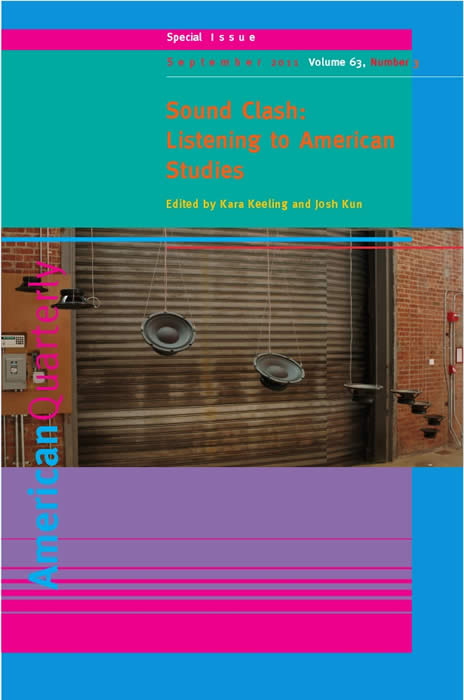
This year’s American Studies Association meeting in Baltimore, Maryland (October 19th-23rd) marks a real tipping point for Sound Studies within the interdisciplinary field of American Studies. First of all, there was the publication of Kara Keeling and Josh Kun’s co-edited special issue for American Quarterly, Sound Clash: Listening to American Studies, this past September 2011. Packed with 17 cutting-edge essays—culled from a record breaking 80+ submissions—this must-read issue is, according to Keeling and Kun’s introduction, “a sign not only of sound’s quantitative currency but the promise of its future as a field of ongoing inquiry, and its importance and relevance to the future of American Studies itself” (452). In addition to its vibrant blend of emerging scholars and senior folk, the issue is notable for its head-on engagement of sound and power in multiple, intersecting dimensions: race, ethnicity, gender, sexuality, and national identity. The issue’s intervention tracing the aural edge to U.S. citizenship privilege is especially important, and game-changing for both American Studies and Sound Studies. If you have access to Project Muse, you may download the entire issue (or selected essays) through this link here. The issue also kicks off a new audio-visual web interface for American Quarterly, and you can look here to see and hear more from several authors in the issue.

We at Sounding Out! are proud to be mentioned in the introduction to AQ’s Sound Clash and to have five members of Team SO! featured in the issue: yours truly, Editor-in-Chief and Guest Posts Editor Jennifer Stoever and guest authors, D. Inés Casillas, Nina Eidsheim, Tara Rodgers, and Gayle Wald. Look for Sounding Out! posts in 2012 from more of the AQ special issue’s contributors, including Mack Hagood, D. Travers Scott, and Roshanak Kheshti. If you are headed down to B’more and you’d like to hear from many of these folks in person, American Quarterly is sponsoring a roundtable panel on Saturday, October 22nd, bright and early at 8:00 a.m. at the Hilton Baltimore Holiday Room 5. It will be moderated by Josh Kun (USC) and will feature Kara Keeling (USC), Asma Naeem (University of Maryland, College Park), Dustin Tahmahkera (Southwestern University), and Roshnak Kheshti (UCSD) as panelists. Look also for unscheduled guests to appear from the issue, such as Gayle Wald (George Washington) and myself (SUNY Binghamton)—ASA rules do not permit formal participation in more than one panel—and know that, despite the early tip-off time, Keeling and Kun will be taking full advantage of the session to give Sound Clash an enthusiastic and proper send off. Between now and then, I’ll be frantically figuring out how to clone myself, because a couple of the issue’s contributors, Tara Rodgers (University of Maryland) and Barry Shank (Ohio State), are unfortunately scheduled in two excellent competing sound studies panels that very morning (scroll down for full details)! Hopefully, when the ASA Sound Studies Caucus gets fully up and running, there will be less tortuously tantalizing research pile-ups like this one.
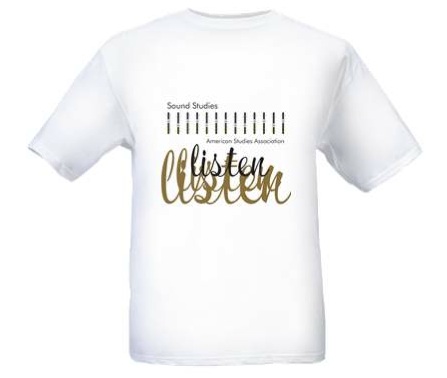
That’s right, I said the ASA Sound Studies Caucus. If the publication of the AQ special issue wasn’t awesome enough news, the word on the street is that next year, I may not have to do Sounding Out!’s beloved ASA conference pre-game round-up. Sound Studies is in the process of gaining that all-important indexing in the front of the American Studies Association conference program through the brand-new Sound Studies Caucus. Through ASA, the caucus is hoping to sponsor specific sound-related panels for forthcoming ASA meetings. This year’s reception is a planning session where interested parties can introduce themselves and become more involved in some of the caucus’s administrative tasks. The official meet up takes place on Saturday, October 22nd from 4-6 p.m. at the upstairs bar area of the Pratt Street Ale House (206 W. Pratt Street) and Team ASA SSC will be selling limited edition T-Shirts to fund raise for the group. Interested folks can join the Sound Studies Caucus Googlegroup in advance of the meeting and catch the latest breaking news.
The ASA Sound Studies Caucus came out of a 2010 working group of UC faculty called “Sounding Race” generously funded by a UC Humanities Research Institute Grant. The caucus centralizes race, gender, and sexuality to the study of sound and vice versa; in the words of their grant: “A new direction in sound studies suggests that sound, indeed, racializes, queers, and genders both the speaking subject as well as the listener.” The grant was authored by Deborah Vargas (UC Irvine), Roshanak Kheshti(UC San Diego), D. Inés Casillas (UC Santa Barbara and frequent Sounding Out! blogger), and Kevin Fellezs (formerly at UC Merced, now at Columbia University). We at Sounding Out! are thankful for their scholarship, enthusiasm, and their critical administrative labor; we look forward to hearing more from this collective both at the caucus meeting and at the sure-to-be-excellent roundtable: “ASA Committee on Ethnic Studies: Sounding Race” on Friday October 21st, at 10:00 a.m. in Hilton Baltimore Peale B. It will be moderated by Herman Grey (UC Santa Cruz) and will also include Kirstie Dorr (UC San Diego). Look for me at both events—I will be the one live-Tweeting furiously with a huge grin on my face, excited to be gathering with so many Sound Studies colleagues from across ASA’s many (inter)disciplines.

In addition, I will be representing Sounding Out! on a panel organized by Nicole Hodges Persley (University of Kansas) and sponsored by the American Studies Women’s Committee called “Digital Displays: Women Imagining Blogospheres as Alternative Public Spheres,” on Saturday, October 22nd from 2:00p.m. to 3:45 p.m. at the Hilton Baltimore Holiday Ballroom 4. I will be joining Tanya Golash-Boza (University of Kansas, author of the blog Get a Life, Ph.D), Judy Lubin (Howard University, author of the blog Judy Lubin’s Leading Voices) and Jamie Schmidt Wagman (Saint Louis University) in a conversation about the role and power of blogging in contemporary academic careers. In particular, my paper, “Sounding Off About Sounding Out!: Emerging Scholars in an Emerging Field” will focus on the mission and history of our blog and its interventions in the problem of access for women, junior scholars, and scholars of color. Sounding Out! will continue the conversation beyond Saturday afternoon by publishing excerpts from my paper post-ASA. We hope that you will join us, either in person or by contributing your thoughts and comments when that post eventually goes live.
Below you will find Sounding Out!’s picks for panels, papers, and events of interest to Sound Studies scholars at ASA 2011. We’d like to thank IASPM (the US branch of the International Association for the Study of Popular Music for compiling the Popular Music Panels a few weeks back and add that our version of course understands “sound” more broadly: you’ll find music panels among work on urban soundscapes, theorizations of listening, research on sound and space, sound and race, sound and citizenship, as well as new research in the digital humanities for those interested in blogging and other audio-visual technologies, methodologies, and pedagogies. In addition to panels, I have also copiously trolled through the program looking for events of interest to sound studies scholars as well as individual papers housed on panels not ostensibly or exclusively about sound (another important measure of the health, usefulness, and influence of Sound Studies methodology across the board). If you find that I have missed you—or have placed your paper here in error—drop me a line at jsa@soundingoutblog.com and I will rectify the situation ASAP.
Finally, I want to give a quick shout out to local organizations and research projects in Baltimore that study sound, both as a gambit for Sound Studies scholars at ASA to think about how to foster relationships with site-specific colleagues and professionals at this and future meetings, but also as a way of introduction (or a welcome back) to the city that we will live in and be a part of for a few precious days this week. Here are links to the Baltimore Soundscape Project, an interactive, collective soundmap facilitated by the private nonprofit group The Hearing and Speech Agency, which began in Baltimore in 1926 and functions as a “direct service provider, information resource center, and advocate for people of all ages and incomes who are deaf, hard of hearing, or have speech-language disabilities”; Baltimore Sounds, a website run by Joe Vaccarino, a local musician, writer, and restaurateur, “dedicated to the history of past and present pop musicians throughout the Baltimore regional area” that features an extensive “Big List” of all musicians and groups in the area between 1950 and 2000; and the enjoyable Sounds of the Baltimore Oriole for a ornithological taste of “wild” Baltimore beyond the built environment. Take a good listen and I’ll see you all very soon. For the virtual experience, look for my live tweets via our Facebook and Twitter pages or on the official ASA backchannel: #2011asa.
—
Jennifer Stoever is co-founder, Editor-in-Chief and Guest Posts Editor for Sounding Out! She is also Assistant Professor of English at Binghamton University and a Fellow at the Society for the Humanities at Cornell University.
Jump to THURSDAY, October 20
Jump to FRIDAY, October 21
Jump to SATURDAY, October 22
Jump to SUNDAY, October 23

THURSDAY PANELS
2:00 pm – 3:45 pm
African American Soundscapes and Sound Theory, Hilton Baltimore Tubman B
CHAIR: Alexander Weheliye, Northwestern University (IL)
PAPERS: Anthony Reed, Yale University (CT), “Some Echo of Haunting Melody”: W.E.B. Du Bois’ Musical Modernity
Noelle Morrissette, University of North Carolina, Greensboro (NC), James Weldon Johnson’s Soundscape of Modernity: Black Manhattan
Benjamin S. Glaser, Cornell University (NY), “They require(d) of us a song”: Psalm 137 and the Negro Renaissance
Carter Mathes, Rutgers University, Newark (NJ), Narrative Acoustics: “Free” Writing Black Consciousness
.
Towards a Sensual Politics: Nation, Race, and Sense Perception, Hilton Baltimore Peale B
CHAIR: Todd Carmody, University of California, Berkeley (CA)
PAPERS: Britt Rusert, Temple University (PA), Fugitive Senses: Race and Empiricism in the Early Republic
Erica Fretwell, Duke University (NC), Sensitive Citizenship, Passing, and Other Nervous Conditions
Patrick Jagoda, University of Chicago (IL), How Videogames Think
COMMENT: Nihad Farooq, Georgia Institute of Technology (GA)
4:00 pm – 5:45 pm
Folk, Pop, and Indie Rock: Race and Ethnicity in American Music, Hilton Baltimore Carroll B
CHAIR: Ulrich Adelt, University of Wyoming (WY)
PAPERS: Lorena Alvarado, University of California, Los Angeles (CA), Ambiguous Anthems: Narratives of the Immigrant Subject and Popular Music
Nicholas Francisco Centino, University of California, Santa Barbara (CA), Raza Rockabilly: Reclaimed Space, History, and Identity in Contemporary Los Angeles
Matthew Mace Barbee, Siena Heights University (MI), The Unseen Power of the Picket Fence: How Black Nationalism Created Indie Rock
.
Voicing a Riff: The Village Voice Music Section and Its Critical Legacy, Hilton Baltimore Johnson B
CHAIR: Eric Weisbard, University of Alabama, Tuscaloosa (AL)
PANELISTS: Joshua Clover, University of California, Davis (CA), Ann Powers, Independent Scholar, Greg Tate, Independent Scholar, Eric Weisbard, University of Alabama, Tuscaloosa (AL)
INDIVIDUAL PAPERS
12:00 pm – 1:45 pm
Nijah N. Cunningham, Columbia University (NY), Strident Light, Radiant Sound: Reparation and Redress in a Flyer for a Forsaken Life, Reparative Justice and the Failures of Government, Hilton Baltimore Brent
4:00 pm – 5:45 pm
Patricia Herrera, University of Richmond (VA), Sonic Memorials to Roberto Clemente, The Nuyorican Movement, Aesthetics, and Feminism, Hilton Baltimore Peale B

FRIDAY PANELS
10:00 am – 11:45 am
Performative Black Christianity and the Logics of Religious Representation, Hilton Baltimore Holiday Ballroom 4
CHAIR: Daphne A. Brooks, Princeton University (NJ)
PAPERS: Ashon T. Crawley, Duke University (NC), Arthur, Crunch, and the Sound of Blackness in Baldwin’s Just Above My Head
Ronald Neal, Wake Forest University (NC), Spike Lee Can Go to Hell! Tyler Perry, Religion, and Southern Masculinity
Terrion L. Williamson, Michigan State University (MI), Juanita Bynum: Black Religiosity and the Making of a Good Christian Girl
COMMENT: Fred Moten, Duke University (NC)
.
Affective Histories, Critical Transformations: A Roundtable Discussion, Hilton Baltimore Latrobe
CHAIR: Jasbir K. Puar, Rutgers University, New Brunswick/Piscataway (NJ)
PANELISTS: Mel Y. Chen, University of California, Berkeley (CA), Dana Luciano, Georgetown University (DC), Robert McRuer, George Washington University (DC), Karen Tongson, University of Southern California (CA)
ASA Committee on Ethnic Studies I: Sounding Race, Hilton Baltimore Peale B
CHAIR: Herman S. Gray, University of California, Santa Cruz (CA)
PANELISTS: Deborah R. Vargas, University of California, Irvine (CA), Kirstie A. Dorr, University of California, San Diego (CA), Kevin Fellezs, Columbia University (NY), Dolores InÈs Casillas, University of California, Santa Barbara (CA), Herman S. Gray, University of California, Santa Cruz (CA)
12:00 pm – 1:45 pm
Musical Migrations, Political Transformations: Reassembling Caribbean Musics in the Post-War United States, Hilton Baltimore Johnson B
CHAIR: Brent Hayes Edwards, Columbia University (NY)
PAPERS: Alexandra Vazquez, Princeton University (NJ), Listening in the Cold War Years
Nadia Ellis, University of California, Berkeley (CA), From a Broken Bottle, Traces: Haunt and the Poetics of Diasporic Repair
Shane Vogel, Indiana University–Bloomington (IN), Madam Zajj and U.S. Steel: Duke Ellington’s Calypso Theatre
COMMENT: Brent Hayes Edwards, Columbia University (NY)
.
Transforming Scholarly Research in the Digital Age (Sponsored by the Digital Humanities Caucus), Hilton Baltimore Key Ballroom 09
CHAIR: Wendy Chun, Brown University (RI)
PANELISTS: A. Joan Saab, University of Rochester (NY), Gwendolyn DuBois Shaw, University of Pennsylvania (PA), Tara McPherson, University of Southern California (CA), Mark Williams, Dartmouth College (NH)
2:00 pm – 3:45 pm
The Musical Imaginary: Race, Class, and Authenticity, Hilton Baltimore Paca A
CHAIR: Aldon Lynn Nielsen, Pennsylvania State University, University Park Main Campus (PA)
PAPERS: William Fulton, City University of New York, Graduate School (NY), Re-inventing Authenticity: Big Brother and the Holding Company’s Cheap Thrills as Haight-Ashbury Counterculture Statement
Sonnet Retman, University of Washington, Seattle (WA), Muddy the Waters: Other Stories of Love and Theft in the Making of the Delta Blues
Elizabeth Yeager, University of Kansas (KS), “Find[ing] myself a city to live in”: Middle Class American Imagination and Phish Scene Identity
Jack Hamilton, Harvard University (MA), Being Good Isn’t Always Easy: Aretha Franklin, Dusty Springfield and Janis Joplin in the 1960s
COMMENT: Danielle Heard, University of California, Davis (CA)
INDIVIDUAL PAPERS
2:00 pm – 3:45 pm
Daylanne English, Macalester College (MN), ArchAndroids and Their Antecedents: The Roots of Janelle Monae’s Afrofuturistic Post-human, Afrofuturism, Hilton Baltimore Peale A
4:00 pm – 5:45 pm
Marisol Negron, University of Massachusetts, Boston (MA), From Mambo to Hip Hop: (Re)Imagining ìNuyoricanî with HÈctor LaVoe and La Bruja, Imagining Latinidad and Citizenship in Popular Cultures, Hilton Baltimore Brent

EVENTS
9:30 p.m.
Book Release Party for Karen Tongson (USC): Relocations: Queer Suburban Imaginaries (NYU Press), 9:30 p.m. at Red Maple, 930 N. Charles Street, Baltimore, 21201
SATURDAY PANELS
8:00 am – 9:45 am
American Quarterly Theme Session I: Sound in American Studies, Hilton Baltimore Holiday Ballroom 5
CHAIR: Josh Kun, University of Southern California (CA)
PANELISTS: Kara Keeling, University of Southern California (CA), Asma Naeem, University of Maryland, College Park (MD), Dustin Tahmahkera, Southwestern University (TX), Roshanak Kheshti, University of California, San Diego (CA)
**Other scholars appearing in the issue are invited to attend and participate. Confirmed attendance as of this posting: Jennifer Stoever, SUNY Binghamton (NY), Gayle Wald, George Washington University (DC)
.
Sounds of Response in the Age of Communicative Capitalism, Hilton Baltimore Key Ballroom 07
CHAIR: Travis Jackson, University of Chicago (IL)
PAPERS: Ruby Tapia, Ohio State University, Columbus (OH), Sonic Architectures of Memory: Digital Re-mixes and Structured Mournings at the Virtual WTC
Barry Shank, Ohio State University, Columbus (OH), Imagination and Transformation in Alarm Will Sound’s 1969
Shana Redmond, University of Southern California (CA), Manifold Music: On Markets and the Limits of Racial Exchange
COMMENT: Travis Jackson, University of Chicago (IL)
.
Automation or Imagination? Aesthetics and Politics in the History of Electrical Communication, Hilton Baltimore Holiday Ballroom 4
CHAIR: Patricia Ticineto Clough, City University of New York, Queens College (NY)
PAPERS: Mara Mills, New York University (NY), The Politics of Reading Machines, 1912–1971
Drew Daniel, Johns Hopkins University (MD), What Is a Digital Sound Object?
Tara Rodgers, University of Maryland, College Park (MD), The Liveliness of Synthesized Sound: From Helmholtz and Darwin to the Cybernetic Imagination
Orit Halpern, New School University (NY), The Autonomous Eye: Cybernetics, Perception, and Bio-politics
COMMENT: Patricia Ticineto Clough, City University of New York, Queens College (NY)
.
10:00 am – 11:45 am
Musical Lives and Imaginaries in B’More and the Chocolate City, Hilton Baltimore Carroll B
CHAIR: Lester Kenyatta Spence, Johns Hopkins University (MD)
PAPERS: Natalie Hopkinson, Independent Scholar, Go-Go Live: The Musical Life and Death of a Chocolate City
Al Shipley, Independent Scholar, Tough Breaks: The Story of Baltimore Club Music
Gavin Mueller, George Mason University (VA), The Ecology of Go-Go’s Informal Markets
COMMENT: Lester Kenyatta Spence, Johns Hopkins University (MD)
.
2:00 pm – 3:45 pm
ASA Women’s Committee: Digital Displays: Women Imagining Blogospheres as Alternative Public Spheres, Hilton Baltimore Holiday Ballroom 4
CHAIR: Nicole Hodges Persley, University of Kansas (KS)
PAPERS: Tanya Golash-Boza, University of Kansas (KS), How Academics Can Benefit from Blogging and How to Get Started
Judy Lubin, Howard University (DC), Reframing Shirley Sherrod: Black Women Bloggers and the Intersection of Race, Class and Gender
Jamie Schmidt Wagman, Saint Louis University (MO), A Woman’s Sphere: The Pill, The Net, and What’s Next
Jennifer Stoever, State University of New York, Binghamton (NY), Sounding off about Sounding Out!: Emerging Scholars in an Emerging Field
COMMENT: Nicole Hodges Persley, University of Kansas (KS)
.
4:00 pm – 5:45 pm
Transforming Sound(s): A Reading and Discussion, Hilton Baltimore Tubman B
CHAIR: Jonathan Peter Moore, Duke University (NC)
PANELISTS: Mark McMorris, Georgetown University (DC), Nathaniel Mackey, Duke University (NC), Evie Shockley, Rutgers University, New Brunswick (NJ)
INDIVIDUAL PAPERS
8:00 am – 9:45 am
Allison Perlman, New Jersey Institute of Technology (NJ), Regulating the Color Line: Univision, Spanish Language Broadcasting, and Latino Speech Rights, Regulation, Citizenship, and Communication Technologies,Hilton Baltimore Armistead
10:00 am – 11:45 am
Jason William Loviglio, University of Maryland, Baltimore County (MD), Radio Free Baltimore: Neoliberal Transformation on the Local Public Airwaves, Behind The Wire, Hilton Baltimore Holiday Ballroom 6
Fran McDonald, Duke University (NC), Supreme Laughter: The Reparative Function of Laughter in the American Courtroom, Humor Studies Caucus: Humor as Reparation and Representation, Hilton Baltimore Key Ballroom 09
Lerone Martin, Eden Theological Seminary (MO), Play It Again!: The Phonograph and the Re-imagination, Reparation, and Transformation of Black Protestantism, 1925–1941, The Arts of African American Faith: Social Transformation and the Black Religious Imagination, Hilton Baltimore Peale B
12:00 pm – 1:45 pm
Felicidad Bliss Cua Lim, University of California, Irvine (CA), Audible/Visible: Racialized Stardom and Language in Philippine Cinema, American Quarterly Theme Session III: Visuality and Race, Hilton Baltimore Holiday Ballroom 5
2:00 pm – 3:45 pm
Clare Corbould, Monash University, Australia, Performance and the Oral History of Slavery: The WPA Ex-Slave Narratives of the Interwar Years, Imagined Spaces and Reparative Performances: Constructing Public Memory in the Americas, Hilton Baltimore Johnson B
James Deutsch, Smithsonian Institution, Hark the Noisy Streets: The Nineteenth-Century Sounds of Baltimore, The City and Its Spaces, Hilton Baltimore Peale C
4:00 pm – 5:45 pm
Hishaam Aidi, Columbia University (NY), Hip Hop, Public Diplomacy and Indigenous Islam, Islamophobia: 10 Years after September 11, 2001, Hilton Baltimore Johnson A
.
EVENTS
8:00 am – 9:45 am
Business Meeting of the Science and Technology Caucus, Hilton Baltimore Chase
12:00 pm – 1:45 pm
Business Meeting of the Digital Humanities Caucus, Hilton Baltimore Stone
4:00 pm – 5:45 pm
Business Meeting of the ASA Women’s Committee, Hilton Baltimore Chase
4:00-6:00 p.m.
ASA Sound Studies Caucus Meeting, Pratt Street Ale House, 206. W. Pratt Street, Baltimore, 21201

SUNDAY PANELS
10:00 am – 11:45 am
The Golden Years: Fifties TV and Radio, Hilton Baltimore Key Ballroom 07
CHAIR: Candace Moore, University of Michigan, Ann Arbor (MI)
PAPERS: Benjamin Min Han, New York University (NY), Cold War Talent: Ethnic Performers, Music, and Variety Shows in 50s America
Susan Murray, New York University (NY), Colortown: NBC’s Investment in Color, 1950–1959
Christina Abreu, University of Michigan, Ann Arbor (MI), From the Bronx to I Love Lucy: Lived and Televised Latinidad at the Tropicana Club in the 1950s
Patrick Roberts, National-Louis University (IL), Soul Machine: Agency and the Art of the Gimmick on Chicago R&B Radio, 1955–1963
COMMENT: Joel Dinerstein, Tulane University (LA)
.
Reparative Warhol, Hilton Baltimore Peale A
CHAIR: Eric Lott, University of Virginia (VA)
PAPERS: Jonathan Flatley, Wayne State University (MI), Liking and Likeness: Across the Color Line in Warhol
Homay King, Bryn Mawr College (PA), Moving On: Andy Warhol and the Exploding Plastic Inevitable
Gustavus Stadler, Haverford College in Pennsylvania (PA), Andy’s Wife: Fidelity and Faith in Warhol’s Aural Practices
COMMENT: Eric Lott, University of Virginia (VA)
.
INDIVIDUAL PAPERS
10:00 am – 11:45 am
Albert Sergio Laguna, Columbia College (IL), Listening to Change: Radio, Humor, and the Future of Cuban Miami, Humor Studies Caucus: Ethnic Humor: Pleasures and Problems, Hilton Baltimore Key Ballroom 10
10:00 am – 11:45 am
Grace Wang, University of California, Davis (CA), Tiger Moms and Music Moms: On “Asian” Parenting; and Tamar Barzel, Wellesley College (MA), …pater le Punkeoisie—No Wave’s Queer and Jewish Interventions into Punk Rock’s Semiotic Terrain, Disciplining Gendered Bodies: The Strategic Performance of Ethnic Identity in Musical, Literary, and Visual Culture, Hilton Baltimore Peale C

Share this:

Music is not Bread

DOI: https://doi.org/10.59350/m0agh-0t213
Video: “Copying is not Theft” by Nina Paley.
“If we are having a conversation about music, we are having a conversation about ideas.”
–Devon Powers, At “Sex, Hope, and Rock n’ Roll: The Writings of Ellen Willis” Conference,
April 2011

Share this:




Current Top Posts





April 2021

January 2020

November 2019

October 2019

August 2019

April 2014

November 2017

March 2015

December 2017

October 2015


Recent Comments