
Afecto Caribeño / Caribbean Affect in Desi Arnaz’s “Babalú Aye”

Recently, the new biopic and telenovela Celia, La Serie on the life of Celia Cruz reminded me of how her iconic call “Azucar!”(translated as sugar) engaged audiences to feel the sabrosura of her music. The soap-opera included documentary footage of the larger iconic events in Celia’s career that could not be recreated, scenes that captured how Cruz and the audience connected. The scenes that best captured this are when Celia performs with Fania at Yankee Stadium in 1973 and in Zaire in 1974. When she felt the audiences’ joy in her performance she’d share that expressive sentiment of the sweetness in the moment, taking audiences to a deeper ecstatic place.
I also felt and witnessed this myself when I saw Cruz perform at the Hollywood Bowl decades ago. It’s akin to what I sensed when also hearing Damaso Pérez Prado’s guttural “Maaam-bO” in his “Mambo No 5.” While watching Celia, La Serie, I asked my mom if she had ever watched Desi Arnaz on I Love Lucy. Her response included a dislike for Arnaz, while I remembered enjoying his performance of “Babalú Aye.” Our exchange raised the question: can Arnaz’s performance, like Cruz’s expressive phrasing or Pérez Prado’s musical cue, unify a Latinx and African diaspora through sound and affect?
 I posit that Arnaz’s televised performances of “Babalú Aye” like Celia’s “Azucar” or Prado’s “Mambo” exemplify what Alejandra T. Vazquez calls in Listening in Detail “vocal armament and ornament” (132), a sound that cultivates an afecto caribeño among Spanish-speaking diasporic migrants and their descents. My use of afecto here is a key sonic detail, playing upon the Spanish meaning to show tenderness and emotion. I also appreciate affect theory as it provides a framework by which to explore the emotionality and connection to experiences that have not been named. For example, in “Feeling, Emotion, Affect,” Eric Shouse writes about affect as “the body’s way of preparing itself for action in a given circumstance by adding a quantitative dimension of intensity to the quality of an experience. The body has a grammar of its own that cannot be fully captured in language.” I attempt here to cultivate a language that address how Arnaz’s physical and sonic articulation sets an entry to examine contributions by members of the Latinx Caribbean diaspora and its reach to those of us hearing and seeing them in a US context.
Growing up bilingual and bicultural in Los Angeles, I saw how my mom retained a bit of her homeland by watching a variety show called Siempre en Domingo. Many of the artists who performed were also heard on the local Spanish language station K-Love. The ritual gathering on Sunday nights as we watched the show metaphorically united my mom with her family.I believe that viewing and hearing her Mexico made the distance away from her family soften. For me, listening to the songs I heard on Siempre en Domingo then replayed on the radio helped codify something more than Mexican; it was pan-Latino. These moments of engaging with television shows mediate my experience of sound and affect, which I’ve named afecto caribeño (translated to “caribbean affect”).
 My fondness of Desi Arnaz stems from a familiarity of Spanglish when I saw my first episodes of I Love Lucy (1951-1957) on Saturdays on KTLA. Its stars, Lucille Ball and Desi Arnaz, played a married couple, and the comedy of errors would inevitably involve “Lucy Ricardo” trying to scheme something. In real life, Ball and Arnaz were a Hollywood power couple who produced their show, establishing a practice of syndication rights paid to the actors. Arnaz played “Ricky Ricardo,” the owner of the Tropicana nightclub where he was also the bandleader. When scenes featured him at the club he would always play the congas, thus creating a continuum of his earlier career as a musician to now television star.
Hearing Desi Arnaz speaking inglés with a Cuban accent was familiar to my ears. I knew that sound of English blended with español because it was what I heard from my parents and their acquaintances. In the show, misunderstandings happened because one could not decipher what “Ricky” meant or said. The mistranslations led to some comedic moments and the establishment of a long-running comedic television trope at the expense of Latino characters and actors, as explored by Dolores Inés Casillas and Sebastien Ferrada in “Listening to Modern Family’s Accent.” However, in Life on the Hyphen, Gustavo Pérez-Firmat describes Arnaz’s nilingüe–someone who speak neither Spanish nor English—and argues his nilingüe-ism was personified through “Ricky Ricardo” as “Spanish utterances shot through anglicisms so that the monolingual viewer can understand what he was saying” (43). But, Arnaz did not reach only “English-only’ ears. To my pocha ears Arnaz spoke a familiar—and not incorrect—spoken Spanish. As a young viewer, I had no reference for his mistakes. Sonically “Ricky’s” familiarity came through when he complained about “Lucy” in Spanish. Hearing the español I spoke at home on “I Love Lucy” is how I connected to the hyphened Americano via tv. Nowhere was this more pronounced than with Ricardo’s frequent performances of “Babalú”.

Diosa Costello and Desi Arnaz in Too Many Girls (1939)
Before his film career, Arnaz was known as the mambo king. Due to his lackluster rise as a “Latin Lover” in Hollywood, Arnaz returned to work as a musician and began singing his signature “Babalú” around 1943. The song is attributed to Margarita Lecuona and published in 1939. “Babalú” conflates the popular 1940s-50s big band sound with a Cuban folksong (or son) sung to the Orishas (deities or gods). Babalú is an Orisha deity who oversees health and is revered because of his power over life and death, and is also known as San Lázaro within the pantheon of Catholic saints. By the time Arnaz made the song popular in the United States, the song had also been associated with Miguelito Valdés, who was known as “Mr. Babalú.” Other musical contemporaries like Damaso Pérez Prado were also making a name for themselves by developing a new sound that Latinized dance music in the U.S. According to Ed Morales in Living in Spanglish, it is in the 1950s that Prado creates his signature sound in Mexico City by “mixing North American swing and bebop” known as mambo (152). However, it is Arnaz’s performance that I reference because of its reach to a multi-generational audience through syndication of the “I Love Lucy” show.
 Each time Arnaz performs “Babalú” it serves as an offering to the Orisha to heal the longing for a homeland he left long ago, as experienced by many musicians like Cruz who live in exile. With each performance on the “I Love Lucy Show,” Arnaz reconnects to his cultura. Performing this on national television it’s not about the Anglo viewer who only sees Arnaz as the “Rhumba Rhythm King” (sic) (Pérez-Firmat, 52) made famous in movies; rather it is about Arnaz creating a space of agency through a prayer and healing ritual in song, thus an expression of Afecto Caribeño connecting the Latinx diaspora to something beyond national borders and generations.
For example, in Season 2 episode 21 “Lucy Takes a Job at the Bank,” Arnaz (as Ricky Ricardo) brings out his son Ricky Jr. to play the congas alongside him. Ricky as proud father shares his joy in this moment. The camera pans out to Lucille Ball and her co-star Vivian Vance sitting at the table. Arnaz instructs his son to “say thanks” and he replies in Spanish “gracias.” This exchange is profound because it accentuates the bilingualism and bicultural exchanges that happen in the home space now introduced to many via television. Arnaz continues, “Even though Little Ricky was born in America, there’s lots of Cuban in his heart.” The Cuban in his heart plays out in sonic beats through a father-and-son performance on the congas and the calling upon “Babalú Aye.” Both Lucille Ball and Desi Arnaz are happy parents, not just stage parents, who revel in this moment. As Ricky Jr. plays, his mother bangs on the table too and Arnaz looks up to the sky as if in gratitude for this moment to the Orisha Babalú.
Upon reflection, I am aware of how television informed my childhood search for something that reflected how I spoke and heard the world. In these linguistic-sonic moments I reconnected to my mother’s homeland and sought to make sense of my pocha identity when I heard English spoken with a Spanish accent. In Relocations, Karen Tongson names these moments of connection that occur through a technological network as “remote intimacies” that can “account both technically and affectively, for the symbiosis that can happen between disparate subjects. . .I like to think that these imaginary correspondences sometimes have to happen across greater distances, both conceptually and topographically with other ethnicities, accents, nations (130)” The conceptual and topographical correspondence informs afecto caribeño as a means to enable critical connections to a Latinx diaspora centered en el Caribe highlighting the mestizaje of African and Spanish heritage, thus expanding upon Paul Gilroy’s notion of the “black Atlantic” on how the Atlantic slave trade also impacted culturally el Caribe. Upon singing “Babalú Aye” Arnaz’s performance not only is a disruption to Anglo American viewers, but also “disrupts the myth of Cuban whiteness” (Vasquez, Listening in Detail, 150).
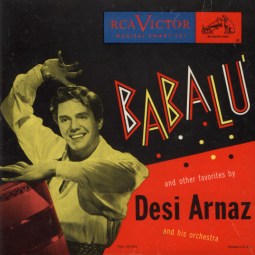 I am drawn to sonic experiences that can help unpack Latinidad and the multicultural roots that are informed by other migrations of Africans, Asians, and Spaniards to the Américas. I am a descendant of these mestizajes, as Gloria Anzaldúa writes in her canonical text Borderlands / La Frontera. A concept like afecto caribeño addresses the social and emotional exchanges that emanate from the complexity of these migrations and how they reveal themselves in momentary connections. When Arnaz performs as “Ricky,” he breaks that character upon playing the congas. Here he does not act as the nightclub owner; the reverberation of the conga mediates an embodiment of his true self exemplifying un afecto caribeño.
—
reina alejandra prado saldivar is an art historian, curator, and adjunct lecturer in the Women, Gender and Sexuality Studies Program and Liberal Studies Department at CSULA and in the Critical Studies Program at CALArts. As a cultural activist, she focused her earlier research on Chicano cultural production and the visual arts. Prado is also a poet and performance artist known for her interactive durational work Take a Piece of my Heart as the character Santa Perversa (www.santaperversa.com) and is currently working on her first solo performance entitled Whipped!
—
Featured Image: Desi Arnaz performing with Diosa Costello, 1948.
—

REWIND!…If you liked this post, you may also dig:
The Sweet Sounds of Havana: Space, Listening, and the Making of Sonic Citizenship – Vincent Andrisani
SO! Amplifies: Shizu Saldamando’s OUROBOROS–J.L. Stoever
SO! Reads: Dolores Inés Casillas’s ¡Sounds of Belonging! – Monica de la Torre
Share this:

SO! Reads: Dolores Inés Casillas’s ¡Sounds of Belonging!

 In Sounds of Belonging: U.S. Spanish-Language Radio and Public Advocacy (NYU Press, 2014), Dolores Inés Casillas turns up the volume on the sonic and the political dynamics of the Latino immigrant experience in the United States. A theoretically rich yet accessible book, Sounds of Belonging jump-starts Spanish-language radio studies, proving that the broader field of radio and sound studies can no longer continue to ignore or silence the importance of Spanish-language radio—from its historical significance for Spanish speaking Latinos to its lucrative place in radio markets today. Spanish-language radio reveals the power of sound in shaping the lived experiences of Latina/o communities, including immigrants and those with deep roots in the United States. Casillas shows how sound acts as a platform through which Latin Americans insert themselves in the U.S. imaginary, despite the nation’s attempts to erase their presence.
Sounds of Belonging provides keen insight into the constant buzz of immigration on the airwaves. Some questions that propel this book: What sonically constitutes the Latina/o experience in the United States? Also, what immigration-related sounds are found on Spanish-language radio airways? Casillas’s emphases shows how little we know of how the Latina/o sounds.
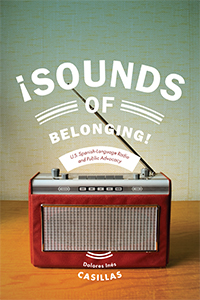 Sounds of Belonging deftly navigates the historical and contemporary domains of Spanish-language radio, theorizing them as a dynamic sonic terrain where we can listen to struggles for and against power, as well as to modalities of difference. Beginning with the traces of Spanish-language radio that emerged early in American radio’s so-called “Golden Age” in the 1930s-1940s, moving through the activist-driven bilingual Chicano community radio of the 1960s and 1970s, and then laying out the landscape of the highly profitable world of Spanish-language broadcasting today, Casillas guides readers through a historical trajectory of Spanish-language radio. She draws from Spanish-language radio broadcasting in its commercial and non-commercial iterations, while keeping tuned to the transnational connections transmitted through these frequencies.
Casillas engages with critical cultural studies, Chicana/Latina studies, and radio/media studies to explore the production of masculinity on El Cucuy’s morning radio program. Casillas studies El Cucuy as both an on-air personality and a political figure advocating for immigrants’  rights, illustrating the “complex interplay of gender, labor, and globalization” (104). While El Cucuy’s “shock-jock” style–imbued with sexual humor–often garners him comparison to Howard Stern or Rush Limbaugh, El Cucuy does more than shock and entertain his listeners. Casillas argues that sound and immigrant listening practices are integral to El Cucuy’s discursive aural constructions of a transnational working-class male audience, one that is not shamed for speaking Spanish, enjoying ranchera music, or laboring in “women’s work.” However, by highlighting how El Cucuy and his listeners reinscribe traditional gender roles that silence and marginalize Latinas, Casillas reveals the complexity of El Cucuy’s political advocacy for male workers on the one hand, and the program’s misogynistic message on the other.
Sounds of Belonging pushes scholars to think more thoroughly about the role format and genre play in the characterization of radio stations, as well as the audience constructed through these programming choices. She characterizes Spanish-language radio as both on-air dialogues and conversations between callers and radio hosts. This approach provides an intersectional analysis comparing radio listeners to those working in production. Casillas opens a line of inquiry into non-normative or non-hegemonic radio practices by positing that Latino radio listening is public and communal and not a solitary practice. Casillas shows how research that frames listeners as a market—simply audiences or consumers—polarizes our understanding of radio practices, particularly within research on Spanish-language radio.
One of Casillas’s most important interventions is her granular analysis of the role of radio in Latino communities, particularly within migrant and working class groups who may have easier access to and familiarity with radio, as opposed to other media such as the Internet. For these communities, radio becomes as an anchor, grounding the cultural ties Latinos have to the communities they migrated from—through stations’ language and music—but it also functions as a way to aurally migrate between borders, specifically when listeners-turned-callers locate themselves bi-nationally.

Casillas also argues that Spanish-language radio is an alternative site of congregation and dialogues amongst communities that are marginalized and made hyper visible by mainstream English-language media. Anti-immigrant policy and legislation—heard and seen in popular media as a narrative of “illegal aliens” invading America—is the backdrop against which Casillas explores the role of Spanish-language radio as an “acoustic ally,” a concept she explores in the chapters “Acoustic Allies: Early Latin-Themed and Spanish-Language Radio Broadcasts, 1920s-1940s,” and “Sounds of Surveillance: U.S. Spanish-Language Radio Patrols La Migra.” She explains that Texas and California were home to the debut of U.S. Spanish-language radio in the 1920s, crafted specifically for Mexican listeners. Radio announcers such as Pedro J. Gonzalez brokered airtime, typically broadcasting during the unfavorable times of late night or early morning. As a method of resistance, radio provided Spanish-language audiences with the capability of listening to “home.”

Images of Pedro J. González, who was also a musician and a founding member of Los Madrugadoras in addition to an important early Spanish language radio announcer
In the chapter “Mixed Signals: Developing Bilingual Chicano Radio, 1960s-1980s,” Casillas uncovers a major gap in research on the aurality of the Chicano Media Movement. She pivots the analytical lens of Chicano movement activism from urban to rural areas and traces the emergence of bilingual community in conjunction with farm worker activism in California and Washington. Bilingual community radio stations such as Radio KDNA in Granger, Washington, KBBF-FM in Santa Rosa, California, and Radio Bilingüe in Fresno, California—places that rely heavily on low-wage farmworker labor—showcase how the political activism of this movement era took place on emergent community airwaves. Listener-focused Chicano community radio stations “sought to broadcast independent of commercial influence, produce local programming, and, perhaps most significant, operate under the full control of Mexicans and Chicanos themselves” (52-53). While under the control of Chicano/a community radio producers, Casillas demonstrates how the funding model for community radio stations—namely, a heavy reliance on grants from the Corporation for Public Broadcasting—underscores the bureaucratic limitations for public broadcasts.
Sounds of Belonging opens the path for a new line of inquiry regarding Spanish-language radio while revealing that there is much work to do in the area of Spanish-language radio studies. Despite the chapter “Mixed Signals”’s focus on the community radio format, Casillas’s dedication to commercial radio highlights an urgent need for scholarship on non-commercial radio. Studying non-commercial stations will advance necessary conversations around content and innovation rather than economic success and failure.

Overall, Sounds of Belonging is an exciting and foundational text for scholars and readers interested in Latina/o media studies, sound, radio, cultural production, immigration and the Latina/o experiences in the United States as experienced and lived through sound and listening. Casillas’s agility in drawing from various theoretical and methodological perspectives provides a rich analysis of Spanish-language radio situated in a transnational context that reflects not just the listenership, but also the continued importance of radio for Latina/o communities living throughout the U.S. borderlands.
—
Monica De La Torre is a doctoral student in the Department of Gender, Women and Sexuality Studies at the University of Washington. Her scholarship bridges New Media and Sound Studies by analyzing the development of Chicana feminist epistemologies in radio and digital media production. A member of Soul Rebel Radio, a community radio collective based in Los Angeles, Monica is specifically interested in the ways in which radio and digital media production function as tools for community engagement. She is an active member of the UW Women of Color Collective and the Women Who Rock Collective. Monica earned a B.A. in Psychology and Chicana/o Studies from University of California, Davis and an M.A.in Chicana/o Studies from California State University, Northridge; her master’s thesis was entitled “Emerging Feminisms: El Teatro de las Chicanas and Chicana Feminist Identity Development.” Monica received a 2012 Ford Foundation Predoctoral Fellowship, which recognizes superior academic achievement, sustained engagement with communities that are underrepresented in the academy, and the potential to enhance the educational opportunities for diverse students.
—
Featured image: “Hi-Fi” by Flickr user Feans CC BY 2.0
—
 REWIND! . . .If you liked this post, you may also dig:
SO! Reads: Daniela Cascella’s F.M.R.L. (Finding Materials for Remembering and Listening) — Kyle D. Stedman
The Sonic Roots of Surveillance: Intimacy, Mobility, and Radio — Kathleen Battles
Sounding Out Podcast #24: The Raitt Street Chronicles: A Survivor’s History — Sharon Sekhon and Manuel “Manny” Escamilla
Share this:


Current Top Posts





April 2021

January 2020

November 2019

October 2019

August 2019

April 2014

November 2017

March 2015

December 2017

October 2015
 Sounding Out!
Recent Comments