
SO! Reads: Dolores Inés Casillas’s ¡Sounds of Belonging!

 In Sounds of Belonging: U.S. Spanish-Language Radio and Public Advocacy (NYU Press, 2014), Dolores Inés Casillas turns up the volume on the sonic and the political dynamics of the Latino immigrant experience in the United States. A theoretically rich yet accessible book, Sounds of Belonging jump-starts Spanish-language radio studies, proving that the broader field of radio and sound studies can no longer continue to ignore or silence the importance of Spanish-language radio—from its historical significance for Spanish speaking Latinos to its lucrative place in radio markets today. Spanish-language radio reveals the power of sound in shaping the lived experiences of Latina/o communities, including immigrants and those with deep roots in the United States. Casillas shows how sound acts as a platform through which Latin Americans insert themselves in the U.S. imaginary, despite the nation’s attempts to erase their presence.
Sounds of Belonging provides keen insight into the constant buzz of immigration on the airwaves. Some questions that propel this book: What sonically constitutes the Latina/o experience in the United States? Also, what immigration-related sounds are found on Spanish-language radio airways? Casillas’s emphases shows how little we know of how the Latina/o sounds.
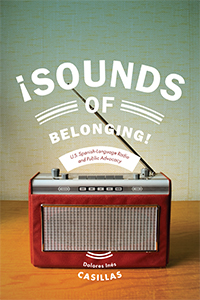 Sounds of Belonging deftly navigates the historical and contemporary domains of Spanish-language radio, theorizing them as a dynamic sonic terrain where we can listen to struggles for and against power, as well as to modalities of difference. Beginning with the traces of Spanish-language radio that emerged early in American radio’s so-called “Golden Age” in the 1930s-1940s, moving through the activist-driven bilingual Chicano community radio of the 1960s and 1970s, and then laying out the landscape of the highly profitable world of Spanish-language broadcasting today, Casillas guides readers through a historical trajectory of Spanish-language radio. She draws from Spanish-language radio broadcasting in its commercial and non-commercial iterations, while keeping tuned to the transnational connections transmitted through these frequencies.
Casillas engages with critical cultural studies, Chicana/Latina studies, and radio/media studies to explore the production of masculinity on El Cucuy’s morning radio program. Casillas studies El Cucuy as both an on-air personality and a political figure advocating for immigrants’  rights, illustrating the “complex interplay of gender, labor, and globalization” (104). While El Cucuy’s “shock-jock” style–imbued with sexual humor–often garners him comparison to Howard Stern or Rush Limbaugh, El Cucuy does more than shock and entertain his listeners. Casillas argues that sound and immigrant listening practices are integral to El Cucuy’s discursive aural constructions of a transnational working-class male audience, one that is not shamed for speaking Spanish, enjoying ranchera music, or laboring in “women’s work.” However, by highlighting how El Cucuy and his listeners reinscribe traditional gender roles that silence and marginalize Latinas, Casillas reveals the complexity of El Cucuy’s political advocacy for male workers on the one hand, and the program’s misogynistic message on the other.
Sounds of Belonging pushes scholars to think more thoroughly about the role format and genre play in the characterization of radio stations, as well as the audience constructed through these programming choices. She characterizes Spanish-language radio as both on-air dialogues and conversations between callers and radio hosts. This approach provides an intersectional analysis comparing radio listeners to those working in production. Casillas opens a line of inquiry into non-normative or non-hegemonic radio practices by positing that Latino radio listening is public and communal and not a solitary practice. Casillas shows how research that frames listeners as a market—simply audiences or consumers—polarizes our understanding of radio practices, particularly within research on Spanish-language radio.
One of Casillas’s most important interventions is her granular analysis of the role of radio in Latino communities, particularly within migrant and working class groups who may have easier access to and familiarity with radio, as opposed to other media such as the Internet. For these communities, radio becomes as an anchor, grounding the cultural ties Latinos have to the communities they migrated from—through stations’ language and music—but it also functions as a way to aurally migrate between borders, specifically when listeners-turned-callers locate themselves bi-nationally.

Casillas also argues that Spanish-language radio is an alternative site of congregation and dialogues amongst communities that are marginalized and made hyper visible by mainstream English-language media. Anti-immigrant policy and legislation—heard and seen in popular media as a narrative of “illegal aliens” invading America—is the backdrop against which Casillas explores the role of Spanish-language radio as an “acoustic ally,” a concept she explores in the chapters “Acoustic Allies: Early Latin-Themed and Spanish-Language Radio Broadcasts, 1920s-1940s,” and “Sounds of Surveillance: U.S. Spanish-Language Radio Patrols La Migra.” She explains that Texas and California were home to the debut of U.S. Spanish-language radio in the 1920s, crafted specifically for Mexican listeners. Radio announcers such as Pedro J. Gonzalez brokered airtime, typically broadcasting during the unfavorable times of late night or early morning. As a method of resistance, radio provided Spanish-language audiences with the capability of listening to “home.”

Images of Pedro J. González, who was also a musician and a founding member of Los Madrugadoras in addition to an important early Spanish language radio announcer
In the chapter “Mixed Signals: Developing Bilingual Chicano Radio, 1960s-1980s,” Casillas uncovers a major gap in research on the aurality of the Chicano Media Movement. She pivots the analytical lens of Chicano movement activism from urban to rural areas and traces the emergence of bilingual community in conjunction with farm worker activism in California and Washington. Bilingual community radio stations such as Radio KDNA in Granger, Washington, KBBF-FM in Santa Rosa, California, and Radio Bilingüe in Fresno, California—places that rely heavily on low-wage farmworker labor—showcase how the political activism of this movement era took place on emergent community airwaves. Listener-focused Chicano community radio stations “sought to broadcast independent of commercial influence, produce local programming, and, perhaps most significant, operate under the full control of Mexicans and Chicanos themselves” (52-53). While under the control of Chicano/a community radio producers, Casillas demonstrates how the funding model for community radio stations—namely, a heavy reliance on grants from the Corporation for Public Broadcasting—underscores the bureaucratic limitations for public broadcasts.
Sounds of Belonging opens the path for a new line of inquiry regarding Spanish-language radio while revealing that there is much work to do in the area of Spanish-language radio studies. Despite the chapter “Mixed Signals”’s focus on the community radio format, Casillas’s dedication to commercial radio highlights an urgent need for scholarship on non-commercial radio. Studying non-commercial stations will advance necessary conversations around content and innovation rather than economic success and failure.

Overall, Sounds of Belonging is an exciting and foundational text for scholars and readers interested in Latina/o media studies, sound, radio, cultural production, immigration and the Latina/o experiences in the United States as experienced and lived through sound and listening. Casillas’s agility in drawing from various theoretical and methodological perspectives provides a rich analysis of Spanish-language radio situated in a transnational context that reflects not just the listenership, but also the continued importance of radio for Latina/o communities living throughout the U.S. borderlands.
—
Monica De La Torre is a doctoral student in the Department of Gender, Women and Sexuality Studies at the University of Washington. Her scholarship bridges New Media and Sound Studies by analyzing the development of Chicana feminist epistemologies in radio and digital media production. A member of Soul Rebel Radio, a community radio collective based in Los Angeles, Monica is specifically interested in the ways in which radio and digital media production function as tools for community engagement. She is an active member of the UW Women of Color Collective and the Women Who Rock Collective. Monica earned a B.A. in Psychology and Chicana/o Studies from University of California, Davis and an M.A.in Chicana/o Studies from California State University, Northridge; her master’s thesis was entitled “Emerging Feminisms: El Teatro de las Chicanas and Chicana Feminist Identity Development.” Monica received a 2012 Ford Foundation Predoctoral Fellowship, which recognizes superior academic achievement, sustained engagement with communities that are underrepresented in the academy, and the potential to enhance the educational opportunities for diverse students.
—
Featured image: “Hi-Fi” by Flickr user Feans CC BY 2.0
—
 REWIND! . . .If you liked this post, you may also dig:
SO! Reads: Daniela Cascella’s F.M.R.L. (Finding Materials for Remembering and Listening) — Kyle D. Stedman
The Sonic Roots of Surveillance: Intimacy, Mobility, and Radio — Kathleen Battles
Sounding Out Podcast #24: The Raitt Street Chronicles: A Survivor’s History — Sharon Sekhon and Manuel “Manny” Escamilla
Share this:

On Whiteness and Sound Studies

 This is the first post in Sounding Out!’s 4th annual July forum on listening in observation of World Listening Day on July 18th, 2015. World Listening Day is a time to think about the impacts we have on our auditory environments and, in turn, their effects on us. For Sounding Out! World Listening Day necessitates discussions of the politics of listening and listening as a political act, beginning this year with Gustavus Stadler’s timely provocation. –Editor-in-Chief JS
—
Many amusing incidents attend the exhibition of the Edison phonograph and graphophone, especially in the South, where a negro can be frightened to death almost by a ‘talking machine.’ Western Electrician May 11, 1889, (255).
What does an ever-nearer, ever-louder police siren sound like in an urban neighborhood, depending on the listener’s racial identity? Rescue or invasion? Impending succor or potential violence? These dichotomies are perhaps overly neat, divorced as they are from context. Nonetheless, contemplating them offers one charged example of how race shapes listening—and hence, some would say, sound itself—in American cities and all over the world. Indeed, in the past year, what Jennifer Stoever calls the “sonic color line” has become newly audible to many white Americans with the attention the #blacklivesmatter movement has drawn to police violence perpetrated routinely against people of color.

“Sheet music ‘Coon Coon Coon’ from 1901” via Wikimedia, public domain
Racialized differences in listening have a history, of course. Consider the early decades of the phonograph, which coincided with the collapse of Reconstruction and the consolidation of Jim Crow laws (with the Supreme Court’s stamp of approval). At first, these historical phenomena might seem wholly discrete. But in fact, white supremacy provided the fuel for many early commercial phonographic recordings, including not only ethnic humor and “coon songs” but a form of “descriptive specialty”—the period name for spoken-word recordings about news events and slices of life—that reenacted the lynchings of black men. These lynching recordings, as I argued in “Never Heard Such a Thing,” an essay published in Social Text five years ago, appear to have been part of the same overall entertainment market as the ones lampooning foreign accents and “negro dialect”; that is, they were all meant to exhibit the wonders of the new sound reproduction to Americans on street corners, at country fairs, and in other public venues.
Thus, experiencing modernity as wondrous, by means of such world-rattling phenomena as the disembodiment of the voice, was an implicitly white experience. In early encounters with the phonograph, black listeners were frequently reminded that the marvels of modernity were not designed for them, and in certain cases were expressly designed to announce this exclusion, as the epigraph to this post makes brutally evident. For those who heard the lynching recordings, this new technology became another site at which they were reminded of the potential price of challenging the racist presumptions that underwrote this modernity. Of course, not all black (or white) listeners heard the same sounds or heard them the same way. But the overarching context coloring these early encounters with the mechanical reproduction of sound was that of deeply entrenched, aggressive, white supremacist racism.

“66 West 12th Street, New School entrance” by Wikimedia user Beyond My Ken, CC BY-SA 4.0
The recent Sonic Shadows symposium at The New School offered me an opportunity to come back to “Never Heard Such a Thing” at a time when the field of sound studies has grown more prominent and coherent—arguably, more of an institutionally recognizable “field” than ever before. In the past three years, at least three major reference/textbook-style publications have appeared containing both “classic” essays and newer writing from the recent flowering of work on sound, all of them formidable and erudite, all of great benefit for those of us who teach classes about sound: The Oxford Handbook of Sound Studies (2012), edited by Karen Bijsterveld and Trevor Pinch; The Sound Studies Reader (2013), edited by Jonathan Sterne; and Keywords in Sound (2015), edited by David Novak and Matt Sakakeeny. From a variety of disciplinary perspectives, these collections bring new heft to the analysis of sound and sound culture.
I’m struck, however, by the relative absence of a certain strain of work in these volumes—an approach that is difficult to characterize but that is probably best approximated by the term “American Studies.” Over the past two decades, this field has emerged as an especially vibrant site for the sustained, nuanced exploration of forms of social difference, race in particular. Some of the most exciting sound-focused work that I know of arising from this general direction includes: Stoever’s trailblazing account of sound’s role in racial formation in the U.S.; Fred Moten’s enormously influential remix of radical black aesthetics, largely focused on music but including broader sonic phenomena like the scream of Frederick Douglass’s Aunt Hester; Bryan Wagner’s work on the role of racial violence in the “coon songs” written and recorded by George W. Johnson, widely considered the first black phonographic artist; Dolores Inés Casillas’s explication of Spanish-language radio’s tactical sonic coding at the Mexican border; Derek Vaillant’s work on racial formation and Chicago radio in the 1920s and 30s. I was surprised to see none of these authors included in any of the new reference works; indeed, with the exception of one reference in The Sound Studies Reader to Moten’s work (in an essay not concerned with race), none is cited. The new(ish) American Studies provided the bedrock of two sound-focused special issues of journals: American Quarterly’s “Sound Clash: Listening to American Studies,” edited by Kara Keeling and Josh Kun, and Social Text’s “The Politics of Recorded Sound,” edited by me. Many of the authors of the essays in these special issues hold expertise in the history and politics of difference, and scholarship on those issues drives their work on sound. None of them, other than Mara Mills, is among the contributors to the new reference works. Aside from Mills’s contributions and a couple of bibliographic nods in the introduction, these journal issues play no role in the analytical work collected in the volumes.

“Blank pages intentionally, end of book” by Wikimedia user Brian 0918, CC BY-SA 3.0
The three new collections address the relationship between sound, listening, and specific forms of social difference to varying degrees. All three of the books contain excerpts from Mara Mills’ excellent work on the centrality of deafness to the development of sound technology. The Sound Studies Reader, in particular, contains a small array of pieces that focus on disability, gender and race; in attending to race, specifically, Sterne shrewdly includes an excerpt from Franz Fanon’s A Dying Colonialism, as well as essays on black music by authors likely unfamiliar to many American readers. The Oxford Handbook’s sole piece addressing race is a contribution on racial authenticity in hip-hop. It’s a strong essay in itself. But appearing in this time and space of field-articulation, its strength is undermined by its isolation, and its distance from any deeper analysis of race’s role in sound than what seems to be, across all three volumes, at best, a liberal politics of representation or “inclusion.” Encountering the three books at once, I found it hard not to hear the implicit message that no sound-related topics other than black music have anything to do with race. At the same time, the mere inclusion of work on black music in these books, without any larger theory of race and sound or wider critical framing, risks reproducing the dubious politics of white Euro-Americans’ long historical fascination with black voices.
What I would like to hear more audibly in our field—what I want all of us to work to make more prominent and more possible—is scholarship that explicitly confronts, and broadcasts, the underlying whiteness of the field, and of the generic terms that provide so much currency in it: terms like “the listener,” “the body,” “the ear,” and so on. This work does exist. I believe it should be aggressively encouraged and pursued by the most influential figures in sound studies, regardless of their disciplinary background. Yes, work in these volumes is useful for this project; Novak and Sakakeeny seem to be making this point in their Keywords introduction when they write:
While many keyword entries productively reference sonic identities linked to socially constructed categories of gender, race, ethnicity, religion, disability, citizenship, and personhood, our project does not explicitly foreground those modalities of social difference. Rather, in curating a conceptual lexicon for a particular field, we have kept sound at the center of analysis, arriving at other points from the terminologies of sound, and not the reverse. (8)
I would agree there are important ways of exploring sound and listening that need to be sharpened in ways that extended discussion of race, gender, class, or sexuality will not help with. But this doesn’t mean that work that doesn’t consider such categories is somehow really about sound in a way that the work does take them up isn’t, any more than a white middle-class person who hears a police siren can really hear what it sounds like while a black person’s perception of the sound is inaccurate because burdened (read: biased) by the weight of history and politics.

“Pointy Rays of Justice” by Flickr user Christopher Sebela, CC BY-NC 2.0
In a recent Twitter conversation with me, the philosopher Robin James made the canny point that whiteness, masquerading as lack of bias, can operate to guarantee the coherence and legibility of a field in formation. James’s trenchant insight reminds me of cultural theorist Kandice Chuh’s recent work on “aboutness” in “It’s Not About Anything,” from Social Text (Winter 2014) and knowledge formation in the contemporary academy. Focus on what the object of analysis in a field is, on what work in a field is about, Chuh argues, is “often conducted as a way of avoiding engagement with ‘difference,’ and especially with racialized difference.”
I would like us to explore alternatives to the assumption that we have to figure out how to talk about sound before we can talk about how race is indelibly shaping how we think about sound; I want more avenues opened, by the most powerful voices in the field, for work acknowledging that our understanding of sound is always conducted, and has always been conducted, from within history, as lived through categories like race.
The cultivation of such openings also requires that we acknowledge the overwhelming whiteness of scholars in the field, especially outside of work on music. If you’re concerned by this situation, and have the opportunity to do editorial work, one way to work to change it is by making a broader range of work in the field more inviting to people who make the stakes of racial politics critical to their scholarship and careers. As I’ve noted, there are people out there doing such work; indeed, Sounding Out! has continually cultivated and hosted it, with far more editorial care and advisement than one generally encounters in blogs (at least in my experience), over the course of its five years. But if the field remains fixated on sound as a category that exists in itself, outside of its perception by specifically marked subjects and bodies within history, no such change is likely to occur. Perhaps we will simply resign ourselves to having two (or more) isolated tracks of sound studies, or perhaps some of us will have to reevaluate whether we’re able to teach what we think is important to teach while working under its rubric.
—
Thanks to Robin James, Julie Beth Napolin, Jennifer Stoever, and David Suisman for their ideas and feedback.
—
Gustavus Stadler teaches English and American Studies at Haverford College. He is the author of Troubling Minds: The Cultural Politics of Genius in the U. S.1840-1890 (U of Minn Press, 2006). His 2010 edited special issue of Social Text on “The Politics of Recorded Sound” was named a finalist for a prize in the category of “General History” by the Association of Recorded Sound Collections. He is the recipient of the 10th Annual Woody Guthrie fellowship! This fellowship will support research for his book-in-progress, Woody Guthrie and the Intimate Life of the Left.
—
REWIND! . . .If you liked this post, you may also dig:
Reading the Politics of Recorded Sound — Jennifer Stoever
Hearing the Tenor of the Vendler/Dove Conversation: Race, Listening, and the “Noise” of Texts — Christina Sharpe
Listening to the Border: “‘2487’: Giving Voice in Diaspora” and the Sound Art of Luz María Sánchez — Dolores Inés Casillas
Share this:


Current Top Posts





April 2021

January 2020

November 2019

October 2019

August 2019

April 2014

November 2017

March 2015

December 2017

October 2015
 Sounding Out!
Recent Comments