What. A. Year. Thank you to all of the amazing thinkers who generously shared their writing with us during rough waters worldwide. During those times when our work feels like we’re screaming underwater, it’s especially important that we’re still out here making waves. A special shout out in gratitude to our readers, who are listening even harder during our 15th year, and rocking the boat along with us into 2025. –JS, Ed-in-Chief
Here, beginning with number 10, are our Top 10 posts released in 2024 (as of 12/19/24)!
What is it? The braids?–Kendrick Lamar, “Euphoria”
After a much-anticipated wait, Kendrick dropped “Euphoria.” It not only stopped Hip Hop culture in its tracks, but it allowed all spectators to realize this was gearing up to be an epic battle. The song starts with the backwards Richard Pryor sample from the iconic film The Wiz. For those unfamiliar, The Wiz is a film adaptation of The Wizard of Oz featuring an all-Black star-studded cast, including Diana Ross and Michael Jackson. Richard Pryor played the role of the Wizard. When the characters realize the Wizard is a fraud, he says, “Everything they say about me is true”; this is the sample Kendrick uses, grounding himself in 1970s Black culture and situating where he plans to go in his writing.
“By now, it’s safe to say very few people have not caught wind of the biggest Hip-Hop battle of the 21st century: the clash between Kendrick Lamar and Drake. Whether you’ve seen the videos, the memes or even smacked a bunch of owls around playing the video game, this battle grew beyond Hip Hop, with various facets of global popular culture tapped in, counting down minutes for responses and getting whiplash with the speed of song drops. There are multiple ways to approach this event. We’ve seen inciteful arguments about how these two young Black males at the pinnacle of success are tearing one another down. We also acknowledge Hip Hop’s long legacy of battling; the culture has always been a ‘competitive sport’ that includes ‘lyrical sparring.'”
“In both sound studies and the sonic arts, the concept of ‘resonance‘ has increasingly played a central role in attuning listeners to the politics of sound. The term itself is borrowed from acoustics, where resonance simply refers to the transfer of energy between two neighboring objects. For example, plucking a note on one guitar string will cause the other strings to vibrate at a similar frequency. When someone or something makes a sound, everything in the immediate environs—objects, people, the room itself—will respond with sympathetic vibrations. Simply put, in acoustics, resonance describes a sonic connection between sounding objects and their environment. In the arts, the concept of resonance emphasizes the situated existence of sound as a transformative encounter between bodies in a particular time and place. Resonance has become a key term to think through how sound creates a listening community, a transitory assemblage whose reverberations may be felt beyond a single moment of encounter.
“Sarah La Morena (Sarah the Black woman), or Sarah Palafox, was adopted and raised by a Mexican family in Mexico. At the age of five, she moved to Riverside, California, a predominantly Mexican city an hour east of Compton. Palafox started singing as a way to express the racism she faced as a child in Southern California, feeling caught between her Black appearance and her Mexican sound. She found her voice in church, a nurturing environment where she could be herself, surrounded by her family’s love. She gained attention with a viral video of her rendition of Jenni Rivera’s “Que Me Vas a Dar.” Palafox delivers each note with profound emotion and precision, leaving even the accompanying mariachi violinist in awe. . .”
“Sometime last year, during a recent deep clean of the apartment, I pulled out a wooden chest that my father built for me when I was ten, a pine-scented time capsule of that period of my life, full of assorted construction-paper projects and faded movie tickets. Buried underneath all this loose paper, set apart by a shiny laminated cover, is the first “novel” I ever wrote, our final project in fourth grade, which was really just a few typed pages folded and stapled together, held between a cardstock cover. In this book, I write about a mall janitor with magic powers, who uses his mop handle to transform villains into piles of fabric, and who time travels throughout history by way of a magic corvette (clearly, I had just seen a certain Robert Zemeckis film).
Having rediscovered this story, I am struck by the realization that my writerly voice has hardly changed. I am still drawn to the same hokey surrealism, the same comic book sensibilities, the same spirit of hand-stapled publishing projects. This is to say: I could not help but to identify in this proto-novel traces of my work to come, early impulses that echo throughout my present practice. As Lisa Robertson puts it in an interview: “Defunct forms resurface after years of latency. New work speaks with old work, as well as with the future.”.”
“I am not a board games person, yet I always seem to find myself surrounded by them. Such was the case one August evening in 2023, during a round of the bird-watching-inspired game, Wingspan. Released in 2019 by Stonemaier Games, designer Elizabeth Hargrave’s creation is credited with a dramatic shift in the board game industry. The game received an unparalleled number of awards, including the prestigious 2019 Kennerspiel des Jahres (Connoisseur Game of the Year), and an unheard of seven categories of the Golden Geek Awards, including Best Board Game of the Year and Best Family Board Game of the Year. In addition to causing shifts in typical board game topic, artistry, and demographic, Wingspan has led many board game fans to engage with the natural world in new ways, even inspiring many to become avid birders.
Following the game’s rise to popularity, developer Marcus Nerger released an app, Wingsongwhich allows players to scan each of the beautifully illustrated cards and play a recording of the associated bird’s song. On the evening in question, the unexpected occurred when I scanned the Spotted Owl (Strix occidentalis) card and received a message that read:
Playback of this birds[sic] song is restricted. . .”
“‘So I have heard The Hum… The rest of what I’m about to tell you is beyond reasoning, and understanding.” Here, in a Reddit post, Michael A. Sweeney prefaces their story of their first encounter with “the hum,” an unexplained phenomenon heard by only a small percentage of listeners around the world. The hum is an ominous sonic event that impacts communities from Australia to India, Scotland to the United States. And as Geoff Leventhall writes in “Low Frequency Noise: What We Know, What We Do Not Know, and What We Would Like to Know,” the hum causes “considerable problems” for people across the globe—such as nausea, headaches, fatigue, and muscle pain—as it continues to be an unsolved “acoustic mystery” (94). . .”
“The announcer’s piercing “lucharaaaaaán” cries from the middle of the ring proclaims the constitutional two-out-of-three-falls rule of lucha libre. But before the famous cry rings out to set the stage for the spectacularized acrobatic combat between costumed warriors, their theatrical entrances set the all-important emotional stakes of the battle. The entrances are loud, campy, interactive exchanges between luchadores and spectators. An entrance song itself cues the luchador’s persona: a cumbia could signal a técnico (a good guy); a heavy metal song more than likely indicates a rudo (a bad guy) typically donning black, death-themed getups. Luchadores saunter into the arena, stopping to pose, high five their fans, and verbally heckle their opponents. The storylines of good versus evil, betrayal and revenge, or humility versus arrogance are some of the more standard plots that motivate spectators to adamantly cheer for the favorite and jeer for the foe.
The sonic exchanges between luchadores’ and spectators before, during, and after the fight positions lucha libre as much more than a sport. And while the term spectators, suggests the privileged act of watching or viewing; here, we expand spectators within lucha libre arena to mean “a call to witness” (á la Chela Sandoval). Put simply, lucha libre is a cultural phenomenon where contemporary cultural, social, and political anxieties are often tapped as fodder for theatrical plots. In the U.S./Mexico’s sister cities of El Paso, Texas and Ciudad Juarez, Chihuahua, the political realities of border enforcement, immigration politics, and racial tensions are loudly heard and placed on display. . .”
“in the context of the rapid rise of big tech in san francisco, california, the perspective of land as perpetually exploitable is ever-present. tech-sponsored development projects are always framed by the city as being motivated by care and consideration for residents, and sometimes as being motivated by environmentalism. in reality, the displacement and destruction that results from projects like these falls primarily on poor people of color, and their homes, gardens, businesses, community spaces, and schools. similarly, large-scale development projects more often than not have devastating impacts on the land – whether it’s the land that’s being built over or the sacrifice zone elsewhere. perhaps the electric cars of san francisco are thought to represent clean energy and a healthy modern city, but the manufacturing of these cars is predicated upon extensive mining and exploitative and extractive labor outside far outside the city’s borders. and these cars drive over flattened creeks and sand dunes turned to asphalt—through gentrified neighborhoods on stolen land of the Ramaytush Ohlone, people who are still alive and fighting for sovereignty on their traditional territory, and who remain stewards of the land.
these disparities are present in the sounds of the bay area. sound, quite literally, does not exist in a vacuum. the presence of sound thus implies the presence of something outside of that sound; in every sound we hear, there is also information about the context that surrounds it. and the sounds that we do hear say something about the value of the sounds that we don’t. however, i want to argue for a soundwalking praxis that does not settle for the sounds that most easily reach the ear, as in the freeway noise or the planes passing above or the white people on the street, but that reaches beyond to listen for the negative sonic space that is always present and creating itself in the spaces between what weperceive as audible. in my understanding, this is a practice of giving life to that which capitalism/white supremacy/colonialism renders dead, a practice of centering the life that is otherwise stepped on, forgotten, discarded, silenced. listening for the ecologies of the dispossessed. for proof of life, insisting. this is a decolonial soundwalk praxis. . .”
Part of this surge in scholarly attention and artistic projects is premised on the idea that sound and sound recordings are important additions to cultural heritage in documenting histories and personal evidence, and yet, they are often viewed as supplementary adjuncts to more physical or visual archival artefacts. This subjugation to the primacy of the visual extends to the arts, humanities, and social sciences, but this is beginning to change as scholars across these fields increasingly argue that sound (with its attendant listening) is an especially critical medium for cultivating different modes of attention, forging affective relations, producing alternative knowledges, revealing hidden narratives, and attuning to neglected pasts.
Two digital sound archival projects created in response to the pandemic, The Pandemic SensoryArchive and#StayHomeSounds, are especially instructive in thinking about sound as a key medium for engaging with the monumental a/effects of the present and as important contributions to cultural history. Like other pandemic digital sound archival projects, these two projects sought to document the present for the future – creating a “past” in real time, based on the underlying assumption that sound – as a material-discursive apparatus – can offer particularly generative possibilities in this context. The methods, scope, and presentation design employed by these two web-based archival platforms generates a sense of intimacy, proximity, andcollectivity in otherwise surreal, secluded, uncertain, detached, and disconnected situations, much like in radio and podcasting though in this case with different infrastructure and interactivity.
In these online, mediated spaces where worlds intensely collide and conflate, and users become flattened out and disembodied, new configurations of intimacy, subjectivities, and world-building emerge through alternative forms of affective archival engagement. This was (and still is) particularly important and complex during COVID-19, which is marked not only by a series of indefinite lockdowns and uneven distribution of intervention measures, but an affective logic whereby life is completely reconfigured and capacities within the world are diminished and redistributed. Part of making mass sound archives usable relies on the medium for circulation, the presentation for users, and what user participation empowers for these living histories, as Fabiola Hanna makes clear. These two projects generate what Hanna identifies as a particular orientation in digital humanities projects through a politics of listening that necessitates an active mode of participation that is not simply one-directional but a two-way engagement.
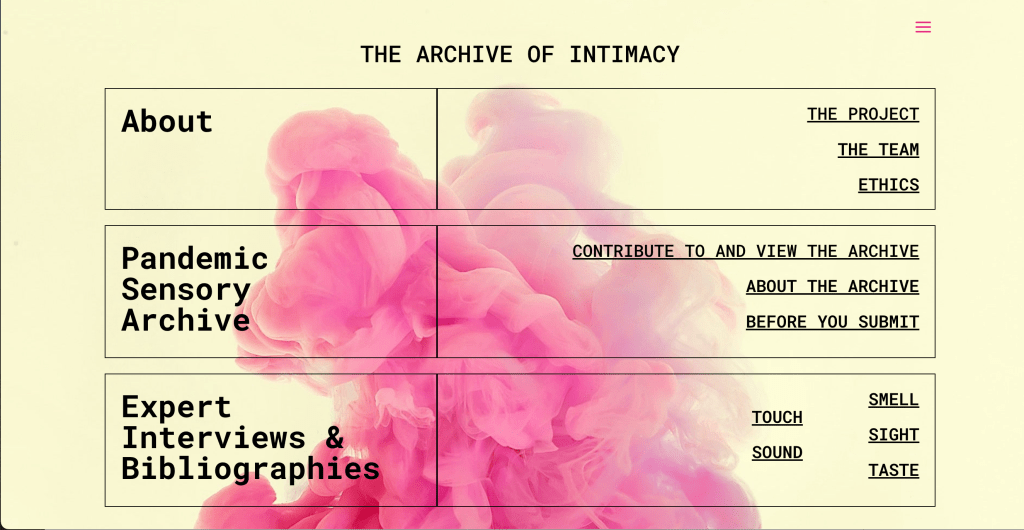
The Archive of Intimacy, later renamed The Pandemic Sensory Archive (PSA), wascreated by professors William Tullett (Associate Professor in Sensory History, Anglia Ruskin University, U.K.) and Hannah McCann (Senior Lecturer in Cultural Studies, University of Melbourne, Australia) with the goal of exploring the senses through a digital platform and to act as an open data bank of contributions from the public. Their open call for contributions asks for a response that considers two questions: What smells, sights, sounds, touch, and/or tastes do you associate with the pandemic? Has your experiences of the senses (smell/sight/hearing/touching/taste) changed at all as a result of the pandemic? Contributors are then asked to drop a pin on the map (though this is not a typical Google Maps rendition of a specific locale, but a sort of simplified graphic representation of sensory input/output waves) and follow the prompts to anonymously submit. The digital map is divided among the five senses and features the entries that contain a title and brief response, such as:
Quiet where there should not be quiet: “Being in my flat in the centre of town on my own with nobody else around on a Saturday. Everything weirdly, eerily, quiet.”
Birdsong: “Hearing birdsong in the garden having not noticed it before, no longer drowned out.”
You’re on mute! “Did the conversation in meetings become less robust as we all sit there on mute, politely waiting for our turn to speak?”
Less sound, more sound: “Blissfully quiet at night as curfew curtails the normal constant traffic roars, far more voices in the early morning and through the day as people‘exercise together’ to socialize in the park”
Complimenting this map, which may seem limited in scope but allows users to engage without having to sift through an overwhelming amount of content, is the Sound category page, where four interviews are embedded with “sensory experts on sound during the Covid-19 pandemic,” including Shoshana Rosenberg, Andrew Mitchell, Martin Stewart, and Stephen Sullivan. One interview considers how the pandemic clarified the immensely relational dimension of artistic sound practice and that the lack of access to intimacy during lockdown instigated a radical reformatting and questioning of what it means, more broadly and now, to be intimate and close in creating sound art. For them, what the pandemic spelled out is that intimacy is fragile and valuable, and that this delicate balance and fluctuating ratio has come to the fore during this time.
The initial designation for the platform, “the archive of intimacy,” is worth meditating on to consider the particular forms of intimacy in this context, perhaps through Lauren Berlant’s “intimate publics” – a concept that captures the affective and collective dimensions of intimacy among strangers. The notion lends itself to understanding the mediated social intimacy in these spaces and the different affective experiences they invite in varying capacities through sound.The connection between imagined publics and community through sound has, of course, been conceptualized by scholars who do historical work on radio and podcast studies, but it can also be extended to these digital, affective, pandemic sound archives. Evidenced in the submission prompts and interview data, the emphasis on the distinct shifts and palpable changes resulting from this new situation, and its accompanying affective logic, can be read as a strategy for cultivating intimacy and connection because attending to these changes may render their intensities as less alarming.
“Listening” by Flickr User Silvia Siri, April 4, 2020CC BY-NC 2.0 DEED
Through the descriptions and dialogues of these new affective environments grounded in sound, some users might feel a sense of camaraderie, connection, and affinity to these novel experiences and how it relates or compares to one’s own (or the sense of not being so alone), especially in the personalized, diaristic, idiosyncratic tone in the short text extracts and longer interview forms. According to Tizian Zumthurm and Stefan Krebs (2022), digital spaces enable this type of “self-affirmation: by contributing and following the contributions of others, users are assured that they are not alone in whatever they experienced” (492). They also point out that as a result crowdsourced archives, particularly related to traumatic events, have a curative function.
Although the PSA may not be what likely comes to mind when thinking about a digital sound archive, presumably composed exclusively of musical or field recordings, it provides an entry point into a confluence of concerns to grapple with some of the key questions and issues related to sound, intimacy, and affect during the pandemic. In particular, diversity in form – between short excerpts and lengthier conversations, creates different engagement options for users based on preference and capacity (quick snapshots of the sonic changes in daily life or deeper explorations concerning sonic worlds), and across sensory inputs. Moreover, interviews add an oral history aspect to the project, which some scholars argue is more empowering and intimate than other modes of telling or sharing history. As a historically feminist practice, oral history has the potential to expose ignored topics and present diversified perspectives on traumatic pasts (like the 1918 pandemic) which is also especially important considering the research areas and professional backgrounds among the interview experts.
#StayHomeSounds is part of a larger project led by UK-based sound artist Stuart Fowkes, who created Cities and Memories in 2014, which Milena Droumeva describes as a “one-of-a-kind sonic portal dedicated to the exploration of place, sound and memory” (147). The website boasts being the largest sound project in the world with over 5000 sound recordings from over 1000 different contributors across 100 territories worldwide. It encompasses field recordings, sound art, and sound mapping, and each location features two sounds: the original field recording of that place and a reimagined sound that presents that place and time as somewhere, something else. The listener can explore sites through their actual sounds or the reimagined versions, flipping between the two different sound worlds. #StayHomeSounds is one of the latest ongoing sub-projects on the site and it is a collection of recordings during the pandemic from all over the world mostly done using cell phone recordings.
Bari lockdown sound recorded by Roberto Lippolis.
Although there is a wide range of quality and content, #StayHomeSounds offers a glimpse into the everyday sonic realities of quarantine life that cut across geography, life, and circumstances. The immensely mundane soundscapes and sheer multitude of recordings across cities and regions allows us to listen comparatively and try to notice the striking sonic cultures of different places even in lockdown. Those submitting sounds are required to provide a reflective text, and an elective representative image, to accompany their recording which details the changes in the soundscape as well as any a/effects that change has produced on other aspects of life.
An entry from Vancouver reads “Their chorus runs day and night and is a most pleasant soundtrack to both fall asleep with and wake up to. In this clip the background birds have joined in to add their avian melody to the amphibian bass line.”
Another from the Greek island of Crete, “after a heavy rain last night, the chirping of the birds woke me up this morning. It was such a powerful sound, like waking up from a sweet dream or a bad nightmare. I think that due to quarantine measures the nature’s sounds are more clear than even before.”
Athens, Greece lockdown sound recorded by Stamatis Mitrou.
In New Orleans, “I’m thankful for my quiet spot out here on the edges of town, but I worry about how the city can recover and for all those sick, out of work, or unable to stay home.”
New Orleans lockdown sounds recorded by Elizabeth Joan Kelly.
The objectives of the project, as described by Fowkes in the online text, are largely affective or affectively oriented, that is, to establish a sense of connection in the present, “how it feels at this unique moment,” by being able to discover new relations to place, to others, and to our sentient selves, through these sonic recordings and texts. In an interview with the Thomson Reuters Foundation, Fowkes said, “(You can) see what other people are hearing around the world and also read their stories and see that actually people are feeling similarly… hopefully that helps to make us feel a little bit more connected.” The breadth of contributions in terms of different locations and number of entries helps build this sense of connection, increasing the possibility of similar experiences to be seen and heard.
Lockdown sound from Lagos, Nigeria recorded by Ibukun Sunday.
By attending to personal struggles, observations, and speculations in relation to sound, these two digital sound archival projects gesture towards the intersections of intimacy, memory, and world-building, and alleviate and mediate some of the dominant and pervading affects that marked lockdown and remote life. In undertaking this project, I found pleasure in the informality of the responses and both the fresh insights and shared resonances, creating an experience that was jointly intimate (feeling seen and validated) and expansive (an opening to alternative experiences). In cultivating openness and a space for difference, and making the reflections and recordings publicly available, so that we can listen together but apart, the projects cultivate new forms of intimacy, empathy, collectivity, and nostalgia.
Dhaka, Bangladesh lockdown sound recorded by youKnowWho.
But, of course, the potential affective experience with the entries and recordings is not a given, much like with any critical scholarly intervention or artwork that attempts to raise awareness (in this case, to both the grave and minute effects of the pandemic) and resist dominant narratives (that the pandemic is under-control, over, or effects only one’s respiratory system), there is no guarantee that the intended experience will transpire in every engagement, but the possibility to do so – to cultivate intimacy and world-building at a time of profound uncertainty and physical distance – is nonetheless still valuable. Much like the diversity in responses, undoubtedly there are varying degrees and types of resonances, perceptions, and impacts within each visit.
Using an open access, crowdsourced approach, the PSA and #soundsathome construct participatory, community archives, creating and remediating documents and recordings for collective access and engagement on behalf of a global community that underwent monumental change, disruption, and loss. Calling explicit attention to palpable sensory shifts and disruptions is a central way to track, record, and make sense of the immense changes in this historical moment, and to illuminate the inequalities in environments and experiences that have been exacerbated by the (lack of) responses by governments and policy. The very existence of these projects and their participation through listening marks a resistance to the discourses of a “return to normalcy” or that we are on the other end of the pandemic. Because affects live in the body and are not often considered as objects of knowledge, the ongoing presence, use, and discussion of these two projects amplifies the a/effects, and a resistance to the affective logic of the pandemic, that they seek to produce. By considering COVID as an unprecedented, deeply affective, traumatic event, these online spaces operate to archive this moment in time and its myriad sonic dimensions, bringing these affective worlds into dialogue through an intimate exchange and assemblage between different bodies, experiences, and locations.
—
Emily Collins is an interdisciplinary researcher, writer, educator, and PhD Candidate in Cinema and Media Studies at York University in Tkaronto (Toronto) whose work draws on sound studies, feminist theory, critical disability studies, and cultural theory to examine sonic social relations and materiality through entanglements of resistance and care within contemporary artworks and creative practices. As a cultural worker and active member in the arts community, Emily has worked at diverse film, visual arts, and digital media organizations, institutions, and research networks within Canada and abroad, including Archive/Counter-Archive, PUBLIC Journal, VUCAVU, Festival Scope (Paris), the Toronto International Film Festival, and the Walter Phillips Gallery at Banff Centre for Arts and Creativity.
—
REWIND! . . .If you liked this post, you may also dig:

















 Sounding Out!
Recent Comments