
Of Resilience and Men: How Bieber, Skrillex, and Diplo Play with Gender in “Where Are Ü Now”

Justin Bieber caught me off guard last year. There I was, minding my own business, listening to a pop station, and this breathy little thing, this delicate vocal wrapped in a halo of shimmering effects starts piping through my car. I didn’t even realize it was him at first; it had been so long since I’d heard a new Bieber song. And I had no clue the production was from Skrillex and Diplo (from their 2015 Skrillex and Diplo Present Jack Ü), which is why I was probably also not ready for the drop, that moment when the song’s tension releases and I’m suddenly gliding across a syncopated bass synth while Bieber’s vocals are pinched into a dolphin call. Somehow, two of the most notoriously unsubtle producers and the posterboy for “too much, too soon” had snuck up on me with “Where Are Ü Now” (WAÜN).
 WAÜN’s drop from nowhere isn’t brand new. Subtle soars and understated drops are officially A Thing. More importantly, they do work beyond the sonic aesthetic. In this case, I want to listen to WAÜN in the context of Bieber’s performance of gender, specifically with an ear toward the way Skrillex and Diplo mix elements from dancepop’s 2015 toolkit to produce a track that plays on feminine tropes, which articulate a kind of masculinity. Listening to WAÜN alongside Robin James’s Resilience & Melancholy (2015) amplifies the male privilege at play in WAÜN. James calls attention to the way drops can sonify feminine resilience, and WAÜN’s surprise drop toys with that resilience in a thoroughly heteromasculine way. I’ll first set up how drops usually work, then read James in the context of Bieber’s gender performance as heard in WAÜN.
Drops, at their most basic, are climactic moments when a song’s full instrumental measure hits (hence “drop”), often after some key elements of the instrumental have been removed so that the climax can sound more intense. At that broad level, any genre can employ a drop of some sort. EDM and dancepop drops—the kind that most directly inform the music of Skrillex, Diplo, and Bieber—are bass-heavy and typically follow a soar that intensifies volume, texture, rhythm, and/or pitch: you soar to a sonic plateau or a cliff, and with a “YEEEEEES!!!!!” coast on some wobbly goodness to the next verse.
The pre-chorus soar in the Messengers/Sir Nolan/Kuk Harrell-produced “All Around the World” from Bieber’s 2012 Believe is a solid example. In the video below, the soar starts at 0:45, the chorus enters at 1:00, and the drop lands at 1:15. It’s textbook: the instrumental is stripped back and filtered, and in the opening moments, we hear a descending bass glide. A filter does what its name suggests–it filters out a prescribed set of frequencies so that we only hear a certain range, and in this case it’s the low end that comes through. The effect makes the synths sound like they’re pulsating through water, and the higher frequency overtones take on a shimmery quality. Over the course of the 8-measure soar, the higher frequency range is brought into earshot, and then, on the second half of the eighth measure…nothing. This nothingness is integral to James’s central argument in Resilience & Melancholy: nothingness intensifies what follows. In these eight measures, we’ve glided down to the low end only to soar up up up until all that’s left is Bieber’s voice, confident, nasally, with just a touch of autotune as he sings the titular line that will take us to the chorus. That chorus bangs harder because of the soar to oblivion before it.
WAÜN’s drop lands at 1:09. For full context, start from the beginning and listen for the soar. (If you also need to stare dreamily into Bieber’s eyes, then by all means.)
There’s not really a soar there. No intensifying volume, texture, rhythm, pitch. The not-soar (starting at 0:48) is even a weird length, clocking in at 12 measures after an 8-measure intro and 16-measure verse have established a multiples-of-8 structural rhythm; even if we were expecting a drop, it comes four measures early. The clearest sign we get that a drop is imminent is that moment where the instrumental reduces to a quiet hiss for two measures as Bieber sings “Where are you now?” That hiss is the structural equivalent of the nothingness we hear just before “All Around the World”’s chorus, and with no traditional soar before it, we have just enough time to think “Oh shit, are they gonna….?” before we’re off, clutching tight to Justin Bieber as we ride a dolphin through the more tender parts of Skrillex’s and Diplo’s musical oceans.
Until that nothingness, this could just as easily be one of those heartfelt Bieber tunes where he reaches to the high end of his range for a chorus full of feels. That Bieber? He’s incredibly self-assured, bearing his soul because he’s certain you’ll love him. The bait-and-switch of WAÜN’s soarless drop highlights Bieber’s insecurity in this song—he’s just dolphin calls and “Where are you now”s—by creating expectations for a different persona.
So what we have here is an atypical drop, a drop that calls attention to itself by behaving differently than we expect it to, a drop that’s a study in understatement–all courtesy of three of dancepop’s resident maximalists.

“143 Diplo and Skrillex at Burning Man 2014 Opulent Temple” by Flickr user Duncan Rawlinson, CC BY-NC 2.0
Atypical soars and drops aren’t new, as producers will always toy with musical conventions as a way to disrupt expectations. Skrillex’s own “Scary Monsters and Nice Sprites” (2010) includes a pre-drop that doesn’t soar at all. In 2015, two big acts in the dance scene, Disclosure and The Chemical Brothers, released singles that don’t soar right, either. Disclosure, whose big 2013 hit “Latch” soared rather traditionally into Sam Smith’s chorus, is coyer on “Bang That” and “Jaded.” “Bang That” includes three separate 8-measure phrases (at 0:30, 0:45, and 1:01, respectively, in the linked video) that never take off, finally settling into a descending bass line (starting at 1:09) that just repeats a rhythmic motif, running out the clock on the final four measures before the chorus. “Jaded,” at the other end of the spectrum, includes only a 4-measure pre-chorus (1:18-1:27) that seems to be sweeping upward like a traditional soar, then roller coasters down and back up over the final two measures. The instability of this soar/not-soar is punctuated with an additional eighth note tacked onto the end of the fourth measure, throwing the chorus off-kilter. The Chemical Brothers employ a similar roller coaster sweep in “Sometimes I Feel So Deserted” that marks out an even eight measures (0:58-1:13) without either intensifying rhythmically or pushing to a pitch ceiling at the drop.
These soars and drops stand out precisely because, like WAÜN’s, they aren’t the norm. To help theorize WAÜN’s not-soar, I want to think with Robin James, whose Resilience & Melancholy hears soars and drops in the context of contemporary race and gender politics. James situates soars and drops as the sonic equivalent of resilience–a performance of feminine overcoming that ultimately only strengthens the white supremacist capitalist patriarchy that inflicts the damage that is being surmounted. In other words, women can only attempt to overcome through the damage that white supremacist capitalist patriarchy inflicts upon them. Sonically, the soar is an accrual of damage that is spectacularly (and profitably) overcome in the drop, the music that resiliently endures on the other side of nothingness. Melancholy, on the other hand, is failed resilience, a handling of damage that does not directly profit white supremacist patriarchy and that could sound any number of ways, including like a non-traditional soar. While admittedly these soars and drops aren’t always about gender politics, R&M opens space for us to think about gender and soars/drops together.
I don’t think WAÜN’s non-soar/drop is resilient or melancholic, but I do think it’s helpful to think of it as being about resilience and melancholy. This is where Bieber’s performance of masculinity comes into play. From his earliest poofy-headed, babyfaced performances, Biebs has done a modified bro thing: his heart’s on his sleeve, but mostly as a strategy for sexual conquest. “All Around the World,” again, is exemplary. In the lyrics, Bieber uses his worldly experiences to woo a potential lover, who he also negs, keeping himself in a position of power as someone who knows more, has seen more, and is willing to accept this woman despite her obvious flaws.

“143 Diplo and Skrillex at Burning Man 2014 Opulent Temple” by Flickr user Duncan Rawlinson, CC BY-NC 2.0
In WAÜN, though, I hear his performance of masculinity complicated further, as he tries out a number of more feminized tropes all at once. Lyrically, Bieber is the scorned lover who claims to have done all the care work in his relationship. Visually, he’s the pop icon whose body is ogled, scrutinized, and marked. Vocally, he receives the pitch-shift treatment that has most recently been associated with DJ Snake’s production of diva vocals (think “You Know You Like It” and “Lean On”). He also sings in a breathy style that James has elsewhere noted mimics Ellie Goulding’s vocals. Musically, Skrillex and Diplo give him the soar/drop construction to undergird his pain, a musical technique that most often signifies feminine resilience.
What bubbles up is a heteromasculine play on resilience and melancholy. Skrillex and Diplo liquidate the soar until all that’s left is a nothing-hiss before the drop. In the context of the other feminized tropes Bieber is messing with in WAÜN, this failed soar could feel melancholic, a refusal to spectacularly overcome. Overcome what, though? Bieber gets to sound resilient or melancholic without ever experiencing damage. That’s his male privilege. James points out that one of the most violent outcomes of resilience discourse is the re-enforcement of damage. If resilience is the way women become legible and profitable, then the damage inflicted by ablist white cisheteropatriarchy becomes a necessity, something that must be endured to gain access to power and resources. This is the lynchpin of James’s critique: resilience is a harmful discourse because it ultimately benefits the system it purports to overcome. Melancholy turns resilience logic on its head by refusing to treat damage as something an individual is responsible for overcoming. WAÜN, though, erases damage altogether in its initial drop. WAÜN’s feminized tropes ultimately highlight instead of unsettle Bieber’s performance of hetero-masculinity: what’s more man-ly than accessing power and resources without the threat of institutional violence?
Importantly, these feminized tropes don’t undermine Bieber’s heteromasculine performance; rather, they only seem to add nuance to the slightly bro-ier [that’s a word] Bieber performance we’ve become accustomed to. That’s what I mean when I say WAÜN is about resilience and melancholy; Skrillex and Diplo use the markers of queer or feminine overcoming and failed overcoming to re-construct Bieber’s masculinity, to toss some more ingredients into his manly mix, and the not-soar is a big component of that. Skrillex and Diplo tap into this soar experimentation, then drop it into the middle of a slightly more gender-fluid Bieber.

Screenshot from “Where Are Ü Now” official video
WAÜN’s high water mark is a few months behind us at this point, but Bieber remains hotter than ever, with “What Do You Mean?,” “Sorry” (another Skrillex production credit), and “Love Yourself” still dominating US and UK charts. Several more singles from Purpose (including two more Skrillex collaborations) are poised to do the same in 2016. Each of these singles extends some of the same tropes Bieber, Skrillex, and Diplo explore in WAÜN—breathy vocals, misunderstood and mistreated pop icon, resilience and contrition and care in the face of a failed relationship—and I hear WAÜN’s initial drop as the sonic moment that preps Bieber’s return to the pop charts. He wades back into the mainstream with a more complex performance of heteromasculinity and reaps the profits that come with it.
—
Justin D Burton is Assistant Professor of Music at Rider University, and a regular writer at Sounding Out!. His research revolves around critical race and gender theory in hip hop and pop, and his current book project is called Posthuman Pop. He is co-editor with Ali Colleen Neff of the Journal of Popular Music Studies 27:4, “Sounding Global Southernness,” and with Jason Lee Oakes of the Oxford Handbook of Hip Hop Music Studies (2017). You can catch him at justindburton.com and on Twitter @justindburton. His favorite rapper is Right Said Fred.
—
 REWIND!…If you liked this post, you may also dig:
Vocal Gender and the Gendered Soundscape: At the Intersection of Gender Studies and Sound Studies — Christine Ehrick
They Do Not All Sound Alike: Sampling Kathleen Cleaver, Assata Shakur, and Angela Davis — Tara Betts
Tomahawk Chopped and Screwed: The Indeterminacy of Listening–Justin Burton
Share this:

The Hell, the High Water, and the Funk of It All: Sounding Power in Scandal
Editor’s Note: Here’s installment #3 of Sounding Out!‘s blog forum on gender and voice! Last week I talked about what it meant to have people call me, a woman of color, “loud.” The week before that we hosted Christine Ehrick‘s selections from her forthcoming book; she introduced us to the idea of the gendered soundscape, which she uses in her analysis on women’s radio speech from the 1930s to the 1950s. In the next few weeks we’ll have A.O. Roberts with synthesized voices and gender, Art Blake with his reflections on how his experience shifting his voice from feminine to masculine as a transgender man intersects with his work on John Cage, and lastly Robin James with an analysis of how ideas of what women should sound like have roots in Greek philosophy.
This week regular writer Regina Bradley puts the soundtrack of Scandal in conversation with the agency of the show’s protagonist, a black woman in manages crises for a living. So, lean in and close your eyes, but keep your ears open for any spies creeping in. –Liana M. Silva, Managing Editor
–––
9:00 pm (Eastern). The quick shutter of an invisible camera calls the attention of the viewers to Scandal. The clicking re-emphasizes the show’s title, bringing to mind paparazzi and their capturing of scandalous behavior. The shuttering also signifies the literal and sonic fast paced timing of Shonda Rhimes’ most popular ABC prime time show: quickened plots, fast talks, and blink-and-you’ll-miss-something-important visual details. Scandal’s central character, Washington D.C. crisis manager Olivia Pope (portrayed by Kerry Washington), is known mostly for her sharp professional outfits and no-nonsense approach to work. In Olivia, Rhimes has created a black female character that is perfectly flawed, a symbol of both the potential power and victimization of black women. Olivia Pope is neither just the savior nor is she solely a victim.
 Scandal evokes intense debate about race and power because of its visual politics, but rarely is Scandal’s scoring prominent in those discussions. The soundtrack acts as an indicator of contemporary black women’s agency in popular culture. As both Rhimes and Scandal music director Alexandra Patsavas reveal, Scandal’s ‘vintage’ soundtrack is an opportunity to buoy the plot and add a unique alternative perspective to the action taking place on the show. The soundtrack’s nods to yesteryear artists – including Stevie Wonder, The Ohio Players, The O’Jays, Sam Cooke, Earth, Wind, and Fire, and Nina Simone sonically narrate additional layers of agency and identity on the show. Are these tracks giving Olivia a voice? What does Scandal’s scoring suggest about race, place, and power scripts for black women in contemporary popular culture?

“Inauguration Day – White House” by Flickr user Justin Brown, CC BY-NC-SA 2.0
Scandal takes place in Washington D.C., a location full of physical and sonic significance in national lore and the black popular imagination. In a national narrative D.C. is the epicenter of political agency, power, and the visibility of whiteness as a form of power. It is America’s city. Yet D.C. in the black imagination is the Chocolate City, a space that serves as a living archive of black folks’ attempts to intervene into a national narrative that would rather overlook the contributions of black bodies and culture. Washington, D.C. is the home of the Moorland-Springarn Research Center and multiple black cultural archives, Howard University and its place as the black mecca of Black Greek Letter Organizations, GoGo Music, and (embattled) social-political policies and endeavors for black people. It is a site of black identity that goes much farther than the place where everyone saw how a certain somebody had an American Dream. On the other hand, the increasing gentrification of the city raises questions of whether or not the nickname “Chocolate City” is applicable.Thus, Washington, D.C. exists at the crux of the romanticization of Americanness as a form of worldly power and the reality that (white) Americanness does not include all Americans.
 Yet Washington D.C. as a site of complex and rich black experiences does not alone buoy Scandal’s use of Washington, D.C. as a site where a black woman “handles” the hustle and bustle of American power and its upheaval. This type of work takes place in the scoring, particularly because the show is not culturally recognizable as a “black show.” Its inherent blackness is sonic, using black music to revisit tropes of power and racial politics.
One possible and albeit slightly heavy handed approach for thinking through Scandal’s leaning on funk and soul music is to point out how the show uses black cultural forms to invoke power. For example, soul songs like Otis Redding’s “Mr. Pitiful,” Edwin Starr’s “War,” and Sly and the Family Stone’s “Everyday People” are not only used to accentuate the action in a scene but the possibility of Olivia as a power figure. The use of black men’s voices as they yell, scream, and moan sonically allude to power as a masculine concept. Yet Olivia’s connection to these songs signifies her potential to wield power in unorthodox ways not associated with black women. For example, the crescendo of music before Olivia delivers a demand to her team sets up her agency as a political figure. Her blackness is amplified and earmarked by the music. This pairing amplifies the question of race and power in a useful way. The dominantly black musical script offers the critique and engagement with Olivia Pope’s blackness that many viewers and critics complain are lacking. (See the brilliant synopsis presented by Dr. Jessica Marie Johnson about Shonda Rhimes’ portrayal of black women and popular culture that took place at Duke University last month.)
Scandal serves vintage musical scoring as a double entendre: the sound of black music from previous eras evokes ‘vintage’ scripts of race, gender, and power from that era that seep into this present moment. Scandal’s use of soul, funk, and disco sonically allude to larger questions lingering from the Civil Rights Movement: integration as an equalizer of power and privilege, the hypermasculinity of the Civil Rights Era, its cultural producers, and the immediate aftermath of these scripts on (black) American society in the late 1960s and 1970s. We frequently annotate black agency through the men creating (singing?) the music. This is equally true for the black cultural productions of the era, as they aesthetically supplemented the understanding that black folks mattering connected to the uplift and healthy presence of black men. Even with soul and funk music, which stand as antithetical responses to the problematic expectations of classist respectability politics, black women’s agency was associated with the sexual, emotional, or physical agency of black men.
The blackness and “maleness” of the funk and soul used in Scandal’s score subverts the power that Olivia Pope exerts in her dealings with her clients, her lovers, and team. For example, in season two Olivia and President Fitz’s sex tape is threatened to be leaked to the public. It is important to note that the tape is an audio tape, suggestively alluding the absence of physical and visual rhetoric to address the interracial relationship. As Olivia gives the word to leak the sex tape, The Ohio Players’ track “Love Rollercoaster” begins to play. It sonically stabilizes Olivia’s decision to “leak” her sexuality as a power move while also leaving room to question the deeper implications of how the viewer navigates her blackness and womanhood using physical, aural, and cultural markers of sexuality. Using male funk and soul artists allows Pope to ‘codeswitch’ between cultural scripts of power as masculine and womanhood as opposite power. It amplifies her authority and agency while signifying that her physical appearance and voice may not have the ability to confer her worth to the audience.
This tug-and-pull of power and agency is most amplified in Olivia Pope’s dealings with her father Rowan Pope, played by Joe Morton (who plays the HELL out of this role, by the way). Rowan Pope is a literal and figurative double agent: He is Elijah Pope, a curator of antiquities at the Smithsonian, and Rowan Pope, head of the top secret and lethal U.S. organization called B613. His fragmented life speaks to the constant negotiation of “safe” black masculinity. He also embodies the anxieties about black men as violent and bloodthirsty. Rowan/Elijah encapsulates all of the swagger and vitriol associated with conceptualizations of black power and black men from the Black Liberation Era. He is cold and calculating, and he complicates the rhetoric of racial uplift and expected from the Civil Rights/Black Power movements. He speaks in hardened, hushed tones with conviction, while snarling his words with spite for white authority. Not to mention, his is the character that brings up race overtly in the show.
This balance between hushed tones and snarled words comes through in Rowan’s early interaction with Olivia during Scandal’s season three premiere. Olivia, on the run because her name is leaked as the President’s mistress, is recovered by her father and told to flee the country. Rowan is not a doting and concerned father in this scene. Rather, he is disappointed by her lack of prowess and failure to aspire to higher forms of power and authority than “first lady.” Rowan recognizes there is no power in being the wife of the President, especially as a black woman, and he criticizes her for not following the first rule of black folks’ survival: “You need to be twice as good to get half of what they have.” “They” is a collective noun for white folks, often spoken behind closed doors as a means to inspire young black folks to do better. Rowan demands she state out loud what they need to be twice of. Olivia’s voice cracks and is breathless as she whispers “twice as good to get half of what they have.” Rowan exaggerates a “yes” and dismisses Olivia as “mediocre.” It is a painful and powerful scene where multiple dichotomies take place: a father scolding his daughter, a black man undermining black women’s agency, and the fear/anxiety about black women’s sexuality as a sign of weakness and lacking privilege. The wavering volume of Olivia’s voice signifies her quickly plummeting ability to voice her power. Olivia’s loss of words amplifies Rowans’ own authority, embodied in his voice when he adamantly declares “I am the hell and the high water!” No soundtrack can save her here.
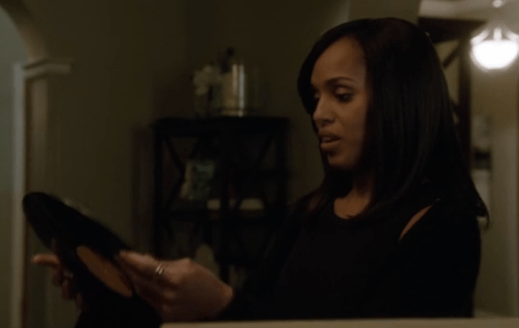
However, Rowan does have human moments, reaching out to his estranged daughter Olivia with wine and music, specifically Stevie Wonder. Her record collection is filled with Stevie Wonder. It is important that she has a record collection instead of a collection of CDs or playlist. Not only does this detail speak to the trope of “vintage” that runs through the show but also gives credence to how Olivia establishes her power. Her major moments are annotated by Stevie Wonder: when her name is leaked “Higher Ground” plays in the background. When she is kidnapped at the end of the episode for past December’s Winter finale “Don’t You Worry Bout a Thing” takes center stage. Again, the sounds of a man, her father in this instance, are the soundtrack to her work. The choice of music subverts the gender balance of power. Through male artists, the show gives Olivia her authority.
The most prominent sonic signifier is the instrumental accompaniment from the artist The Album Leaf titled “The Light.” Also known as Olivia and President Fitz’s “song,” the track plays each time the two characters interact and share intimacy (physical and otherwise).
Notes from what sounds like an electric piano playing a scale are short and sweet to the ear. The track lends its innocence and vulnerability to Olivia and Fitz’s affair and offers a possibility that their love for each other can be read as star-crossed instead of in bad taste.
Scott Poulson-Bryant offered an intriguing read on his Facebook page on “The Light” as an allusion to the Civil Rights’ theme song “We Shall Overcome.” This reading of “The Light” as the context to Olivia and Fitz’s relationship makes room to complicate how Olivia’s agency as a black woman is historically and politically bound to women before–she alludes to her similarity to Sally Hemmings in one episode. Olivia’s Sally Hemmings reference uses Hemmings as the genesis point for understanding the complexity of Olivia’s sexual encounters as well as how to navigate black women’s sexual agency – and pleasure – in popular spaces. Sally Hemmings’ relationship to President Thomas Jefferson lends historical credence to Olivia and Fitz’s Scandal but also signifies the gray area of historical memory, cultural expectations, and consent as a form of power for African American women. “The Light” instrumental is not only a sonic accompaniment of Olivia as she relates to Fitz but her own struggles to recognize and balance her public and personal agency.
The soundtrack of Scandal gives a voice to not just Olivia’s authority in a place where race and power are intertwined but also a voice on national television to how whiteness and political power operate. Scandal’s controversial protagonist/anti-hero Olivia Pope is often central to recent discussions of race, gender, and popular culture. But the soundtrack to the show asks viewers to not just watch closely but also listen closely. Tune out and you might miss something.
—
Regina Bradley recently completed her PhD at Florida State University in African American Literature. Her dissertation is titled “Race to Post: White Hegemonic Capitalism and Black Empowerment in 21st Century Black Popular Culture and Literature.” She is a regular writer for Sounding Out!
—
REWIND!…If you liked this post, you may also dig:
SO! Reads: Shana Redmond’s Anthem: Social Movements and the Sound of Solidarity in the African Diaspora—Ashon Crawley
Freedom Back: Sounding Black Feminist History, Courtesy the Artists–Tavia Nyong’o
They Do Not All Sound Alike: Sampling Kathleen Cleaver, Assata Shakur, and Angela Davis—Tara Betts
Share this:


Current Top Posts





April 2021

January 2020

November 2019

October 2019

August 2019

April 2014

November 2017

March 2015

December 2017

October 2015
 Sounding Out!
Recent Comments