
“Sensing Voice”*
*a longer version of this piece is forthcoming in Senses & Society 6 (2), July 2011.

Bathroom Recital 2007
In 2007, I received an invitation to a recital that would take place in my bathroom; the artist offered to present an underwater concert in my tub. My reaction? “Crazy,” I thought. “Why go to the trouble of singing in an element so far from ideal?” After a year of mulling it over, though, I finally realized that what I had dismissed for its hopeless impracticality might—precisely because it was impractical—offer fresh perspectives on singing and listening by resituating these familiar activities in vastly unfamiliar territory.
The underwater singing practiced by contemporary American soprano and performance artist Juliana Snapper challenges audiences to confront their unexamined assumptions about the relationships between the voice and materiality, the sensed and the singular. How do the physical and sensory properties of singers’ and listeners’ bodies affect and participate in the music we create and the sounds we hear? How do the physical space within and the matter through which sound travels shape what we hear? And how do the relations between these aspects affect what it feels like to sing, and what it is possible to hear?
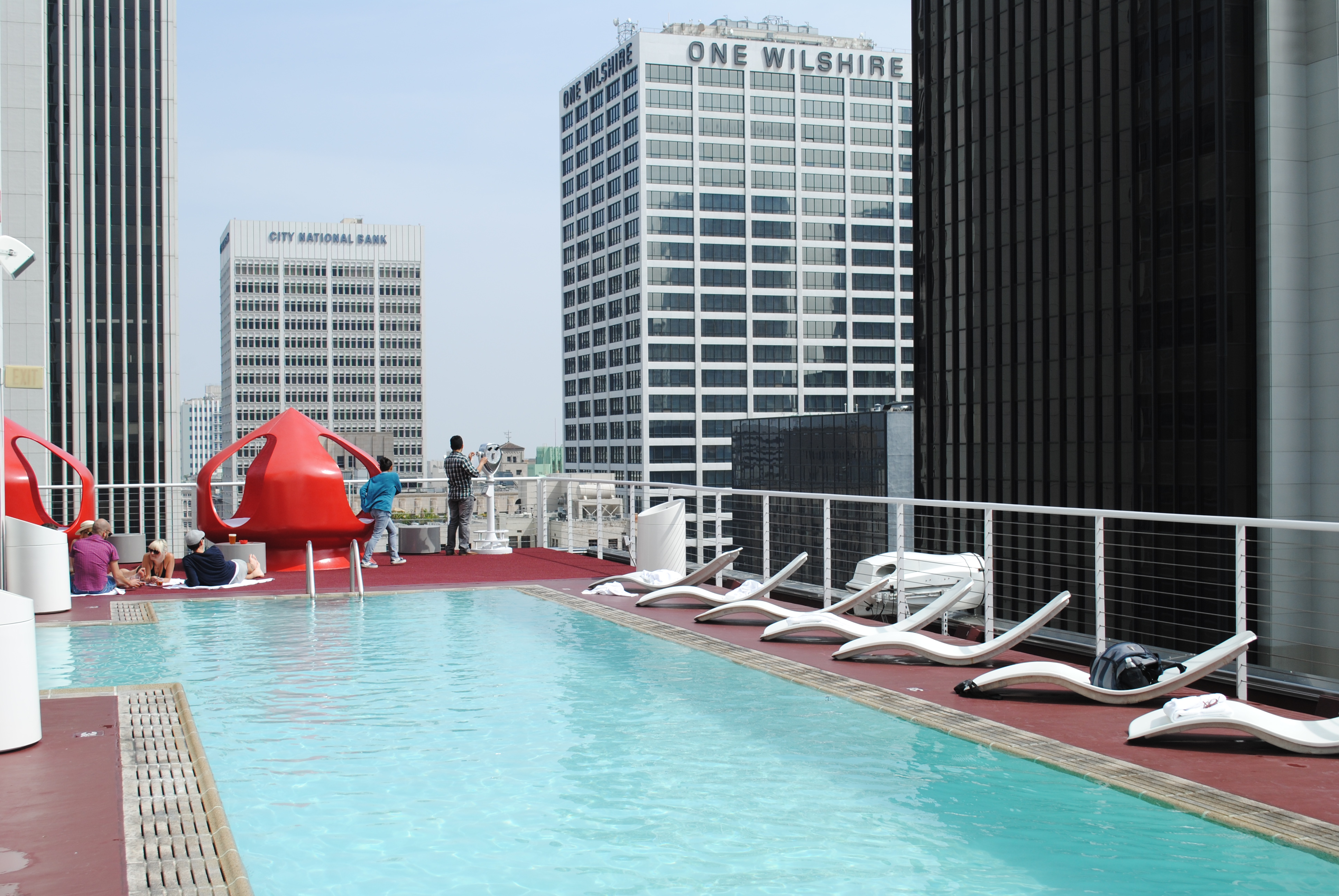
The rooftop bar at the Standard Hotel, downtown LA
During the spring of 2010, while I was working on an article about Snapper’s project and teaching a seminar on the multi-sensory aspects of music, Snapper offered to mount a participatory version of her project for my class. She took us through some exercises in a large swimming pool in downtown Los Angeles. The first exercise paired us up; one person gently held the other under water, while the person underwater made sounds. I was paired with Natalia, who shouted––but with my ears above the water I couldn’t hear her voice.

The author with Natalia Bieletto (under water). Aquaopera #4/Los Angeles, 28 April 2010.
So we tried another strategy: one person made sounds underwater while the rest of us put our heads and ears in – and then we could hear her. We found that the deeper into the water we descended, the more difficult it was to sing high notes. Fast tempi were also difficult to maintain; Natalia’s attempt resulted in muddled sounds.
We found that the deeper into the water we descended, the more difficult it was to sing high notes. Fast tempi were also difficult to maintain; Natalia’s attempt resulted in muddled sounds. Surprisingly, while sung sounds didn’t seem very loud, small internal throat sounds were incredibly powerful. These exercises demonstrate how much the medium through which sound waves flow affects their characteristics: their speed, direction and so on. It also shows that in order to register sound, the listening body (including the head) must be immersed in the material through which the sound flows.

The next exercise linked the six of us together
The next exercise linked the six of us together by the arms; three participants stood in a line, with their backs against three others. We sang in a drone-like manner, playing with our voices above the water, at its surface, and then slowly sinking into it. We felt the sonic vibrations largely through direct contact with each other’s bodies. Of course sound also passed through the air and water, but because the most immediate path was from one body to another, this was the sensation that overpowered us.
At the end of the day, gathered around the poolside fireplace, we discussed how different singing felt in a liquid environment. We’d discovered that aural experience is predicated on physical contact with sound waves through shared media, in this case water and air, flesh and bone. We noted that the shared medium makes a great differenceto how we experience the voice, and that the sound we ultimately hear depends partly on what is sung, and partly on the medium through which it passes (and how our bodies interact with that medium). In other words, in Snapper’s workshop we discovered that sound is a multi-sensory experience, tactile as well as aural. It also became clear that sound and music involve much more than traditional theories and notation can capture. (For a more thorough discussion of the differences between singing and sound underwater and in air, please see my forthcoming article.)
-

- At the Standard poolside fireplace.
-

- Hyunjong Lee and Zachary Wallmark.
-

- Sam Baltimore and Alexandra Apolloni.
-

- Jill Rogers.
I would like to underscore here that the character of a given sound source is not stable. Instead it is dependent on specific material conditions, and on particular relationships between the elements involved. A sound signal will move with a given speed depending on the material––air, water, metal, glass, etc.––through which it is propelled. As humans register the sound it will move more or less directly through the ear drum or bones (and then transfer to the inner ear) depending on the relationship between the material through which it is propelled and the materiality of the ear. The part of the body that registers sound also plays a role in its apparent directionality.

Juliana Snapper.
For example, our ability to hear in “stereo”––two distinct signals, left and right––is the result of sound entering our bodies from two directions (two ears). Because we most frequently deal with sound as it is propelled through air, we take this as a given and adjust our musical and acoustic research (and thus our concert halls and (performance spaces accordingly).
By highlighting the material aspects of sound and their reception, Snapper reminds us that what we hear depends as much on our materiality, physicality, and cultural and social histories as it does on so-called objective measurements (decibel level, soundwave count, or score), which are themselves mere images. Our experience of sound is a triangulation of events in which physical impulses (sonic vibrations), our bodies’ encultured capacity to receive these vibrations, and how we have been taught to understand them are at constant play, and subject to negotiation. In the experience of sound, what becomes clear is not a stable explanation of what sound or music is. Instead we are led to understand that each such account is a composite manifestation of our perception of sound at a given moment in time and place.
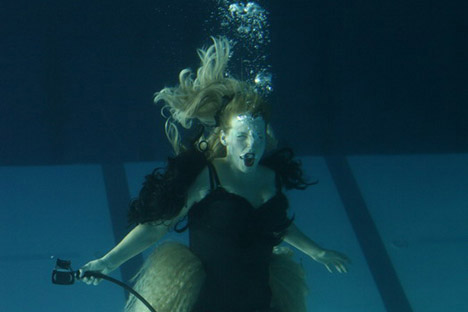
Juliana Snapper
Share this:

What Are You Listening to When youarelistening.to/losangeles ?
 Earlier last week I came across this post by GOOD regarding a new site called youarelisteningtolosangeles.com. Eric Eberhardt’s (http://twitter.com/url2la) web creation uses an LAPD radio feed and plays Creative Commons-licensed music in the background. (According to Olsen Bright at NBC Los Angeles, the URL was registered only last week, but since it went live it has gone viral. As of this post, it has links for New York, Chicago, San Francisco, and Montreal). The site that has gotten more news coverage has been, by far, the Los Angeles site. Nicola Twilley from GOOD calls it “hypnotic, beautiful, and utterly compelling.” When I first tuned in, I couldn’t stop listening. It is certainly haunting and leaves behind a feeling of uncanniness: the disembodied voices of police dispatchers far away mesh with the soothing sounds of ambiance music.
What caught my eye about the article was Twilley’s description of what it was like to listen to LAPD’s radiofeed:
“To listen to it is to be plugged into the pulse of the city; lost in fragments of someone else’s story. Urgency alternates with frustration and low-level routine; some incidents are reported while others are resolved; and jaywalking tickets are issued in the same breath as lives are lost.”
I like her idea that the site allows you to tune into “the pulse of the city.” The feed is a sonic representation of what is happening on LA’s streets. I had the feeling that I was listening to some subversive channel of LA life, narrated by a police dispatcher. However, there are two things that come to mind: a) the sounds of urban life are being filtered through the police department, and b) what are the sounds we hear on the feed telling us about the sonic dimensions of cities?
This online radio station of sorts mashes up city sounds with background music, but once you pause the music what we get are conversations between police officers. The result is that those sounds (voices, codes, numbers, addresses) filter the soundtrack of the city. When we click on youarelisteningtolos angeles.com we are actually listening to the keepers of peace and order on the city streets. The city has already been distilled for us through a radio dispatcher and officers.
The sounds are haunting. Interestingly, what attracts some listeners is the fact that they can eavesdrop on the police feeds, like we’re tuning into what our neighbors are doing. Others point out how soothing the sounds meshed with the dispatcher feed can be. However, the site serves as an example of how city sounds are filtered to us. We don’t hear the actual people who the dispatchers talk about, but the stories of their actions. In that sense, what we hear about them is really a narrative of order, chaos, authority, and traffic violations. Who is stepping outside of the lines?
But…can we ever really listen to The City? This is why audio projects such as soundwalks are important, because they make that aural experience multisonoral. The same way we must reject single stories (like Chimamanda Ngozi Adichie pointed out in her TED talk) we must also bring to light different soundtracks of the city around us, lest the radio feed of a police dispatcher become the one that stands out.
This brings me to my second concern: what are we actually listening to? What was initially problematic for me was that we don’t actually hear urban sounds. We hear voices talking about citizen activity on the streets. Once you mute the music, what you get are voices narrating what is happening on the street level. But then I realized that I was be limiting what sounds are classified as city sounds. In that sense, youarelistening.to is opening up what it means to listen to cities. The citizens also make sounds; their voices are part of the soundscape of the city.
I’d love to hear from our readers from these different cities, see what their reaction to listening to the transmission is.
By the way: can we get a youarelistening.to/kansascity?
Bonus tracks:
Here is Soul Coughing’s “Screenwriter’s Blues,” whose line “You are listening to Los Angeles” provided inspiration for the title. (via laist.com)


Share this:


Current Top Posts





April 2021

January 2020

November 2019

October 2019

August 2019

April 2014

November 2017

March 2015

December 2017

October 2015
 Sounding Out!
Recent Comments