
Functional Sound (Studies): The First European Sound Studies Association Meeting

On October 4-6, 2013 ESSA – The European Sound Studies Association – will have its first conference in Berlin. This initiative is just the latest sign that an institutionalization is taking place within the inter-disciplinary field of sound studies. Erik Granly Jensen, who is one of the founding members and vice-chair of ESSA, tells the story here:
During the past decade, the field of sound studies – or auditory culture if you will –has been growing immensely. International conferences and seminars, numerous dissertations, monographs and research articles have shaped a vibrant, interdisciplinary area of study that of course has a much longer history within the more traditional disciplines of the humanities and social sciences, but which during the past 10-15 years has morphed into a discipline of its own. Just last year, two extensive collections of theoretical texts appeared with major publishing houses, The Oxford Handbook of Sound Studies (ed. Trevor Pinch & Karin Bijsterveld) on Oxford University Press and The Sound Studies Reader (ed. Jonathan Sterne) on Routledge. A second edition of the classic Auditory Culture Reader (ed. Michael Bull) is in the making and supposedly another Routledge anthology is being planned as well. Furthermore, in 2010 three European journals on sound cultures appeared within just a few months: the Holland-based Journal of Sonic Studies, the Ireland-based journal Interference and the Denmark-based SoundEffects; all three of them international online journals devoted to the analysis of sound cultures with an explicit ambition to integrate sound into academic analysis. To give an illustration of the interest that these journals are already enjoying is the fact that SoundEffects in 2012 alone had 15,000 individual article downloads.

With all these activities taking place, supplemented by the high number of research networks and transnational research projects throughout Europe, for instance “Sound in Media Culture” sponsored by the German Research Foundation or “The Nordic Research Network for Sound Studies” sponsored by the Nordic Research Foundation, Nordforsk, it seemed to be a question of time before the area of sound studies would take yet another disciplinary step and bring all the efforts together in an association. For even if the field of sound studies is alive and well, the advantage of creating a lasting academic platform where researchers, practitioners and artists can meet annually to exchange ideas and build new networks should not be underestimated. The existence of an association and an explicit reference to a global community for research and artistic practice into sound could be the decisive argument for both the introduction of university programs and job positions within sound studies. ESSA, The European Sound Studies Association that was founded last year could become such a forum.

As is so often the case, the idea for a sound studies association arose at an occasion that was scheduled for other purposes. In January of 2012, twelve members of the Nordic Research Network for Sound Studies were gathered in Copenhagen to plan the activities of the Nordic research network, www.sdu.dk/norsound. During discussions of a possible doctoral school that would include not just doctoral students from the Nordic countries, but be a traveling European doctoral school, the idea for both a European summer school and for a forum that could facilitate sound studies throughout the European continent was put on the table. Everybody present (including Anahid Kassabian, Michael Bull, Heikki Uimonen, and Marcel Cobussen to mention a few) agreed that this was both a great and a timely idea and the association ESSA, European Sound Studies Association, was born.
ESSA is a groundbreaking organization, bringing together the widest range of approaches to the study of sound. It’s exciting to be involved in its earliest stages and to participate in shaping this new community. I’m very much looking forward to its growth over the next few years and to ESSA becoming a productive environment for scholars working with many aspects of sound. –Anahid Kassabian, University of Liverpool
During the past year, an ESSA website was launched and discussions of a possible legal statute of the association have been circulating in the group parallel with the planning of the first ESSA conference. The reason for the working of the legal statute is, that ESSA in the future will be run by membership donations and through a democratically elected board of members.
In particular musicologist Morten Michelsen from the University of Copenhagen and Holger Schulze, professor of historical anthropology of Sound at the Academy of Arts in Berlin (two other members of the founding group) have been the driving forces of ESSA in this initial phase. At this point where everything is still waiting to happen, it is of course hard to predict what ESSA will be and what kind of an association it can be in the future. However, the ambition is to provide “a forum where those involved in the study of sound can meet and exchange ideas.” ESSA will also encourage “the development of research and systematic study in topics and in areas where such study in not well developed” as is stated on the website. In addition to these overall ambitions, the initial idea of a European doctoral summer school for sound studies still has a high priority as a future goal for ESSA.
With the founding of the European Sound Studies Association – the study of sound in all it’s inter-disciplinary richness and diversity now has an independent institutional voice for the first time. The range of sonic scholars that is converging on Berlin for ESSA’s first annual conference in October is evidence of both the need and the success of ESSA. The presence of ESSA will provide a platform, not just for European scholars, but for all those working on sound globally. –Michael Bull, University of Sussex
The theme for the upcoming conference in Berlin is “Functional Sound.” The conference will focus on existing as well as emergent and cutting-edge approaches to functional sound design, sonification, auditory culture, everyday soundscapes, artistic concepts and popular culture. In particular, the conference encourages presentations that include both theoretical and practical aspects and presentations that address everyday contexts within which sound—in its relation to media, technology, and the arts—is constitutive for new ways of thinking, listening, and becoming. The conference is a joint venture with the international research network “Sound in Media Culture” (led by Holger Schulze). During the three conference days, paper presentations in six parallel streams will cover topics such as “Soundscape of the Urban Future,” “Sound Design Practices,” “Sonic Artistic Practices and Research,” and “Cultural Politics & Sonic Experience.” [Editor: Click here for the full program, which includes several Sounding Out! editors and writers: Jennifer Stoever-Ackerman, Neil Verma, reina alejandra prado saldivar, Mack Hagood, and Regina Arnold. –JSA]

The confirmed keynote speakers are all leading scholars in the field and include Douglas Kahn, who is professor of Media and Innovation at the University of New South Wales in Sydney. Professor Kahn has been a driving force for the development of sound studies, primarily due to his influential 2001 book Noise, Water, Meat: A History of Sound in the Arts. Jason Stanyek, professor at the Faculty of Music at Oxford University, is also a keynote speaker. Professor Stanyek is a musicologist, who specializes in Brazilian hip-hop and Pan-African Jazz. Also he is the co-editor of The Oxford Handbook of Mobile Music Studies. The final keynote speaker is Thomas Macho, professor in cultural history at the Humboldt University in Berlin. Professor Macho has published on numerous subjects but of special interest for the sound studies field is his work concerned with the human voice and most recently his book on synchronization, Kulturtechniken der Synchronisation from 2011.
For those who cannot make it to Berlin this year, the place and dates for the 2014 ESSA conference have already been decided. It will take place in Denmark on June 27-29 2014 at the University of Southern Denmark in Odense. To be updated about ESSA and future events, please visit the website, http://www.soundstudies.eu, and sign up.
—
Featured Image Courtesy of Mediateletipos. In 2008, artist Akio Suzuki presented a sound installation around Berlin’s water tower focused on listening to everyday situations, directing listener’s attention through audial symbols painted on the ground.
—
Erik Granly Jensen is associate professor at the Department for the Study of Culture at the University of Southern Denmark. He is the research leader of The Nordic Research Network for Sound Studies, sponsored by Nordforsk 2011-2014. He is also the co-editor of the online journal SoundEffects and a founding member of ESSA, The European Sound Studies Association. His most recent research areas include historical sound archives and radio art. Contact: erikgranly@sdu.dk
—
 REWIND! . . .If you liked this post, you may also dig:
“Once the word ‘sound’ was in the title, it opened up a kind of door”: A Conversation with Eric Weisbard –-Liana Silva
Listening to the A. D. White House: Cornell’s Society for the Humanities’ Year in Review–Timothy Murray
Sound at ASA 2012–Jennifer Stoever-Ackerman
Share this:

The Noisiest City on Earth? or, What Can the 2012 Manhattan Noise Complaint Maps Really Tell Us?

“It’s a city, not a cemetery. You can’t tell everybody to go around wearing earplugs.”
Ex-New York City Parks Commissioner Henry J. Stern, quoted in “Many Pleas for Quiet, but City Still Thunders”
In 1905, a New York Times article declared New York City “the noisiest city on Earth.” More than a century later—this summer, to be exact—The New York Times ran a series on noise in New York City titled “What? The Long War on Loud” that proved that this city is still trying to figure out its relationship to sound. (One of the gems of that series? “New York’s War on Noise” timeline.) As a displaced New Yorker, some of my most vivid memories of the city are aural. Although New York City isn’t the only loud city out there, there are many reasons it’s called “The City That Never Sleeps”—and sound has a lot to do with it, depending on which neighborhood you call home.
Now you can see what neighborhoods are allegedly noisiest, and where all that noise comes from. Brooklyn designer Karl Sluis created the 2012 Manhattan Noise Complaints maps (click for full image), in which Sluis correlated the data on 311 noise complaints made during the year 2012 (40, 412 complaints, to be exact) that he obtained from the NYC Open Source site with Manhattan’s geographical coordinates. He used circles of various sizes to a) create an aural tracing of the island of Manhattan, sitting in a sea of turquoise blue b) showcase the number of complaints in an area. The bigger the circle, the larger the number of complaints.

Screen Capture of Karl Sluis’s 2012 Manhattan Noise Complaints maps (click for interactive image)
The maps Sluis has created are helpful for visualizing the complaints on a broad scale, but they paint an incomplete picture of what noise means in New York City. The demographics of each neighborhood are absent from each map, a slight that can perhaps be traced to the 311 data available, but in order to better understand how New Yorkers define “noise” those stats must be included. Both Sluis and John Metcalfe from The Atlantic Cities discuss notable findings, but neither takes into account the fact that some of the areas with a higher concentration of noise complaints are not just densely populated but densely populated with racial and ethnic minorities. Indeed, comparing the maps’ noisy hotspots to a map of Manhattan racial demographics reveal how urban racial dynamics intersect with ideas about sound and power: who can make sound, who must be chastised for making noise, who can complain and whose complaints are actually being heard.

“Unnecessary noise prohibited” by Flickr user Ricky Leong, CC BY-NC-SA 2.0
Mapping noise complaints gives a spatial dimension to noise, and it renders noise palpable, in a way. Sluis points out, “Noise complaints reveal the concentration of activity in the city as well as many smaller stories, such as the construction of the Second Avenue subway line, idling buses on the Upper East Side, and the homes of the loudest dogs (or the least patient neighbors).” He reminds us that the data comes from complaints and not necessarily decibels; in other words, it represents local ideas of what counts as sound and what counts as noise.
While Metcalfe correctly describes the thousands of 311 complaints about noise from 2012 as “the entire year’s expression of mass annoyance,” Sluis’s map does not go far enough toward figuring out whose annoyance, exactly. We must remember that annoyance oftentimes stems not just from physical reactions to noise but rather one’s perceptions about noise, what Jennifer Stoever-Ackerman deems “the listening ear.” How we hear others, Stoever-Ackerman argues, is not as natural as it seems. For example, whom we deem as noisy may stem from our community, our parents, and/or social conditioning. Accounting for race/ethnicity in noise maps will show how the listening ear conditions neighbors to categorize and react to certain sounds.
For the purpose of this analytic exercise, I compared Sluis’s maps and the Center for Urban Research, CUNY Graduate Center’s 2010 map of block-by-block demographic changes in New York City, in order to illustrate how population density and racial/ethnic demographics play a role in concentrated pockets of noise complaints. Drawn from 2010 census data, the CUNY map clearly delineates neighborhoods and color-codes the groups in each neighborhood per block: blue for whites, green for Latino, orange for black, purple for Asian, and grey for “Other.” Although the Center for Urban Research, CUNY Graduate Center’s maps cannot be superimposed on Sluis’s maps, they help give a general idea as to where neighborhoods are located in addition to racial demographics.
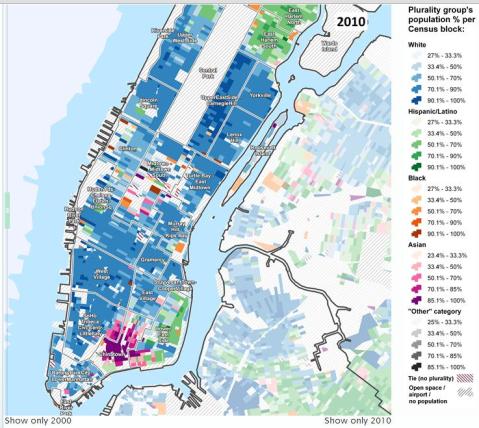
Manhattan below 110th Street in 2010, courtesy of the Center for Urban Research, CUNY Graduate Center

Manhattan above 110th Street 2010. Courtesy of the Center for Urban Research, CUNY Graduate Center
From the maps illustrating changing race/ethnicity patterns, I gathered what neighborhoods were predominantly white (West Village, Lincoln Square, Yorkville, Upper West Side), predominantly Latino (Washington Heights, East Harlem) predominantly black (Central Harlem, parts of Hamilton Heights), and predominantly Asian (Chinatown, blocks of the Lower East Side). When one compares Sluis’s overall noise map of Manhattan to the racial demographic maps of Manhattan, what stands out is that the major circles of noise complaints are also places where there are different racial and ethnic groups mingling (for example, Times Square) or places that are populated by mostly minorities (Hamilton Heights). Whereas Sluis flattens out the noise complaints, demographic stats point to the racial/ethnic contours of each neighborhood. Sluis’s maps focus on number of complaints; unfortunately this assumes everyone complaining is the same and that everyone making the noise is the same—a level aural playing field if you will. Bringing demographics into the equation underscores how not all complainers are equal and how not all complaints carry the same heft.
The city may be noisy, but “noisy” is relative. Sluis’s map shows some predictably noisy areas for those of us familiar with Manhattan’s soundscape (Union Square, Times Square) but it also draws attention to other areas not as predictable in the mainstream imagination (East Harlem South, Hamilton Heights). However, the maps by the Center for Urban Research, CUNY Graduate Center help us better understand the context for the high or low number of complaints in certain areas. For example, one of the biggest circles on Sluis’s general map of Manhattan is located in the Hamilton Heights/Washington Heights area; the Center for Urban Research, CUNY Graduate Center’s map of Manhattan above 110th Street show that these areas are densely populated by blacks and Latinos/as. This is key information because it reminds viewers that this neighborhood is a lot more ethnically diverse than other neighborhoods with a smaller number of complaints. It brings to mind: what role does race play in these complaints, in terms of those who complain and those who are the focus of the complaints? Although more people might mean more complaints, the prevalence of complaints like “loud talk” in East Harlem (Spanish Harlem) are nevertheless connected racialized ideas about people of color being “loud.” This doesn’t assume that the people complaining are white, but that they are complaining about groups that are characterized as loud, noisy, rowdy.

“Classic New York: noise, smoke” by Flickr user Will, CC BY-NC-ND 2.0
These noise maps, when put into conversation with demographic data, also indicate what areas are priorities in urban planning—the sounds of gentrification. The visualizations of the complaints by section (under the main map), combined with CUNY’s maps, are even more telling because they break down the number of complaints by category. The aforementioned northern tip of Manhattan, for example, is also where many of the complaints are concentrated. At a glance, loud parties, loud people, and loud car stereos seem to be the major complaints in those areas, according to Sluis’s visualizations. Meanwhile, noises of “urban growth,” such as construction and jackhammers, are less prevalent in these areas, whereas they are more prevalent below Central Park North, in now mostly-white neighborhoods.
Sluis’s maps of the 311 noise complaints data allow readers to see differences in terms of neighborhoods: who complains the most? what do they complain about? However, one thing to keep in mind is that first question: who makes the complaints. This is where the data falls short. Can it be assumed that those who are calling about the noise are mostly people who live in the neighborhood? Are Upper Manhattan neighbors less or more tolerant of noise? The answers to these questions, although they’re not found in Sluis’s map, point to how ideas of who is noisy or who can make noise are at play here.
I do not mean to downplay the usefulness of Sluis’s map. I instead call for the necessary addition of key missing factors to future noise maps in order to give us a more complex picture of noise complaints in Manhattan and elsewhere. Although it may not be possible to gather who the 311 callers are, including factors such as race and class may lead to very different noise maps. For example, what would a noise map of Manhattan look like if researchers brought income into the equation? Income inequality, especially in Manhattan where that imbalance is starkly on display, matters for the purpose of sound mapping. The more affluent neighborhoods are also the ones with less complaints and are the ones that are mostly inhabited by whites. Wealthier communities are more spread out and have more ability to couch themselves from noise, not to mention that it probably takes fewer complaints to get a response.

“Marcus Garvey Park Drum Circle, Harlem, NYC” by Flickr user j-No, CC BY-NC-ND 2.0
Gentrification is another factor: what kind of analysis could we do if we considered what neighborhoods have been gentrified in the past ten years? It is possible that as whites move into neighborhoods where people of color have historically lived, suddenly they find them noisy—hence, complaints. It is fitting to consider, for example, the tension between an established group of drummers in Marcus Garvey Park in Harlem and the inhabitants of a new highrise (characterized as “young white professionals”) who wanted the 30-years and running drum circle shut down, as reported in The New York Times in 2008. Moreover, if we accounted for the history of zoning in the neighborhoods that have the most or the least complaints it would add another layer of analysis to the data. Are some of these neighborhoods used as entertainment zones, for example? Is it easier to open up bars there than elsewhere in the city?
With these questions in mind, the maps go from beautiful renditions of data, to opening up a bigger conversation about the arbitrariness of noise. The demographical and sociological context of these noise complaints must accompany the raw data, especially when it comes to sound. The analysis also points to the source of the data: 311 calls. I wonder if this is the only way that people in Manhattan (and New York City at large) are dealing with noise. I’m sure that after a century of being “the noisiest city on Earth,” folks have gotten creative about it.
—
Featured image: ” Stranger 10/100 Johano” by Flickr user MichaelTapp, CC BY-ND 2.0
—
Liana M. Silva-Ford is co-founder and Managing Editor of Sounding Out! She is also known professionally as the Writer Whisperer.
—
REWIND! . . .If you liked this post, you may also dig:
“I’m on my New York s**t”: Jean Grae’s Sonic Claims on the City -Liana Silva
The Noise You Make Should Be Your Own–Scott Poulson-Bryant
Sounding Out! Podcast Mini-Series (#16): Listening to The Tuned City of Brussels, Day 1: “Noise”
Share this:


Current Top Posts





April 2021

January 2020

November 2019

October 2019

August 2019

April 2014

November 2017

March 2015

December 2017

October 2015
 Sounding Out!
Recent Comments