
Radio’s “Oblong Blur”: Notes on the Corwinesque

Miguel Covarrubias, untitled iIlustration to “Radio I: A $140,000,000 Art,” Fortune (May, 1938).
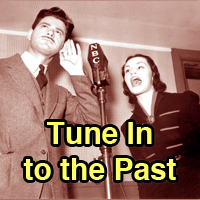 Editor’s Note: Today, Neil Verma kicks off our summer series “Tune In to the Past,” which explores the life and legacy of radio broadcaster Norman Lewis Corwin, the “poet laureate of radio” who died last summer at the age of 101. Corwin, pictured in the icon to the left with actress Peggy Burt around 1947, passed too quietly into the ether–as, unfortunately, has too much of radio history. Sounding Out!‘s three-part exploration of his legacy by radio scholars Verma, Shawn VanCour (July), and Alex Russo (August) not only gives his work new life (and critique), but also speaks to the growing vitality of radio studies itself. As I mentioned this past March in my round-up of the 2012 Society of Cinema and Media Studies conference, radio scholarship is on the rise–a Radio Studies Special Interest Group was established at SCMS this year, reaching a critical mass–and scholars are finding new and innovative ways to approach radio’s unique silences. We are proud over here at SO! to broadcast the future of radio studies by helping you “Tune In to the Past” this summer, so get ready for an array of voices–living and dead, textual and aural–spirited debate, and great sound history, in both senses of the word. So don’t touch that dial. –JSA
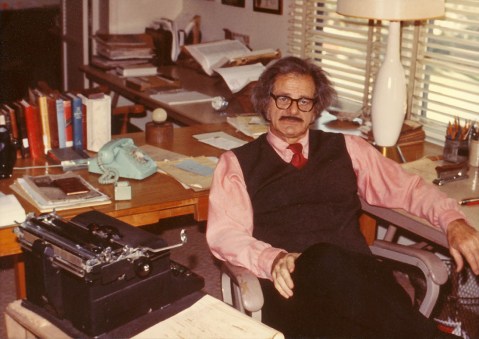
Norman Corwin in 1973 (Source: Arrowcatcher, Wikimedia Commons)
“I am a Dead Sea Scroll,” Norman Corwin, in an interview with writer Tom Lewis, 1992.
 Rising to prominence in the 1930’s, radio dramatist Norman Corwin (1910-2011) aired a body of work of unsurpassed variety, reaching audiences upwards of sixty million with plays that range from “The Odyssey of Runyon Jones,” about a boy searching the afterlife for his beloved dog, to One World Flight, for which Corwin visited 17 countries seeking voices of peace. Often compared to such figures as Eugene O’Neill and Walt Whitman, Corwin was known for seventy years as the “Poet Laureate” of radio, an unofficial title invented for him and impossible to confer on another. I interviewed Norman for my book Theater of the Mind (University of Chicago Press, 2012). These remarks derive in part from those conversations.
—-
In June of 1947, New Yorker writer Philip Hamburger published a profile of Norman Corwin, then already recognized as a distinguished radio dramatist. From Pearl Harbor to V-J Day, Corwin had staged daring plays to mark Allied milestones and earned frothy praise from the likes of Carl Sandburg, who called Corwin’s V-E Day show “On a Note of Triumph” one of the “all-time best” American poems.
Such acclaim was not universal. That same broadcast drew scorn from historian Bernard DeVoto, who called it a “mistake from the first line” full of “pretentiousness” and “bargain-counter jauntiness.” Like many others, DeVoto and Sandburg reacted to Corwin’s habit of excess by mimicking it. Hamburger’s profile caught that same bug. Billing itself as “The Odyssey of the Oblong Blur,” Hamburger tells a gauzy story of Corwin’s older brother building him a crystal set out of a box of Quaker Oats, and relates tall tales of Corwin’s artistry, like the time he spent two days trying to simulate the sounds of depth charges. And not only did Hamburger write the profile as a radio play, but he wrote it in the style of Norman Corwin.
What is that style, exactly? Thoughts on that question have been surprisingly minimal. When Corwin died last fall, commentators celebrated his life (see here, here, here and here), but the memorials lacked precisely the sense of scale to which both Sandburg and DeVoto responded. There was no voice to speak of Norman in a “Corwinesque” manner, in part because the man probably outlived more likely eulogists than anyone else in the history of broadcasting. Had he not outlasted them, Corwin would have been mourned by the avuncular elders of midcentury liberalism, like his friends Edward R. Murrow and Carl Sandburg or admirers Robert Altman, Walter Cronkite and Studs Terkel, any one of whom could have written a loving burlesque in Corwin’s voice.
But no one did, and no one can, not now. Who would get the joke, anyway? Collective experience of Corwin’s sound is passing out of living memory. Yet this very elapsing “afterlife” of the radio age, I feel, lends new richness to the question of the Corwinesque, an aesthetic that needs clarification both to give full credit to the man behind it, and, in a larger sense, to show how a theory of sound experience can “happen” at the twilight zone of collective human memory.
So what was “the Corwinesque” around 1947? What is it nowadays? What might it become in the future? In this post I’ll consider both the nature of the “Oblong Blur” and the methods we’ve tried to bring its ongoing odyssey into focus.
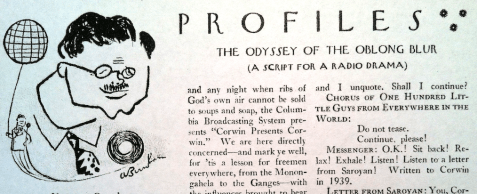
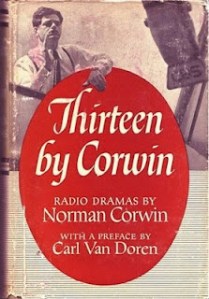
Philip Hamburger’s New Yorker profile, with illustration by A. Birnbaum
A High Wireless Act
In its profile, The New Yorker poked fun at how Corwin made unreasonable demands of sound (e.g. “Music: a universal theme, oscillator beneath, denoting pain of the world and bigness thereof, fading”) and let childish literary tactics run amok, as when the audience is called “Sons of a Sun spinning sadly through space.” In his era, Corwin’s penchant for such overwriting was an unavoidable aesthetic issue.
Corwin’s work was widely understood as a challenge to technicians and actors just for the sake of it. In the script for “New York: A Tapestry for Radio,” for example, a date scene contains this befuddling note: “Music: Love on brownstone stoop at three in the morning after an evening at the RKO Proctor Theater and a long walk in the park. It sustains, behind.” In “The Undecided Molecule,” meanwhile, we learn of a particle that refuses to select his destiny before “The Court of Physiochemical Relations.” Here are some of many tongue-twisting lines in verse:
I’d argue that Corwin’s writing is impressive here precisely because it’s so easy to botch in delivery. The style spotlights its own overworked literary calisthenics, saying: look at me trying so hard I might blow it.
In this way, the Corwinesque names a connection between the soaring and the buffoonish, a link that a contemporary called his “frontier spirit.” Thanks to this spirit, even when the prose was purple, the defect came across as that of an innovator. To keep that up, Corwin had to innovate constantly. That’s why his plays took on so many other forms – the letter (“To Tim and Twenty”); the lecture (“Anatomy of Sound”); the pageant (“Unity Fair”).
So one key to the Corwinesque was to walk a high wire without a net, another was to say so. Nothing confirmed both better than a fall. I’d wager many listened for a lousy line or overdone tune as part of the pleasure of it all. Indeed, it may be incorrect to evaluate Corwin’s aesthetic as poetic; think of the Corwinesque as broadcasting rather than writing, and its liabilities come across as dares.
If that is correct, then the “high wire act” of the Corwinesque relies on a kind of listening-for-risk that’s hard for us to do now, because we can’t listen to Corwin’s work new, or live. One deep aspect of the Corwinesque of the 1940’s – the possibility, even anticipation, of artistic failure, up above an enormous audience out there in the dark – seems lost for good.
Coalition and Collation
But in another way, the Corwinesque is only possible to grasp now, at the safe remove of the digital era. Today it’s easy to listen “distantly” to classic radio through formats that allow us to pause, rewind, categorize and remix vast amounts of golden age audio in a way that was impossible in 1947. By doing so it becomes clear that what we call the “Corwinesque” drew on a broad vocabulary of radio dramaturgy, a way of “talking about” time and space that characterized many programs of that time.
Consider Corwin’s famous attempts to glorify the “common man” – farmers, G.I.s, factory workers – by drawing their voices to a sonorous space and national coalition, indeed by making these two imaginary sites mirror and rationalize one another. Perhaps the paramount example is “We Hold These Truths,” which celebrated the 150th anniversary of the Bill of Rights only days after Pearl Harbor. In that broadcast, we hear Americans of the revolutionary period (widows, blacksmiths, politicians) speak from a series of shallow locations in a quick succession, and a similar group in the present (workers, Okies, businessmen, mothers), as a way of building mystical union through time.
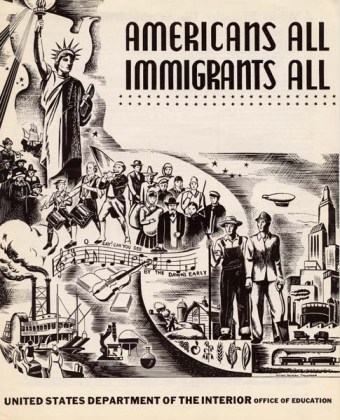
A visual representation of the “kaleidosonic” from the 1939 broadcast “Americans All, Immigrants All”
This style has had many names. Historian Erik Barnouw likened it to painting, calling it a chance to “splash quickly over a large canvas,” while actor Joseph Julian called it a “telescoping montage.” Variety’s radio editor Bob Landry suggested that it resembled cantata. When I interviewed him, Corwin said that it was like writing music; elsewhere he spoke of a kind of “horizontal” drama, or mosaic form.
In my book, I employ another word: “kaleidosonic.” In kaleidosonic radio, we segue from place to place, experiencing shallow scenes as if from a series of fixed apertures, thereby giving time periods expressive existence. That can be contrasted with what I refer to as the “intimate style,” in which the listener is attached to a character who moves through deep scenes, as a way to give space expressive existence. A good example of the latter is Corwin’s American in England series, in which the horizon of wartime is shaped by a proximal relation to a surrogate narrating entity “nearby.” Here’s a representative episode:
Today, listening broadly, it becomes clear that neither of these styles belongs to Norman exclusively. For other uses of the kaleidosonic, consider the works of Stephen Vincent Benét, Orson Welles’ “The War of The Worlds” or Cavalcade of America. For examples of the “intimate style,” listen to Brewster Morgan’s “A Trip To Czardis,” or any “first-person” style play from The Mercury Theater on the Air. What made Corwin special was how he made these styles complimentary. The opening of “On a Note of Triumph” is a good example:
In six minutes, we go from a kaleidosonic sequence of songs and crowds to an ordinary G.I. overseas asking questions intimately. This connection between the context and the individual, between the nearby and the simultaneous, is Corwin’s way of letting space and time merge together vividly.
It is that capability, I contend, that underlies and secures Corwin’s glorification of the common man, who is really Corwin’s public aestheticized. In 1939, Archibald MacLeish wrote, “The situation of radio is the situation of poetry backwards. If poetry is an art without an audience, radio is an audience without an art.” Corwin intuited what MacLeish didn’t understand: in radio, the audience is the art.
And just as airing a coalition of voices was an epistemological act that reinvented those it depicted in 1945, our use of a new collation of recordings today redraws the parameters of what those sounds might mean, amplifying latencies, superficialities, and entwinings hitherto inaudible.
A Dead Sea Scroll
By 1947, Corwin’s dedication to the “little guy” was out of vogue. It seemed seditious to red-baiters, phony to leftists, and compromised to critics – The Nation’s Lou Frankel wrote of One World: “It is as if the late John Barrymore decided, without warning, to play Hamlet in pantomime.” On this point Hamburger’s profile pivots from hagiography to satire, including a series of goofy verses voiced by a “Chorus of One Hundred Little Guys from Everywhere in the World” and a grouchy monologue by the “Common Man,” complaining that Corwin talked past him, advising “you ought to think about what the words mean before you use them.”
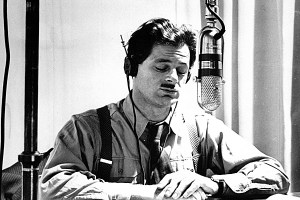
Norman Corwin in 1947 (Credit: Los Angeles Times)
That reminds me of another coda, this one in Corwin’s 1944 play “Untitled.” The play concerns a dead soldier named Hank Peters, who speaks as he lies “fermenting in the wisdom of the earth.” The monologue concludes this way:
Death is a patriotic act, a metaphysical state, but also a restless moral energy bearing down on life, a thing standing in requirement of its vindicating narration. Perhaps this feature of the Corwinesque will ring especially true as classic radio continues to exist in its ongoing pseudo-immortality. Now that Corwin reposes in his own acre of undisputed ground and his voice circulates ghostlike in clouds of data, our question may be what ontological relation we ought to have with that voice, and those of other dead social visionaries, who really do keep on advising us after death, and will go on echoing after we’re gone.
But the Corwinesque isn’t just about how the dead “speak” to the living, long the ruling conceit in the theory of sound recording. It is also about another enigma: how the dead listen to us, an audience eavesdropping, in hiding, taking notes on an old scroll in a lost language.
—
Neil Verma is a Harper-Schmidt Postdoctoral Fellow at the University of Chicago, where he teaches media aesthetics. Verma works on radio and its intersection with other media, and has taught subjects including film studies, sound, art history, literature, critical theory and intellectual history. His book, Theater of the Mind: Imagination, Aesthetics, and American Radio Drama, is published by the University of Chicago Press.
Share this:

Sound at SCMS 2012

I cannot tell you how utterly bummed I am that the Experience Music Project/IASPM joint POP conference falls on exactly the same weekend as the 2012 Society for Cinema and Media Studies meeting in Boston. A lot of scholars, the editorial board of Sounding Out! included, have been forced to make the excruciating choice between them, or—as, the newly nomadic EMP POP will be hosted in New York City this year—to crisscross the Eastern seaboard with heroic train, bus, and car jaunts in an attempt to make both meetings at once. The good folks here at SO! will be doing our utmost to make the best out of a bad situation; in addition to my SCMS offering, look for Liana Silva’s bonus EMP conference preview round-up post this Wednesday and our dueling live tweets from both joints (a little love for those unable or unwilling to go on tour). Our Twitter handle is @soundingoutblog
 Given the huge crossover audience between the EMP/IASMP and the SCMS, I do think this planning snafu brings unfortunate consequences for both meetings, most noticeably a large dip in sound work at this year’s SCMS, including the massive downturn of scholarship on popular music. The dearth is a real disappointment considering how hard-fought its place has historically been in the organization (see Norma Coates’ 2008 Cinema Journal piece, “Sound Studies: Missing the (Popular) Music for the Screens?” for a compelling story of the institutional turf wars between sound studies, media studies, and popular music study writ large) as well as the fact that 2011’s SCMS New Orleans meeting positively brimmed with music and sound. Not to mention that this year’s Sound Studies Special Interest Group Meeting, helmed by Co-Chairs Norma Coates and Tim Anderson on Wednesday March 21 from 2:00-3:45, is more music-oriented than it has been in the past, featuring guest speaker Charles McEnerney, who has been the Host + Producer of Well-Rounded Radio, a music interview audio podcast series (more details below). I am excited that the SSSIG is working to bridge popular music study with an exploration of “new media sound” and its possibilities, and not solely because Sounding Out! hosts a podcast series of its own. Unfortunately, one of the few music panels at SCMS is scheduled at the same time as the Sound Studies Special Interest Group Meeting—and it is the panel of co-chair Anderson!!—another scheduling bummer.

Something Old, Something New, Radios by Flickr User woutervddn
Rather than dwelling on bad news, however, I want to amplify some of the unanticipated positive effects of the confluence of conferences this weekend, especially the dramatic upswing in research on radio and video game studies this year. There are seven free-standing radio panels at SCMS 2012 (!!!), featuring an excellent blend of radio’s top scholars and brightest emerging voices that dial in some strikingly fresh conversation about contemporary radio technology and programming (E10: Thursday, March 22, 2012 09:00AM-10:45AM), the study of aesthetics in historical radio (D8: Wednesday, March 21, 2012 04:00PM-05:45PM), and transnational sonic exchange, both past and present (L21: Friday, March 23, 2012 02:15PM-04:00PM). We are especially excited to hear the new scholarship from Neil Verma, Shawn VanCour, and Alex Russo, the three radio scholars who Sounding Out! will feature this summer in our upcoming series on the life and legacy of radio innovator Norman Corwin—look for one post each month in June, July, and August 2012.
It is also wonderful for questions regarding sound and video game studies to emerge more prominently at SCMS, especially given their contemporary global cultural influence and the vibrancy of their sound design community, especially in the Twitterverse and via blogs like GameSound. We are especially excited that Aubrey Anable’s panel on Thursday, March 22, 2012(3:00-4:45) offers us the chance to listen at the intersection of sound studies with the growing scholarship on affect and play, something dear to hearts and minds over here at SO! (see Aaron Trammell’s recent “Orality and Cybernetics in Battleship”). Especially impressive is how the interventions of videogame scholarship are so fundamentally audio-visual, an articulation that took film studies many years—and even now still seems somewhat reluctant and tenuous. For a list of all video-game panels at SCMS, check theMarch 18th post from Mark Sample’s Sample Reality.
.
The rise of different types of old and new sound media at this year’s SCMS, along with the retrospective roundtable on the pathbreaking scholarship of film sound scholar Rick Altman—featuring fellow heavy hitters Jay Beck, Norma Coates, John Belton, Donald Crafton, Michele Hilmes, Amy Lawrence, and Jonathan Sterne—has made me once again ponder the state of sound studies in film, one of the earliest fields to make the most recent “sonic turn” in scholarship. While certainly there are some innovative, boundary-crossing gems regarding sound and film at SCMS 2012—such as Friday’s “Sonic Approaches to Genre” (12:15-2:00) and Sunday’s “Interwar Sounds” (11:00-12:45), by and large, cinema studies remains overwhelmingly visually oriented as represented at this year’s meeting. Very few panels engage with sound as a primary modality and there are far less individual papers threading sound into panel discussions not explicitly about sound. We need more of both kinds of scholarly engagement, and perhaps the sudden resurgence of interest around silent film with the Oscar runs of Martin Scorcese’s Hugo and Michel Hazanavicius’s black-and-white silent film The Artist, which won Best Picture, will once again de-naturalize the relationship between film sound and image. Or, as Altman told us in the introduction to Sound Theory, Sound Practice (1992): “In a world where sound is commonly taken as an unproblematic extension of the image, within a comfortably unified text, the concept of multi-discursivity is bound to enfranchise sound, concentrating attention on its ability to carry its own independent discourses” (10). [By the way, guest writer April Miller, film and cultural studies scholar at the University of Northern Colorado, will be helping us think through the resurgence of silent film next month here at Sounding Out!].
.
Speaking of trying to find sound where there doesn’t appear to be any, I would be remiss if I didn’t mention my own roundtable on archival dilemmas, “You Are Who, Exactly?”: A Workshop on Working with Non-traditional Scholars,” moved from Wednesday to Saturday afternoon because of scheduling conflict (11:00-12:45, Room TBA in the hard copy SCMS program). A highly interdisciplinary and intermedia panel chaired by Visual Studies scholar Joan Saab, I will be chatting with sound scholar (and CB researcher) Art Blake, cinema scholar Philip Leers, and Media and Animation scholar Nicolas Sammond about the challenges (and breakthroughs) that arise for cultural studies scholars working in areas where, to quote our abstract, “there is no fixed archive nor even a reliable set of sources for our work.” Some questions we plan to collectively think through include: “Is there an ethics of interpretation that differs from those we use in the [traditional] archive? For those of us working in more ephemeral media (e.g. sound, graffiti, cartoons, everyday life), how do we begin to locate or name our archives, and subsequently how do we acknowledge and catalogue these collections? Where does collaboration begin and end, and where might exploitation and appropriation take over?” My introductory remarks, “Listening from the Margins: The Problem of Historical Sound” will focus on the challenges I face hunting for sound in visually-oriented archives—a methodology of marginalia, afterthoughts, and seemingly offhand remarks—as well as the difficulties of archival research when sound media matters. What happens when you are studying the editorial practice of a sound montage artist like Tony Schwartz, for example, as I was for “Splicing the Sonic Color-line: Tony Schwartz Remixes Postwar Nueva York” (Social Text 102, Spring 2010) but the Library of Congress will only provide access to seamlessly streaming digital reproductions of his work, rather than the painstakingly—and clearly—edited magnetic tape? While I definitely do not have all the answers, I hope you will join me and my stellar fellow panelists in in discussing solutions to such vexing dilemmas.
 Ah, dilemmas. One last one. For all of you Sound Studies heads who aren’t totally exhausted by rushing all over the East Coast for our academic version of EMP/IASPM/SCMS “March Madness,” I highly recommend Cornell’s Resoundingly Queer conference next weekend—March 30—April 1st—featuring the work of John Waters, Charles Busch, D.R.E.D., Holly Hughes, Terry Galloway, Moe Angelos, David Savran, Jose Munoz, Jill Dolan, Stacy Wolf, Ann Pellegrini, Eng Beng Lim, Amy Villarejo, Nick Salvato, Shane Vogel, and Judith Peraino, among others. This groundbreaking event will “explore the utterances, echoes, moans, and groans that animate contemporary studies of sex, gender, and sexuality,” one of the first major conferences do so in such a deep and sustained way. I’ll be there, exhausted but enthused, and ready to Tweet for our reader-verse. I’m just thankful such excellence does not fall on this already insane weekend. See you in Boston! And New York City! And Ithaca!
Please comment to let SO! know what you think–both before and after SCMS 2012. If I somehow missed you or your panel in this round up, please let me know!: jsa@soundingoutblog.com
—
Jennifer Stoever-Ackerman is co-founder, Editor-in-Chief and Guest Posts Editor for Sounding Out! She is also Assistant Professor of English at Binghamton University and a Fellow at the Society for the Humanities at Cornell University.
.
Jump to WEDNESDAY, March 21
Jump to THURSDAY, March 22
Jump to FRIDAY, March 23
Jump to SATURDAY, March 24
Jump to SUNDAY, March 25
.

Back to menu
WEDNESDAY, March 21
Wednesday, March 21, 2012
Wednesday, March 21, 2012, 10:00AM-11:45PM (Session A)
A12: Music and Media Shifts
Room: Gloucester
Chair: Carol Vernallis (Arizona State University)
Kyle Stevens (University of Pittsburgh), “Singing the Pretty: Woman’s Voices and the Classical Hollywood Musical”
Daniel Bishop (Indiana University), “Sounding the Past in Arthur Penn’s Bonnie and Clyde”
Andrew Ritchey (University of Iowa), “Moving in Time: Musical Analogy and the Emergence of Avant-Garde Film”
Carol Vernallis (Arizona State University), “What Was, What Is, ‘My MTV’: MTV’s First Broadcast and Music Video Now
.
Wednesday, March 21, 2012, 12:00PM-01:45PM (Session B)
B4: 60s Experimental Cinema and Eccentric Embodiment
Room: Board Room
Chair: Juan Suarez (University of Murcia)
Co-Chair: Ara Osterweil (McGill University)
Lucas Hilderbrand (University of California, Irvine), “Sex Out of Sync: Christmas on Earth’s Queer Soundtrack”
Ara Osterweil (McGill University), “Yoko Ono: Philosophy in the Bedroom”
Juan Suarez (University of Murcia), “Film Grain and the Queer Body: Tom Chomont”
Marc Siegel (Goethe University Frankfurt), “The Sound Recordings of Mario Montez
.
Wednesday, March 21, 2012 02:00PM-03:45PM (Session C)
***Sound Studies Special Interest Group 2012 Annual Meeting
Room: Stanbro Room on Level 4
Convened by SSSIG Co-Chair Norma Coates (University of Western Ontario), featuring special presentation by Charles McEnerney.
SSSIG Co-Chair Tim Anderson (Old Dominion) is scheduled to present at this time (see session C19 “Rebooting the Music Industry”)

Charles McEnerney
From the SSSIG’s Correspondence: “Charles is a talented marketer and has worked with clients such as HBO and WGBH. However, he has most recently worked with the Future of Music Coalition, a national education, research and advocacy organization for musicians based out of Washington D.C. to help them better understand how musicians are actually making money in a new music economy.
Since 2002, Charles McEnerney has been the Host + Producer of Well-Rounded Radio, a music interview audio podcast series that has included a wide range of genres and topics. Ranging from discussions of bluegrass, independent rock, folk, rap, new music industry, music festivals, and so on, the podcast has included interviews with musicians such as Dave Allen (Gang of Four/Shriekback), Ken Irwin (founder of Rounder Records), Lawrence Lessig, Erin McKeown, and Amanda Palmer.
McEnerney is also the ‘instigator’ behind the Musicians for Music 2.0 Venture Fund, an idea to create a new kind of funding organization for music discovery for taste makers and technology start-ups. Music 2.0 is dedicated to building ‘a better music ecosystem.'”
To join the SCMS Sound Studies Special Interest Facebook Group click here. To join the group via the SCMS website click here.
C9: The Culture and Practice of the Sound Image in Japan around 1930
Room: Constitution
Chair: Michael Raine (Independent Scholar)
Respondent: James Lastra (University of Chicago)
Masaki Daibo (Theatre Museum of Waseda University), “Before Reimei: Early Attempts to Produce Talking Japanese Cinema through the Phonograph”
Michael Raine (Independent Scholar), “‘No Interpreter, Full Volume’: The Benshi and the Sound Image in Early 1930s Japan”
Johan Nordstrom (Waseda University), “The Sound Image in Early Japanese Musicals”
.
C17: Audiovisual Archives in the Digital Age
Room: Stanhope
Chair: Katherine Groo (University of Aberdeen)
Jasmijn Van Gorp (Utrecht University), “Unavailable Audiovisual Material, No Research? Improving Data Collection in the Audiovisual Archive”
Nanna Verhoeff (Utrecht University), “Visual Archives on the Move: Locative Media for Digital Heritage”
Katherine Groo (University of Aberdeen), “Cut, Paste, Glitch, and Stutter: Remixing Silent Film (History)
.
C19: Rebooting the Music Industry
Room: Thoreau
Chair: David Arditi (George Mason University)
Alyxandra Vesey (University of Wisconsin, Madison), “Women’s Work: Gendering the Music Supervisor, Mainstreaming Indie Culture”
Andrew deWaard (University of California, Los Angeles), “The Cultural Capital Project: Radical Monetization of the Music Industry”
Tim Anderson (Old Dominion University), “From Background Music to Above-the-Line: A System Analysis of the Newfound Importance of the Music Supervisor in Film and Television”
David Arditi (George Mason University), “Digitizing Distribution: The MP3’s Impact on the Album”
.
Wednesday, March 21, 2012 04:00PM-05:45PM (Session D)
D4: Terrence Malick, Film Form, and Meaning: Exploring the Last Three Films
Room: Board Room
Chair: Chuck Maland (University of Tennessee)
Respondent: Walter Metz (Southern Illinois University)
Clint Stivers (University of Tennessee Knoxville), “‘What’s Your Name Kid?’: The Enigmatic Voiceover in The Thin Red Line”
Lloyd Michaels (Allegheny College), “Text, Author, Meaning: Reading the ‘Extended Cut’ of The New World”
Anders Bergstrom (Wilfrid Laurier University), “Voice-Over, Focalization, and the Cinematic Memory Image in Terrence Malick’s The Tree of Life (2011)”
.
D8: The Aesthetic Turn in Radio Studies
Room: Charles River
Chair: Neil Verma (University of Chicago)
Co-Chair: Shawn VanCour (University of South Carolina)
Allison McCracken (DePaul University), “‘Whispers and Pops’: Microphone Singing and the Invention of the Intimate Aesthetic, 1920s”
Shawn VanCour (University of South Carolina), “Reconstructing Early Radio Genres: The Case of Musical Variety”
Neil Verma (University of Chicago), “Impossible Scenes: The Fall of the City and the Problem of Representation in Radio Drama”
Elena Razlogova (Concordia University), “Radio Noise as Social Perception: From Wireless to Radio”
D16: Save to Continue: The State of Video Game Archiving and Preservation
Room: St. James
Chair: Matthew Payne (University of Alabama)
Workshop Participants:
Henry Lowood (Stanford University)
Ken McAllister (University of Arizona)David O’Grady (University of California, Los Angeles)
Judd Ruggill (Arizona State University)
Megan Winget (University of Texas, Austin)

Back to menu
THURSDAY, March 22
Thursday, March 22, 2012
Thursday, March 22, 2012 09:00AM-10:45AM (Session E)
E10: On the (Re)Death of Radio: Continuities and Changes in Radio in the 21st Century Part I : Technologies
Room: Constitution
Chair: Alexander Russo (Catholic University of America)
Tona Hangen (Worcester State University), “Troubleshooting the Wayback Machine: When Radio Goes Online”
Kathleen Griffin (University of Brighton), “Shifting Sands: The Changing Power Relations Between Listeners and Programme Makers”
Andrew Ó Baoill (Cazenovia College), “Degrees of Freedom: How Community Radio Stations Are Responding to New Distribution Channels”
Christina Dunbar-Hester (Rutgers University), “The Symbolic Value of Technical Practice in 21st-Century Radio Activism”
.
E21: Digital Methodologies for Screen Histories: Performing Research in the 21st Century
Room: Whittier
Chair: Paul Moore (Ryerson University)
Workshop Participants:
Richard Abel (University of Michigan)
Janet Bergstrom (University of California, Los Angeles)
Ross Melnick (Oakland University)
Jan Olsson (Stockholm University)
James Steffen (Emory University)
.
Thursday, March 22, 2012 11:00AM-12:45PM (Session F)
F7: Signal Traffic: Researching Media Infrastructures
Room: Cambridge
Chair: Cristina Venegas (University of California, Santa Barbara)
Lisa Parks (University of California, Santa Barbara), “Beaming the Audiovisual: Toward a Theory of Media Infrastructures”
Jonathan Sterne (McGill University), “Audible Infrastructures and Telephone Effects”
Nicole Starosielski (Miami University Ohio), “Disappearing Infrastructures: Undersea Cables and Narratives of Connection”
Shannon Mattern (The New School), “Deep Time of Media Infrastructure”
.
F10: On the (Re)Death of Radio: Continuities and Changes in Radio in the 21st Century, Part II: Programming
Room: Holmes
Chair: Christina Dunbar-Hester (Rutgers University)
Cynthia Conti (New York University), “Localizing Localism: The Complexities of LPFM Broadcasting”
Alexander Russo (Catholic University of America), “‘Beyond’ the Terrestrial?: Distribution, Formats, and the Place of the Local in Satellite Radio”
Christopher Cwynar (University of Wisconsin, Madison), “I Want My NPR.org/Music: ‘Independent’ Popular Music Culture and American Public Broadcasting in the Digital Convergence Era”
Jason Loviglio (University of Maryland, Baltimore County), “NPR’s Useful Crises”
.
Thursday, March 22, 2012 01:00PM-02:45PM (Session G)
G21: Sound Thinking: Rick Altman and Sound Studies
Room: Whittier
Chair: Jay Beck (Carleton College)
Co-Chair: Norma Coates (University of Western Ontario)
Workshop Participants:
John Belton (Rutgers University)
Donald Crafton (University of Notre Dame)
Michele Hilmes (University of Wisconsin, Madison)
Amy Lawrence (Dartmouth University)
Jonathan Sterne (McGill University)
.
Thursday, March 22, 2012 03:00PM-04:45PM (Session H)
H7: Playing With Feelings 1: Video Games and Affect
Room: Cambridge
Chair: Aubrey Anable (University of Toronto)
Seth Mulliken (North Carolina State University, Raleigh), “The Order of Hardness: Rhythm-Based Games and Sonic Affect”
Laura Cook Kenna (George Washington University), “Feeling Empathetic? . . . Ironic? . . . Postracial?: Grand Theft Auto’s Offers of Affective Engagement with Ethnic and Racial Difference”
Allyson Shaffer (University of Minnesota, Twin Cities), “Playing Life, Managing Play”
Aubrey Anable (University of Toronto), “Casual Games, Serious Play, and the Affective Economy
.
Thursday, March 22, 2012 05:00PM-06:45PM (Session I)
I2: Music on Television
Room: Back Bay
Chair: Matt Delmont (Scripps College)
Mikal Gaines (Emmanuel College), “Undead Carnival: Monsters, Magic, and Black Self-Making in Michael Jackson’s Thriller”
Norma Coates (University of Western Ontario), “How Commercial Is Too Commercial? Hootenanny and the Struggle Over Folk Authenticity”
Matt Delmont (Scripps College), “‘They’ll Be Rockin’ on Bandstand, in Philadelphia, PA’: Imagining National Youth Culture on American Bandstand”
I8: “Time to Smile”: Conceptualizing the Form and Place of Radio Comedy in the 1930s
Room: Charles River
Chair: Cynthia Meyers (College of Mount Saint Vincent)
Co-Chair: David Weinstein (National Endowment for the Humanities)
Cynthia Meyers (College of Mount Saint Vincent), “‘Resist the Usual’: Young & Rubicam’s Soft Sell Strategies in Radio Comedy Programming”
David Weinstein (National Endowment for the Humanities), “‘The Apostle of Pep’ Tackles the Airwaves: Eddie Cantor and Broadway Style in 1930s Radio”
Kathryn Fuller-Seeley (Georgia State University), “Reinventing Jack Benny: Developing the Character-Focused ‘Comedy Situation’ for Radio”
Jennifer Wang (Independent Scholar), “Why Women Aren’t Funny?: The Marginalization of Comedy in 1930’s Daytime Radio”
.
I25: Video Essays: Film Scholarship’s Emergent Form
Room: Longfellow
Chair: Girish Shambu (Canisius College)
Workshop Participants:
Christian Keathley (Middlebury College)
Catherine Grant (University of Sussex)
Benjamin Sampson (University of California, Los Angeles)
Richard Misek (University of Bristol)
Craig Cieslikowski (University of Florida)
.
Thursday Individual Papers of Interest:
Deniz Bayrakdar (Kadir Has University), “Silence of Sound and Image in the New Cinema in Turkey, 11:00AM-12:45PM, Room: Constitution
David Gurney (Texas A&M University, Corpus Christi), “‘Put These in Your Ear-Holes’: The Sonic Assemblages of [adult swim], 03:00PM-04:45PM, Room: Cabot
Krin Gabbard (Stony Brook University), “‘Throw It Away’: Abbey Lincoln in Hollywood,” 03:00PM-04:45PM, Room: St. James
Hannah Frank (University of Chicago), “The Invisible Visible and the Inaudible Audible: Testing the Limits of Vertov’s Kino-Eye,” 05:00PM-06:45PM, Room: Board Room
Events:
The Sound Studies SIG and the Television Studies SIG are co-sponsoring a party at Scholar’s Bistro Boston, 95 School Street, a nice walk through the Public Garden and Boston Common from the conference site. The festivities start after the Television Studies SIG meeting, which lasts until 8:45, so plan on arriving at Scholars after that. .

The Boston Typewriter Orchestra
Friday, March 23
.
Friday, March 23, 2012
Friday, March 23, 2012 09:00AM-10:45AM (Session J)
J6: The iPad for Cinema and Media Studies: A Hands (and Fingers)-on Workshop
Room: Cabot
Chair: Andrew Miller (Sacred Heart University)
Co-Chair: Judd Ruggill (Arizona State University)
Workshop Participants:
Michael Aronson (University of Oregon)
Elizabeth Ellcessor (University of Wisconsin, Madison)
Phoebe Bronstein (University of Oregon)
Dan Leopard (Saint Mary’s College of California)
Heidi Cooley (University of South Carolina)
.
Friday, March 23, 2012 12:15PM-02:00PM (Session K)
K6: Sonic Approaches to Genre
Room: Cabot
Chair: Mark Kerins (Southern Methodist University)
Co-Chair: William Whittington (University of Southern California)
Benjamin Wright (University of Southern California), “The Sonic Compass: Re-recording Mixing Choices and The Bourne Ultimatum”
Vanessa Ament-Gjenvick (Georgia State University), “‘How Would You Like To Work on a Monster Movie?’: Bram Stoker’s Dracula, Technological Convergence, and Sound Design Authorship”
Mark Kerins (Southern Methodist University), “Genre Effects on Surround Sound Gaming”
William Whittington (University of Southern California), “The Cinema of Disorientation: A Hearing on Horror
Friday, March 23, 2012 02:15PM-04:00PM (Session L)
L17: Bridging Disciplines in Media and Urban Studies
Room: Stanhope
Chair: Joshua Gleich (University of Texas, Austin)
Workshop Participants:
Mark Shiel (King’s College London)
Joshua Gleich (University of Texas, Austin)Merrill Schleier (University of the Pacific)
Erica Stein (University of Arizona)
.
L21: Over the Borderline: Transnational Radio Histories
Room: Whittier
Chair: Derek Vaillant (University of Michigan)
Derek Vaillant (University of Michigan), “Sounds Too French: The Challenges of US-France Transatlantic Broadcasting, 1920-1939”
Gisela Cramer (University of Colombia-Bogota), “The Shortcomings of Shortwave: US Programming to Latin America during World War II”
Jennifer Spohrer (Bryn Mawr College), “Visions and Realities of International Commercial Broadcasting: Radio Luxembourg in the 1930s”
Michele Hilmes (University of Wisconsin, Madison), “Building Bridges, Crossing Wires: The BBC’s North American Service”
.
Friday Individual Papers of Interest:
Juana Suarez (New York University), “Beyond Entertainment: Radio, Comedia Ranchera, and the Political Agenda of Colombian Films from the 1940s,” 12:15PM-02:00PM, Room: Constitution
Julianne Pidduck (University of Montreal), “Thinking the Audiovisual Relation: Su Friedrich’s Experimental Kinship Documents,” 02:15PM-04:00PM, Room: White Hill
Friday Events:
The organizational meeting to establish a Radio Studies SIG is Friday morning, March 23, from 9am – 10:45am in the Stanbro Room Level 4.
.
Rob Nokes, Sound Effects Field Recordist, for the 2008 miniseries JOHN ADAMS recreating the sounds of Boston Harbor.
Sound were created for the Supervising Sound Editor, Steve Flick, who won an Outstanding Sound Editing Emmy for JOHN ADAM (2008)
Back to menu
Saturday, March 24
.
Saturday, March 24, 2012
Saturday, March 24, 2012 09:00AM-10:45AM (Session M)
M6: Why Apps Can’t Argue . . . Or Can They? The Critical Essay, Screen Cultures, and the Digital Humanities
Room: Cabot
Chair: James Tobias (University of California, Riverside)
James Tobias (University of California, Riverside), “Histories and Futures of the Critical Audiovisual Essay: Kit Literatures, Audiovisual Composition, and Scholarly Uses of Vernacular Media”
Holly Willis (University of Southern California), “The Letter and the Line: Text in Film and Video”
Steve Anderson (University of Southern California), “Technologies of Critical Writing: On the War between Data and Images”
Ian Ross (University of California, Riverside), “Hardware as Argument: Finding the Essayistic in Hardware Modding Considered as Material Semiotic Practice”
.
M13: Violent Images
Room: Holmes
Chair: Ora Gelley (North Carolina State University)
Asbjorn Gronstad (University of Bergen), “Archives of Violence”
Jacqueline Waeber (Duke University), “Revisiting an Empathetic Music: Visible Violence and the Audible Offscreen”
Julian Hanich (Freie Universtitaet Berlin), “Suggestive Verbalizations: Evoking Cinematic Violence through Words”
Ora Gelley (North Carolina State University), “Narrative Form, Violence, and the Female Body
Saturday, March 24, 2012 11:00AM-12:45PM (Session N)
N3: Unforgettable: Popular Music and Memory on Film
Room: Beacon Hill
Chair: Katherine Spring (Wilfrid Laurier University)
Respondent: Jeff Smith (University of Wisconsin, Madison)
Michael Dwyer (Arcadia University), “Old Time Rock and Roll: Fifties Nostalgia on Hollywood Soundtracks”
Sangeeta Marwah (University of Southern California), “The Hindi Film Song: Narrative, Cultural Memory, and Identity”
Ethan de Seife (Hofstra University), “Old Times Were Good Times: Neil Young Remembers Greendale”
.
N15: A Scholarship of Audiovision: Theory/Praxis/Production in the 21st Century
Room: Newbury
Chair: Brigitta Wagner (Indiana University, Bloomington)
Workshop Participants:
Brigitta Wagner (Indiana University, Bloomington)
Charles Musser (Yale University)
Gabriel Paletz (Prague Film School)
Hanna Shell (Harvard University)
Jesse Shapins (Harvard University)
.
N23: “You Are Who, Exactly?”: A Workshop on Working with Non-traditional Scholars
Room: Franklin
Chair: Joan Saab (University of Rochester)
Workshop Participants:
Art Blake (Ryerson University)
Jennifer Stoever-Ackerman (State University of New York Binghamton)
Philip Leers (University of California Los Angeles)
Nicholas Sammond (University of Toronto)
.
Saturday, March 24, 2012 01:00PM-02:45PM (Session O)
O1: Laughter That “Encounters a Void?”: On Humor and Cinema in the Middle East
Room: Alcott
Chair: Hossein Khosrowjah (California College of Arts)
Perin Gurel (Dickinson College), “America, the (Oppressively) Funny: Humor and Anti-Americanisms in Modern Turkish Cinema”
Roberta Di Carmine (Western Illinois University), “Israeli Comedy’s Multiple Voices/Languages in The Band’s Visit”
Elise Burton (Harvard University), “Ethnic Humor, Stereotypes, and Cultural Power in Israeli Cinema”
Iris Fruchter-Ronen (University of Haifa), “Humor and Gender in Nadin Labaki’s Films: Caramel and Where Do We Go Now?”
.
O8: Contemporary Latin American Cinema and the New Latin American Cinema: Aesthetic and Ethical Continuities and Discontinuities
Room: Charles River
Chair: Cynthia Tompkins (Arizona State University)
Respondent: Claudia Ferma (University of Richmond)
Ana Forcinito (University of Minnesota), “Almost a Voice Over: Echoes and Distortions in the New Argentina Cinema Directed by Women”
.
O9: Sound Across Media and Genre
Room: Emerson
Chair: Todd Decker (Washington University, St. Louis)
Kristen Hatch (University of California, Irvine), “Harlem in Hollywood: The ‘Negro Vogue’ of the Early Sound Era”
Hannah Allen (Michigan State University), “The Obscene Scream: Aurality in The Texas Chainsaw Massacre”
Michelle Puetz (University of Chicago), “Projecting Sound as Image”
Todd Decker (Washington University, St. Louis), “Elegies in Waltz Time: Meter, Memory, and Remembrance in Band of Brothers (2001)
.
O13: New Perspectives in Cinema and Multilingualism
Room: Holmes
Chair: Tijana Mamula (John Cabot University)
Co-Chair: Peter Sarram (John Cabot University)
Brian Hochman (Georgetown University), “Plains Indian Sign Language and the Protocinematic Aesthetic”
Charles Linscott (Ohio University), “The Talking Money Order: Mandabi and the Languages of Globalization”
Mara Matta (University of Rome ‘La Sapienza’), “Talking Back: The Issue of Multilingualism in Northeast Indian Cinema”
Jaap Verheul (New York University), “Divided in Unity: European Integration versus Regional Language in Dutch and Flemish Cinema”
Saturday, March 24, 2012 03:00PM-04:45PM (Session P)
P8: DVDs UnpackedTales of Glocal Piracy and Stardom
Chair: Monika Mehta (University of Binghamton, SUNY)
Room: Charles River
Jasmine Trice (National University of Singapore), “Action Stars and Indie Cinema: Global Media Piracy and Local Cultural Production in the Philippines”
Suzanne L. Schulz (University of Texas, Austin), “Law, Order, and the DVD: On the Containment of Discs in India”
Monika Mehta (University of Binghamton, SUNY), “DVD Compilations of Hindi Film Songs: (Re) Shuffling Sound, Stardom, and Cinephilia”
.
Saturday, March 24, 2012 05:00PM-06:45PM (Session Q)
Q2: Sing-a-longs and Dance-a-thons: Re-visioning the Contemporary Musical on Film and Television
Room: Back Bay
Chair: Aviva Dove-Viebahn (University of Northern Colorado)
Kenneth Chan (University of Northern Colorado), “Swinging and Swaying the Body Cultural Politics: Musicalizing the Already Musical Hairspray”
Jesse Schlotterbeck (University of Iowa), “Notorious and the Apparent Contradictions of the Contemporary Musical Biopic”
Tamar Ditzian (University of Florida), “Transgender’s Transgressions Undone in Hedwig and Rocky Horror: Reviewing Queerness in the Glam Rock Musical”
Kyra Glass von der Osten (University of Wisconsin, Madison), “Musical Marriage: The Mash-Up as Governing Principle in Glee”
.
Q12: Materialities of Film Sound
Room: Gloucester
Chair: Delia Konzett (University of New Hampshire)
Delia Konzett (University of New Hampshire), “Sound in War/Combat Film”
Walter Metz (Southern Illinois University), “‘Here’s to Ben!’: Visual Sound in the Films of David Lynch”
Michael Wutz (Weber State University), “Notes toward a Media-Historical History of Sound in Film
.
Q16: Collective Scholarship in Digital Contexts
Room: St. James
Chair: Kristina Busse (Independent Scholar)
Workshop Participants:
Kathleen Fitzpatrick (Modern Language Association)
Jason Mittell (Middlebury College)
Richard Edwards (Indiana University-Purdue University, Indianapolis)
Louisa Stein (Middlebury College)
Francesca Coppa (Muhlenberg College)
.
Saturday Individual Papers of Interest
Karen Backstein (Sterling Publishing), “Documenting Musica Brasileira: Culture, History, Memory in the Brazilian Music Documentary,” 09:00AM-10:45AM, Room: Constitution
Jason Zuzga (University of Pennsylvania), “The Violent, Silent World: Affect, History, and Ethical Orientation on Screen and at Sea,” 11:00AM-12:45PM, Room: Stanhope
Andrea Kelley (Indiana University), “From the Factory to the Ferry: Soundies’ Sites of Exhibition,” 11:00AM-12:45PM, Room: Stuart
John Connor (Yale University), “The Modern Sounds of Modern Massachusetts: The Friends of Eddie Coyle and the Voice of Southie,” 01:00PM-02:45PM, Room: Winthrop
Lisa Coulthard (University of British Columbia), “Dirty Sound: The Ethics of Noise in the New Extremity,” 01:00PM-02:45PM, Room: Constitution
Nina Cartier (Northwestern University), “Supa Soul Cinema: Blaxploitation Narration,” 01:00PM-02:45PM, Room: Newbury
.

Back to menu
SUNDAY, March 25
Sunday, March 25, 2012
Sunday, March 25, 2012 09:00AM-10:45AM (Session R)
R18: Radio Dynamics
Room: Stuart
Chair: David Uskovich (University of Texas, Austin)
Mette Simonsen Abildgaard (Southern University Denmark), “Intimate Messages: A History of Interactions in Youth Radio”
Catherine Martin (Boston University), “Re-imagining the City: Contained Criminality in The Radio Adventures of Sam Spade”
Adrienne Foreman (Texas A&M University), “From Revolt to Style: Movements in Advertising and Text from The Maltese Falcon and The Adventures of Sam Spade”
David Uskovich (University of Texas, Austin), “Programming Practice and Musical Genre: 1980s College Radio and the hifting Meanings of ‘Alternative’”
.
R25: Expanded Cinema in Four Dimensions: Origins, Senses, Interactivity, Publicness
Room: Longfellow
Chair: Dimitrios Latsis (University of Iowa)
Dimitrios Latsis (University of Iowa), “Expanding Cinema: Genealogies of the Para-cinematic within American AvantGarde Cinema”
Justus Nieland (Michigan State University), “‘The Scale Is the World’: Expanded Cinema and the Midcentury Sensorium”
Marina Hassapopoulou (University of Florida), “Interactive Cinema: Expanding and Updating Film Theory”
Annie Dell’ Aria (CUNY Graduate Center), “Critical Synthesis: Reading Krzysztof Wodiczko through Film Theory”
.
Sunday, March 25, 2012 11:00AM-12:45PM (Session S)
S3: Interwar Sounds
Room: Beacon Hill
Chair: Michael Slowik (University of Iowa)
Jessica Fowler (University of California, Los Angeles), “Open to Interpretation: Multiple Language Versions (MLVs) in the Early Sound Era”
Matthew Perkins (University of California, Los Angeles), “Can You Hear Me Now? Sound Department Creation and Personnel During the Transition to the Talkies”
Brian Hanrahan (Cornell University), “Radio, Film, Radio-Film: Intermedial Comparison in Discourses of Early German Broadcasting”
Michael Slowik (University of Iowa), “Why Max Steiner Was Wrong, Or, Re-recording and the Hollywood Film Score, 1929 to 1931”
.
Sunday Individual Papers of Interest:
Paul Fileri (New York University), “Documentary Voices in the Algerian War: State Violence, Colonial Bureaucratic Filmmaking, and the Figure of the Refugee,” 09:00AM-10:45AM, Room: Whittier
Kiranmayi Indraganti (Ramoji Academy of Film and Television), “Song Taxonomies: New Categories of Songs in the Telugu Language Cinema in the Decade of 2000-2010,” Room: Back Bay
Robert Buerkle (University of Pittsburgh), “At a Loss for Words: Portal 2 and the Silent Avatar,” 11:00AM-12:45PM, Room: Cambridge
Craig Cieslikowski (University of Florida), “Writing Sounds: Cinematic Writing and Cinephilia,” 11:00AM-12:45PM, Room: Emerson
Inez Hedges (Northeastern University), “White Flash: Silence and Amnesia in Japanese A-Bomb Films,” 11:00AM-12:45PM, Room: St. James
Aniruddha Maitra (Brown University), “‘Narcissisizing’ the Locally Global: Language, Image, and a ‘Touch’ of Untranslatability in Tsai Ming-liang’s I Don’t Want to Sleep Alone,”11:00AM-12:45PM, Room: Stuart

Share this:


Current Top Posts





April 2021

January 2020

November 2019

October 2019

August 2019

April 2014

November 2017

March 2015

December 2017

October 2015
 Sounding Out!
Recent Comments