
The Top Ten Sounding Out! Posts of 2018!
For your end-of-the year reading pleasure, here are the Top Ten Posts of 2018 (according to views as of 12/4/18). Visit this brilliance today–and often!–and know more fire is coming in 2019!
***
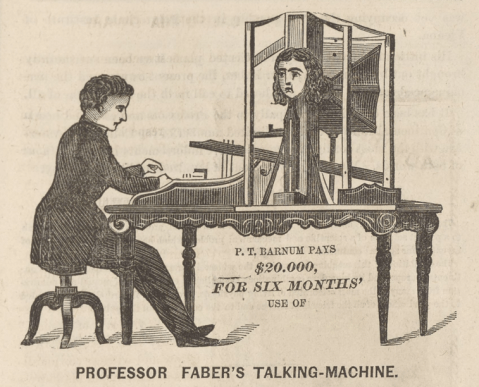
J. Martin Vest
In the early 1870s a talking machine, contrived by the aptly-named Joseph Faber appeared before audiences in the United States. Dubbed the “talking head” by its inventor, it did not merely record the spoken word and then reproduce it, but actually synthesized speech mechanically. It featured a fantastically complex pneumatic system in which air was pushed by a bellows through a replica of the human speech apparatus, which included a mouth cavity, tongue, palate, jaw and cheeks. To control the machine’s articulation, all of these components were hooked up to a keyboard with seventeen keys— sixteen for various phonemes and one to control the Euphonia’s artificial glottis. Interestingly, the machine’s handler had taken one more step in readying it for the stage, affixing to its front a mannequin. Its audiences in the 1870s found themselves in front of a machine disguised to look like a white European woman.[. . .Click here to read more!]
9).Mixtapes v. Playlists: Medium, Message, Materiality
Mike Glennon
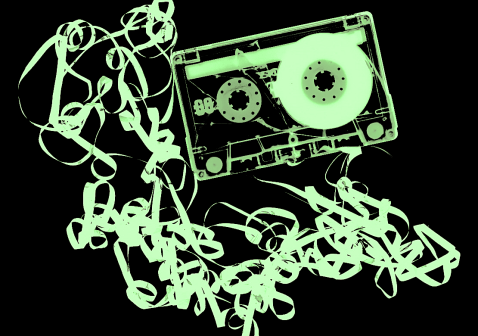
The term mixtape most commonly refers to homemade cassette compilations of music created by individuals for their own listening pleasure or that of friends and loved ones. The practice which rose to widespread prominence in the 1980s often has deeply personal connotations and is frequently associated with attempts to woo a prospective partner (romantic or otherwise). As Dean Wareham, of the band Galaxie 500 states, in Thurston Moore’s Mix-Tape: The Art of Cassette Culture, “it takes time and effort to put a mix tape together. The time spent implies an emotional connection with the recipient. It might be a desire to go to bed, or to share ideas. The message of the tape might be: I love you. I think about you all the time. Listen to how I feel about you” (28).
Alongside this ‘private’ history of the mixtape there exists a more public manifestation of the form where artists, most prominently within hip-hop, have utilised the mixtape format to the extent that it becomes a genre, akin to but distinct from the LP. As Andrew “Fig” Figueroa has previously noted here in SO!, the mixtape has remained a constant component of Hip Hop culture, frequently constituting, “a rapper’s first attempt to show the world their skills and who they are, more often than not, performing original lyrics over sampled/borrowed instrumentals that complement their style and vision.” From the early mixtapes of DJs such as Grandmaster Flash in the late ’70s and early ’80s, to those of DJ Screw in the ’90s and contemporary artists such as Kendrick Lamar, the hip-hop mixtape has morphed across media, from cassette to CDR to digital, but has remained a platform via which the sound and message of artists are recorded, copied, distributed and disseminated independent of the networks and mechanics of the music and entertainment industries. In this context mixtapes offer, as Paul Hegarty states in his essay, The Hallucinatory Life of Tapes (2007), “a way around the culture industry, a re-appropriation of the means of production.” [. . .Click here for more!]
8).My Music and My Message is Powerful: It Shouldn’t be Florence Price or “Nothing”
Samantha Ege
Flashback to the second day of the recent Gender Diversity in Music Making Conference in Melbourne, Australia (6-8 July 2018). In a few hours, I will perform the first movement of the Sonata in E minor for piano by Florence Price(1887–1953). In the lead-up, I wonder whether Price’s music has ever been performed in Australia before, and feel honored to bring her voice to new audiences. I am immersed in the loop of my pre-performance mantra:
My music and message is powerful, my music and message is powerful.
Repeating this phrase helps me to center my purpose on amplifying the voice of a practitioner who, despite being the first African-American woman composer to achieve national and international success, faced discrimination throughout her life, and even posthumously in the recognition of her legacy.
In Price’s time, there were those in positions of privilege and power who listened to her music and gave her a platform. One such instance was Frederick Stock of the Chicago Symphony Orchestra and his 1933 premier of her Symphony in E minor. But there were times when her musical scores were met with silence. For example, when she wrote to Serge Koussevitzky of the Boston Symphony Orchestra requesting that he hear her music, the letter remained unanswered. There was a notable intermittency in how Price was heard, which continues today. It seems most natural for mainstream platforms to amplify her voice in months dedicated to women and Black history; any other time of the year appears to require more justification. And so, as I am repeating this mantra—my music and message is powerful—I am attempting to de-centre my anxieties, and center my service to amplifying Price’s voice through an assured performance . [. . .Click here for more!]
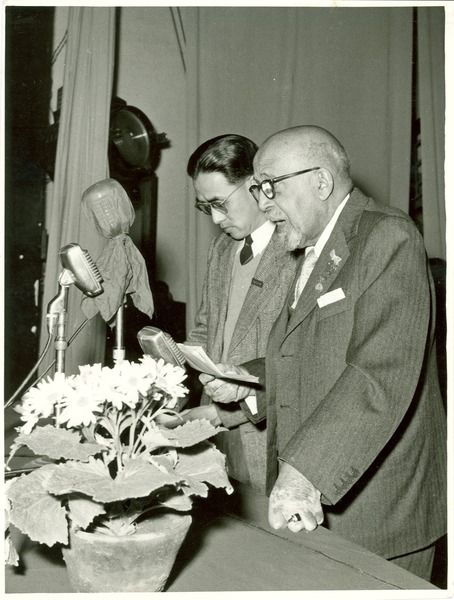
7). “Most pleasant to the ear”: W. E. B. Du Bois’s Itinerant Intellectual Soundscapes
Phillip Sinitiere
Upon completing a Ph.D. in history at Harvard in 1895, and thereafter working as a professor, author, and activist for the duration of his career until his death in 1963, Du Bois spent several months each year on lecture trips across the United States. As biographers and Du Bois scholars such as Nahum Chandler, David Levering Lewis, and Shawn Leigh Alexander document, international excursions to Japan in the 1930s included public speeches. Du Bois also lectured in China during a global tour he took in the late 1950s.
In his biographical writings, Lewis describes the “clipped tones” of Du Bois’s voice and the “clipped diction” in which he communicated, references to the accent acquired from his New England upbringing in Great Barrington, Massachusetts. Reporter Cedric Belfrage, editor of the National Guardian for which Du Bois wrote between the 1940s and 1960s, listened to the black scholar speak at numerous Guardian fundraisers. “On each occasion he said just what needed saying, without equivocation and with extraordinary eloquence,” Belfrage described. “The timbre of his public-address voice was as thrilling in its way as that of Robeson’s singing voice. He wrote and spoke like an Old Testament prophet.” George B. Murphy heard Du Bois speak when he was a high school student and later as a reporter in the 1950s; he recalled the “crisp, precise English of [Du Bois’s] finely modulated voice.” [. . .Click here for more]
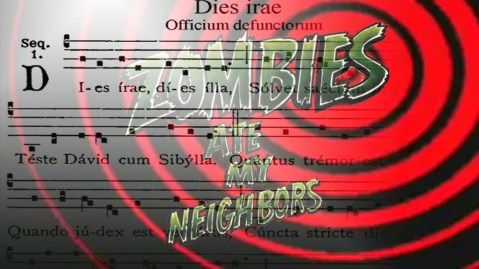
6.) Beyond the Grave: The “Dies Irae” in Video Game Music
Karen Cook
For those familiar with modern media, there are a number of short musical phrases that immediately trigger a particular emotional response. Think, for example, of the two-note theme that denotes the shark in Jaws, and see if you become just a little more tense or nervous. So too with the stabbing shriek of the violins from Psycho, or even the whirling four-note theme from The Twilight Zone. In each of these cases, the musical theme is short, memorable, and unalterably linked to one specific feeling: fear.
The first few notes of the “Dies Irae” chant, perhaps as recognizable as any of the other themes I mentioned already, are often used to provoke that same emotion. [. . .Click here for more!]
5). Look Away and Listen: The Audiovisual Litany in Philosophy
Robin James
According to sound studies scholar Jonathan Sterne in The Audible Past, many philosophers practice an “audiovisual litany,” which is a conceptual gesture that favorably opposes sound and sonic phenomena to a supposedly occularcentric status quo. He states, “the audiovisual litany…idealizes hearing (and, by extension, speech) as manifesting a kind of pure interiority. It alternately denigrates and elevates vision: as a fallen sense, vision takes us out of the world. But it also bathes us in the clear light of reason” (15). In other words, Western culture is occularcentric, but the gaze is bad, so luckily sound and listening fix all that’s bad about it. It can seem like the audiovisual litany is everywhere these days: from Adriana Cavarero’s politics of vocal resonance, to Karen Barad’s diffraction, to, well, a ton of Deleuze-inspired scholarship from thinkers as diverse as Elizabeth Grosz and Steve Goodman, philosophers use some variation on the idea of acoustic resonance (as in, oscillatory patterns of variable pressure that interact via phase relationships) to mark their departure from European philosophy’s traditional models of abstraction, which are visual and verbal, and to overcome the skeptical melancholy that results from them. The field of philosophy seems to argue that we need to replace traditional models of philosophical abstraction, which are usually based on words or images, with sound-based models, but this argument reproduces hegemonic ideas about sight and sound. [. . .Click here to read more!]
4). becoming a sound artist: analytic and creative perspectives
Rajna Swaminathan
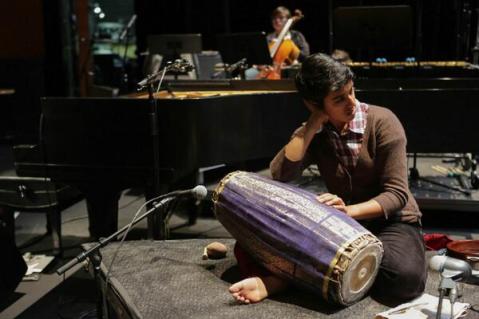
Recently, in a Harvard graduate seminar with visiting composer-scholar George Lewis, the eminent professor asked me pointedly if I considered myself a “sound artist.” Finding myself put on the spot in a room mostly populated with white male colleagues who were New Music composers, I paused and wondered whether I had the right to identify that way. Despite having exploded many conventions through my precarious membership in New York’s improvised/creative music scene, and through my shift from identifying as a “mrudangam artist” to calling myself an “improviser,” and even, begrudgingly, a “composer” — somehow “sound artist” seemed a bit far-fetched. As I sat in the seminar, buckling under the pressure of how my colleagues probably defined sound art, Prof. Lewis gently urged me to ask: How would it change things if I did call myself a sound artist? Rather than imposing the limitations of sound art as a genre, he was inviting me to reframe my existing aesthetic intentions, assumptions, and practices by focusing on sound.
Sound art and its offshoots have their own unspoken codes and politics of membership, which is partly what Prof. Lewis was trying to expose in that teaching moment. However, for now I’ll leave aside these pragmatic obstacles — while remaining keenly aware that the question of who gets to be a sound artist is not too distant from the question of who gets to be an artist, and what counts as art. For my own analytic and creative curiosity, I would like to strip sound art down to its fundamentals: an offering of resonance or vibration, in the context of a community that might find something familiar, of aesthetic value, or socially cohesive, in the gestures and sonorities presented. [. . .Click here for more!]
Eddy Francisco Alvarez Jr.
How Many Latinos are in this Motherfucking House? –DJ Irene
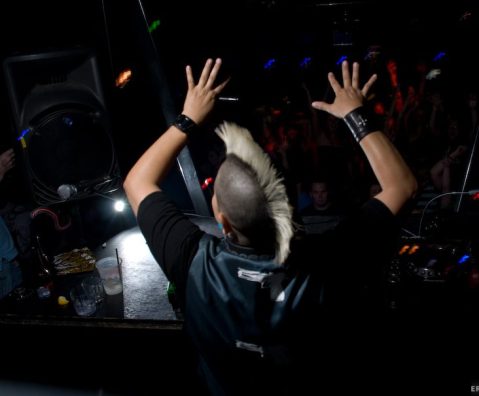
At the Arena Nightclub in Hollywood, California, the sounds of DJ Irene could be heard on any given Friday in the 1990s. Arena, a 4000-foot former ice factory, was a haven for club kids, ravers, rebels, kids from LA exurbs, youth of color, and drag queens throughout the 1990s and 2000s. The now-defunct nightclub was one of my hang outs when I was coming of age. Like other Latinx youth who came into their own at Arena, I remember fondly the fashion, the music, the drama, and the freedom. It was a home away from home. Many of us were underage, and this was one of the only clubs that would let us in.
Arena was a cacophony of sounds that were part of the multi-sensorial experience of going to the club. There would be deep house or hip-hop music blasting from the cars in the parking lot, and then, once inside: the stomping of feet, the sirens, the whistles, the Arena clap—when dancers would clap fast and in unison—and of course the remixes and the shout outs and laughter of DJ Irene, particularly her trademark call and response: “How Many Motherfucking Latinos are in this Motherfucking House?,” immortalized now on CDs and You-Tube videos.
Irene M. Gutierrez, famously known as DJ Irene, is one of the most successful queer Latina DJs and she was a staple at Arena. Growing up in Montebello, a city in the southeast region of LA county, Irene overcame a difficult childhood, homelessness, and addiction to break through a male-dominated industry and become an award-winning, internationally-known DJ. A single mother who started her career at Circus and then Arena, Irene was named as one of the “twenty greatest gay DJs of all time” by THUMP in 2014, along with Chicago house music godfather, Frankie Knuckles. Since her Arena days, DJ Irene has performed all over the world and has returned to school and received a master’s degree. In addition to continuing to DJ festivals and clubs, she is currently a music instructor at various colleges in Los Angeles. Speaking to her relevance, Nightclub&Bar music industry website reports, “her DJ and life dramas played out publicly on the dance floor and through her performing. This only made people love her more and helped her to see how she could give back by leading a positive life through music.” [. . .Click here for more!]

2). Canonization and the Color of Sound Studies
Budhaditya Chattopadhyay
Last December, a renowned sound scholar unexpectedly trolled one of my Facebook posts. In this post I shared a link to my recently published article “Beyond Matter: Object-disoriented Sound Art (2017)”, an original piece rereading of sound art history. With an undocumented charge, the scholar attacked me personally and made a public accusation that I have misinterpreted his work in a few citations. I have followed this much-admired scholar’s work, but I never met him personally. As I closely read and investigated the concerned citations, I found that the three minor occasions when I have cited his work neither aimed at misrepresenting his work (there was little chance), nor were they part of the primary argument and discourse I was developing.
What made him react so abruptly? I have enjoyed reading his work during my research and my way of dealing with him has been respectful, but why couldn’t he respect me in return? Why couldn’t he engage with me in a scholarly manner within the context of a conversation rather than making a thoughtless comment in public aiming to hurt my reputation?
Consider the social positioning. This scholar is a well-established white male senior academic, while I am a young and relatively unknown researcher with a non-white, non-European background, entering an arena of sound studies which is yet closely guarded by the Western, predominantly white, male academics. This social divide cannot be ignored in finding reasons for his outburst. I immediately sensed condescension and entitlement in his behavior. [. . .Click here for more!]
1). Botanical Rhythms: A Field Guide to Plant Music
Carlo Patrão
Only overhead the sweet nightingale
Ever sang more sweet as the day might fail,
And snatches of its Elysian chant
Were mixed with the dreams of the Sensitive Plant
Percy Shelley, The Sensitive Plant, 1820
ROOT: Sounds from the Invisible Plant
Plants are the most abundant life form visible to us. Despite their ubiquitous presence, most of the times we still fail to notice them. The botanists James Wandersee and Elizabeth Schussler call it “plant blindness, an extremely prevalent condition characterized by the inability to see or notice the plants in one’s immediate environment. Mathew Hall, author of Plants as Persons, argues that our neglect towards plant life is partly influenced by the drive in Western thought towards separation, exclusion, and hierarchy. Our bias towards animals, or zoochauvinism–in particular toward large mammals with forward facing eyes–has been shown to have negative implications on funding towards plant conservation. Plants are as threatened as mammals according to Kew’s global assessment of the status of plant life known to science. Curriculum reforms to increase plant representation and engaging students in active learning and contact with local flora are some of the suggested measures to counter our plant blindness.
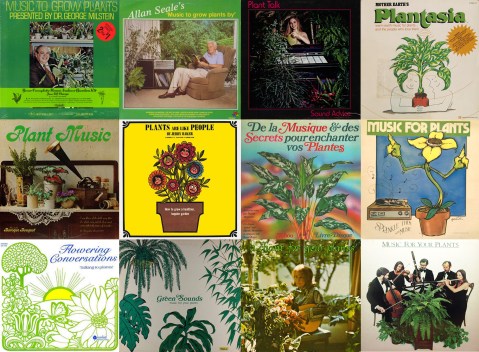
Participatory art including plants might help dissipate plants’ invisibility. Some authors argue that meaningful experiences involving a multiplicity of senses can potentially engage emotional responses and concern towards plants life. In this article, I map out a brief history of the different musical and sound art practices that incorporate plants and discuss the ethics of plant life as a performative participant. [. . .Click here for more!]
—
Featured Image: “SO! stamp” by j. Stoever
—
 REWIND! . . .If you liked this post, you may also dig:
The Top Ten Sounding Out! Posts of 2017!
The Top Ten Sounding Out! Posts of 2016!
The Top Ten Sounding Out! Posts of 2015!
Blog-o-versary Podcast EPISODE 62: ¡¡¡¡RESIST!!!!
Share this:

My Music and My Message is Powerful: It Shouldn’t be Florence Price or “Nothing”
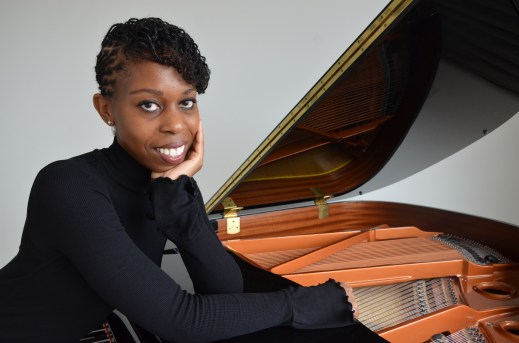
Flashback to the second day of the recent Gender Diversity in Music Making Conference in Melbourne, Australia (6-8 July 2018). In a few hours, I will perform the first movement of the Sonata in E minor for piano by Florence Price (1887–1953). In the lead-up, I wonder whether Price’s music has ever been performed in Australia before, and feel honored to bring her voice to new audiences. I am immersed in the loop of my pre-performance mantra:
My music and message is powerful, my music and message is powerful.
Repeating this phrase helps me to center my purpose on amplifying the voice of a practitioner who, despite being the first African-American woman composer to achieve national and international success, faced discrimination throughout her life, and even posthumously in the recognition of her legacy.
In Price’s time, there were those in positions of privilege and power who listened to her music and gave her a platform. One such instance was Frederick Stock of the Chicago Symphony Orchestra and his 1933 premier of her Symphony in E minor. But there were times when her musical scores were met with silence. For example, when she wrote to Serge Koussevitzky of the Boston Symphony Orchestra requesting that he hear her music, the letter remained unanswered. There was a notable intermittency in how Price was heard, which continues today. It seems most natural for mainstream platforms to amplify her voice in months dedicated to women and Black history; any other time of the year appears to require more justification. And so, as I am repeating this mantra—my music and message is powerful—I am attempting to de-centre my anxieties, and center my service to amplifying Price’s voice through an assured performance.
I applied to the conference a few months ago. I was keen to bring my research to new audiences. Upon seeing that the conference was in Australia, I knew this would be a fantastic opportunity to gain transnational insight into the ongoing work around representation and inclusion in music. Fast-forward to July: here I am, in Australia for the first time. The venue is unfamiliar and I have not met anyone here before this visit. However, this is what I do know: I have fifteen minutes for my performance; hence, I have only prepared the first movement of the sonata. Looking in the program, I noticed there will be a paper taking place at the same time as my performance, given by an academic who identified himself in his printed abstract as “a white, old, straight man with power and privilege.”
The title of his paper? “I Have Nothing to Say.” While gender diversity was the overarching theme of the conference, the goal towards inclusion negated the fact that not all platforms are created equal. The speaker’s proposed topic advertised the ease with which the dominant voice may access a space for its mere presence, regardless of what will be said. Conference logistics then set this voice and its contribution against the radically diverse sounds of our time slot. In addition to my lecture and performance, there are several other events taking place simultaneously. The subjects include: mentoring women composers, creative realizations of parenthood in composition, gender balance in Australian jazz, interpretative approaches to the music of Kaija Saariaho, music as a vehicle for navigating the challenges around non-binary and transgender identity, and a cis-gendered white man’s exploration of ceding power and listening.
I remember a casual conversation the night before in which the joke arose of the speaker being “the token white man.” Of course it was a joke; the very notion is absolutely ridiculous. I remember reflecting on tokenization earlier that day and tweeting to that effect:
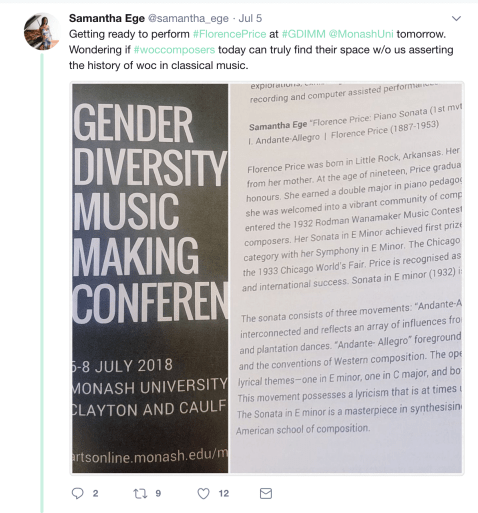
I knew the joke was light-hearted, but there is nothing light-hearted about being a token, nothing light-hearted about knowing your excellence, yet wondering if it will even factor into the decisions around your involvement. Anyway, I did not want to prioritize thoughts about the token white man over my purpose at the conference because that would take up time, space and energy, and in my pre-performance rituals, that time, space and energy belongs exclusively to the women that I seek to honour.
When it is time to perform, I bow, then sit, then sink into the first sound, which is this rich e minor chord that engages almost all of my fingers. I relish the rich tones in the grandeur of the introduction. But as the first theme comes in, conjuring up the soundworld of plantation songs, I calm the mood down to ensure that the lyricism of the top melody really sings.
My music and message is powerful.
The performance is followed by a presentation where I talk more about the sonata, who Price was, and what she achieved. I make sure to highlight her Arkansan roots and her Chicago successes, particularly around the Symphony in E minor. I speak about the influence of the spirituals within the classical frameworks of her compositions. I also speak about the privilege and the incredibly moving significance of being able to present and perform her music for an audience, largely of African descent, at the Chicago Symphony Center.
I play excerpts from the rest of the sonata off my recent album Four Women on Spotify and struggle to find the best time to pause the track because there is so much that I want the audience to hear: from the development of spiritual themes in the second movement, to the virtuosic whirlwind that is the final movement.
A dynamic discussion ensues, weaving in the narratives of Nina Simone, African-American folk tradition and my passion for this repertoire. I elaborate upon the ways in which exploring classical music by women has been an empowering personal journey. I articulate how the perception of men achieving “firsts” renders them gods while women achieving “firsts” are miracles that were never supposed to happen, that may never happen again. I express my role as a musicologist-pianist as demonstrating a long and rich history of women music-makers and, therefore, evidencing precedents—her-stories—for the creative contributions of women now. My time comes to an end and I am left feeling proud to have represented Price’s music and legacy here, today.
After my performance, I tweeted the following thought-through (but clearly not proof-read) thread expressing my disappointment:
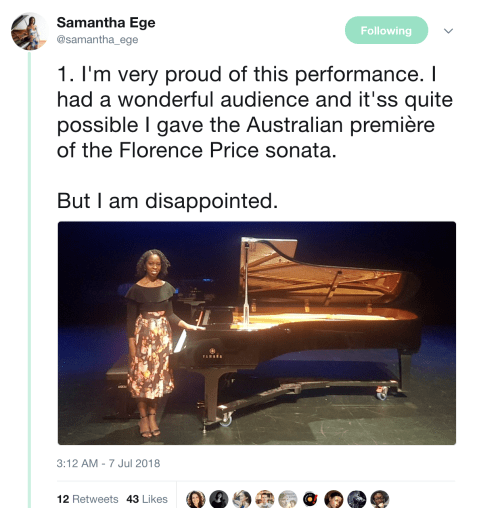
My goal with this post was to juxtapose this paper with Price’s music and career, spotlighting the implications of uneven power and access therein.
3. His talk was called “I have nothing to say.”
Some people therefore chose to listen to a man who has “nothing to say” over the music of an African American woman composer who has historically been silenced and is barely heard in this current day.
Let that sink in.
— Samantha Ege (@samantha_ege) July 7, 2018
Wrapped up in my post was the criticism of the fact that, being a university professor, the speaker of “I Have Nothing to Say,” has access to this kind of platform year-round, while marginalised voices only get amplified in the specific and limited spaces that society has carved out for them.
My critique is not about the individual, but about the systemic and institutionalized undermining of underrepresented voices, even at a conference designed to amplify them. The fact that such a work was placed on such a program evidences the extent to which we are so conditioned to ensuring the most powerful and privileged voice speaks in every single space, even when they acknowledge they have nothing to say.
Since posting that evening to both Twitter and Facebook, I have received a backlash on the latter, one that is, at present, unaffiliated with the organisers of the event. It has, however, attempted to derail the conversation. Apparently I was only upset because my program faced competition from other papers. Maybe I should have looked into the scheduling to make different arrangements. Or I should have found out what the speaker’s talk was about because there is a chance that I would have enjoyed it. Repeatedly, the onus was placed on me to reach out to the “token white man” and better understand his position. I also learned something new: passing judgement on a presentation because of its title is no better than passing judgement on a composer because of their gender. However, I was under the impression that the paper title was a choice and that Price’s identity as a black woman was not.
Anyway, I did not judge by the title. I judged by the abstract:
When one of the organisers of this conference suggested in a Facebook exchange on someone else’s post that I should submit an abstract for a paper, I was surprised. And a little frightened. What could I possibly contribute to such an event? I am the problem. I am a white, old, straight man with power and privilege. Surely my voice could only be heard by others as a violence in this context. Surely, my job is to get out of the way, to shut up, to not be heard. Surely, the only thing I could ethically and honourably bring to this is my listening. But then I felt that this is what needs to be said. I am and old straight white man who says that the job of people like me is to actively get out of the way, actively cede power and authority, actively be told, actively shut the fuck up. So I decided to use the occasion to practice a way of speaking that does those things, gets out of the way, cedes power and authority, gets told, shuts the fuck up. To practice speaking which listens. A listening-speaking. So that’s what I am trying to do in this paper. To enact a listening-speaking that gets out of the way, cedes power and authority, gets told, shuts the fuck up.
The speaker’s participation was invited and his proposal both encouraged and evidently accepted by the organizers. The abstract presents a sense of knowing better. “Surely my voice could only be heard by others as a violence in this context.” Yes. “Surely, my job is to get out of the way, to shut up, to not be heard.” Yes. “Surely, the only thing I could ethically and honourably bring to this is my listening.” Yes! “But…”
Ultimately, what needed to be said, actually needed to be done. The enacting of a listening-listening with neither platform nor audience would have been a powerful statement, quietly powerful, but powerful nonetheless. To reiterate, not all platforms are made equal—could I, realistically, have told him to shut the fuck up? How would that have sounded? How would I have sounded?
The derailing responses I have received pointedly ignore how the very presence of this paper disrupted the multiple and intersectional conversations happening in that moment. It distracted from the rarity of these subjects and their platform, and quite materially, culled an audience who could and should have been doing the very listening the abstract advertises. Scheduling this paper restored the speaker’s position to the center, and re-centered his power and authority to speak about everything and “nothing.” His privilege remained intact. In the midst of the most diverse and pertinent themes was the voice that has, both historically and to this day, spoken over the top of so many others.
“Trocadero Piano Player” by Flickr User Pierre Metivier (CC BY-NC 2.0)
I chose not to reach out directly to the institution nor its organisers because of the emotional labor this would entail. To put the issue forward in a quiet behind-the-scenes way that is sensitive to those who created the issue, is to chip away at my voice and its power. On the otherhand, to project the issue with a loud “shut the fuck up” is to perform a type of power and privilege on a platform that I do not have. I enact a public conversation here via Sounding Out! so that this experience may inform wider work towards diversity and representation. I enact this conversation in order to progress definitions of inclusion to a point where the choice to engage the dominant voice factors in a listening-listening as an exceedingly valuable contribution to the narratives offered by lesser heard voices.
I have since received a written acknowledgement from the organizers of this problematic programming, with a formal apology for the impact. But I must bring to light the important action of two allies, in particular, who recognised the emotional work required of me to bring this forward institutionally. They offered to continue the conversation on my behalf. We talked about the way in which the ensuing discussion must center listening. We shared that the process towards inclusivity may result in mistakes being made along the way. We discussed that while compassion and sensitivity can be important parts of the dialogue, I cannot afford to extend that compassion and sensitivity without becoming emotionally drained. And so, they wrote to the institution with the message of actively learning and making efforts towards change. I am so grateful for that allyship because while I knew that my voice would be heard, I could not guarantee how it would be heard. After all, if there is one take away to be had from this experience, it is that regardless of intention—and regardless of occasion—the dominant voice is very much conditioned to speak up, and speak over. And the dominant ear cannot help but listen.
So, how do I move forward?
My music and my message is powerful.
—
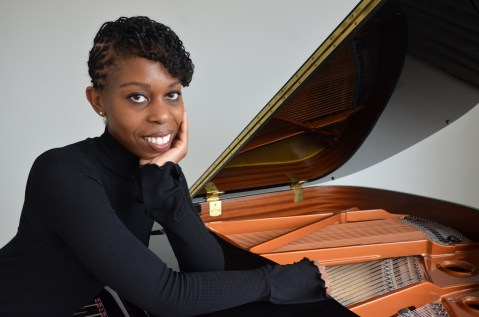
Featured Image: Courtesy of Author
—
 Samantha Ege is a British musicologist, pianist and teacher based in Singapore. She is a Ph.D. candidate in Music at the University of York, UK. Her research focuses on the aesthetics of Florence Price. As a pianist, her focus on women composers has led to performances in Singapore (supported by the British High Commission and International Women’s Day), and lecture-recitals at the University of York, the Chicago Symphony Center and the Women Composers Festival of Hartford, USA. Her album Four Women: Music for Solo Piano by Price, Kaprálová, Bilsland & Bonds reflects her journey into a rich and unrepresented repertoire.
She would like to thank Deborah Torres Patel for the gift of this mantra.
—
 REWIND! . . .If you liked this post, you may also dig:
Spaces of Sounds: The Peoples of the African Diaspora and Protest in the United States–Vanessa Valdes
becoming a sound artist: analytic and creative perspectives–Rajna Swaminathan
Sounding Out Tarima Temporalities: Decolonial Feminista Dance Disruption–Iris C. Viveros Avendaño
Gendered Soundscapes of India, an Introduction –Praseeda Gopinath and Monika Mehta
On Whiteness and Sound Studies–Gustavus Stadler
Share this:




Current Top Posts





April 2021

January 2020

November 2019

October 2019

August 2019

April 2014

November 2017

March 2015

December 2017

October 2015


Recent Comments