Part of this surge in scholarly attention and artistic projects is premised on the idea that sound and sound recordings are important additions to cultural heritage in documenting histories and personal evidence, and yet, they are often viewed as supplementary adjuncts to more physical or visual archival artefacts. This subjugation to the primacy of the visual extends to the arts, humanities, and social sciences, but this is beginning to change as scholars across these fields increasingly argue that sound (with its attendant listening) is an especially critical medium for cultivating different modes of attention, forging affective relations, producing alternative knowledges, revealing hidden narratives, and attuning to neglected pasts.
Two digital sound archival projects created in response to the pandemic, The Pandemic SensoryArchive and#StayHomeSounds, are especially instructive in thinking about sound as a key medium for engaging with the monumental a/effects of the present and as important contributions to cultural history. Like other pandemic digital sound archival projects, these two projects sought to document the present for the future – creating a “past” in real time, based on the underlying assumption that sound – as a material-discursive apparatus – can offer particularly generative possibilities in this context. The methods, scope, and presentation design employed by these two web-based archival platforms generates a sense of intimacy, proximity, andcollectivity in otherwise surreal, secluded, uncertain, detached, and disconnected situations, much like in radio and podcasting though in this case with different infrastructure and interactivity.
In these online, mediated spaces where worlds intensely collide and conflate, and users become flattened out and disembodied, new configurations of intimacy, subjectivities, and world-building emerge through alternative forms of affective archival engagement. This was (and still is) particularly important and complex during COVID-19, which is marked not only by a series of indefinite lockdowns and uneven distribution of intervention measures, but an affective logic whereby life is completely reconfigured and capacities within the world are diminished and redistributed. Part of making mass sound archives usable relies on the medium for circulation, the presentation for users, and what user participation empowers for these living histories, as Fabiola Hanna makes clear. These two projects generate what Hanna identifies as a particular orientation in digital humanities projects through a politics of listening that necessitates an active mode of participation that is not simply one-directional but a two-way engagement.
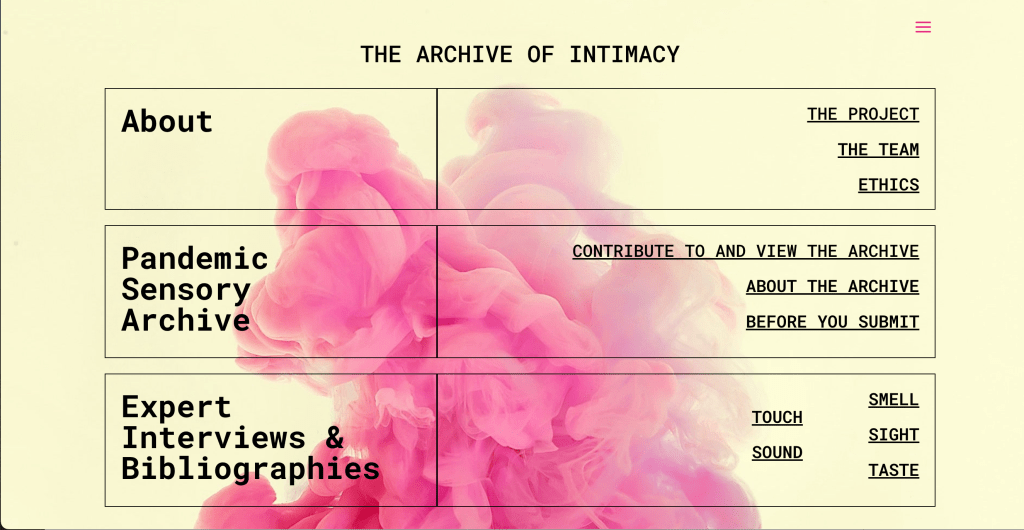
The Archive of Intimacy, later renamed The Pandemic Sensory Archive (PSA), wascreated by professors William Tullett (Associate Professor in Sensory History, Anglia Ruskin University, U.K.) and Hannah McCann (Senior Lecturer in Cultural Studies, University of Melbourne, Australia) with the goal of exploring the senses through a digital platform and to act as an open data bank of contributions from the public. Their open call for contributions asks for a response that considers two questions: What smells, sights, sounds, touch, and/or tastes do you associate with the pandemic? Has your experiences of the senses (smell/sight/hearing/touching/taste) changed at all as a result of the pandemic? Contributors are then asked to drop a pin on the map (though this is not a typical Google Maps rendition of a specific locale, but a sort of simplified graphic representation of sensory input/output waves) and follow the prompts to anonymously submit. The digital map is divided among the five senses and features the entries that contain a title and brief response, such as:
Quiet where there should not be quiet: “Being in my flat in the centre of town on my own with nobody else around on a Saturday. Everything weirdly, eerily, quiet.”
Birdsong: “Hearing birdsong in the garden having not noticed it before, no longer drowned out.”
You’re on mute! “Did the conversation in meetings become less robust as we all sit there on mute, politely waiting for our turn to speak?”
Less sound, more sound: “Blissfully quiet at night as curfew curtails the normal constant traffic roars, far more voices in the early morning and through the day as people‘exercise together’ to socialize in the park”
Complimenting this map, which may seem limited in scope but allows users to engage without having to sift through an overwhelming amount of content, is the Sound category page, where four interviews are embedded with “sensory experts on sound during the Covid-19 pandemic,” including Shoshana Rosenberg, Andrew Mitchell, Martin Stewart, and Stephen Sullivan. One interview considers how the pandemic clarified the immensely relational dimension of artistic sound practice and that the lack of access to intimacy during lockdown instigated a radical reformatting and questioning of what it means, more broadly and now, to be intimate and close in creating sound art. For them, what the pandemic spelled out is that intimacy is fragile and valuable, and that this delicate balance and fluctuating ratio has come to the fore during this time.
The initial designation for the platform, “the archive of intimacy,” is worth meditating on to consider the particular forms of intimacy in this context, perhaps through Lauren Berlant’s “intimate publics” – a concept that captures the affective and collective dimensions of intimacy among strangers. The notion lends itself to understanding the mediated social intimacy in these spaces and the different affective experiences they invite in varying capacities through sound.The connection between imagined publics and community through sound has, of course, been conceptualized by scholars who do historical work on radio and podcast studies, but it can also be extended to these digital, affective, pandemic sound archives. Evidenced in the submission prompts and interview data, the emphasis on the distinct shifts and palpable changes resulting from this new situation, and its accompanying affective logic, can be read as a strategy for cultivating intimacy and connection because attending to these changes may render their intensities as less alarming.
“Listening” by Flickr User Silvia Siri, April 4, 2020CC BY-NC 2.0 DEED
Through the descriptions and dialogues of these new affective environments grounded in sound, some users might feel a sense of camaraderie, connection, and affinity to these novel experiences and how it relates or compares to one’s own (or the sense of not being so alone), especially in the personalized, diaristic, idiosyncratic tone in the short text extracts and longer interview forms. According to Tizian Zumthurm and Stefan Krebs (2022), digital spaces enable this type of “self-affirmation: by contributing and following the contributions of others, users are assured that they are not alone in whatever they experienced” (492). They also point out that as a result crowdsourced archives, particularly related to traumatic events, have a curative function.
Although the PSA may not be what likely comes to mind when thinking about a digital sound archive, presumably composed exclusively of musical or field recordings, it provides an entry point into a confluence of concerns to grapple with some of the key questions and issues related to sound, intimacy, and affect during the pandemic. In particular, diversity in form – between short excerpts and lengthier conversations, creates different engagement options for users based on preference and capacity (quick snapshots of the sonic changes in daily life or deeper explorations concerning sonic worlds), and across sensory inputs. Moreover, interviews add an oral history aspect to the project, which some scholars argue is more empowering and intimate than other modes of telling or sharing history. As a historically feminist practice, oral history has the potential to expose ignored topics and present diversified perspectives on traumatic pasts (like the 1918 pandemic) which is also especially important considering the research areas and professional backgrounds among the interview experts.
#StayHomeSounds is part of a larger project led by UK-based sound artist Stuart Fowkes, who created Cities and Memories in 2014, which Milena Droumeva describes as a “one-of-a-kind sonic portal dedicated to the exploration of place, sound and memory” (147). The website boasts being the largest sound project in the world with over 5000 sound recordings from over 1000 different contributors across 100 territories worldwide. It encompasses field recordings, sound art, and sound mapping, and each location features two sounds: the original field recording of that place and a reimagined sound that presents that place and time as somewhere, something else. The listener can explore sites through their actual sounds or the reimagined versions, flipping between the two different sound worlds. #StayHomeSounds is one of the latest ongoing sub-projects on the site and it is a collection of recordings during the pandemic from all over the world mostly done using cell phone recordings.
Bari lockdown sound recorded by Roberto Lippolis.
Although there is a wide range of quality and content, #StayHomeSounds offers a glimpse into the everyday sonic realities of quarantine life that cut across geography, life, and circumstances. The immensely mundane soundscapes and sheer multitude of recordings across cities and regions allows us to listen comparatively and try to notice the striking sonic cultures of different places even in lockdown. Those submitting sounds are required to provide a reflective text, and an elective representative image, to accompany their recording which details the changes in the soundscape as well as any a/effects that change has produced on other aspects of life.
An entry from Vancouver reads “Their chorus runs day and night and is a most pleasant soundtrack to both fall asleep with and wake up to. In this clip the background birds have joined in to add their avian melody to the amphibian bass line.”
Another from the Greek island of Crete, “after a heavy rain last night, the chirping of the birds woke me up this morning. It was such a powerful sound, like waking up from a sweet dream or a bad nightmare. I think that due to quarantine measures the nature’s sounds are more clear than even before.”
Athens, Greece lockdown sound recorded by Stamatis Mitrou.
In New Orleans, “I’m thankful for my quiet spot out here on the edges of town, but I worry about how the city can recover and for all those sick, out of work, or unable to stay home.”
New Orleans lockdown sounds recorded by Elizabeth Joan Kelly.
The objectives of the project, as described by Fowkes in the online text, are largely affective or affectively oriented, that is, to establish a sense of connection in the present, “how it feels at this unique moment,” by being able to discover new relations to place, to others, and to our sentient selves, through these sonic recordings and texts. In an interview with the Thomson Reuters Foundation, Fowkes said, “(You can) see what other people are hearing around the world and also read their stories and see that actually people are feeling similarly… hopefully that helps to make us feel a little bit more connected.” The breadth of contributions in terms of different locations and number of entries helps build this sense of connection, increasing the possibility of similar experiences to be seen and heard.
Lockdown sound from Lagos, Nigeria recorded by Ibukun Sunday.
By attending to personal struggles, observations, and speculations in relation to sound, these two digital sound archival projects gesture towards the intersections of intimacy, memory, and world-building, and alleviate and mediate some of the dominant and pervading affects that marked lockdown and remote life. In undertaking this project, I found pleasure in the informality of the responses and both the fresh insights and shared resonances, creating an experience that was jointly intimate (feeling seen and validated) and expansive (an opening to alternative experiences). In cultivating openness and a space for difference, and making the reflections and recordings publicly available, so that we can listen together but apart, the projects cultivate new forms of intimacy, empathy, collectivity, and nostalgia.
Dhaka, Bangladesh lockdown sound recorded by youKnowWho.
But, of course, the potential affective experience with the entries and recordings is not a given, much like with any critical scholarly intervention or artwork that attempts to raise awareness (in this case, to both the grave and minute effects of the pandemic) and resist dominant narratives (that the pandemic is under-control, over, or effects only one’s respiratory system), there is no guarantee that the intended experience will transpire in every engagement, but the possibility to do so – to cultivate intimacy and world-building at a time of profound uncertainty and physical distance – is nonetheless still valuable. Much like the diversity in responses, undoubtedly there are varying degrees and types of resonances, perceptions, and impacts within each visit.
Using an open access, crowdsourced approach, the PSA and #soundsathome construct participatory, community archives, creating and remediating documents and recordings for collective access and engagement on behalf of a global community that underwent monumental change, disruption, and loss. Calling explicit attention to palpable sensory shifts and disruptions is a central way to track, record, and make sense of the immense changes in this historical moment, and to illuminate the inequalities in environments and experiences that have been exacerbated by the (lack of) responses by governments and policy. The very existence of these projects and their participation through listening marks a resistance to the discourses of a “return to normalcy” or that we are on the other end of the pandemic. Because affects live in the body and are not often considered as objects of knowledge, the ongoing presence, use, and discussion of these two projects amplifies the a/effects, and a resistance to the affective logic of the pandemic, that they seek to produce. By considering COVID as an unprecedented, deeply affective, traumatic event, these online spaces operate to archive this moment in time and its myriad sonic dimensions, bringing these affective worlds into dialogue through an intimate exchange and assemblage between different bodies, experiences, and locations.
—
Emily Collins is an interdisciplinary researcher, writer, educator, and PhD Candidate in Cinema and Media Studies at York University in Tkaronto (Toronto) whose work draws on sound studies, feminist theory, critical disability studies, and cultural theory to examine sonic social relations and materiality through entanglements of resistance and care within contemporary artworks and creative practices. As a cultural worker and active member in the arts community, Emily has worked at diverse film, visual arts, and digital media organizations, institutions, and research networks within Canada and abroad, including Archive/Counter-Archive, PUBLIC Journal, VUCAVU, Festival Scope (Paris), the Toronto International Film Festival, and the Walter Phillips Gallery at Banff Centre for Arts and Creativity.
—
REWIND! . . .If you liked this post, you may also dig:
It’s baaaaack! For your end-of-the year reading pleasure, here are the Top Ten Posts published within the last three years (totals as of 12/8/22). Read and re-read this brilliance today–and often! And please do listen out for us in 2023– our Racial Bias in Speech AI series co-edited with Johann Diedrick is already in the works for May 2023 and a new CFP related to a print edition (!!) of Sounding Out! just launched! Please take good care, stay safe and well, and we’ll see you in January. Thank you for your readership and continued support. We’re here because you are here. –JS
. . .Over the past decade, Stoicism, which teaches that self-discipline, moderation, and emotional equanimity are key to overcoming hardship and living a good life, has had something of a revival as a self-help paradigm – and Holiday has been one of its most energetic evangelists. Articles in Vice, the New York Times, the Atlantic, the New Yorker, the Guardian, Forbes, Wired, and Sports Illustrated have all taken note of his influence among Silicon Valley tech workers, corporate executives, professional athletes, military personnel, and celebrities to whom he markets the philosophy as a “life-hack”; his six best-selling books on the subject, meanwhile, have positioned him as perhaps the most commercially successful author in a mushrooming genre of Stoic literature; and The Daily Stoic’s A-level guest list, which has included Malcom Gladwell, Camilla Cabello, Matthew McConaughey, and Charlamagne Tha God, has established Stoicism’s cultural cachet as a practical guide for living, and positioned Holiday as its authoritative interpreter. . . [Click here to read the full post!]
I first heard about voice donation while listening to “Being Siri,” an experimental audio piece about Erin Anderson donating her voice to Boston-based voice donation company, VocaliD. Like a digital blood bank of sorts, VocaliD provides a platform for donating one’s voice via digital audio recordings. These recordings are used to help technicians create a custom digital voice for a voiceless individual, providing an alternative to the predominately white, male, mechanical-sounding assistive technologies used by people who cannot vocalize for themselves (think Stephen Hawking). VocaliD manufactures voices that better match a person’s race, gender, ethnicity, age, and unique personality. To me, VocaliD encapsulates the promise, complexity, and problematic nature of our current speech AI landscape and serves as an example of why we need to think critically about sound technologies, even when they appear to be wholly beneficial. . . [Click here to read the full post!]
On January 23, 1973, Jean-Claude Duvalier, only 18 months into his life-long appointment, received a call that threatened to profoundly destabilize his nascent presidency. On the other end was Clinton E. Knox, a close political ally and advisor, who also happened to be the US Ambassador to Haiti. Knox, Jean-Claude was informed, along with US consul general Ward Christensen were being held hostage at a residence just outside of Port-au-Prince. To secure the safe return of two high-ranking US officials, the captors demanded the release of political prisoners, a hefty ransom, and a plane to facilitate their escape. The kidnappers “meant business,” reported The Washington Post, Times Herald on Jan 26, 1973, and during the call, Knox warned Jean-Claude of the severity of the situation, that they ”threatened to blow my head off, if they didn’t get what they wanted” . . . [Click here to read the full post!]
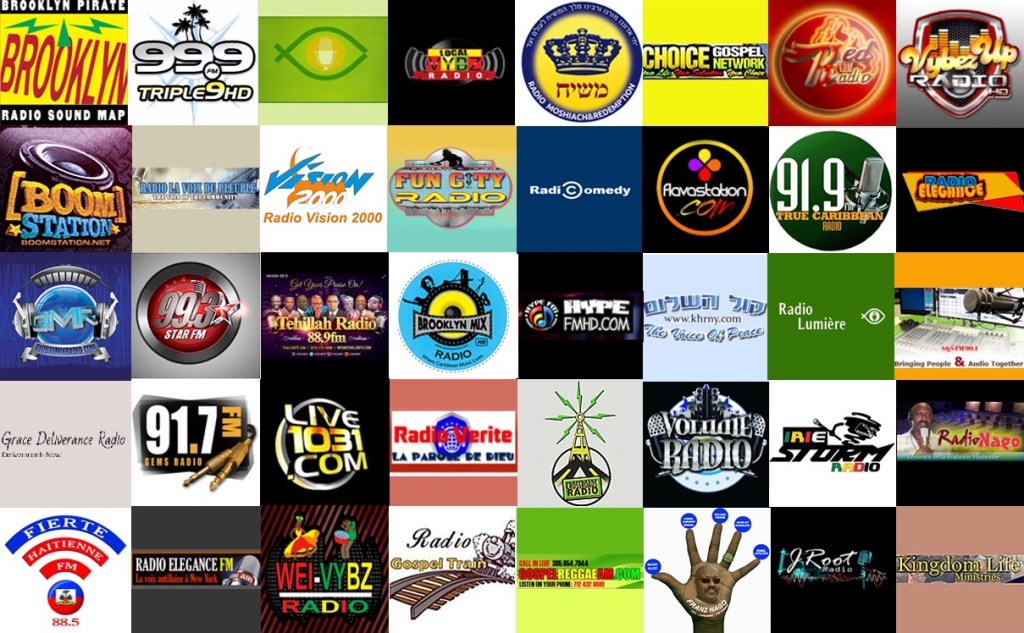
‘A lot of these stations, especially the Haitian stations, they have such an extensive music library that a song will come on the radio and all of a sudden my mom is like, ‘Oh my God! Your grandma used to have this record and she played it every Saturday!’ says Joan Martinez, a young Haitian-American born in the US and a former program host on some of the unlicensed Kreyol language stations. “Now she’s transported back to being on the island, with the big radio that’s a piece of furniture in the living room. People are chatting, little drinks are flowing about, my grandmother milling about in a gorgeous dress. It’s kind of like that whole nostalgia era that unfortunately was probably lost because of the political turmoil in Haiti. So it’s harkening back to a good time, to a simpler time, a better time, a more carefree era.” . . . [Click here to read the full post!]
On May 5, 2018, the C-ville Weekly, a newspaper based out of Charlottesville, Virginia, published an article titled “Sex, drugs and rock ’n’ roll: new apartment complex promises at least one of those.” The headline referred to the complex being built at 600 West Main St. in Charlottesville. The complex has since been completed and studio bedrooms currently cost more than $1000 a month. As the C-ville Weekly headline shows, the developers were using the term and connotations of “rock ’n’ roll” to sell exclusive – and in many ways unaffordable – housing.
After reading this headline, I began to develop an idea for a summer course at my institution, the University of Virginia (UVA). I ultimately titled that course “Black Music and Corporate America” which I offered online during the summer of 2021 (syllabus available for download via the link above). Although the course discussed varied content – from the multi-ethnic, multi-racial, and multi-gendered histories of rock and roll to the endorsement of conspicuous forms of consumption in hip hop – I wanted to spend one unit focusing on the interrelationship between music, corporate America, and gentrification. I strove to solidify this connection by assigning two related articles. The first article, by geographer and sociologist Brandi Thomson Summers, argues that black residents in Washington D.C. adopt go-go music as a form of reclamation aesthetics to combat their city’s increasingly rampant gentrification. In the second article, ethnomusicologist Allie Martin conducts a soundwalk of D.C.’s Shaw District to forefront the experience of a black woman in the city and help displace white hearing as the default standard of interpreting sound (see Sounding Out!’s Soundwalking While POC series from Fall 2019). These two articles served as a foundation for one of the assignments the students had to complete in class: conducting a soundwalk of their own in which they had to walk around a field site of their choosing and think critically about the sounds they were hearing. . .[Click here to read the full post!]
For four years, I spent forty hours a week in a cubicle in a converted tobacco warehouse with noise-cancelling headphones over my ears, listening to and describing the entire audio archive of Haiti’s first independent radio station, Radio Haïti-Inter. Though my title was “project archivist,” I am not an archivist by training. But I am compelled to compile, assemble, and preserve stories from lost people and lost worlds. Sound is more intimate than printed words or video. With sound, voices are inside your head, as close as another person can be. As I processed the Radio Haiti collection, I would forget that many of the voices I heard every day belonged to people I never knew in life. Sometimes in my dreams I would see the station’s director, Jean Dominique, alive and laughing. . . [Click here to read the full post!]
If you could listen to your DNA, what would it sound like? A few answers, at random: In 1986, the biologist and amateur musician Susumo Ohno assigned pitches to the nucleotides that make up the DNA sequence of the protein immunoglobulin, and played them in order. The gene, to his surprise, sounded like Chopin.
With the advent of personalized DNA sequencing, a British composition studio will do one better, offering a bespoke three-minute suite based on your DNA’s unique signature, recorded by professional soloists—for a 300GBP basic package; or 399GBP for a full orchestral arrangement.
But the most recent answer to this question comes from the genealogy website Ancestry.com, which in Fall 2018 partnered with Spotify to offer personalized playlists built from your DNA’s regional makeup. For a comparatively meager $99 (and a small bottle’s worth of saliva) you can now not only know your heritage, but, in the words of Ancestry executive Vineet Mehra, “experience” it. Music becomes you, and through music, you can become yourself. . . [Click here to read the full post!]
It’s understandable to resist reading or thinking about Covid in late-2021, even as the Delta variant’s new surges are making headlines around the world. Covid has surrounded and overwhelmed us for over a year, and many people’s reluctance to engage meaningfully with it at this time is fueled by feelings of fatigue, mental exhaustion, and frustration. However, I urge in this post that we have a continued responsibility to sustain our sonic engagement and listen to what the Covid-19 soundscape teaches us.
Covid-19, as most of us now know now, is a virus caused by the coronavirus strain SARS-CoV-2. While the symptoms of Covid-19 are many and varied, one symptom seemed most vital and censorious—a nagging and persistent dry cough that became referred to as the “Covid cough” in everyday vernacular. The Covid cough became an intrusive and yet all too familiar presence in the Covid soundscape—an isolated acoustic environment that allows us to study its characteristics. For instance, investigations within the Covid soundscape have studied the noise annoyances of traffic, neighbors, and personal dwellings; have recorded the quieting of the usually bustling streets of New York City; have researched whale stress hormones linked to less noise pollution in our ocean waters; and have analyzed the reception and aural imagery of sirens. I seek to add to this research by bringing the sounds of the Covid body (or a body perceived to have Covid) into the larger soundscape conversation . . . [Click here to read the full post!]
Fabrice Joseph is a mender, set up on a street corner in Cap Haïtien, Haiti’s second largest city. He shows me a red plastic toolbox filled with supplies — thread, wires, scraps of fabric—which he can use to fix a jammed zipper or stitch up a torn backpack strap. I stop because he’s cradling a radio set in his hands, tuned to the city’s most popular station: Radio Venus.
We meet on a quiet day; Fabrice has been sitting on the stoop for five hours already with no work. Another day he’s engrossed in assembling a large umbrella—the kind food vendors use for shade—but the radio is still on, now propped on a ledge just behind his head. He replaces the batteries almost weekly, because the radio is always on. In the morning Radio Venus plays news, Fabrice tells me, followed by music as the day heats up. Then in the afternoon he’ll hear sports or perhaps a religious program, before the station returns to music in the evening.
This arc Fabrice describes is designed to follow the arc of his day. In this post, I trace that link: between the rhythms of radio programming and the rhythms of daily life, to show how formatting choices create a heightened sense of ‘liveness’ on Haiti’s airwaves, with all content located in a specific moment: the present moment. . .[Click here to read the full post!]
—
Featured Image: “New Years, about to unfurl” by Flickr User Darwin Bell, Attribution-NonCommercial 2.0 Generic (CC BY-NC 2.0)
—
REWIND! . . .If you liked this post, you may also dig:





















 Sounding Out!
Recent Comments