
Sonic Spirituality: Meditations on Eminem’s “Beautiful” and “My Darling”

Guest writer Marcia Alesan Dawkins’s new book on rapper Eminem, Eminem: The Real Slim Shady is now available. We here at Sounding Out! are thrilled, so for this week’s post we asked Dr. Dawkins to give us a glimpse into a side of the notorious rapper that few may have heard: the intersection between artist and spirituality. This comes just in time too, considering Kanye West’s latest release, Yeezus, not to mention Touré’s recent biography of Prince, I Would Die 4 U: Why Prince Became an Icon (2013), which examines the confluence of celebrity and spirituality for a generation of Prince fans. Without further ado, give it up for Dr. Dawkins! Pump it up pump it up pump it up! —Liana M Silva-Ford, Managing Editor
Eminem caught my ear a year before The Slim Shady LP hit record stores in 1999, when I came across a single released by Rawkus Records called “5 Star Generals” (1998) on which he made a guest appearance. I would later learn that this was an old track the rapper recorded for cash while he was unsigned and then forgot. Nevertheless, Em’s first lines about sinning boldly, shooting nuns in Bible class, and damning hell itself hit me like a ton of bricks. I knew that lines like his, which were sure to enrage anyone within earshot, would make him (in)famous.
To my surprise, I learned a year later that my 89-year-old Cuban American grandfather, a poet and a reverend, had been listening to Eminem too. This struck me as strange for two reasons. First, my grandfather wasn’t fluent in English. Second, he’d never expressed much interest in rap music other than commenting that he noticed kids rapping in the parks near his house in Hollis, Queens every now and then. Of course, I knew that many of those boom-box-toting kids were now superstars like Run-DMC and LL Cool J, but my Grandfather didn’t.
When I entered the living room to the sound of Slim Shady, my grandfather sat transfixed. After the song ended, I asked him if he knew what he was hearing. Sitting up in his blue La-Z-Boy recliner he said, “I’m listening to some guy who calls himself Eminem. I can tell he’s probably a heathen and I don’t care. I love what he’s doing with his words.” I was shocked. My grandfather went on to tell me that despite the obvious language and experiential barriers that stood between him and Eminem, he was in awe of the way the rapper was using his voice and his words as instruments. What really got me was when my grandfather said that Eminem’s unapologetic tone reminded him of many preachers’ fiery delivery over the years. I could not believe it. Grandpa’s encounter with Eminem was not just sonic. It was spiritual.
 Fifteen years later I am still listening for what my grandfather heard. In the process, my ears have been captivated by Eminem’s sonic spirituality, open to its every sound. So open, in fact, that I dedicated three chapters in my forthcoming book to understanding how his music can be seen as a dynamic sphere of spiritual activity in terms of guilt-purification-redemption, love-hate, and relationship-awareness. While paying attention to Eminem’s sonic spirituality began as a personal exercise, it now represents an important part of understanding how spirituality operates culturally and is just like sound: recognizable, uncontainable and elusive.
In other words, I’ve finally understood what my grandfather was trying to tell me — how, rather than simply what, he heard in Eminem’s music. Here’s the revelation: sonic spirituality is a listening attitude, a personalized relationship with music that allows us to mark time, experience the intangible, track movement, engage otherness and, in the end, encounter more honest versions of ourselves. Sonic spirituality, then, might be characterized as open instead of closed, exploratory and experimental rather than static. Eminem’s spiritual themes play out in terms of solidarity with the supernatural, a mistrust of organized religion due to its inherent hypocrisy, a desire for redemption from guilt through purification, and an intense personal battle between love and hate. Following are two potent examples of what I’ve found in Eminem’s oeuvre from 2009’s Relapse: Refill, examples that showcase the development of his sonic spirituality over the decade since my grandfather first introduced it to me.
In “Beautiful” (2009), Eminem poses a powerful question: What would you think if you saw someone important, like a government official or celebrity, digging around in the trash? The answer: you’d probably think that this kind of behavior was suitable for beggars only and certainly not for yourself or someone very important. But this is exactly what the rapper does in “Beautiful.” He looks for himself, others, and their fallen world or Eden (aka Detroit, Michigan) and finds everyone and everything in the garbage. In this way, “Beautiful” is a lovely parable. As with any parable, its objective is to illustrate a moral or a spiritual lesson using a simple human relation. The lesson in this case is looking for something or someone that has been lost. In Eminem’s parable, there are seven ideas expressed about how to find what we have lost and develop our spiritual selves along the way: loss (the starting point of humanity’s spiritual condition), light (a force created through words), movement (standing in another person’s shoes), discovery (finding what’s lost in low places), salvation (anyone can be redeemed), connection (exchange traditional religion for a new culture of communication with the supernatural), and celebration (that everyone can be made beautiful again).
These seven images are evoked by the lyrics and music. The slow and deliberate beat invites listeners to connect the subject and object; the song and themselves, the song and the rapper. The release provided as Eminem sings the chorus doesn’t just change the course of the song, but converts the shared loss into an opportunity for discovery, salvation, connection and celebration. Just as the discovery begins, the drums suddenly increase in volume; the bass and guitar begin to cry out as a background harmony in a major key builds and adds to the intensity. The sounds remind us even if we choose to shield our eyes, we cannot shield our ears from the plight of our fellows and that this is a call to action, salvation and celebration. In “Beautiful” Eminem listeners become aware of others’ oppression while remembering that they are no stronger or more beautiful than anyone else. In this way listeners are engaged not just with the sounds, but also with the spirits of the people who produce them in active relationship.
The experiences and encounters inherent in Eminem’s alternative spiritual portrait, “My Darling” (2009), still emphasize the same spiritual themes I pointed out earlier: personal struggles between light and darkness, finding a purpose in suffering, and seeing a connection between societal and supernatural powers. Only this time, the supernatural power belongs to the Devil. Yet, unlike other songs in which Eminem does battle with the Devil or suffers for his sins through eternal damnation, “My Darling” is about a soul living in hell on earth. In this way, “My Darling” is both a lamentation and a dark parable whose moral complements that of “Beautiful.” Eminem shares this moral in “My Darling” through six ideas about what happens when a person is losing his or her battle with the demons he or she carries inside. These ideas are uncertainty (never being sure about redemption), possession (selling one’s soul), darkness (force maintained by the absence of words), harm (effects of love turning to hate), wholeness (spiritual relationships based on labor and exchange rather than on salvation and forgiveness), and lament (mourning one’s losses of self and loved ones).
As in “Beautiful,” the lyrics and the music evoke spiritual elements. The song is set to a minor key, which communicates penitential lamentation, intimate conversation with the Devil, and echoes with sighs of disappointment, divorce and disillusion. Possession, darkness and harm are communicated through call and response between Eminem and the Devil, who hears and accepts Eminem’s invitation and appears in his mirror where he whispers seductively for Eminem to draw close. The increasing intensity and harm of the spiritual exchange between Mathers and the Devil is reflected in their verbal back-and-forth. Their “souls, minds and bodies” are increasingly connected as they exchange more and more words. And the words become more desperate and cruel. At the end of the song, Eminem submits. Listeners come to understand that Eminem and the Devil are one and whole as the Devil’s final solo becomes the pair’s solemn duet. The two have become one spirit through a relationship of exchange and possession.

“Eminem, Lil Wayne Named ‘Gods Of Rock’ By GQ” by Flickr usermp3waxx.com, CC-BY-NC-SA-2.0
The recurrence of spiritual themes in Eminem’s soundscape suggests that music is a way to communicate with the other who is both present and hidden. Sometimes the other is God. Sometimes the other is the Devil. Sometimes the other is other people. Sometimes the other is the other within. The tones, rhythmic patters, key changes, intensity and release patterns combine with Eminem’s lyrics to create an experience within which listeners can be still, in which their souls can take refuge, and the other can be encountered. However, though sonic spirituality exists in Eminem’s music, and rumors abound regarding his “born again” status, it cannot be argued that Eminem adheres to a particular religion. Rather, the sonic spiritual element suggests that Eminem communicates a genuine awareness of supernatural powers, guilt-redemption-purification and love-hate that allows him to relate to the world at large. In this way Eminem is one of many artists whose pop culture content carries a strong spiritual dimension that is sonic, confirming results of Chris Rojek’s study, entitled “Celebrity and Religion,” which argues that “celebrity culture is secular society’s rejoinder to the decline of religion and magic” (393).

“DJ Hero party – Eminem 2” by Flickr user monsieurlam, CC-BY-NC-SA-2.0
As “Beautiful” and “My Darling” demonstrate, the spiritual reflections heard in Eminem’s music are not just harmonic, they are also discordant, revealing how conflicted we often are about ourselves and the supernatural. Just as Eminem walks with God in “Beautiful” and dances with the Devil in “My Darling,” audiences listening to his music are able to escape from their own worlds and find temporary refuge in sonic spirituality. This idea didn’t start with Eminem, or with the Judeo-Christian tradition, as many faiths across time and space utilize the power of music to evoke higher powers and acquire spiritual insight through prayers, storytelling, meditation, chanting, mantras, singing, silent vows, etc. But Eminem has added his own unique touch by using his personas Slim Shady and Marshall Mathers to speak with demonic and godly authority, respectively. As Peter Ward writes in Gods Behaving Badly, the spiritual power of Eminem’s music for audiences lies in its representations of a “conflicted and complex self clothed in the metaphors of the divine and reflected back to us” (107). In other words, sonic spirituality is about engaging with something beyond the world around us while grappling with the personas and situations into which we’re immersed. As the music plays we are challenged to develop a listening heart.
The popularity of Eminem’s music supports the conclusion that his brand of sonic spirituality is set to the same rhythm as the hearts of fans that buy and listen to his messages. But his work can also speak to those who consider themselves spiritually committed, even if that commitment is often not manifested in traditional religious activities. In this way the dynamic nature of sonic spirituality manifests as a way of listening that allows for communication and communion through music and language. If the above is true, then we can take Eminem’s claim, expressed via tweet, that “music has the power to heal” as a spiritual declaration. And we can also take a fan’s response to this tweet as an Amen: “All Eminem songs has [sic] a spiritual connection… you have to have the ear to find that for yourself.”
—
Featured Image: “Slim Shady” by Flickr user Walt Jabasco, CC BY-NC-ND 2.0
—
Marcia Alesan Dawkins, PhD is an award-winning writer, speaker, educator, and lecturer at the University of Southern California’s Annenberg School for Communication and Journalism. She is the author of Clearly Invisible: Racial Passing and the Color of Cultural Identity (Baylor UP, 2012) and Eminem: The Real Slim Shady (Praeger, 2013).
Marcia writes about racial passing, mixed race identities, media, popular culture, religion and politics for a variety of high-profile publications. She earned her PhD in communication from USC Annenberg, her master’s degrees in humanities from USC and NYU and her bachelor’s degrees in communication arts and honors from Villanova. Contact: www.marciadawkins.com
—
 REWIND! . . .If you liked this post, you may also dig:
The Victoria’s Secret Fashion Show and the Soundtrack of Desire–Marcia Alesan Dawkins
Love and Hip Hop: (Re)Gendering The Debate Over Hip Hop Studies–-Travis Gosa
“I Love to Praise His Name”: Shouting as Feminine Disruption, Public Ecstasy, and Audio-Visual Pleasure—Shakira Holt
Share this:

Sounding Out! Podcast #12: Animal Transcriptions: Listening to the Lab of Ornithology
CLICK HERE TO DOWNLOAD: Animal Transcriptions: Listening to the Lab of Ornithology
SUBSCRIBE TO THE SERIES VIA ITUNES
This podcast culls material from seven hours of interviews about sound and animal life with scientists, engineers, programmers, archivists and other staff working in the Bioacoustics Research Program (BRP) and in the Macaulay Library of Natural Sounds (LNS) at the Cornell Lab of Ornithology. The interviews were conducted as part of a research project situated at the intersection between sound in poetry (prosody) and environmental sound (soundscape), specifically focused on animal vocalizations.
Poetry might help us to use, study, and deploy animal morphologies in ways that hope to better, rather than merely exploit, the human relation with such life forms, if not to improve the welfare of the species themselves. As Katy Payne, Mike Webster and others suggest, when we speak of animal “song,” we bring metaphors from the arts of poetry and music to complement our limited scientific understanding of the intricacies of animal communication.
At the same time, the process of capture, practiced by poets and recordists alike, heightens ethical choice in a time of accelerated species extinction: many of the techniques and resources developed at LNS and BRP are currently used for basic monitoring of conflict between animal life and human industry. This podcast explores both why and how the Macaulay LNS collects animal sounds (which some of the archivists refer to as “specimens”), and how such a collection is conceptualized, deployed and situated within a matrix of concerns (philosophical, aesthetic, ethical, and political) about human relations to other-than-human life forms.
This article continues the work on “rendering” I began here at Sounding Out! last spring. My interest in the Macaulay LNS, directed by Mike Webster and Greg Budney, introduced me to the vital, cutting-edge, and often mind-blowing work being done in BRP, under the leadership of Chris Clark as well as of a pioneer in animal communication and conservation such as Katy Payne, who founded the Elephant Listening Project and has also contributed to the podcast. Although I did not get Chris’s voice on record, his groundbreaking research, activism and leadership on behalf of a “singing planet” nevertheless loom large behind much of the work featured here. I was fortunate to be able to speak with Tim Gallagher, of Ivory-billed Woodpecker fame, in the Lab of Ornithology. The podcast also explores the crucial work of audio engineers Bill McQuay and Karl Fitzke, and of software analysts and research specialists LIz Rowland, Ann Warde, Laura Strickland, and Ashakur Rahaman, amongst others.
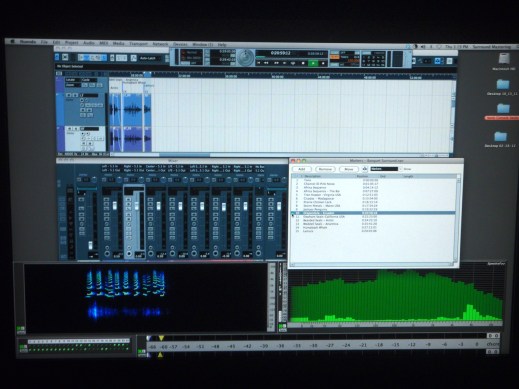
The staff at the Lab of Ornithology generously granted me a tour of their archive, showed me their gear, explained their sound visualization software, and sat me down in the surround sound listening room, where I heard some unforgettable recordings, which opened up my investigation to acoustic dimensions I had never before suspected. We sounded these dimensions in wide-ranging conversations about archiving, acoustics, field work, gear, communication, looking at sound, music, evolution, and conservation. This podcast offers, in a condensed form, some of the highlights of those conversations and experiences.
Thanks are due to the staff whose voices the podcast features: Mike Webster, Greg Budney, Bill McQuay, Liz Rowland, Alexa Hilmer, Ann Warde, Mary Winston, Tim Gallagher, Ashakur Rahaman, Katy Payne, Laura Strickland, and Karl Fitzke. Thanks are equally due staff who consented to be interviewed or otherwise helped out but whose voices didn’t make it onto the podcast: Chris Clarke, Christianne McMillan White, George Dillmann, Connie Bruce, Tammy Bishop. Thanks to Aaron Trammell for crucial editorial and technical help. Thanks finally to the Cornell Society for Humanities for the 2011-2012 research fellowship and the scholarly community that made this research possible.
Animal Transcriptions: Listening to the Lab of Ornithology – Contents and Credits
Intro
Mike Webster
Winter Wren, at normal and at one-half speed (Greg Budney, from The Diversity of Animal Sounds, Macaulay Library of Natural Sounds sampler CD)
Sound: Greg Budney and Musician Wren (Cyphorhinus arada, LNS 8897, Peter Paul Kellogg)
Archive 2:40
Mike Webster
Greg Budney
Bill McQuay
Sound: Ashakur Rahaman and Blue Whale (Balaenoptera musculus, played back at eight times normal speed, LNS 128263, Paul Thompson)
Acoustics 5:45
Liz Rowland
Bill McQuay, Greg Budney: Africa Sequence (The Bai)
Alexa Hilmer
Ann Warde
Sound: Greg Budney and Townsend’s Solitaire (Myadestes townsendi, LNS 50192, Geoffrey Keller) and Brown-backed Solitaire (Myadestis occidentals, LNS 136544, Michael Andersen)
Field 11:00
Bill McQuay
Greg Budney
Mary Winston
Tim Gallagher
Liz Rowland
Sound: Ann Warde and Beluga Whale (Delphinapterus leucas, LNS 126105, Donald Ljungblad)
Gear 14:30
Ann Warde
Ashakur Rahaman
Greg Budney: Beluga multi-array recording
Liz Rowland
Sound: Katy Payne (Humpback Whale)
Communication 20:05
Greg Budney: Madagascar lemur family group
Bill McQuay
Ann Warde
Laura Strickland
Bill McQuay: Treehopper sequence (NPR Radio Expedition)
Katy Payne
Tim Gallagher
Sound: Mike Webster and Crested Oropendola (Psarocolius decumanus, LNS 12830, Ted Parker), Common Potoo (Nyctibius griseus, LNS 59964, Paul Schwartz)
Looking at Sound 27:25
Liz Rowland
Laura Strickland
Alexa Hilmer
Ashakur Rahaman
Katy Payne
Sound: Alexa Hilmer and Humpback Whale (Megaptera novaeangliae, LNS 110847, Paul Perkins)
Music 36:05
Bill McQuay
Ann Warde
Laura Strickland
Katy Payne
Karl Fitzke
Alexa Hilmer
Sound: Laura Strickland and Wood Thrush (Hylocichla mustelina, LNS 11316, Arthur Allen; LNS 125223, Michael Andersen)
Evolution 40:10
Greg Budney (Spot-breasted Oriole duet, LNS 164045, David Ross)
Mike Webster (Black-throated Blue Warbler, LNS 27208, Randolph Little)
Katy Payne (Humpback whale group singing, LNS 118147, William Steiner)
Sound: Alexa Hilmer, Katy Payne with Common Loon (Gavia mimer, LNS 107964, Steven Pantle)
Conservation 47:05
Greg Budney: Attwater’s Prairie Chicken lek
Ashakur Rahaman
Tim Gallagher
Liz Rowland
Sound: Karl Fitzke and European Starling (Sturnus vulgaris, recording by Greg McGrath)
Recordings used with permission of Macaulay Library, Cornell Lab of Ornithology.
Starling recording used with permission of Greg McGrath.
–
Jonathan Skinner founded and edits the journal ecopoetics, which features creative-critical intersections between writing and ecology. Skinner also writes ecocriticism on contemporary poetry and poetics: he has published essays on Charles Olson, Ronald Johnson, Lorine Niedecker, Mei-mei Berssenbrugge, Bernadette Mayer, Cecilia Vicuña, translations of French poetry and garden theory, essays on bird song from the perspective of ethnopoetics, and essays on horizontal concepts such as the Third Landscape and on Documentary Poetry. Currently, he is writing a book of investigative poems on the urban landscapes of Frederick Law Olmsted, and a book on Animal Transcriptions in contemporary poetry. He teaches poetry and poetics in the Department of English and Comparative Literature at the University of Warwick.
—
REWIND! . . .If you liked this post, you may also dig:
Listening to Disaster: Our Relationship to Sound and Danger— Maile Colbert
Animal Renderings: The Library of Natural Sounds— Jonathan Skinner
Six Years in Nodar: Sound Art in a Rural Context— Rui Costa
Share this:


Current Top Posts





April 2021

January 2020

November 2019

October 2019

August 2019

April 2014

November 2017

March 2015

December 2017

October 2015
 Sounding Out!
Recent Comments