
Listening to Kansas City
The reality of our time is that we listen more readily and with greater interest to the mediated treatment of soundscapes [by artists] than to the material in its original form and context.–R. Murray Schafer, “Sensing the City” (Lecture)
For this month’s post I want to walk you through my current urban home, Kansas City, as I try to listen to it in its “original form and context” as Schafer encourages us to do. I consider myself a city gal (notwithstanding one who grew up in the country) and I love cities; the fact that I have been able to return to a city fills me with joy. I am a new transplant to Kansas City, so there is a lot that is new to me. One of the ways I am exploring Kansas City is through sound.
I wanted to do a sound walk because I felt my point of view was that of an outsider, tourist: I just moved to Kansas City over the summer, so my sound memories of Kansas City are almost like a clean slate (more on that later). You might say I’m somewhat of a soundscape tourist, as Schafer calls it. Also, part of my research focuses on how our listening practices help construct our homespaces—and those listening practices are not limited to simply the music we listen to. I believe we construct our “home” through the way we listen to it, the sounds we create, and how we remember sounds. For example, some of my memories of growing up in Puerto Rico are related to sound. I remember going home for the weekend when I was in college, and lying in bed awake listening to all the sounds of the countryside. It amazed me that we were surrounded by sounds (night birds, crickets, cars, horses, cows, dogs, snores, bugs) even though the country was remarkably quieter from the city I lived in during the week. Now that I live in Kansas City, I want to keep a close eye/ear on my sonic surroundings.
For those of you unfamiliar with sound walks, it is a method conceived by Schafer, composer and acoustic ecologist, to explore the soundscape. It consists in walking through a particular area and taking stock of the sounds around you. Schafer helped develop the World Soundscape Project at Simon Frasier University, a project that wanted to research the sonic environments we live in. Interestingly enough, Schafer was not a fan of the sounds of cities, and went so far as to state that “noise pollution is one of the main problems in urban life.” I am familiar with this now-common complaint of urban locations. However, my sound walk yielded a different result.
My sound walk took place this past Saturday, December 11. The day started out cool, but the temperatures dropped quickly past midmorning. The cold, added to the wind chill factor in the single digits, cut my sound walk short. Since part of what I want to do with this sound walk project is take stock of the sounds of my home, I started by walking along streets close to my apartment that I usually drive along. I walked along the thoroughfares I use the most: 39th Avenue/Street (we live close to the Kansas/Missouri border), Adams Street, and 43rd Street. (See the map below.)
As I prepared myself to face the dropping temperatures, I thought to myself about Kansas City’s sounds. One of the first memories I have of Kansas City is the sound of the cicadas. I came in early September 2009 to visit my boyfriend, who lived by Country Club Plaza. The sounds of bell chimes, horns, cars, and people didn’t seem out of the ordinary to me. What irked me was the loud biiiiiiiiiiiiiiiizzzzzzzzzzzzz of the cicadas late at night, when the Plaza was still and quiet. When I woke up at night, that sound haunted me. I did not expect the deafening sound of the cicadas when I came here. I hadn’t noticed it when we first parked in front of the building, but once I had settled into bed I couldn’t ignore them. The bizz followed me that long weekend, and even when I returned to New York I could remember clearly the sound. I found it annoying at first; I could barely sleep that first night. But now that I am here I think of it as part of the sounds of my new home. It’s nice to know that there’s a sound that’s exclusively Kansas Citian for me. (Here is a link to an NBC Action News clip on the cicadas. Click on the video to hear them loud and clear.)
I started by jotting down the sounds I noticed as I walked. At the beginning I wanted to jot down every single sound, and it got to the point where I wasn’t listening anymore; I was analyzing instead of listening. After I turned onto Genesee Street and I noticed some of the sounds kept on repeating, I decided to just listen for now and write later. The sound walk was a lot more enjoyable when I could listen unfettered.
There were few people out on Saturday. I shouldn’t be surprised because it was cold outside (26 degrees with a wind chill of 13 when I checked a few blocks away from the apartment), but I missed hearing the sounds of humans, not sounds manufactured by humans, but sounds emanating from human bodies: coughing, talking, singing, walking…However, I tried to not listen to my own sounds. It sounds silly, but I was trying to listen to sounds other than my own. When I noticed this, it shocked me: why should I not write down the sounds I make, unconsciously or consciously? I am a part of the soundscape; why not keep track of the sounds I make? All of a sudden I felt like I was a lot louder than I actually was. My boots hitting the sidewalks, my pant legs rubbing up against each other, and my mouth chewing gum.
There were a lot of chimes out there. This was interesting to me; I have three windchimes on my terrace, and this is a sound that has become part of my soundscape. I like how sometimes I go to bed and in the still of the night I can hear my chimes shaking in the wind. Now that I think of that I wonder if other my neighbors find them annoying.
Some other sounds I heard repeatedly were: flags flapping against poles, cars zipping past me, wind blowing in my ears, gum smacking, boots against pavement, leaves rustling. The sound of the wind seemed to envelope me, and it howled louder between the branches and the houses. But once the wind died down and the leaves stopped rustling and the sound of my shoes faded into the background, I could hear a hum, barely audible but still existent. I wonder if it’s the hum of the expressway (1-35), or the hum of the air filters at the hospital (KU Med). I could hear it when I was at my farthest from my house but also when I was closest. I think of it as the hum of the city. If when we are super quiet we can hear our bodies breathe, the hum can be the city breathing, all of its sounds coming together as one. I’d like to think so.
I plan on doing three more walks, one per season coming up, as a way to get to know my new city and to continue exploring city sounds. It would be awesome if we could put together a sound walk project of Kansas City, similar to other sound projects in other urban locations. (New York seems to be a popular location for sound walks.) If anything, a sound walk is a great way to get to know your area, rediscover it with new ears.
Bonus track: After the map you will find a link to an audio clip from my sound walk. Also, if you’re interested in doing a sound walk of your own, click on the following links to find out more.
http://www.cityinasoundwalk.org/
http://soundslikestatenisland.com/take-soundwalk
http://www.coldstare.50megs.com/old%20soundwalk/Pagetwo.html


Share this:

The Noise You Make Should Be Your Own
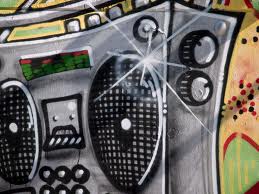 Before I suggested the name VIBE, even before the magazine was being called Volume, it was known as NOISE. I never liked that name. I mean, I knew what they were going for: “Noise” was meant to imply the loud raucousness of youth that defined the increasingly popular urban culture that would fill its pages. But the dominant strand of that youth culture was going to be represented by hip-hop, and I was quite sensitive to mainstream society’s tendency to think of hip-hop—what I liked to think of as the breakbeat concertos of inner city maestros—as not-music, as nothing but noise, something not necessarily from the street but of it, like a garbage truck or a knife fight.
I started to reminisce about the Noise name a coupla weeks ago when I walked into my university-owned apartment building and saw a note with the word “NOISE” poised at the top of it in a huge bold and italicized font, assured of getting everyone’s attention as they entered the elevator vestibule. According to the note taped to the wall, there was a noise problem in the building, and it was getting worse. Would tenants please be considerate of the other members of the apartment community and refrain from playing music loudly after certain proprietary hours?
I thought about it. I never heard music being played loudly. But maybe that was because I live on of the upper floors, away from the blaring speakers of others. The noise I was privy to was the natural noise of the many babies who lived in the building, the children of grad students, probably bored to tears (and tantrums) living in this austere monolith we all call home.
But then I thought about it some more. And I considered the musical noise I heard in this building, compared to the musical noise I’d heard in my building in Manhattan before I re-located to pristine, polite Cambridge, Massachusetts. In New York, I remember the guy on the second floor, the raging theater queen, who blasted cast albums and show tunes at top volume, usually during the day, when the only people in our small West Village building were him (a theater designer), me and the “model” who lived on the third floor—in other words, those of us who lived lives outside the traditional mainstream. The “model” cranked up the volume on her club-kid techno beats, while I was probably playing The Smiths or The Cure or R.E.M. at loud volumes, re-living my college rock days while missing a freelance deadline or two.
I remember, when I lived in New York, thinking that people had no shame when it came to making noise: people had loud  conversations about personal business on the subways; vendors shouted to (at?) delivery guys on street corners; sirens blared their way through the streets; boomboxes competed with car speakers for the ears and stares of passersby. But no one complained. If anything it was a competition of soundtracks in, on and around the streets of New York. Do the lipstick lesbians outside the bar across from my apartment mind, relish in the fact perhaps, that the iconic sound of Stevie Nicks growling out of the jukebox codifies them as queer women on the scene? That kid in the business suit and expensive Wall Street shoes on the train, bobbing his head to the rhythms of Jay-Z rapping loudly through his earbuds: does he really want those of us around him to know he was a hip-hopper? The 6’4” theatrical designer from the second floor who struts down 12th Street like a linebacker: does he simply want the world to know that Barbra’s star-making turn as Miss Marmelstein soothed his soul and that the Pippin version of “Corner of the Sky” is what gets him through the day?
And what was my noise telling the world? I was the queer black writer dude upstairs. But if someone had walked by the apartment, not knowing who was inside, and stopped to tap a toe or shed a tear at the mopey, fop-rock of Morrissey that so often cleared my door jamb, would I be what they expected? Perhaps; perhaps not.
But then I think about the times that I just had to hear Martika. And I had to hear her loud. Or I had to hear some 80s-style deep house, especially the tracks defined by the soul-shouting diva-fied orgasmic melismas that not only date me age-wise, but most definitely queer the space that was blasting the Rolling Stones’ Let It Bleed just a half hour before. I used to be self-conscious of those sonic shifts in my noise soundtrack, as if they highlighted a larger, deeper confusion about my own position, culturally-, racially-, and sexually-speaking.
But then I joined the team to start VIBE, a magazine once called NOISE. And my sensitivity over its possible name settled my own personal dilemma: We may want the world to hear our noise, because of its shorthand to who we are. But what we really want them to do is feel our noise, vibe it if you will, and hopefully feel our joy, pain, shame, love and contradictions in the process.
–SPB (Scott Poulson-Bryant)


Share this:


Current Top Posts





April 2021

January 2020

November 2019

October 2019

August 2019

April 2014

November 2017

March 2015

December 2017

October 2015
 Sounding Out!
Recent Comments