
Sounding Out! Podcast Episode #2: Building Intimate Performance Venues on the Internet
 The podcast is (or, can be) an intimate performance venue on the internet because it allows you to whisper into the ears of your fans. It allows you to grow close to communities of listeners. And podcasts also do one last thing, to be revealed at the end of this piece, after we’ve seen how far I can take you. For now, I will quote podcasters I admire to help explain these ideas in their own words. I also quote these podcasters in an audio format. I have recorded this essay as an episode of the Sounding Out! podcast. You can listen right here, and I suggest you do. Go ahead, press play:
The podcast is what’s happening if you’re listening to these words. Are you? Because remember: my central claim is that a podcast is an intimate performance venue on the internet. Keep that in mind.
I am a podcaster, musician, and assistant professor of Economics. I have released six episodes of my own podcast, The Lion in Tweed.

Me. (Photo by Hadassah Head)

The Lion in Tweed. (Drawing by Winston Rowntree)
My podcast is primarily a narrative, with music and sound effects interwoven. It is about a character, The Lion in Tweed, and his experiences as a musician and professor of economics. He is also a lion. The second half of each podcast episode is a references section where I cite my sources and leave the fictional Tweedoverse canon to discuss real things.
I am not the first podcaster to remark on the ability of podcasts to traffic in intimacy. Chris Hardwick, of the Nerdist podcast, has claimed that, due to their intimacy, podcasts are the best medium going. He stressed: “you’re talking directly into the ears of your listeners.” There is no doubt that Hardwick was referring to those white iPod earbuds, which are a primary method of listening to podcasts. Part of a podcast’s intimacy comes from the closeness of the earbud to the membrane in the ear. Listening to earbuds evokes the intimate, and physical, closeness of someone whispering in your ear. Hardwick’s style of podcast is also intimate: vocal storytelling, mostly three comedians talking about the funniest things that have happened recently. The fact that it is not visual accentuates the intimacy of “whispering in your ears.” Although I would like to argue that the visual always reduces a sense of intimacy, I may simply prefer the sonic over the visual. Nevertheless, I believe that, the intimacy to which Hardwick is refers, is tied to the fact it is only sonic.

Chris Hardwick.

The Nerdist Podcast.
COMMUNITY
Podcasts as performance have a strange kind of liveness, episode-to-episode interactivity. By this I mean that they are not immediate; they lack the urgency of a theater-goer’s applause, or a heckler’s retort. Though not immediate, they are still dynamic, with their episodic pacing. And, unlike heckling, almost completely positive. This sense of long-term interactivity provides a foundation for understanding a second way that podcasts are intimate: they can cultivate intimate and interconnected communities of listeners.
They [Stop Podcasting Yourself, hosted by Graham Clark and Dave Shumka] have a really good community of people, community interaction: people send them stuff, sometimes people send them stuff unprompted. And they have a phone number [for people to call in messages that they play].
To illustrate how interconnected this community is, let me describe to you where this quote came from. It is a clip of Dan Sai, recorded by Davin Pavlas at MaxFunCon (the annual convention of the MaximumFun.org podcast label). I know Davin because of our mutual love of MaxFun podcasts. When I brought The Lion in Tweed into the world, I advertised it on podcasts in the MaxFun network. When Davin heard the description, he began to listen to my podcast. Now we are collaborating on an episode of The Lion in Tweed, which will quote these very words when it comes out two weeks from now. Similarly, UK resident Will Owens and I exchanged tweets after he started listening to my podcast and I found out he reviewed various narrative media on his website, and now he has written a review of my podcast, which we both promote. Ours is a community in which a feeling of value comes with a sense of connectedness. The podcasts give a shared culture.
SO IN PODCASTS, WE FIND A MEDIUM that is both sonic and vocal. They provide a platform for intimate and interconnected communities, which are rooted in an alternative kind of interactivity (long-term liveness), to grow. The whisper-in-the-ear quality of podcasts, as well as the feeling of community, all but completely explain why podcasts are so intimate.
AUTHENTICITY
Podcasts may be hip and modern, but they are not ironic. Podcasts represent a distillation of what the podcasters genuinely love, and in that they find their authenticity. According to Paul F. Tompkins, a comedian and podcaster:
It’s very freeing to be able to say: “Here are all the things that I like; I’m going to put them all into this [podcast].”
That was at minute 50:32 of Nerdist podcast ep 33 hosted by Chris Hardwick, with Paul F. Tompkins as a guest.

Paul F. Tompkins
The Pod F. Tompkast
Here is Jesse Thorn, mastermind behind the aforementioned MaximumFun.org, in an interview by Neiman Labs:
I can mostly just do things that I am interested in, and so I don’t have to do something that is false to me, and I can let my guiding light be, “Do I like this and think it’s worth doing?”

Jesse Thorn.

The Sound of Young America.
And we see that authenticity completes the puzzle: podcasts are intimate because they feel so real. In podcasts it feels like you are listening to a real person because you are listening to the things that a real person loves…and interacting with real people is much more intimate than feeling like you are interacting with a marketing department (as you may when listening to a CD, or radio-show).
This is how I construct intimate performance venues: Audio-only, voice/storytelling focused, in which I try to build and exploit supportive, interconnected communities of fans with a shared culture (the podcasts). And, in doing so, I try to remain true to what I truly love. This authenticity, I believe, deepens the intimacy.
.
In the background of this podcast episode, Andreas plays an instrumental cover of “Bound for Hell” by Love and Rockets.
Share this:

Play it Again (and Again), Sam: The Tape Recorder in Film (Part One on Noir)
 Being a teacher, I can’t resist giving out a summer reading list. Being a researcher, I can’t help but want to share the projects that I am working on–which right now includes excavating the cultural history of the magnetic tape recorder in the United States. So, in honor of the Summer Solstice tomorrow (marking the official start of the season) I compiled a three-part summer series for Sounding Out! that does both: “Play it Again (and Again) Sam: The Tape Recorder in Film.”
My summer sound studies A-V list encourages you to fill your idle hours watching the “top 6” featured appearances of the magnetic tape recorder in film, in chronological order (2 each month, with a bonus “supporting role” nod rounding out each post). Not only will “Play it Again (And Again) Sam” help you beef up your cinema buff credentials, but it will trace a little-known history, asking you to consider how the recorder tangled its thin brown plastic tape so effectively into the warp and weft of our twentieth-century lives. You’ll find that my “top 6” list reveals much more human desire than technological determinism; the representations I examine express a complex mixture of fear and fascination, optimism and regret, change and stasis. Often a tool of the powerful, sometimes a weapon of the weak, the tape recorder was a cold war domestic product that could never truly be domesticated. As you will see in this spoiler-free three part series, interactions with the tape recorder remixed America’s workplaces, schools, homes, public spaces and private moments, ultimately shifting how the world was heard (and heard again and again).
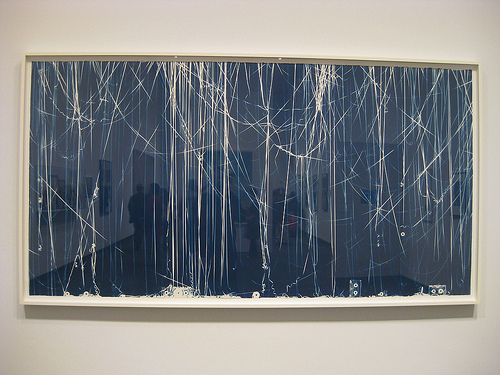
Memento (Soul II Soul) 2008 by Christian Marclay, Photo by Nathan Bowers
So, load up your Netflix queue, shake up your Jiffy Pop, and take a much-needed couch-break from the heat and humidity with these oh-so-cool black-and-whites from the 1940s and 1950s. Of course, we can’t start our films without some “Coming Attractions”: look for part two on July 18th (spotlight on Walter Murch) and part three (the 1980s) on August 15th.
1. Double Indemnity (Paramount, 1944, Directed by Billy Wilder)
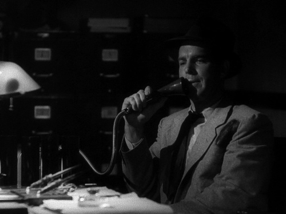
Walter Neff (Fred MacMurray) speaks his sordid tale into the dictaphone
Okay, so it is actually a dictaphone that appears in this film and the tormented insurance salesman Walter Neff (Fred MacMurry) is “putting it on wax” rather than magnetic tape, but this once ubiquitous, now long forgotten recording device has such a haunting presence and a structuring role in this grim noir confessional that, like Neff himself, I am suddenly willing to break my own rules. Outside of femme fatale Phyllis Dietrichson’s (Barbara Stanwyck) elaborately sculptured coiffure, the key image of Double Indemnity is Neff’s lips murmuring his murderous late night confessions into the dictaphone’s horn, a physical and metaphorical stand in for the ear of his hardnosed boss (and the true object of his desire) claims investigator Barton Keyes (Edward G. Robinson).
The dictaphone was Billy Wilder (director/screenwriter) and Raymond Chandler’s (screenwriter) deliberate addition to the filmscript; James M. Cain’s 1943 novella was essentially Neff’s scrawled confession to the reader of his almost-perfect plot to kill Phyllis’s husband and reap double insurance rewards. The introduction of the dictaphone transformed the standard noir flashback voiceover into an even-more intimate exchange of anxious aspiration, guilty pleasure, and homosocial desire channeled through Neff’s tense vocal grain and fierce grip on the machine’s cord. A familiar office machine made strange by Neff’s late-night admissions, the dictaphone mediates the entire film, transforming the audience into eavesdroppers, listening in to an act of recording made for Keyes’s ears only. After stumbling into his office and jamming a cylinder into the machine, Neff begins, sternly: “Office memorandum. ‘Walter Neff to Barton Keyes, Claims Manager, Los Angeles, July 16, 1938. Dear Keyes: I suppose you’ll call this a confession when you hear it. Well, I don’t like the word ‘confession.’ I just want to set you right about something you couldn’t see because it was smack up against your nose.” Sound, in the form of Neff’s heated breath pressed through the dictaphone’s curves and into our waiting ears, is the perfect device to exorcise the unseen desire in a film that tests the boundaries of darkness.
..
2. Blackboard Jungle (MGM, 1955, Directed by Richard Brooks)

Screen Capture by JSA
Most people remember Blackboard Jungle for its seductive visual representations of juvenile delinquency, stoked by the sound of Bill Haley and the Comet’s “Rock Around the Clock,” the song (written in 1952, recorded in 1954) that opened and closed the film (and became a smash hit as a result, as I discussed in a previous archival blog post here). I’d like to add an often-overlooked image to the film’s legacy, that of teacher Mr. Dadier (Glenn Ford) plunking a bulky case down on his desk and triumphantly announcing “This is a tape recorder!” A cutting edge device at the time—magnetic tape was only introduced in the states after World War II, largely through the efforts of Bing Crosby and Les Paul—Dadier’s recorder is part and parcel of the technological milieu of the 1950s, which evoked positivistic fascination with “progress” even as it was shaped by existent fears and inequalities.
At the point of almost giving up on his surly working class, ethnic, inner-city students to seek a cushy job in the segregated suburbs, Dadier brings in the reel-to-reel as a Hail Mary attempt to quell his students’ noise and remake them into good Cold War citizens once and for all. As he tells them, “We all talk, but nobody listens.” From the moment he enters the classroom, the students continue to defy the white male authority embodied in Dadier and housed in his machine—“Did you bring your cosmetics to school, Chief?” taunts one student (Gregory Miller, played by Sydney Poitier)—and they undermine his assignment by selecting the “noisiest” student in the class to make a recording: Puerto Rican Student Pete Morales. As I have discussed on this blog and in print, the concept of “noise” has a racialized edge, particularly in the 1950s, when Cold War cosmologies of colorblindness and “enemies within” ruled the day. Sound was an efficient way to separate “Us” from “them”—the noisy dissident from the quiet citizen—without making explicit reference to visual markers of race. And, let me tell you, Morales’s obscene, heavily-accented speech—peppered with “stinkin’”s, 14 of them in total—really makes Dadier’s spools spin. To hear more on the tape recorder in 1950’s American life and this film, see my essay “Reproducing U.S. Citizenship in a Blackboard Jungle: Race, Cold War Liberalism and the Tape Recorder” forthcoming in the American Quarterly special issue on sound (September 2011).
[youtube=http://www.youtube.com/watch?v=tr7n9Wxmcf4]..
And. . .in a supporting role:
Kiss Me Deadly (Parklane Pictures, 1955, Directed by Robert Aldrich)

Hammer Screens His Calls: Screen Capture by Michael Leddy
The byzantine stairwalks and gingerbread Victorians of Los Angeles’s defunct Bunker Hill neighborhood are not the only ghosts you will encounter in the noir classic Kiss Me Deadly. Our first glimpse of Mike Hammer’s (Ralph Meeker) space-age Wilshire Boulevard bachelor pad includes a shot of his wall mounted, reel-to-reel answering machine, quite a technological marvel in 1955; it would be over 15 years before Phone Mate introduced the first commercially viable home model in 1971. His recorder manages to look both ridiculously large yet streamlined–and to twenty-first century audiences, old yet futuristic. However, it also allows the hunted, haunted private detective to take just a little more control of his tailspin of a life. After the jarring ring of a telephone call, the spools spin, and a sultry female voice intones: “This is Crestview 5-4124. Mister Hammer, whom you are calling, is not available at present. If you wish to leave a record of your call, please state your message at the sound of the tone.” His back inevitably against the wall, Hammer brings a suave tension to an act that has now become mundane: call screening. Removing the small surprise of who’s on the line, Hammer uses his recorder to listen just a step ahead, pacing an increasingly mysterious world given over to the dangerous riddle of the “whatsit” that leaves so many in the morgue by the film’s end. For a more general take on sound in this film (with a brief mention of Mike Hammer’s tape recorder), see Noira-Blanchè-Rougi’s November 2009 blog post, “The Use of Sound in Kiss Me Deadly.”


Share this:


Current Top Posts





April 2021

January 2020

November 2019

October 2019

August 2019

April 2014

November 2017

March 2015

December 2017

October 2015
 Sounding Out!
Recent Comments