
Sounding Out! Podcast Episode #2: Building Intimate Performance Venues on the Internet
 The podcast is (or, can be) an intimate performance venue on the internet because it allows you to whisper into the ears of your fans. It allows you to grow close to communities of listeners. And podcasts also do one last thing, to be revealed at the end of this piece, after we’ve seen how far I can take you. For now, I will quote podcasters I admire to help explain these ideas in their own words. I also quote these podcasters in an audio format. I have recorded this essay as an episode of the Sounding Out! podcast. You can listen right here, and I suggest you do. Go ahead, press play:
The podcast is what’s happening if you’re listening to these words. Are you? Because remember: my central claim is that a podcast is an intimate performance venue on the internet. Keep that in mind.
I am a podcaster, musician, and assistant professor of Economics. I have released six episodes of my own podcast, The Lion in Tweed.

Me. (Photo by Hadassah Head)

The Lion in Tweed. (Drawing by Winston Rowntree)
My podcast is primarily a narrative, with music and sound effects interwoven. It is about a character, The Lion in Tweed, and his experiences as a musician and professor of economics. He is also a lion. The second half of each podcast episode is a references section where I cite my sources and leave the fictional Tweedoverse canon to discuss real things.
I am not the first podcaster to remark on the ability of podcasts to traffic in intimacy. Chris Hardwick, of the Nerdist podcast, has claimed that, due to their intimacy, podcasts are the best medium going. He stressed: “you’re talking directly into the ears of your listeners.” There is no doubt that Hardwick was referring to those white iPod earbuds, which are a primary method of listening to podcasts. Part of a podcast’s intimacy comes from the closeness of the earbud to the membrane in the ear. Listening to earbuds evokes the intimate, and physical, closeness of someone whispering in your ear. Hardwick’s style of podcast is also intimate: vocal storytelling, mostly three comedians talking about the funniest things that have happened recently. The fact that it is not visual accentuates the intimacy of “whispering in your ears.” Although I would like to argue that the visual always reduces a sense of intimacy, I may simply prefer the sonic over the visual. Nevertheless, I believe that, the intimacy to which Hardwick is refers, is tied to the fact it is only sonic.

Chris Hardwick.

The Nerdist Podcast.
COMMUNITY
Podcasts as performance have a strange kind of liveness, episode-to-episode interactivity. By this I mean that they are not immediate; they lack the urgency of a theater-goer’s applause, or a heckler’s retort. Though not immediate, they are still dynamic, with their episodic pacing. And, unlike heckling, almost completely positive. This sense of long-term interactivity provides a foundation for understanding a second way that podcasts are intimate: they can cultivate intimate and interconnected communities of listeners.
They [Stop Podcasting Yourself, hosted by Graham Clark and Dave Shumka] have a really good community of people, community interaction: people send them stuff, sometimes people send them stuff unprompted. And they have a phone number [for people to call in messages that they play].
To illustrate how interconnected this community is, let me describe to you where this quote came from. It is a clip of Dan Sai, recorded by Davin Pavlas at MaxFunCon (the annual convention of the MaximumFun.org podcast label). I know Davin because of our mutual love of MaxFun podcasts. When I brought The Lion in Tweed into the world, I advertised it on podcasts in the MaxFun network. When Davin heard the description, he began to listen to my podcast. Now we are collaborating on an episode of The Lion in Tweed, which will quote these very words when it comes out two weeks from now. Similarly, UK resident Will Owens and I exchanged tweets after he started listening to my podcast and I found out he reviewed various narrative media on his website, and now he has written a review of my podcast, which we both promote. Ours is a community in which a feeling of value comes with a sense of connectedness. The podcasts give a shared culture.
SO IN PODCASTS, WE FIND A MEDIUM that is both sonic and vocal. They provide a platform for intimate and interconnected communities, which are rooted in an alternative kind of interactivity (long-term liveness), to grow. The whisper-in-the-ear quality of podcasts, as well as the feeling of community, all but completely explain why podcasts are so intimate.
AUTHENTICITY
Podcasts may be hip and modern, but they are not ironic. Podcasts represent a distillation of what the podcasters genuinely love, and in that they find their authenticity. According to Paul F. Tompkins, a comedian and podcaster:
It’s very freeing to be able to say: “Here are all the things that I like; I’m going to put them all into this [podcast].”
That was at minute 50:32 of Nerdist podcast ep 33 hosted by Chris Hardwick, with Paul F. Tompkins as a guest.

Paul F. Tompkins
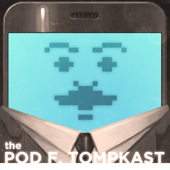
The Pod F. Tompkast
Here is Jesse Thorn, mastermind behind the aforementioned MaximumFun.org, in an interview by Neiman Labs:
I can mostly just do things that I am interested in, and so I don’t have to do something that is false to me, and I can let my guiding light be, “Do I like this and think it’s worth doing?”

Jesse Thorn.

The Sound of Young America.
And we see that authenticity completes the puzzle: podcasts are intimate because they feel so real. In podcasts it feels like you are listening to a real person because you are listening to the things that a real person loves…and interacting with real people is much more intimate than feeling like you are interacting with a marketing department (as you may when listening to a CD, or radio-show).
This is how I construct intimate performance venues: Audio-only, voice/storytelling focused, in which I try to build and exploit supportive, interconnected communities of fans with a shared culture (the podcasts). And, in doing so, I try to remain true to what I truly love. This authenticity, I believe, deepens the intimacy.
.
In the background of this podcast episode, Andreas plays an instrumental cover of “Bound for Hell” by Love and Rockets.
Share this:

Listening to the Border: “’2487’: Giving Voice in Diaspora” and the Sound Art of Luz María Sánchez

Statistics of death can startle a reader. As tidy yet powerful numeric representations statistics are often used as tools of persuasion, cited routinely by journalists and politicians alike to strengthen or belittle a political objective. According to professors from Wharton’s School of Business, statistics are also gaining in importance as our society attempts “to make sense of an increasingly large and complex barrage of information.” Many have argued, quite provocatively, of the gendered and racialized nature of statistics as objective, “hard,” facts. In “2487: Giving Voice in Diaspora,” the artist Luz María Sánchez uses sound-based art to trouble a statistic brought on by institutional violence on the U.S./Mexico border.
In 2006 Luz María Sánchez used a lone statistic from 2004 – 2487, the number of bodies found dead throughout the border region of the U.S. and Mexico – to create a sound-based art installation for the San Antonio Artpace (now available as an online exhibit). The museum invited audiences to sit in sparsely furnished rooms with strategically placed speakers in order to experience the exhibition. The online access, however; makes certain the exhibit travels beyond the geographical boundaries of Texas, bellowing from the private devices of laptops. Seemingly simple, the crux of the project involves the artist stating each of the 2487 names. Its complexity, as mentioned below, lies in the actual organization of the names. The voice of Luz María Sánchez within this artistic expression reminds us, as Brandon LaBelle states, that sound “leaves a body and enters others” and is never merely a “private affair.” The use of sound forces spectators to listen closely to a statistic and in doing so, directs attention towards the parts of the sum.
The topic of immigration has become a staple of news network channels. Its somewhat mundane presence has served to lump immigrants together into one sound bite: “them” sapping social services; “them” taking away our jobs; or “them” having those anchor babies. The reporting of immigrants as a block serves to dehumanize and delegitimize intentions of family reunification held by many immigrants. Indirectly, “2487” tackles the verbal “them” head on.
Buried within discussions of immigration policy and arguments for increased border enforcement on the U.S./Mexico border are the statistics of those who have died crossing the treacherous dry desert. A series of shifts in immigration policy and increasingly anti-immigrant public sentiment have produced record setting budgets that intensified efforts to beef up border control. The once urban points of crossing in Tijuana or Juarez are now heavily discouraged; the visual yellow and black warning of a family running an insignia of those times. Many immigrants take greater risks as they walk through the Sonoran desert in southern Arizona, now considered the busiest gateway for immigrants where temperatures easily mount well into the 100s.
Within 2487, it is not merely the statistic that serves to astound, it’s the ingenuous yet powerful act of listening to the full name of each body that can engulf the listener.
José Salomon López
Francisco Torres Santiago
Leticia Torres Solis
Adolfo Sánchez
Enrique Soto Pacheco
Guadalupe Valdez Sandoval
Antonio Sánchez Morales
Juan Antonio Sánchez Reyes
Patricia Trinidad
Narrated by the artist herself, each name is voiced individually with a dignified, strong tenor. The text itself – the names – mark this sound piece as solemn. It’s as if one is listening to an obituary read out loud, a roll call with no response, or – a tradition many Latinos identify with – a rosary in honor of the dead. Despite studies that explain a Latina’s public wail as a sign of pain and grief, this piece in its parallel focus of honoring the dead stands out as the artist’s female voice never quivers, trembles, or abandons its strength. In naming each person, listeners may not necessarily focus on their death – represented numerically in 2487 – but may also find themselves imagining their risk as they hear each name. Under the website’s database tab, lies a detailed chart of each name, the location of their body, presumable age, known origin, and the cause of death. Many of the columns are listed with a tag of “unknown” or left blank except for their names.
It’s a forced, almost-awkward, tension-laden, and heavy listening experience. Sánchez makes certain that any semblance of passive listening is disrupted, disturbed, and therefore nearly impossible since the names voiced do not follow a pattern or rhythm. The eight piece sound compilation offers no sense of monotony since it is played continuously and at random. Pauses are sometimes short, long, pensive, and altogether distressing. Names are voiced either in isolation or in an overlapping manner, said to model the “organic patterns of migration itself”; an audible gesture towards the word “diaspora” itself. Because of the deliberate variation of the names, the listener can make out the names of some yet not detect the names of others.

Even as Sánchez gives voice and dignity to a statistic based on dead bodies, the topic of death certainly is not easy to translate. Regina Marchi’s “Day of the Dead in the USA” argues that the public commemoration of death by Latino communities has slowly begun to transform American Culture’s views of death. According to Marchi, Americans tend to be “removed from death” or lack positive modes of relating to those deceased. A popular case in point is the plethora of euphemisms used to characterized death: moved on, no longer with us, watching over us now, passed away. Día de los Muertos or Day of the Dead (on November 1) has become a multicultural method of publically viewing and even embodying death as different communities construct altars, dress as the dead, and openly pay tribute to those who have died. The use of art galleries, the mass media, and community centers have become public venues for these celebrations since their inception by Chicano artists in 1972.
Despite, or (perhaps more precisely) because, honoring the dead is so frequently a visual custom these sonic remembrances are that much more significant. A politicized eulogy for immigrants who have died while crossing the border merits the weight of listening. The 2487 statistic encompasses two thousand and eighty seven bodies and each, according to Luz María Sánchez, had a name that deserves our listening attention.
by Dolores Inés Casillas, UCSB
Share this:


Current Top Posts





April 2021

January 2020

November 2019

October 2019

August 2019

April 2014

November 2017

March 2015

December 2017

October 2015
 Sounding Out!
Recent Comments