
Learning to Listen: The Velvet Underground’s “Once Lost” LPs

 Welcome back to Start a Band, our two-part series on Lou Reed and the Velvet Underground, focusing on what the band’s sonic provocations mean for sound studies today. Last week, we heard from Jake Smith, who introduced us to a way of thinking about the Velvets that emphasized the “haptic” qualities that emerge so often while listening to them. Following that idea, Smith took us on a kind of journey from the skin to the musculature and the viscera through a deep analysis of key songs in their catalog — “This is your body on the Velvet Underground.”
This week, we’re delighted to welcome to Sounding Out! a writer whose work we’ve been eager to feature for a long while — Tim Anderson, Associate Professor of Communication and Theatre Arts at Old Dominion University. Tim has written extensively on popular music and sound, and is currently a leader of the Sound Studies Scholarly Interest Group at the Society for Cinema and Media Studies, one of the scholarly groups associated with the SO! Thursday stream. It’s such a pleasure to present this sensitive and personal account of the Velvet Underground — and of learning to listen.
– NV
—

Lou Reed and Andy Warhol as the respective definers of audible and visual cool for misfits and undergroundlings for the last five decades.
Reports of Lou Reed’s death came on a Sunday. Even though he was 71, it was still a shock. To many present-day friends and colleagues Reed’s Velvet Underground are a band that they understand are important, but just don’t get. In the case of an artist like Lou Reed, an artist who never had a top ten charting single and only two gold albums, you could see their point.
Still, I obsessed. Rattled from my travels in Washington, DC, I called my wife and we talked about his music for about an hour or so, after which I took a long walk to the Washington Mall. It was a sunny fall day, October 27, 2013, and I walked past the Smithsonian with its prominent memorials, such a clean space for so much past, some of which the nation has buried and some of which we don’t even bother to think about. The deceased have always done the most important work in our nation’s capital.
The day after, I really don’t remember doing much. I took a train home, read everything I could online about Reed, and thought a lot about his records. The ones I liked —New York and The Blue Mask—the ones I learned to like —it took me years to enjoy Transformer—and the ones I loved —The Velvet Underground and Nico, White Light, White Heat, The Velvet Underground and VU. Those four records, more than any records I can remember, altered me, many of my friends in my teens and in college, and almost every rock musician I admired in the 1980s. Velvet Underground records were simply foundational. Writing about Reed’s death, rock critic Greg Kot summed up the Velvet’s influence by claiming that they were “as influential as The Beatles” and if you named “just about any left-of-centre band or artist since the ‘70s”, some of whom like R.E.M., U2 and Talking Heads “became mainstream giants”all of them would “acknowledge a deep debt to the Velvet Underground.”
This influence is the reason that the collective mourning of such a marginally popular figure swelled to such a crescendo. However, to paraphrase the words of one of Reed’s most storied rivals, Lester Bangs, on the death of John Lennon, this was not the mourning of a person. Most of us never met Lou Reed. Instead, we were mourning ourselves. To lose Lou Reed was tantamount to losing the author of a proverbial urtext of a kind of secret rock language that has been passed down since the late 1960s on how to be cool. It was a language of composed of style, gestures, and reactions. It was one that was filled with a fun that was not of the obligatory “hey-dude-let’s-party!” party. The Velvet’s overdriven guitars repeatedly underscored that teenage kicks included other aesthetic pleasures such as contemplation and melancholy. Most importantly, the Velvet Underground offered a language of listening passed down from one rock underground to another.
Because pop fans of all stripes must learn how to be a fan, learning how and what to listen to is a taste-defining social exercise. Simon Frith once explained that, for him, “one aspect of learning how to be a rock fan in the 1960s was, in fact, learning to prefer [original records made by black artists of the 1950s] to covers [made by white artists of the same era]. And this was, as I recall, something that had to be learned [by Frith]: nearly all the records I had bought in the late 1950s had been the cover versions” (Performing Rites: On the Value of Popular Music, 1996). In my case, learning to listen also meant learning what to listen to while listening to The Velvet Underground, a process involving peers, record clerks, friends, musicians and reviews.
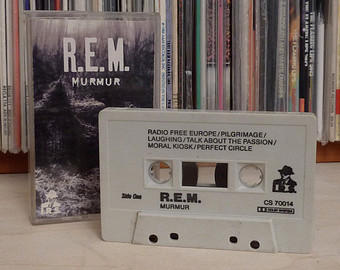
R.E.M.’s 1983 LP release of “Murmur” on cassette
As a young rock fan who began first collecting cassettes —that’s right, cassettes —this process would begin through an obsession with R.E.M.’s Murmur, a cryptic, odd inscrutable cassette with no lyrics, a black and white picture and layers of reverb. The copy I found had been severely discounted in a ma and pa record store in Globe, Arizona. In Summer 1983 I read a rave review in a copy of Rolling Stone and at 14 had purchased a cassette unlike anything I had ever heard; I wasn’t sure I enjoyed it. Why did so many reviewers seem to fall over themselves about this record? To solve this puzzle, it meant learning how to listen to music invested in tone rather than ostentatious chops. It meant paying attention to drones rather than solos. It meant following those features to Velvet Underground records after peers, record clerks, friends, musicians and reviews made a point that Murmur reminded them a bit of VU records.
Murmur was also the first record I ever purchased that embraced what Jacob Smith so wonderfully identifies as a distinctive trait of all Velvet Underground records. For Smith, these pop records are part of a genealogy that “stress evocative timbres, idiosyncratic voices, and signature sounds over structural or lyrical complexity.” The distillation of this pop ethos onto record was one of the reasons that so many musicians whose abilities may have been limited but whose tastes tended toward the poetic found The Velvets so influential. As Jonathan Richman explained, “I didn’t start singing or playing till I was 15 and heard the Velvet Underground. They made an atmosphere, and I knew that I could make one too!” (Quoted in Greil Marcus, Lipstick Traces: A Secret History of the Twentieth Century, 61). Indeed, Smith notes that the deceptive complexity of VU Records “can be found more on the level of timbre than in musical structure or instrumentation” and “lyrics often encourage a blurring of listening and touching”; his post actually reads like many of the conversations and reviews surrounding R.E.M.’s debut LP. The same could also be said of records released by other 1980s and 90s artists such as The Pixies, My Bloody Valentine, Opal, Mazzy Star, Radiohead, The Dream Syndicate, Galaxie 500, The Rain Parade, Green on Red, New Order, Joy Division, The Feelies, Spacemen 3, Sonic Youth, The Pretenders, The Sisters of Mercy, Ministry, The Jesus and Mary Chain, and The Violent Femmes, to name but a few who drew water from the Velvet Underground well. Bands sonically inspired by the Velvets often providing feedback before solos, drummed without cymbals, and portrayed dark themes sung in monotones that sounded sophisticated and obscure.
.
However, actually hearing a Velvet Underground record in 1983 and 1984 was a significant problem for newer fans, as their MGM catalog was out of print. Many understood these records to be effectively buried by label president Mike Curb’s infamous axing of the act from MGM along with seventeen others who allegedly promoted and exploited “hard drugs through music” (Tiegel, Eliot “Mgm Busts 18 Rock Groups.” Billboard, November 7 1970, 1, 70). As Lou Reed himself once noted, “it’s depressing when you’re still around and your albums are out of print.” I have often wondered if this was one of the reasons that The Velvets catalogue would have such a profound effect on so many of us. Sure, I had found a copy of Loaded, the band’s fourth official release, but its bright tones had none of the subversive menace that so many reviewers alluded to when speaking of the Velvets. Even in a mountain town in Arizona, I had a better chance of finding used copies of The Grateful Dead’s Wake of the Flood or Blues for Allah than I did The Velvet Underground and Nico. In other cities, in other record stores, when I did find those records they were used and prices started at $15 and up. They were records I simply could not afford to listen to.

The Velvet Underground’s “lost” fourth album, “VU”
All that changed after 1985, when every MGM Velvet Underground record would appear in my life for less than $25. Bill Levenson’s efforts as Polygram’s then A&R manager to reissue the buried and lost MGM catalog on Verve provided me and every other young person who had only “heard of The Velvet Underground” the chance to finally to listen to all of these records at once. Indeed, the moment of the catalogue’s reissue was simply a sonic flood, one where sounds filled in gaps that had been cut deeply by conversations, descriptions and my own imagination. Writing at the time about these reissues and the unveiling of a lost album’s worth of material that would be titled V.U., David Fricke argued that “rock historians and fans alike owe Bill Levenson, the executive producer of V.U., a debt of thanks for resurrecting these tracks and for giving the band’s first three LPs the proper reissue they’ve long deserved. At $5.98 list price, The Velvet Underground and Nico,White Light/White Heat and The Velvet Underground are essential purchases —certainly essential listening for any study of Seventies and Eighties punk evolution. As for V.U., the Great Lost Velvet Underground Album is no longer lost. It is simply great” (Fricke, David. “The Velvet Underground – V.U.” Rolling Stone, March 14 1985).
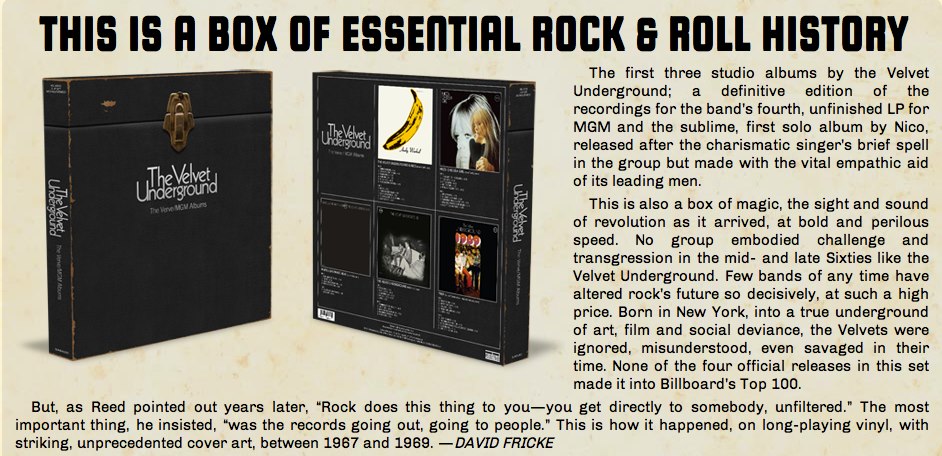
A 2012 ad for another reissue of the MGM Velvet Underground catalog and Nico’s first solo LP
Is it too much to suggest a that the pent up desire to hear a secret history sparked by The Velvet Underground’s reissues created the 80s/90s iteration of “alternative rock”? Perhaps, but history is filled with desires asserted, accepted and denied. Indeed, most of those aforementioned 80s alternative acts I came into contact with had been performing and recording and releasing records years before 1985. However, there is no doubt that the VU reissues turned a number of ears predisposed to hearing in a certain way onto new ways of listening to the Velvets concentrated doses of moody darkness, modes that earlier Velvet Underground fans simply had little access to.
Ignoring the impact of the sonic flood of VU material that fell upon my ears during this period turns away from a specific history of listening that, while personally unique, was an opportunity available to so many of my contemporaries. Indeed, if sounds have histories because their traces persist, then listening must have histories guided partially by testimonial. To hear these histories we might ask ourselves to remember how, why, and with whom did we listen, and to trade in this information. If we did so, we might better understand how we learned to listen: especially what to listen to and why it was important. And, without these testimonials of our pasts as listeners, we just may lose sound’s crucial other half.
—
Featured Image: “Velvet Underground Yellow Label Mono” by Flickr user Simon MurphyThe Velvet Underground – Yellow label mono
—
Tim J. Anderson is an Associate Professor of Communication and Theatre Arts at Old Dominion University where studies the multiple cultural and material practices that make music popular. He has published numerous book chapters, refereed journal articles, and two monographs: Making Easy Listening: Material Culture and Postwar American Recording (University of Minnesota Press, 2006) and Popular Music in a Digital Music Economy: Problems and Practices for an Emerging Service Industry (Routledge, 2014). His latest research project focuses on recordings, musicians, listeners and the public sphere. His website is timjanderson.weebly.com and he can be contacted at tjanders@odu.edu.
—
 REWIND!…If you liked this post, you may also dig:
“One Nation Under a Groove?: Music, Sonic Borders, and the Politics of Vibration” -Marcus Boon
“Sound + Vision: Andy’s Mick” -Eric Lott
“Hold this Thread: A Partial History of a Rock n’Roll Relationship”-Benjamin Gold
Share this:

SO! Reads: Susan Schmidt Horning’s Chasing Sound: Technology, Culture and the Art of Studio Recording from Edison to the LP

 The recently published Chasing Sound: Technology, Culture & the Art of Studio Recording from Edison to the LP (Johns Hopkins Press, 2013) is historian Susan Schmidt Horning’s first book. Veering away from the usual sound recording suspects (like the phonograph), Chasing Sound shows the studio and the audio engineer as central to the cultural and technological changes associated with the production and reproduction of sound.
According to Schmidt Horning, such changes were reflected in the shifting ideal of recorded music as a representation of live performance to the ideal of recorded music as a studio-engineered creation. Using the accounts of those responsible for recording sound, Schmidt Horning constructs a rich narrative that manages to be accessible while still focused on the highly technical work required of studio workers. That said, by focusing so heavily on user practices and anecdotes she misses an opportunity to engage with the theoretical implications of the ways audio engineers imagine and describe the actual space in which they work. Still, I contend that Chasing Sound represents an indispensable and critical approach for historians of sound, one that is unafraid of reconfiguring the central players in a narrative as big as the history of recorded music.
As a contribution to sound studies, Chasing Sound follows in the footsteps of Trevor Pinch’s Analog Days, the first work to explicitly apply Science and Technology Studies (STS) approaches to the history of a musical instrument. For Pinch, a critical understanding of sound requires examining the ways in which society and technology produce historical sites of change and stabilization. This approach focuses on understanding the ways people engage with technologies of sound, in order to interrogate their cultural and historical meanings. A historian of science and technology by training, Schmidt Horning has thus devoted much of her academic career to writing about the production and reproduction of sound through the practices and tacit knowledge of engineers, producers, musicians and technicians at music studios. By following the breadcrumbs dropped by these actors, Chasing Sound reveals the rich history of commercial studios and the cultural ideals cultivated therein.
 Methodologically, the author draws on a mixed bag of sources, which include oral histories from early recordists, interviews with more contemporary audio engineers, her own ethnomethodogical studio research, trade literature, and archival documents from big studios like EMI. The book proceeds in chronological order, with each chapter laying out changes in the physical and acoustic qualities of commercial studios as they shifted from bare-walled rooms with “the recording horn jutting through a wall at the far end of the room” (9) to multi-track studios complete with “Mission furniture, [and] hand-laid distressed wood floors.” (209) The author plots these changes alongside improvements in the science of acoustics, the importation of techniques and tools from the more well developed medium of radio broadcasting, the consolidation and growth of the recording industry, the rise of independent labels, the emergence of new attitudes and musical tastes, and the professionalization of audio engineering.
Chasing Sound, unlike many other books on the topic, places the studio in relation to a set of changing cultural expectations regarding recorded music. Where recordings were once understood as a reflection of live performance, they later were seen as a signature creation of music studios. Rather than focusing on the phonograph, gramophone, microphone, or magnetic tape, the author argues that the recording studio belongs at the center of recorded music because it was there that the ideal of music as a “technologically mediated art” was first engineered into cultural listening norms. Consequently the audio engineer, or recordist as he (or in rare cases, she) was known prior to the 1930s, must also be understood as central to narratives regarding recorded sound from its inception. In this way, Schmidt Horning aims to recontextualize and centralize the studio and its inhabitants within histories of the production and reproduction of sound.
Because the audio engineer represents an inextricable part of this history, each chapter devotes time to the technologies and practices cultivated by the amateur recordists and trusted professionals responsible for recording sound. Initially such practices formed the basis of their tacit knowledge regarding the proper “staging” of artists in relation to acoustic recording horns among other techniques, but by the 1950s, sound engineers were responsible not just for positioning artists, microphones, and the increasingly important work of “enhancing” recordings during post-production. The book concludes by charting the unfettered rise of independent studios as well as the consequent proliferation of (and backlash to) new sound manipulation technologies in the 1970s.
Throughout the text the author notes the ways in which audio engineers often lamented the increasing technological mediation involved in record production, even as it granted them more creative control and prestige.
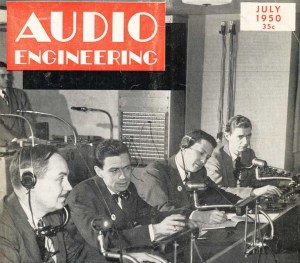 Schmidt Horning’s methodology represents Chasing Sound’s strongest quality. The rich narratives of the audio engineers allow the author to directly connect their technologically and culturally informed ideas about what constitutes good sound to the desires and expectations of listeners. In addition to this work, Schmidt Horning also highlights the ways in which advances in engineering technology did not necessarily overlap neatly with cultural norms. Throughout the text the author notes the ways in which audio engineers often lamented the increasing technological mediation involved in record production, even as it granted them more creative control and prestige. Such examples reveal the tightly knit relationship between ideas of liveness, talent, creativity, and authenticity. Chasing Sound is full of stories that detail the complex material, artistic, and ethical constraints around which recordists and engineers navigated in order to achieve the perfect sound.
The author’s methodological approach certainly helps to structure the narrative, but there are also ways in which it prevents her from digging in to important theoretical discourses regarding the studio. As Eliot Bates notes in his article, “What Studios Do,” the way audio engineers conceive of their workspaces is crucial for making sense of the power relations and social interactions that govern and are governed by studio spaces. Chasing Sound does not pursue these discourses. The author briefly mentions how the metaphor of flight is often used by sound engineers regarding the increasingly complex console controls of the 1950s and 60s but does not provide further elaboration on the implications of such a comparison. Even if the participants in her study did not reflect on their colloquial notes about the studio space, it would have been interesting to see Schmidt Horning consider what these metaphors reveal about the changing roles of the engineer.
These points aside, Chasing Sound is an important read both for those with a general interest in the history of sound production and reproduction as well as those scholars more specifically invested in understanding the role of recorded sound in society. Since I discussed the book’s limitations in “Making Music in Studio X,” Chasing Sound has become a foundational text in much of my research. Specifically, the author’s claim that the studio is (and has been) a critical site for examining broader industrial, technological, and cultural changes resonates deeply with me because it offers a critical methodology for considering issues of identity and power within studio spaces that are often neglected. In this regard, Chasing Sound is important not just for what it discusses, but also for what it does not. Noting the lack of female and black audio engineers discussed throughout the book, the author laments, “For the first century of sound recording, the field of audio engineering and recording studios in particular comprised a profoundly white male-centered culture that reflected corporate culture at large and technical professions in particular.” (9) The absence of these faces serves to remind us that while successfully “chasing sound” certainly relies on the cultivation of craft skill, and tacit knowledge, it also depends heavily on access.

Reproduced under a Creative Commons Attribution license from Reel2ReelTexas.com
Chasing Sound stands out as the most exhaustive history of audio engineering available. Schmidt Horning’s user-focused narrative successfully ties together changes in studio configurations and audio engineering practices with cultural expectations regarding recorded music. This helps to show how the studio and audio engineer can easily be recognized as central figures in the history of sound reproduction. Chasing Sound’s intervention is necessary as the history of recording is often told through artifacts like the phonograph, microphone, and magnetic tape, not living spaces like the studio and its inhabitants. Schmidt Horning’s dedication to telling these neglected stories is what makes the book come to life. Her research promises to open up new avenues for others interested in these issues. For me, this means pursuing lines of inquiry related to the growing philanthropic interest in the recording studio as a site for engaging and “assisting” low-income communities. In this way Chasing Sound asks us to recognize the recording studio as a critical site for the production and reproduction of our assumptions about what counts as appropriate, good, or real in music and people.
—
Featured Image: My Recording Studio by Flickr User Fabio Dellutri
—
Enongo Lumumba-Kasongo is a PhD student in the Department of Science and Technology Studies at Cornell University. Since completing a senior thesis on digital music software, tacit knowledge, and gender under the guidance of Trevor Pinch, she has become interested in pursuing research in the emergent field of sound studies. She hopes to combine her passion for music with her academic interests in technological systems, bodies, politics and practices that construct and are constructed by sound. More specifically she would like to examine the politics surrounding low-income community studios, as well as the uses of sound in (or as) electronic games. In her free time she produces hip hop beats and raps under the moniker Sammus (based on the video game character, Samus Aran, from the popular Metroid franchise).
—
 REWIND! . . .If you liked this post, you may also dig:
Making Music at Studio X: The Identity Politics of Community Studios— Enongo Lumumba-Kasongo
SO! Reads: Japanoise: Music at the Edge of Circulation— Seth Mulliken
SO! Reads: Isaac Weiner’s Religion Out Loud: Religious Sound, Public Space, and American Pluralism— Jordan Musser
Share this:


Current Top Posts





April 2021

January 2020

November 2019

October 2019

August 2019

April 2014

November 2017

March 2015

December 2017

October 2015
 Sounding Out!
Recent Comments