
A Tradition of Free and Odious Utterance: Free Speech & Sacred Noise in Steve Waters’s Temple
**This post is co-authored by Gabriel Solomon Mindel and Alexander J. Ullman
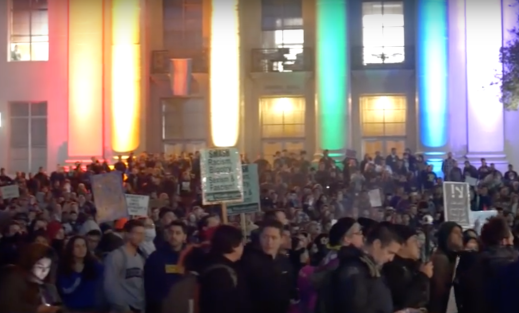
On February 2, 2017, thousands of protesters took to the University of California Berkeley’s Sproul Plaza to protest and ultimately shut down a planned talk by the right-wing provocateur Milo Yiannopoulos. Captured in real time, its dark and blurry image projected to screens across the world, this gathering dumped fuel on a fire that had been burning slowly for many years. Conservative and predominantly “white-male” resentment against the mainstreaming of “politically correct” speech had become the basis for an inchoate community via the internet and was now emerging as a socially acceptable sentiment in the era of Trump. For those protesting at Berkeley, the silencing of Yiannopoulos was not intended simply to condemn the content of his speech, but to intervene preemptively in the culture-wide “fascist creep” disguising itself as humour and taboo breaking. It called into question the actual meaning of both speech and freedom in a place that had become synonymous with the struggle for both.
Viewed by some as a riot, the militant protest tactics evoked scorn, distress, and confusion from a wide spectrum of respondents. Conservative audiences were horrified by the self-evident violence of the Left, even while enjoying a laugh with Milo at the various fails of “SJW’s” and “snowflakes”. Meanwhile Liberals couldn’t seem to fathom the expressions of anger and nihilism evinced by the black-clad mass celebrating in front of the shattered windows of the Martin Luther King Jr. Student Union, who set a fire at the very steps upon which the Free Speech Movement of 1964 had been birthed. The cancellation of Yiannopoulos’s talk has since set off a chain of rhetorical and physical confrontations resulting in the cancellation of Conservative speeches on campus and multiple “free speech” rallies which have devolved into street battles between a motley cohort of alt-right groups and various counter-protesters surrounding a park that was also named after MLK.
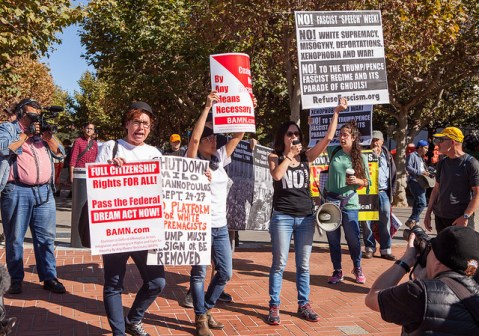
Sproul Plaza Protests, UC Berkeley, September 24, 2017, Image by Pax Ahimsa Gethen, (CC BY-NC-SA 2.0)
Coincident with the events that same spring, Berkeley’s Aurora Theatre staged Temple by British playwright Steve Waters, a revisiting of 2011’s Occupy London protests whose encampments surrounded the area of St. Paul’s Cathedral. First performed in London in 2015, the play speculates that the swirling circumstances of the ten-day period leading up to the dean’s resignation (including the cathedral’s closing on October 21; the Canon Chancellor’s abrupt resignation on the morning of October 28; and the reopening of the cathedral later that day, effectively evicting the protesters) had something to do with the church’s own struggle to reconcile its responsibility to serve both God and his people in the face of ethical contradictions.
Seeing Temple on Aurora Street, barely two weeks and two blocks from the “Patriot’s Day” melee on April 15, provoked us to consider what resonances seemed to be emerging between places and times evoked in the play and humming in the streets. Thinking comparatively between Berkeley in 2017 and Temple yields historical and political synchronicities, between protest movements and the institutions which arbitrate public space and public speech. Temple offers a critique of how the discourse of “free speech” is naturalized, even weaponized, by historical actors; yet it also imagines speech as sonic form never separate from its ethical content. The play exposes how “free speech” often serves as an empty signifier mobilized for political purposes, how it always risks being separated from its material and ethical consequences. Against this, the play pits the noise of protest as a powerful riposte to these abstractions.

“Preaching at. St. Paul’s Church”–Folkmoot
Temple’s story centers around the personal conflict of the Dean, who vacillates between support for the protests surrounding the church and for the city eager to evict them, dramatizing how London’s Occupy movement, displaced from its original encampment outside the London Stock Exchange, took refuge in the courtyards surrounding St. Paul’s Cathedral, replacing one symbolic institution of power with another. As the Dean reminds us, this debating throng gathered on the church’s doorstep is an echo of the folkmoot at St. Paul’s Cross from nearly 800 years before: “In the Reformation era firebrands would preach against usury, against merchants in the very presence of the Mayor…doubtless a riotous affair…” Thus Temple situates Occupy as not an impediment to the functioning of the Church, but a revival of “a tradition of free, even odious utterance… of untrammelled public speech” (41-42).
Despite this sympathetic gesture, the Dean struggles against the unremitting noise of the current protestors outside his window. He frequently sits on the window ledge, holding his head as he peers out toward the loud chanting in what otherwise would be moments of silence: “This drumming, the music, the occasional shout…every night this fitful rhythm of noise, shouts, cries” (34). The polyphonic mass is yet another ethically demanding voice fighting for the dean’s attention. So too the other church leaders, the city lawyer arguing for the camp’s eviction, and the Canon Chancellor’s resort to Twitter where the realm of appearances seems to dictate political decisions because “like the whispering gallery …everything we do is broadcast …amplified …reverberating around the world” (42). Should the dean re-open the church and have the protest camp removed? Should he resign? What would Jesus do?

Still from Aurora Theater’s production of Temple, Berkeley, CA, Image courtesy of authors
This interior struggle is formalized in the clash between the sound of protesters and the ritualized sounds of the church. The play compresses the drama of a three hour period into an hour and a half, and every quarter hour the bells at St. Paul’s ring, marking the ritualized time structure of the church and its domination over the city’s soundscape. R. Murray Schafer points out in The Soundscape that “time is always running out in the Christian system,” (i.e. its inevitable destiny in the apocalypse) “and the clock bell punctuates this fact” (56). The bells mark time, but they also mark power, for they are the “Sacred Noise” that Schafer claims societies “deliberately invoked as a break from the tedium of tranquility” – the silent world of the profane (51). The Church’s ability to determine time and disturb the peace is the (sound)mark of its power, yet the sound of the London protest encampment frequently disrupts its claim to sovereignty. The sonic agon of the play allegorized the one in the street: as Occupy’s cacophony challenged St. Paul’s exclusive right to make noise without censure, so too can the free speech protests be heard as a kind of sonic riposte to the institutionalized soundscape of the university, a sparse scholarly murmur punctuated by the bells of Berkeley’s Sather Tower.
Sonic ritual and sacred noise bookend Temple: the sound of a church choir opening it and the bells in closing. However, the play’s critique of such ritual occurs through constant sonic disruption and the unremitting attack on silence in the final stage direction (“the noise builds”). Therefore, as the Dean’s decision to reopen the cathedral suggests that the church’s rituals have won out, Temple insinuates that Occupy’s struggle was as much about the power to disrupt the peace with speech as it was to preserve its camp. This disruptive quality of ‘noise’ in the play calls attention to protest’s spatial capacities: the ability for sounding to extend beyond the limits of the body, to challenge the very architectures of power. We never see the protesters in the play, yet their acousmatic noise is manifest as if a distinct body were sharing space within the rectory. . Yet what are the limits of this ghostly aurality? Does the noise of the crowd simply become metaphor? We might ask the same thing of the protests at Berkeley, their proximity to the halls of power – university buildings, city hall, police stations – not compensating for their simultaneous containment in public space and exclusion from power’s internal deliberation. How does this risk metaphorizing the very material presence of these protests, the people who were using their actions and bodies to protest against the right’s usurpation of the term “free speech”?
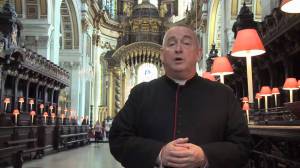
Image of Dean Knowles courtesy of authors
The contest between the pew and the street in Temple exposed how the term “free speech” is metaphorically mobilized for political and ethical convenience. In a way, Temple is a critique of the Dean Graeme Knowles’s actual homily given on October 28th, 2011, just before the church reopened and just after the diegetic time of the play closes. In this homily, Knowles appropriates the language of testimony while at the same time appealing to a more abstract notion of “free speech”:
We are called out to be witnesses, to speak out, to testify…like Simon and Jude, many of us will be anonymous, but like them, our voices need to be heard. Because of their testimony, we are here today. Without their voice, the good news of the gospel would not have reached us.
While the church’s reopening (and the concomitant removal of Occupy) may actually appear like a restriction on free speech, the dean reassures congregants that the church is itself a testament to it. “World leaders have spoken under this throne,” he says, at once emphasizing the church’s personal importance to Christians who feel silenced by the church’s closing and the political importance of an otherwise “neutral” institution.
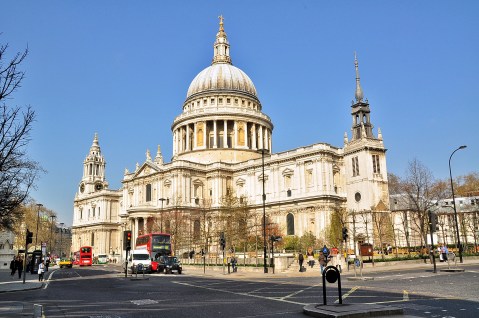
St. Paul’s Cathedral, London, England, Image courtesy of authors
Waters’s play attempts to resolve the church/streets binary by filling hollow calls to testimony with multiple voices across a political spectrum, offering a polyvocality that helps to unpack this contradiction of the church standing up for free speech while simultaneously denying it. Through the clash of sounds and the characters voices, Temple exposes how Knowles’s homily is actually covering up a historical contradiction between numerous relations: between various iterations of what “free speech” means; between who controls the soundscape; between various iterations of free speech movements throughout history. It is here that the link to what is happening in Berkeley in 2017 is most poignant, in the resonance between the church’s past and its conflicted present on the one hand, and the dissonance between the historic memory of the UC Berkeley-based Free Speech Movement (FSM) of the fall of 1964 and how the “New Free Speech Movement” of the “alt-right” has effortlessly yet inaccurately usurped its language and moral ground.
If the Church and the University are spaces of exception, institutions that are both public and private, their responsibility to democratized speech is premised on ethical and legal principles that are not the same as the constitution-bound worlds around them. It is this being of the world and not that incites the agonism around who can speak and what they can say: according to Jesus in John 15:19 “… because you do not belong to the world…therefore the world hates you.”
The Free Speech Movement of 1964 advocated for the ability to offer persuasive speech with social consequences–rather than mere talk–carried forth by an uneasy alliance of liberal and conservative students brought together by the simultaneity of the Civil Rights Movement and Republican Party election campaigns. Campus administrators and the economic and political elite of the day claimed that students were being persuaded to perform illegal activities off campus, while it was the FSM leadership’s assertion that civil disobedience and direct action of the type being developed in civil rights and labor struggles was in fact defensible “free expression.” 50 years ago tactics such as sit-ins, occupations, blocking an arrest, and transforming a police car into a stage were seen by moderate and conservative commentators as coercive and violent forms of rebellion, but for activists they paled in comparison to the everyday racist violence affecting Black people in America, the imperial violence of the Vietnam War, or the total annihilation promised by a potential nuclear war. Similarly today, Antifa accept pre-emptive and coercive violence as necessitated by the potential violence summoned by the “alt-right,” whether in the form of lone individuals inspired by their white supremacist ideology or the spectre of a large scale fascist transformation of American society.
Though protest songs provided the background music to the FSM of the 60’s, the current debate and protests over “free speech” call attention to another constitutive relationship between sound and protest, between noise and power. Behind the liberal plea to “lower the voices” and heighten the reason in political discourse is a reminder that sound has an ability to interact with consciousness in non-rational, even hypnotic ways. We see a kind of hypnosis in the very language of “free speech” today, a term invoked by the alt-right and the university to protect certain political agendas similar to the way that the term “objectivity” was deployed mid-century. Stanley Fish made a similar argument in the 1990’s amidst that moment’s culture wars, arguing that because all speech is socially constructed and ideologically asserted “there’s no such thing as Free Speech.”
Free speech, for Fish, only exists as an ideal construct outside of history in which voices are pure “noise,” separated from consequences and assertions. But his notion of “noise” and “free speech” again are too metaphorical, separated from the uneven histories of protected speech and the materiality of noisy protests. As Jonathan Sterne writes, out of the perceived noise and meaninglessness of protests there emerge rhythms and grooves that can be heard farther than they can be seen, that invite participation and resistance. In the context of Temple and the UC Berkeley protests, the “noise” created within and against the term “free speech” should not simply be dialed down or declared a realm of meaningless utterance, but unpacked as an important opening in to how power is both employed and resisted by institutions like the university and the church.

Berkeley Free Speech Protests of 1964, Image courtesy of author
The Chancellors of UC Berkeley have never been averse to using violence to correct and regulate speech on its campuses, whether it be Chancellor Strong’s eviction of the FSM’s occupation of Sproul Hall in 1964, or the brutalization of student protesters by campus police under the watchful eye of Chancellor Birgeneau in 2009. The Dean of St. Paul’s agony could give us insight into what went into Chancellor Christ’s ambivalent public letter that assures us that “free speech” and “safety” will come at a cost. In ‘64 the discourse of “free speech” became a platform for political dialogue and social transformation, not for usurping the language of testimony and personal experience while abstracting real societal power. What the “alt-right” frames as a common struggle for a moral and legal principle only disguises the balances of power that determine who can speak without the consequence of violence: white people or people of color; governments or protestors; bankers or the poor.
“Free Speech” is the domain of a particular sacred noise, one that has the power to disrupt what Martin Luther King Jr. himself described as the “appalling silence and indifference of good people who sit around saying ‘wait on time’.” In this recently discovered speech, given in London just after he spoke at St. Paul’s in December 1964, MLK goes on to say that “human progress never rolls in on the wheels of inevitability,” retroactively giving moral weight to Mario Savio’s demand that “you’ve got to put your bodies […] upon the wheels.” We can see this spirit of rebellion in the counter-rhythms of London’s anti-austerity occupations, rising up to meet the bells of St. Paul’s, and as well in the “rough music” of outraged students rising up to meet the Sather Tower Carillon as it insistently keeps time.
—
Featured Image: Still from video of Berkeley Protests, February 2017
—
Gabriel Salomon Mindel is an interdisciplinary artist and scholar whose research considers ways that people produce and struggle for space using sound to extend beyond the limits of their bodies, particularly in formal and informal modes of protest. He received an MFA in Visual Arts from Simon Fraser University where his work focused on the production of visual artworks from time-based phenomena such as sound composition, dance, social practices and protest. He has also spent nearly two decades exhibiting artwork, performing improvised music and composing for dance and film. Images, writings and recordings can be found at https://diademdiscos.com/gms/.
Alexander J. Ullman is a PhD student at UC Berkeley’s Department of English where he researches Nineteenth, Twentieth, and Twenty-first Century Literatures.
—
 REWIND! . . .If you liked this post, you may also dig:
The Sound of Hippiesomething, or Drum Circles at #OccupyWallStreet–Gina Arnold
On Ventriloquism, Dummies, and Trump’s Voice–Sarah Kessler
G.L.O.S.S., Hardcore, and the Righteous White Voice–Chris Chien
Share this:

Speaking American
This is something you just don’t hear about in the history books.
–Alex Hutchinson, Creative Director, Assassin’s Creed III
What does it mean to speak American? According to Laura Amico, a teacher in the Cliffside Park school district in New Jersey, to speak American is the opposite of speaking Spanish. Students captured her saying this on Snapchat before they walked out in protest: to be American is the same as to speak American. Evidently, to speak American is to speak English, a historical curiosity, given that English was not spoken on the North American continent until the 17th century, preceded by many Native American languages and, ironically, Spanish. In simplest terms, “American English” is not a homogenous dialect either. What kind of “American English” does Laura Amico exalt as acceptable for patriotic conduct? How does an American patriot speak?

Colonel Tarleton, painted by Sir Joshua Reynolds, 1782, British National Gallery, CC license
In The Patriot (2000), Mel Gibson plays Benjamin Martin, a hero of the French and Indian War, who is forced out of his South Carolina plantation-managing life to avenge the deaths of his sons at the hands of the British during the American Revolution. The main British villain of that film, the fictional Colonel Tavington,–played in sneering style by Jason Isaacs—is notable for his barbaric conduct (among other things, he traps civilians in a barn and burns them alive). British audiences were noticeably aghast at this characterization, which implicitly compared British command of the time period to Nazi atrocities in World War II. Tavington may in part have been based on Banastre Tarleton, a notorious and brutal, misogynist dragoon whose victory at Monck’s Corner was among the bloodiest battles in the dirty war fought in the south at the end of the Revolution, or Lord Rawdon, a serial rapist and generally unpleasant English officer.
Nevertheless, Tavington’s barn-burning exploits are more likely based on American General John Sullivan’s slash-and-burn campaign against British-allied Mohawks, Senecas, Onondagas, and Cayugas, a subject little discussed in American history. This culminated in a 1782 massacre at Gnadenhutten in Ohio, where white Americans murdered 96 Delawares who had converted to the Moravian faith (pacifists). Evidently, in The Patriot, the conflict was not a civil war, and character was constructed in part through dialect (as detailed below, dialect here refers to all the clues in the way a person speaks, not just his or her accent).
Although Tavington’s conduct in The Patriot manifested visibly onscreen, his dialect said much about him. As noted in a recent Atlantic Monthly article, entertainment—such as Disney cartoons—can “take [bias] and pour concrete over it.” Rosina Lippi-Green, a linguist, notes that such biases are then difficult to remove: “They etch it in.” Another linguist, Chi Luu, suggests that with English RP (see below), the effect is more subtle; such accents go beyond “pure evil” by shading villains as more educated and intelligent—but still bad. Relating these findings to The Patriot, viewers understand Tavington as educated, intelligent, and evil through his English RP dialect; moreover, in black-and-white terms, his dialect makes tangible that he is completely different from the rough-and-ready, courageous Benjamin Martin. An aural line is drawn between American “good guys” and British “bad guys.” The British are fighting just to be sadistic or greedy; the Americans are fighting to defend their way of life.
Compared to media about other American conflicts, there has been little recent dramatic depiction of the American Revolution. Historically, one reason dramatizations of the American Revolution have historically remained rare is the tradition of American reverence for the “Founding Fathers,” causing their depiction as human beings to be circumscribed. Just as visual conventions have been built up regarding the antagonists of the conflict, so, too, have aural conventions in audio-visual representations such as a general use of a Standard North American accent for American (patriot) characters (whether they hail from northern or southern colonies) and English RP for all (villainous) British characters. The effect of this is epitomized by the example from The Patriot above: “good guys” versus “bad guys.”
While the way characters sound is important in most creative works—from the written dialect of Dickens’s characters to the chilling, mask-assisted tones of Darth Vader—it is no more so than in audio drama. Richard J. Hand and Mary Traynor have argued in the The Radio Drama Handbook (2011) that the elements of audio drama are words, music, sound, and silence. Arguably the most important of these to the audio drama are words. Alan Beck’s work on radio acting further argues that to create character through words and sound, refinement of dialect is needed. In this context, dialect refers to more than just a regional pronunciation: it includes details on a character’s geographical region, social class, gender, age, style, and subgroup.
In terms of The Patriot, probably the highest profile pop cultural depiction of the American Revolution until Hamilton, accents mattered. “A well-educated British accent,” in American films at least, “had come to serve as a sufficient shorthand for villainy” as Glancy pointed out, or “British, upper class, and a psychopath, happily burning people alive,” as a 2010 Daily Mail article put it. Whatever his villainy, would a historical Colonel Tavington, have sounded the way he did as depicted in The Patriot? How did those on the North American continent in the 18th century sound?
Richard Cullen Rath has convincingly argued that sound was incredibly important in colonial America, but what role did speech in English have? David Crystal, in discussing the Globe Theatre’s 2004 production of Romeo and Juliet in original pronunciation (OP)/Early Modern English (EME), was most frequently asked one question: how do we know? How do we know what Shakespeare’s English sounded like? For EME, spelling, contemporary accounts of the language, and the use of rhythms, rhymes, and puns illuminate this area. Crystal noted that EME would not sound like any modern accent but would have the pronunciation of “rs” in common with “rural” accents, as in Ireland and the West Country (Somerset).
This is important because the association of Shakespeare with a certain kind of English accent—the RP referred to below—has long had the effect of making his works less accessible than they might have been. If Shakespeare’s actual working dialect had more in common with “rural” accents like Irish and West Country, the latter of which is often still designated as a shorthand for stupidity in common with American southern dialect, this has a liberating effect on Shakespeare in performance. It may sound “strange” at first, but it suggests that Shakespeare can/should be performed in a vernacular, at the very least to make it more accessible to a wide variety of audiences.
Crystal has suggested that, “It is unfortunately all too common to hear accents on stage or film in which—notwithstanding the best efforts of dialect coaches—accuracy and consistency throughout the performance leaves, shall we say, a little to be desired.” Sky 1’s recent big-budget effort in historical drama, Jamestown, set in 1619, is diverse and rich in dialect, with characters speaking with Irish, northern English, southern English, and Scottish accents—nor are they uniform in suggesting that one accent will signify the character’s goodness or badness (though it has to be said most of the southern English-speaking characters are, at the very least, antagonistic). Most of the Native American characters have so far not spoken English rather than racist “Tonto talk,” and white English-speaking characters must speak Powhatan (or use sign language) in order to communicate. As actor Jay Tavare points out, early Hollywood was not concerned with the accurate portrayal of indigenous languages, given that Navajo extras were most often used in Westerns (meaning the Diné language of the southwest was heard regardless of where the film was set). More recently, even such films as Dances with Wolves (1991), which has generally received praise for its accurate portrayal of Sioux/Lakota culture, included Lakota dialogue which was linguistically imprecise. Clearly, there is still a long way to go.
Suppose we decide we cannot ever know how such historical actors sounded, so we decide to depict 18th century English speakers based on other criteria. How do directors, actors, and voice coaches bring the viewer/listener as close to the author’s intent as possible in fictional depictions of the years surrounding the American Revolution? How is the 18th century made accessible through dialect? As Glancy suggests above, British officers in film, television, and radio depictions of the American Revolution are most commonly associated with Received Pronunciation (RP), though the term was not coined until 1869, and, as Crystal points out, the “best speech” heard in the English court of the 16th century was “nothing like” RP. In fact, it was probably influenced by the Devonshire accents of Sir Francis Drake and Sir Walter Raleigh (an English so far in Jamestown associated with servants . . .). As Edda Sharp and Jan Haydn Rowles point out in How to Do Standard English Accents, RP has almost disappeared in England, “now confined to a very small section of society, the older upper and upper middle classes, older actors and broadcasters.”
The officer class of the British Army in the 18th century was in fact largely composed of Scots (as per Stuart Reid and Paul Chappell)—though how much they retained their Scottish identity (including accent) is of course impossible to know. As Kevin Phillips in 1775: A Good Year for a Revolution points out, within England, support for the colonies during the American Revolution was generally strongest in the major cities and in the eastern and southern counties—the same places where during the Civil War, support had been strongest for Parliament and Cromwell. Support in Scotland was limited to a small fringe. By contrast, statistics from Revolutionary America 1763 to 1800: Almanacs of American Life on the ancestral origins of the white population of Virginia in 1790 make Scotch-Irish (11.7%) and Scottish (5.9%), the second-largest groups after English. References to the Scottish officer class are made in Cooper’s The Last of the Mohicans, where Colonel Munro is referred to as “the Scotsman” (played memorably in the Michael Mann film by Maurice Roëves). Beal suggests that guides to “correct” pronunciation in the 18th century were often written by and for Scots—to pass as “British.” The Scottish people have had a long history of wishing to disassociate themselves from rule by the English (as evident in the 2014 Scottish Referendum). The Wars of Scottish Independence in the 13th and 14th centuries were fought between English and Scottish forces, at the conclusion of which Scotland retained its status as an independent state. However, in 1707, the Act of Union unified England and Scotland under one government.
With these many regional British accents potentially to be heard in the British Army in America in the 18th century, and with approximately 92.2% of white colonists in Virginia hailing from the British Isles in 1790 (including England, Scotland, Ireland, and Wales), it is perhaps curious that there has been so little variation in dialect in media depictions such as films, TV, and radio. Traditionally, for example, George Washington has been depicted with a Standard North American accent and not a modern southern American accent. This is also true in the case of Colonial Williamsburg re-enactors.
Besides being generally a very sound depiction of the Revolutionary period, HBO’s John Adams (2008), based on David McCullough’s book, is also unusual as far as accents go. John Adams gives the British King George III, played by Tom Hollander, Standard Neutral English, but it does something very unusual with its American characters. Virginian characters (including Washington and Jefferson) have suspiciously Somerset-sounding accents. John Adams introduces a clear regionalism in Anglo-American accents that goes beyond the singling out of the Boston accent (which is generally personified in John Adams himself). It isn’t clear why this decision is made; the accent does not belong exclusively to Virginian characters, as it is also the accent of Benjamin Franklin, proudly Pennsylvanian, and Alexander Hamilton himself. Is the shorthand present to aurally distinguish between Loyalists, and American rebels? What affinity, one might ask, does the Somerset accent have with a depiction of the American character?
Standard North American speech is rhotic (people who say an ‘R’ whenever it is written), as is the Somerset accent (and, as Ben Zimmer explains, was associated with country speech in England from the 17th century). This contrasts with Neutral Standard English Accent, which is non-rhotic (people who only say an ‘R’ if there is a vowel sound spoken after it). Perhaps the filmmakers had in mind the best guesses about how “proper” Anglophones spoke in the 18th century, as in John Walker’s Critical Pronouncing Dictionary (1791), where he normatively condemns rhotic English. Then again, perhaps it is merely a storytelling expedient; look at the actors assembled to play Founding Fathers:
- Washington – David Morse, American, born in Massachusetts
- Jefferson – Richard Dillane, born in London
- Hamilton – Rufus Sewell, born in southern England of Welsh and Australian parents
- Franklin – Tom Wilkinson, born in Leeds, grew up in Canada
- Sam Adams – Danny Huston, American, born in Rome
Standardization may have made practical sense, but the use of the rhotic sends a subtly different message than North American Standard English, and perhaps hints at the influence of David Crystal’s work on OP/EME.

First page of Noah Webster’s Compendious Dictionary (1806)
Even among linguists, North American 18th century English has not been examined to the extent that EME has, with Beal going no further than to suggest “the contact between the various regional dialects of the English-speaking colonists and the languages of the Native Americans and of other European colonists” would have influenced pronunciation, but she is not conclusive as to what extent. Noah Webster in 1789 envisioned “a language in North America, as different from the future language of England, as the modern Dutch, Danish and Swedish are from the German or from one another” (cited in Mühleisen). From the beginning, too, American fiction was concerned with pronunciations, with Cooper sensitive to those which “disclosed class or origins,” as Schachterle noted. The word “Americanism,” in fact, was coined by John Witherspoon in 1781. Its entry in Webster’s Compendious Dictionary (1806) is “a love of America and preference of her interest.” As David Crystal points out, this was the first dictionary written in English to include words like butternut, caucus, checkers, chowder, constitutionality, hickory, opossum, skunk and succotash. It was also the first dictionary to give now-familiar American spellings to words like color and defense.
It is probably not a surprise that many of the words above have their origins in Native American languages. Black and Native voices (and use of dialect) are somewhat rare in media depictions of the Revolutionary period, notable exceptions being The Last of the Mohicans, with its heroes (“Hawkeye,” Uncas, and Chingachgook, played by Daniel Day-Lewis, Eric Schweig, and Russell Means, respectively), as part of an extended, multi-racial family unit, speaking with a uniform Standard North American accent:
and Ubisoft’s smash video game, Assassin’s Creed III (2012).
The hero of this Xbox/Playstation game is Connor/Ratohnhaké:ton (Noah Watts), half-British, half-Mohawk, who speaks Mohawk as well as English (again, no Tonto talk here), as taught by the project’s language consultant, Akwiratekha’ Martin. However, again ignoring historical realities like the Sullivan campaign, the villains are British redcoats, echoing the storyline set up by The Patriot (Connor’s village is burned and his parents are killed by a British officer who sneers, “You are a nothing, living in the dirt like animals.”) In a making-of featurette, the creators of Assassin’s Creed III note that it has more than two hours of “cinematics,” a concept that suggests that the game will be a more potent window into history for its users than film, television, radio, or books. While it is positive that the game inaugurates a Native American action hero role model, it is disappointing that it recycles “the British are baddies” dialect trope.
In media like cartoons, video games, and audio drama, dialect supplies us with many clues about characters and what we should think and feel about them. Class is still very much implicit in accents in Britain, and every time we open our mouths we display characteristics about ourselves, whether feigned or not. When mass media-makers produce historical drama, they make choices. Despite the United States’ and the United Kingdom’s “special relationship,” the “British are baddies” trope remains. Its continued use and the future choices made by media-makers have much to say about Anglo-American relations and conventions in fiction today.
If, as suggested by several linguists identified in this article, children very quickly pick up conventions of who is “bad” via what they sound like, it behooves us to pay careful attention to the way mass media uses voices and what norms these establish, for listeners young and old. Also, what accents filmmakers use for past accents may profoundly influence who can hear themselves as “American” in the present moment–one important reason why Lin-Manuel Miranda’s Hamilton resonated with contemporary audiences. If teacher Laura Amico in the Cliffside Park school district in New Jersey has established that her pupils should “speak American,” what does this mean (besides the fact she expects them to speak English not Spanish)? Should they, for example, speak like President Trump, who uses a New York Queens accent which, according to Jeff Guo, connotes “competence, aggressiveness and directness” despite the fact its speaker comes from a privileged background? As Guo suggests, the way we speak is at least as important as what we say. In response to reports that Trump mocked the Indian Prime Minister, Narendra Modi, by imitating his accent, Congressman Raja Krishnamoorthi published a statement saying, “Americans are not defined by their accents, but by their commitment to this nation’s values and ideals.” That, perhaps, is speaking American?
—
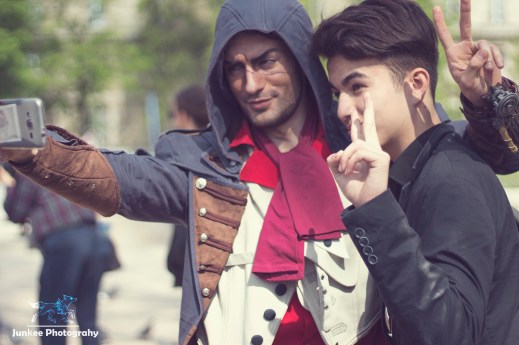
Featured Image: Arno Victor Dorian, Assassin’s Creed Unity: Leon Chiro Cosplay Art
—
With thanks to Kenneth Longden and Matthew Kilburn
—
Leslie McMurtry has a PhD in English (radio drama) and an MA in Creative and Media Writing from Swansea University. Her work on audio drama has been published in The Journal of Popular Culture, The Journal of American Studies in Turkey, and Rádio-Leituras. Her radio drama The Mesmerist was produced by Camino Real Productions in 2010, and she writes about audio drama at It’s Great to Be a Radio Maniac.
—
 REWIND!…If you liked this post, you may also dig:
The Magical Post-Horn: A Trip to the BBC Archive Centre in Perivale–Leslie McMurtry
Speaking “Mexican” and the use of “Mock Spanish” in Children’s Books (or Do Not Read Skippyjon Jones)–Inés Casillas
Sounding Out! Podcast #40: Linguicide, Indigenous Community and the Search for Lost Sounds
Share this:


Current Top Posts





April 2021

January 2020

November 2019

October 2019

August 2019

April 2014

November 2017

March 2015

December 2017

October 2015
 Sounding Out!
Recent Comments