
(Dis)orienting the Bell: Aural Assault from A Game of Thrones to Richard Coer de Lyon


series co-editors Dorothy Kim and Christopher Roman
Hear YE! Below is the introduction to the latest installment of Medieval Sound, Aural Ecology, by series co-editors Dorothy Kim and Christopher Roman. To read their previous introduction, click here. To read the first run of the series in 2016, click here.
Aural Ecology
What is considered music, noise, or harmony is historically and culturally contingent. For example, some medieval musical theory, or musica speculative, such as Jan Herlinger’s “Music Theory of the Fourteenth and Early Fifteenth Centuries” in Music as Concept and Practice in the Late Middle Ages, defined music as “contemplation that serves the moral edification of the mind” (293). Influenced by the work of Boethius’s De Musica, music is not just everyday music but “connotes harmony conceived broadly enough to encompass the relationships obtaining in the human body and psyche and governing the motions of planets” (293). This kind of ecological harmony is explored in the work of Boethius, especially in his discussion of abstract qualities in the prelude to the De Musica, The Book of Arithmetic (as translated by Calvin Martin Bower) “Indeed these things themselves are incorporeal in nature and thrive by reason of their immutable substance, but they suffer radical change through participation in the corporeal, and through contact with variable things they change in veritable consistency” (24). For Boethius these “essences” are concordant with mathematical properties expressed in music. Thus, music was both speculative and moral, and these intertwining purposes derived from music’s phenomenological pleasures derived in the environment, “for nothing is more consistent with human nature than to be soothed by sweet modes and disturbed by their opposites” (Bower 32).
Boethius also comments on the psychological effects experienced in hearing music as they “affect and remold the mind into their own character” (Bower 34). Boethius gives examples of how certain groups of peoples, such as the Thracians or Lacedaemonians, delight in different kinds of music that harmonizes with their natures. For Boethius, music is transcendent in that it exists as a kind of eternal sound, but also an immanent sound, in that it appeals to various peoples depending on their nature and environment. Boethius’ speculations lead him to think about harmony and sound as available to reason and sensory perception. Thus the notion of harmony itself is “the faculty of considering the difference between high and low sounds using the reason and senses. For the senses and reasons are considered instruments of this faculty of harmony” (Bower 295). Harmony (and disharmony in the form of noise) became a marker of the aural ecology for an individual or group.
The essays in “Aural Ecologies” also address the issue of unharmonious sounds, sounds that often mark dissonant critical identities—related to race, religion, material—that reverberate across different soundscapes/landscapes. In this way, this group of essays begins to open up the stakes of Medieval Sound in relation to what contemporary sound studies has begun to address in relation to cultural studies, architectural and environmental soundscapes, and the marking of race through the vibrations of the body. —Dorothy Kim and Christopher Roman
In the neo-medieval A Game of Thrones (2011), the medieval Saracen-inspired and violent Dothraki utilize bells as a symbol of victories in battle. Each time a leader or khal defeats a foe, he incorporates the bells from his foe’s shorn black braid into his own braid. Khal Drogo, khal of the most powerful khalasar in Essos, sports an uncut braid sensuously described by George R. R. Martin as “black as midnight . . . hung with tiny bells that rang softly as he moved. It swung well past his belt, below even his buttocks” (37).
Dothraki bells serve both a hypermasculine and deterritorializing function: esteem and prowess for Eastern men comes from the symbolic castration of their enemies and the eradication of civilizations. For the Dothraki, sexualized and territorial conquest is centralized around amplitude of noise made by an aggregate of bells adorning a phallic braid. Drogo is frightening because of his noise: he wears “[b]ells so his enemies w[ill] hear him coming and grow weak with fear” (802). In the pilot episode of Season 1 of HBO’s Game of Thrones, writers David Benioff and D. B. Weiss and director Tim Van Patten emphasized the contrast in noise between the copper-skinned Dothraki and the white Valyrians of the Free Cities:
East disrupts West in this scene through a racialized auditory disruption of white silence.
The association of the Middle East with noise pervades Western culture. One need only recall juxtapositions of quietly carefully groomed news anchors in sterile American news sets conversing with correspondents struggling to be heard in earsplitting raucous streets embroiled in Middle Eastern crises in countries like Iraq and Syria. See Aron Brown of CNN announcing the U.S. War on Iraq in 2003, for example:
However, this association of the Arab world with noise is not a new one. In medieval literature, noise played a crucial role in distinguishing Saracen East from Christian West. Bells and particularly the cacophonous noise they cumulatively make came to be associated with a violent imagining of the East in literature of the medieval period. The late medieval crusading romance Richard Coer de Lyon, centered on the exploits of the twelfth-century crusading king, Richard the Lionheart, situates the pealing bell as its central object. [Note: Richard Coer de Lyon is cited by line number. All quotations come from the widely-used complete modern version, Richard Löwenherz, ed. Karl Brunner, Wiener Beiträge zur Englischen Philologie (Vienna and Leipzig, 1913)].
As in Dothraki warrior culture in A Game of Thrones, bells gain symbolic power in the romance through replication and accumulation. Richard Coer de Lyon features pealing bells in two crucial episodes concerned with the East and a maternal rather than phallic male body: 1) the exorcism of Richard’s demonic Eastern mother at Mass with a sacring bell (l.221-34); and 2) the appearance of Saladin’s demonic mare arrayed in clamorous bells attached to her crupper at the climactic battle of Acre (l.5532-49, 5753-8). Drawing on both medieval treatises on the function of bells and Gilles Deleuze and Felix Guattari’s theory of the refrain, I argue that the bell—initially a symbol of Christian order, the West, and patriarchy—becomes a disorienting aural force associated with chaos, the East, and maternity.
Early on in the romance, the king’s men try the piety of Richard’s mother, Cassodorien of Antioch, a bewitching foreigner whose only apparent fault is that she cannot remain in church to hear Mass, by physically restraining her during a service. To the shock of the English parishioners, at the ringing of the sacring bell, Cassodorien breaks free of her male captors, seizes two of her children, and flies through the church roof never to be seen again:
And whene þe belle began to ryng,
And when the bell began to ring,
The preest scholde make þe sakeryng,
And the priest was about to do the sacring,
Out off þe kyrke sche wolde away…
Out of the church she tried to go away…
Out of the rofe she gan her dyght,
Out of the roof she began to make her way/transform,
Openly before all theyr syght…
Openly before all of their sight…
— Richard Coer de Lyon, 221-5.
At this striking moment of contact between queen and masculine material object, the bell is forever altered, (re)oriented on a trajectory that transmogrifies it from a symbol of priestly power to a chaotic symbol of maternity and the East.

Sacring Bells in Aberdeen, Scotland. Image by Flickr User rethought (CC BY-NC 2.0)
Medieval thinkers conceptualized the church bell as an agent for revealing both foreign and demonic threats from within the community. In The Rationale Divinorum Officiarum of William Durand of Mende thirteenth-century French liturgical writer and bishop, William Durand,xplains the significance of the pealing of bells– “when the bell rings . . . the people are unified with the unity of faith and charity” (51) –but also expounds on this exorcising function of the church bell:
[T]he bells are rung in processions so that the demons who fear them will flee . . . They are so fearful when they hear the trumpets of the Church militant, that is the bells, that they are like some tyrant who is fearful when he hears in his own country the trumpets of some powerful king who is his enemy (51).
Durand conflates the demonic with the East, both qualities embodied by Cassodorien who hails from Antioch (near the border of Syria and Turkey). He also imbues the bell with an emasculating quality; it renders even a tyrant fearful. The measured sounding of the church bells forms a tonal refrain, an aural sequence to familiarize Christian space.
The purpose of the aural refrain, for Gilles Deleuze and Felix Guattari, is to deterritorialize and then reterritorialize unfamiliar space. In A Thousand Plateaus, they explain the refrain/‘ritournelle’ as a threefold place of disorientation, the familiar, and escape:
They are three aspects of a single thing, the Refrain (ritournelle)…. Sometimes chaos is an immense black hole in which one endeavors to fix a fragile point as a center. Sometimes one organizes around that point a calm and stable “pace” (rather than a form): the black hole has become a home. Sometimes one grafts onto that pace a breakaway from the black hole (312).
The bell was arguably the most important and pervasive aural symbol in medieval Europe, one whose refrain regularly demarcated Christian spaces in times of chaos. Sound theorist R. Murray Schafer has called the medieval church bell “the most salient sound signal in the Christian community” in The Tuning of the World (53), and a unifying force “acoustically demarking the civilization of the parish from the wilderness beyond its earshot” (55). Yet, as the bell multiplies through contact with Cassodorien and Richard wanders into the wilderness or black hole of the East, its sound is layered and its signification coopted by the East and transformed into a disorienting force that decenters Saladin’s enemies.

Richard battles Saladin, Luttrell Psalter, BL42130, 4v
The bell resurfaces once more as Richard prepares for his epic battle against Saladin at the gates of Babylon. In this climactic battle with a second pairing of mother and son, reimagined in the form of a demonic belled “mere” and her “colt” summoned by Saladin’s necromancer, bells occupy a central place of prominence on the mare’s accoutrements. In 1192, Saladin reportedly sent two new horses to Richard after his horse was slain in battle (For an overview of this event, see page 73 of Sir Steven Runciman’s A History of the Crusades, Vol.3: The Kingdom of Acre and the Later Crusades). The mare, as one of only two mothers in the romance, uses the same aural symbol to assault the English Christians that they had used to exorcise Cassodorien. As Saladin’s mare proudly strides onto the battlefield, the poet emphasizes the deterritorializing effect of her cacophonous bells:
þerffore, as þe book vs telles,
Therefore, as the book tells,
Hys crouper heeng al ful off belles,
The mare’s crupper hung all full of bells;
And hys peytrel, and his arsoun.
From the armor, too, and the saddlebow,
þree myle men my3ten here þe soun.
For three miles men could hear the sound.
Þe mere gan ny3e, here belles to ryng,
His mare began to neigh, her bells she rang
Ffor gret pryde, wiþouten lesyng.
With great pride, it is no lie.
–Richard Coer de Lyon, 5753-8.
Fascinatingly, Brunner again diverges in this passage from Caius 175, and changes “þe mere” to “his mere,” further stripping the demonic mare of her agency.
Whereas the church bell is a singular symbol of order, symmetrical and “acoustically demarking” space with its meted refrain, the bells of the mare are multiple, discordant, chaotic, and cacophonous, designed to disorient rather than to unify (see Schafer 55). The medieval illuminator of the Luttrell Psalter (c.1325-1335) similarly emphasizes the clamorous quality of the belled mare, and distinguishes Saladin’s mount from Richard’s by the vast array of bells attached to its crupper and the noise these bells suggest.
The noise, suggested in the Luttrell Psalter by the movement and detail given to the crupper bells, can be heard on a smaller scale in the following video clip of a horse merely walking noisily with a smaller bell-laden crupper:
One can easily infer the discordant sound a running mare might make with a crupper “hung all full of bells.” The poet suggests that the noise encompassed an aural disturbance of three-miles and disrupted the Christian crusaders. The bells also serve an insidious maternal purpose: they serve as a trap to lure her colt to abandon Richard and “knele adoun, and souke hys dame” (kneel down and suck his dame)” (Richard Coer de Lyon, 5547). In A Thousand Plateaus, Deleuze and Guattari suggest the layering of sounds, particularly maternal sounds, can disrupt and deterritorialize space. In their discussion of the reterritorializing effects of layered song, Deleuze and Guattari provide the strikingly maternal example of Debussy’s Sirens, which, they posit, integrates voice with orchestra to make the voices of child and woman inextricable from “the sea and the water molecule” (340). In much the same way in Richard Coer de Lyon, the mare’s imbrication of voice over bells seeks to make the dichotomies of the romance—mother and son, east and west, chaos and order, demonic and angelic—implode as the demarcated boundaries between them are dissolved in her cacophonous demonic lullaby.

Daenerys, Created in ArtRage Studio by Flickr User Happy Snapper 80 (CC BY-NC 2.0)
While A Game of Thrones and its HBO counterpart pick up on the resonances of medieval noise to differentiate between East and West, noise is gendered differently. In RCL the threat signaled by the sound of bells is that Richard will be emasculated by his inability to cut ties with the specter of his mother’s influence and disambiguate himself from the Eastern Saracens she represents. However, in Martin’s series, the Dothraki bells, like much of Dothraki culture, exist only to be subsumed under Daenerys’ imperial ambitions for an Iron Throne the Dothraki neither care about nor want. Daenerys’ bell, affixed to her hair after the death of Drogo and the dissolution of his khalasar, becomes a symbol of cultural and racial appropriation Martin stages under the guise of (white) feminism. That is, the issues noise signals have changed from the challenge of excising Christian West from Islamic East (a fear literalized in Richard’s cannibalistic consumption of Saracen flesh) to cultural appropriation (the devouring of Dothraki culture for the benefit of white colonialism).
—
Featured Image: Proceso Khal Drogo by Flickr User Orgita Sucubita, (CC BY-NC-ND 2.0)
—
Thomas Blake is Assistant Professor of English at Austin College.
—
REWIND!…If you liked this post, you may also dig:
Sounding Out! Podcast #54: The Sound of Magic-K.A. Laity
Mouthing the Passion: Richard Rolle’s Soundscapes–Christopher Roman
Playing with the Past in the Imagined Middle Ages: Music and Soundscape in Video Game–James Cook
Share this:

Listening to the City of Light: An interview with Sound Recordist Des Coulam

How should we take account of, question, describe what happens every day and recurs every day: the banal, the quotidian, the obvious, the common, the ordinary, the infra-ordinaire, the background noise, the habitual?
I’m meeting with the British sound recordist Des Coulam at the brasserie La Coupole on the Boulevard de Montparnasse in Paris. “Just imagine…this place opened in 1927. If you installed a microphone in the middle of this room in 1927 and if it was still there today, how many interesting things could you have recorded in this place? It just begs belief, doesn’t it? François Mitterrand, Picasso, Ford Maddox Ford, Beauvoir, Man Ray, they were all here. They all echo in these walls.”
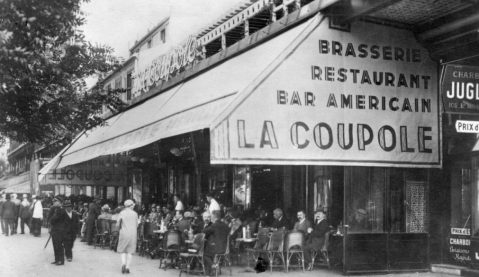
Early photo of La Coupole, date unknown
The sound inside La Coupole by Des Coulam
Des Coulam has been capturing the urban soundscape of Paris for almost ten years. Paris is a city full of mirrors, replicating itself through various mediums. A great archive of the city and its streets, boulevards, arcades and cafés has been written, painted, filmed and photographed throughout the 19th and 20th centuries. However, its aural history is less documented.
“All the archival sounds you find of Paris are adjunct to pictures, so you’ve got television pictures, you’ve got film, you’ve got very few actual recordings of Paris, and I wanted to capture the contemporary soundscape of the city and archive it for future generations to explore, study and enjoy,” explains Coulam. “It’s only on the last few seconds on our historical clock that we’ve been able to capture and archive sounds, so most of our sonic heritage is passed by completely unrecorded. We can get an idea of what nineteenth, eighteenth, and seventeenth century sounds were like from literature and from art in some cases. But the fact is we can’t actually listen to them. All the sounds we hear came from somebody’s imagination.”

Des Coulam, Image courtesy of interviewee.
Coulam’s methodical approach and commitment to the task of recording the sounds of Paris, almost on a daily basis, is helping to create the first comprehensive sound archive of the city. These sounds constitute the Paris Soundscapes Collection and are being archived in the British Library of London.
“Memorable recordings are not limited by your equipment, only by your imagination”
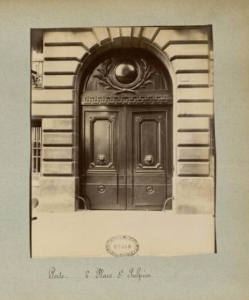
Porte 6, Saint Surplice, Courtesy of Interviewer
“And people forget that,” laments Coulam. “I mean, listening is an art and it’s an art that must be learned. You have to practice, practice, practice to listen. But once you master the art it opens up an all-new world. Because for me, if you give sounds the opportunity to breathe and to speak, they all have a story to tell. We walk along the street and hear a sound and you think: what is that? And you can create a story the sound is telling you. You might hear one of these big Parisian doors bang. What’s behind that door? How many interesting people have walked through that door? And you start to see or experience the place differently.”
Sounds inside l’Eglise Saint-Gervais-Saint-Protais (w/creaking wooden door) by Des Coulam
Des Coulam is of the opinion that the ability to tune into sounds with an inquisitive and imaginative mind can provide better recordings than the most expensive equipment. It’s a skill that he has been developing for over 50 years. “I can tell you the exact day. It was the 25th of December, 1958 when I woke up on Christmas morning and found a tape recorder. And if you had asked me to write a list of 100 things I wanted for Christmas, the tape recorder would not have featured in it. But there it was and I fell in love with it instantly and stayed in love with it ever since. It turned something on in my head that stayed with me all my life. I was 10 years old and now I’m almost 70 years old…I don’t know what I would do without it. I would probably just curl up and die or something…Because now it consumes all of my life. I work seven days a week, but it never feels like work. It’s just fun.”
An aural flâneur in a changing city
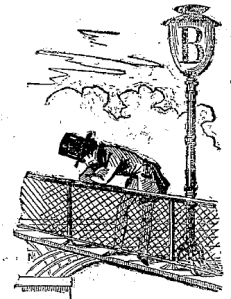
Image from Louis Huart, Physiologie du flâneur (1841)
“Some of my best recordings have come serendipitously when they are not planned.” Most of the time Coulam doesn’t adhere to a strict pathway through the streets of Paris. He follows the background city sounds as someone who follows a river stream. He describes himself as an aural flâneur. The term flâneur (stroller, idler, walker) dates back to the 16th century and was made popular by Walter Benjamin in his 1935 essay “Paris, Capital of the Nineteenth Century” in The Arcades Project. “I’m doing exactly what the 19th century flâneurs did. Observing, that’s all I do. But I observe through sound rather than visually,” says Coulam. “The one thing the flâneur had was time. They had the time to stroll around the streets and observe the everyday life. But in my case I observe listening.” According to Aimée Boutin, the author of City of Noise: Sound and Nineteenth-Century Paris, it is in the writings of Balzac, Louis Huart and Victor Fournel that the flâneur emerges as an attentive listener, an eavesdropper and collector of stories who views the city as a musical score and as a cacophonous/harmonious concert.
19th century images of the flâneur predominately evoke a white male figure of means and privilege who observes and listens to the city from a position of detachment towards the crowd. He is invested in his own anonymity and imagines himself cultivating a sense of neutrality and “objectivity.” Coulam’s active listening practices depart from this perspective by challenging his perspectives and owning the subjectivity of the recording and archiving process. “The way you hear sound changes depending on the circumstances and also the way you interpret sound is different. You and I could walk down the same street and hear it differently. I can walk down the same street twice and hear it differently. There are lots of sounds that I will hear and there are lots of sounds that I won’t hear.” In a recent blog entry Coulam writes that while being “aware that sounds don’t exist in a vacuum, I am always thinking about the social, cultural and historical context of the sounds I find and that has taught me how to explore and appreciate the rich history, complexity and diversity that is Paris.”
Besides his own recordings of the Parisian soundscapes, Coulam has been adding new aural narratives of the city in the series “Paris – A Personal View” inviting guests who live in Paris to visit a place in the city that has a special meaning for them. In this series, Coulam often features the city of the contemporary flâneuse, a radically different form of flâneurie through the steps of the walking woman. In the audio bellow, Monique Wells, an expert on African Diaspora in Paris and founder of the non-profit association Les Amis de Beauford Delaney, explores her favorite place in the city – the Jardin du Luxembourg.
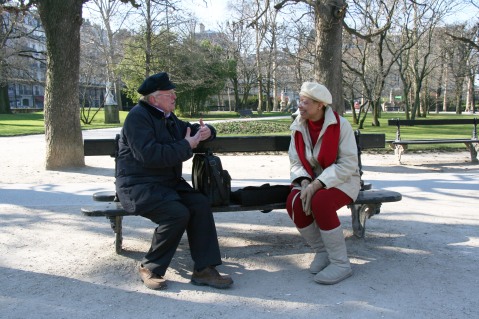
Des Coulam and Dr. Monique Wells, image courtesy of interviewee
Monique Wells, Jardin du Luxembourg, “Paris – A Personal View” Series by Des Coulam
This is a particular time to be listening to the city as a new plan to expand the metropolis of Paris is on its way. “Paris is on the cusp of a huge change. If we look at the history of Paris, it is a history of circles. So you get start with the Romans who invaded and camped out on the Île de la Cité. What did they do? They built a wall around it. And over the years as Paris expanded more walls have been built around the city until today. Now, you’ve got this wall of traffic – the périphérique – and everything within that is Paris and everything without is the suburbs. Nicolas Sarkozy decided, when he was president, that he was going to demolish this invisible wall between Paris and the suburbs. So he gave birth to the Greater Paris Project which is now going ahead. So over the next 10, 20 or 30 years the visual landscape of the city will change and also its sound landscape. And this is a perfect time to capture that change. I won’t live long enough to see it all but I’m already seeing some of it. And what you have right now is that some sounds of Paris are actually disappearing, some are about to disappear, some have stayed remarkably the same and new sounds have appeared.”
Sounds around the Pont National (near Boulevard Périphérique) by Des Coulam

Pont National by Des Coulam
The Vanishing Sounds of Paris
The changes in the visual landscape of Paris and the modernization of its infrastructures will cause a significant change in its soundscape. For instance, Coulam dedicates a lot of his time to recording the changes of the subterranean and aerial soundscape of the Parisian metro lines. “The sounds of the Metro are changing dramatically. If you imagine the sounds of the Paris Metro, you immediately get this picture of the sort of 1950s black and white film, you can hear the sounds of the train rattling over the lines. It’s gone, it’s all completely gone. The last of those trains disappeared in 2012. And I knew this was happening so I recorded a lot of metro line 5 where the old trains were. So I’ve got a stack of recordings of those because nobody else was doing it.”
Sounds of Line 5 at Quai de la Rapée by Des Coulam
“That lovely rattle, these clanking rattling sounds. Just what you imagine it to be!” The old trains on line 5 are now being replaced by modern models with a quieter sound. Also, the trams that covered the city in the 1930s were later substituted by motorized buses. “There are no trams in the center of the city but you’ve got them on the periphery now. There are 8 tram lines. On a lot of the routes they actually go through lot of pains to reduce the amount of noise the tram makes by putting grass down between the tram lines to absorb the sound. So that’s a completely different soundscape than you would have had in this case in the 1930s.”
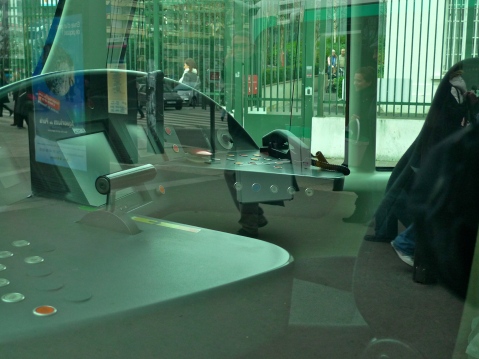
Tram by Des Coulam
Inside a tram on Line T2 from the station Henri Farman to Porte de Versailles by Des Coulam
Coulam has been recording the sounds of the Gare du Nord, one of the six main railway stations in Paris, that is going through some transformations right now. A sign outside the station in the construction zone promises “a brighter and more practically designed hall for enlightened travelling”. The distinctive soundscape of the Gare will certainly change. A new type of pavement is enough to alter the echoing sounds made by footsteps and rolling suitcases.
Inside the Gare du Nord; October 2016
“But on a more human level,” says Coulam, “the street criers, the vagabond man, the knife grinders, people like that who used to come around shouting in the street are completing gone. The only thing you find now are the market traders in the market stores, but you don’t find any of these tradesmen in the streets of Paris.”
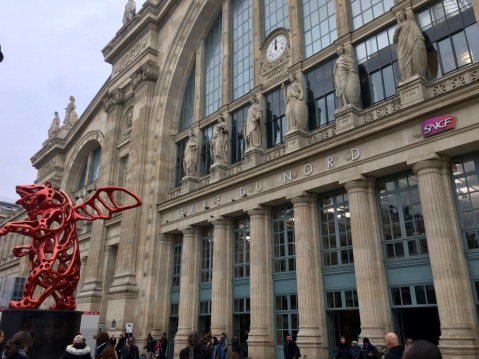
Gare du Nord by Des Coulam
“An attempt to exhaust a place in Paris” in sound
“The only time you really notice the urban soundscape is when isn’t there,” remarks Coulam. On the day we meet, Montparnasse is eerily quiet. There is little traffic and only a few pedestrians are strolling along the Boulevard. “The soundscape you hear is not the normal Montparnasse because this is August and everybody is away on holiday, so you are immediately struck by the relative quiet around here.” It might be difficult to find places of quiet in a city like Paris during the other eleven months of the year.
But even the noise, the chatter and the rumble are important parts of the urban soundscape. “The biggest challenge I face recording the soundscape of Paris is the sound of traffic, and I long ago decided that you couldn’t ignore it. And in a sense, why should you? Because it’s an integral part of the soundscape, so to ignore it is a sort of cheating, really. So, I decided to embrace it and I started to deliberately record traffic and it was absolutely fascinating!”
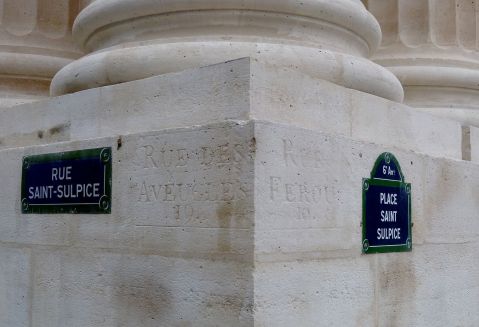
Place Saint Sulpice, courtesy of Wikicommons
The author and filmmaker George Perec once sat down for three days in Saint-Sulpice Square to write down all the non-events around him. “What happens, when nothing happens other than the weather, people, cars, and clouds?” asked Perec. In the same vein, Coulam continues recording the sounds that constitute the backdrop to everyday life and through attentive listening, he weaves the sound tapestry of the city of Paris. “You sit on a Parisian green bench in a busy narrow pavé street and just let the street walk past you. You will hear fabulous sounds.”
“An attempt to exhaust a place in Paris” in sound (Café de la Mairie, Place Saint-Sulpice) by Des Coulam
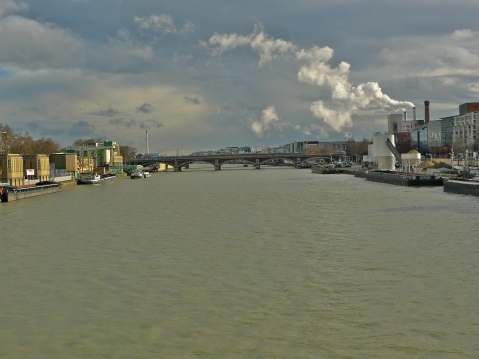
Pont National from the Pont de Tolbiac by Des Coulam
You can hear Des Coulam’s collection of Parisian soundscapes at Soundlandscape or follow him on twitter.
—
Featured Image: Line 5 at Quai de la Rapacca, Image by Des Coulam
—
Carlo Patrão is a Portuguese radio artist and producer of the show Zepelim. His radio work began as a member of the Portuguese freeform station Radio Universidade de Coimbra (RUC). In his pieces, he aims to explore the diverse possibilities of radiophonic space through the medium of sound collage. He has participated in projects like Basic.fm, Radio Boredcast, and his work has been featured in several international sound festivals and has also been commissioned by Radio Arts (UK). He is currently working on a radio show for the Portuguese national public radio station RTP. In addition to his work in radio, he has a master’s in clinical psychology
—
 REWIND! . . .If you liked this post, you may also dig:
Playing with Bits, Pieces, and Lightning Bolts: An Interview with Sound Artist Andrea Parkins — Maile Colbert
(Sound)Walking Through Smithfield Square in Dublin— Linda O’Keeffe
Sounding Our Utopia: An Interview With Mileece— Maile Colbert
Share this:


Current Top Posts





April 2021

January 2020

November 2019

October 2019

August 2019

April 2014

November 2017

March 2015

December 2017

October 2015
 Sounding Out!
Recent Comments