
“This Liquid Dream”: An Interview with Aquaphoneia Composer Navid Navab
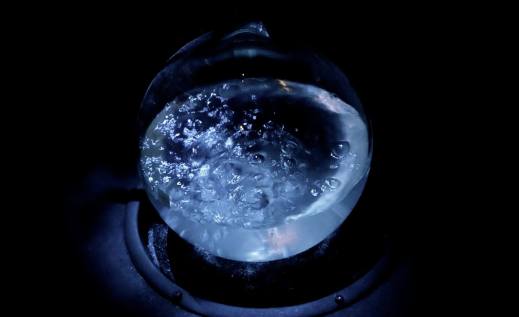
Multidisciplinary composer and media alchemist Navid Navab and his team at the Topological Media Lab based at Concordia University (Montreal) presented Aquaphoneia, a sound installation which transmutes voice into water and water into air at Biennale Nemo in Paris in December 2017 (and will run until March 2018). I conducted this interview in the context of the first presentation of Aquaphoneia originally conceptualized for Ars Electronica 2016: RADICAL ATOMS and the alchemists of our time. This version of the piece looked at technology through the lens of the living materiality. As Prof. Hiroshi Ishii, of the MIT Media Lab’s Tangible Media Group, stated, artists “suggest completely new ways of looking at the role of science in our society and the interplay of technology and nature.”
***
EB [Esther Bourdages]: The theme of the 2016 Ars Electronica Festival, RADICAL ATOMS – and the alchemists of our time, is very close to the Topological Media Lab’s mission: transmutation and alchemy on the philosophical and phenomenological level. For Aquaphoneia, can you expand on alchemy and specifically on how this art piece stands out from your past work? How did alchemical thought process and production techniques come up in the process of the piece?
NN [Navid Navad]: When the 2016 theme for Ars Electronica Festival was announced I was happily surprised and thought: finally, things are coming to light at a much larger scale. Yes, please can we reverse the still prominent European Modernism’s separations—between the conceptual and the material, the precise and the messy, the sciences and the arts—and go back to the holistic richness of alchemical matter? This transition that we are currently experiencing calls for a shift away from representational technologies: from interfaces to stuff, from objects to fields of matter-in-process, from fixed concepts to processes that enact concepts. For over a decade, we as alchemists have been engaging with “bodies and materials that are always suffused with ethical, vital and material power.”
The Topological Media Lab [TML] is occupied by people who are living to fuse and confuse, ready to unlearn the apparent practicality of isolated disciplines, while playfully improvising new pathways to understanding potential futures. The TML hosts an array of projects for thinking-feeling through poetry-infused-matter and breathing life into static forms—which to me is an effortlessly artistic process, and all the while inseparable from a rigorously philosophical or scientific one. Even though it might take decades for the kinds of computational-materials that we are envisioning today to be engineered from ground up at an atomic level, with what is possible today, we explore how the messy stuff of the world could become computationally charged with the potential for play: sounding, dancing, and co-performing new ways of living with or without us.
Aquaphoneia comes out of this rich ecology of experiments. In Aquaphoneia, voice and water become irreversibly fused. The installation listens to the visitors, and transmutes their utterances into aqueous voice, which then is further enriched and purified through alchemical processes.
.
To fully realize this liquid dream, we went to great lengths in order to fuse the messy behaviour of matter flowing throughout the installation with meticulously correlated and localized sonic behaviour. For example, the temporal texture of boiling liquid in one chamber is perceptually inseparable from the spectral entropy of simmering voices which then evaporate into a cloud of spectral mist. All of this dynamic activity is finely localized: the sounds acoustically emit exactly from where the action occurs, rather than spatially schizophying loudspeakers elsewhere.
On another hand, our material-computational-centric approach lead to a tough yet rewarding meditation on control and process. As a composer, I had to let go of all desires for immediate control over sounds and surrender important rhythmical and compositional decisions to messy material processes. In Alchemical Mercury (2009), Karen Pinkus quotes Marcel Duchamp: “alchemy is a kind of philosophy: a kind of thinking that leads to a way of understanding” (159). For us, in the process of creating Aquaphoneia, essentially what had to be understood and then given up was our attachment to our far-too-human notions of time and tempo. Instead we embraced and worked within the infinitely rich and pluri-textural tempi of matter. Technically and compositionally this meant that most of our focus had to be placed on merging the continuous richness of material processes with our computational processes through an array of techniques: temporal pattern following, audio-mosaicing, continuous tracking of fields of activity using computer vision and acoustic sensing techniques in order to synthesize highly correlated sonic morphologies, careful integration of structure-born-sound, etc. We were able to co-articulate compositions by constraining material processes sculpturally, and then letting the liquid voice and the laws of thermodynamics do their thing.
[EB]: One of the first elements that we notice in the installation is the brass horn connected to an old Edison sound recording machine, that now turns into liquid instead of wax cylinders. In fact, it came from an Edison talking machine. You repurpose an authentic artifact, but you do not fall into the trap of nostalgia, and neither into the role of collector, but you embrace innovation with a dynamic approach which excavates past media technologies in order to understand or surpass contemporary audio technologies. Where does the use of the Edison horn come from and how does it speak to your relationship with the superposition of history?
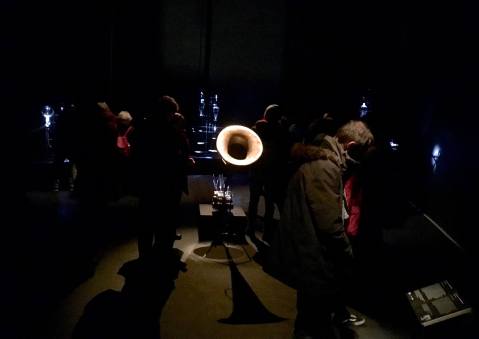
Paris, Biennale Némo, 17 October 2017 – 18 March 2018 Credit: Navid Navad, 2017
[NN]: The history of sound reproduction involves transforming audible pressure patterns or sound energy into solid matter and vice versa. The historic Edison recording machines gathered sound energy to etch pressure patterns onto tinfoil wrapped around a cylindrical drum. Sound waves, focussed at the narrow end of the horn, caused a small diaphragm to vibrate, which in turn caused a miniature steel-blade stylus to move and emboss grooves in the cylinder. The tin foil would later on be replaced by wax cylinders, vinyl disks and eventually digital encoding.
Aquaphoneia engages the intimately recursive relationship between sounding technologies and material transmutations. Our digital audio workstations are an in fact an inclusive part of this history, this endless chain of analog transmutation between energy and matter. Under the fiction of the digital there is always the murmur of electrons and of matter-energy fields in physical transmutation. As J. Fargier writes on an early book on Nam June Paik (1989) “The digital is the analog correspondence of the alchemists’ formula for gold” (translation by NN). Well, yes. The digital revolution has allowed us to shape, compute, purify, and sculpt sounds like never before… but then often at the hefty cost of a disembodying process, with interfaces that are linked to sounds only through layers upon layers of representation, far detached from resonating bodies and the sexy flux of sounding matter.
Aquaphoneia playfully juxtaposes material-computational histories of talking machines within an imaginary assemblage: sounds are fully materialized and messed with tangibly within an immediate medium very much like clay or water or perhaps more like a yet to be realized alchemico-sonic-matter. This odd assemblage orchestrates liquid sounds leveraging intuitive worldly notions—such as freezing, melting, dripping, swishing, boiling, splashing, whirling, vaporizing—and in the process borrows alchemical tactics expanding across material sciences, applied phenomenology, metaphysics, expanded materiology, and the arts. Aquaphoneia’s alchemical chambers set these materials, metaphors, and forces into play against one another. After the initial ritual of offering one’s voice to the assemblage, the aqueous voice starts performing for and with itself, and human visitors have the opportunity to watch and participate as they would when encountering the unpredictable order of an enchanted forest river.
It is also noteworthy that the horn resembles a black hole. The edge of the horn acts like an event horizon, separating sounds from their source-context. Sounds, once having passed the acousmatic event horizon, cannot return to the world that they once knew. Voices leaving the body of their human or non-human speaker, fall into the narrow depths of the horn, and are squeezed into spatio-temporal infinity. Disembodied voices, are immediately reborn again with a new liquid body that flows though alchemical chambers for sonic and metaphysical purification.
Much of my work deals with the poetics of schizophonia (separation of sound from their sources). Sound reproduction (technologies), from Edison’s talking machines to our current systems, transcode back and forth between the concrete and acousmatic, situated and abstract, materialized and dematerialized, analogue and digital. Often sounds are encoded into a stiff medium which then may be processed with an interface, eventually decoded, and re-manifested again as sound. Aquaphoneia ends this nervous cycle of separation anxiety and re-attachment by synthesizing a sounding medium capable of contemporary computational powers such as memory, and adaptive spectro-temporal modulation and morphing. To adapt Marshall McLuhan, instead of encoding and decoding a presumed message with representational technologies, it enchants the medium.
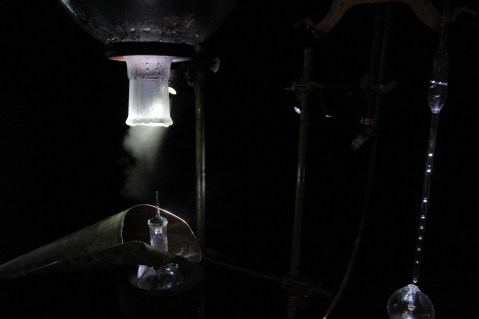
Image Credit: Topological Media Lab, 2016
[EB]: There is the tendency to think that artwork from Media Labs are stable and high tech. Aquaphoneia uses analog and digital technologies with a Do-It-Yourself (DIY) touch in the aesthetic. Since your lab is multidisciplinary oriented and influenced by diverse fields of knowledge, can you develop on the DIY dimension in Aquaphoneia under the gaze of Clint Enns—cinematographer in the experimental field of cinema—: “Adopting a DIY methodology means choosing freedom over convenience”?
[NN]: Aquaphoneia is a truly eclectic assemblage lost in time. Aquaphoneia’s mixed form reflects its extremely fluid, collaborative and playful creative process. Instead of coming up with a definitive design and executing it industrially, Aquaphoneia’s realization involved a much more playful process, where every little aspect of the installation—materials, sounds, software, electronics, etc.—was playfully investigated and messed with. Every little detail matters and every process, undulating back and forth between conception to execution, is an artistic process. The research-creation process leading to the works that come out of our lab are as critical to us as the final and fully produced art works. This was also true for the alchemists who, through their process, were seeking to develop new approaches for understanding the world, relating to matter, and surpassing nature.
Our research-creation activities concern experimenting with ethico-aesthetics of collective thinking-making: humans, non-humans, machines, and materials enacting and co-articulating the ever-changing material-social networks of relations which shape them. This DIY art-all-the-way approach, while providing a healthy dose of aesthetic freedom, is also an ethical one: we live with and within our designs and grow with them. That being said, we are not attached to a DIY process in the same way that some maker cultures might be. Sometimes we blindly find and repurpose something that does something cool, complicated, and mysterious and that is fantastic, sort of like philosophy of media meets cyber dumpster diving meets DIY hacker space meets cutting edge tech research meets miniMax (minimum engineering with maximum impact) meets speculative whatever…
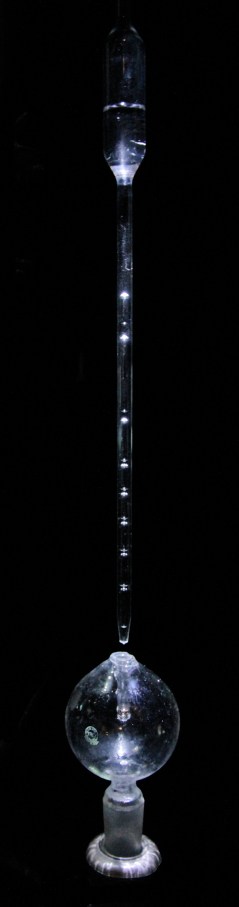
Image Credit: Topological Media Lab, 2016
For example, at some point we decided to gather sonic vapour in a glass dome and condense it back into drops, which were then guided to fall into the bottom of the installation. The purified drop of voice—sonic “lapis philosophorum”—was to fall into the depths of the earth beneath and shine upward like sonic gold, connecting heaven and earth. We had to execute this opus magnum inside a very small hole in the base of the installation. The water drop needed to be immediately sensed and sonified, leading to sounds coming out of the same hole, along with synchronized light. You can imagine that if we were relying on “black-boxed” technologies and ready-made techniques then this task would have seemed like a nightmare to design and fabricate. The water drop was to fall all the way to the bottom of the hole where it would be acoustically sensed by a small apparatus that had to be acoustically isolated from everything else. Then the result of the sonification had to be pushed through the very same hole with a high degree of intelligibility and in a way that it would be seamlessly localized. Meanwhile, light had to shine through this hole in sync with the sounds but the source of light had to remain hidden.
The solution to this technical puzzle came to us effortlessly when playing around with random stuff. We found a hipster product—a little plastic horn—that was made for turning your iPod into a gramophone. Then a speaker was mounted inside of this plastic horn in order to focus sounds towards the end tip of the horn. The back of the speaker was fully covered with foam and duct tape to stop any sound from escaping anywhere except for where we wanted it to appear. A small hole was drilled into the brass pipe in the base of the installation. Our advanced hipster horn-tip-sound-laser-thing was then inserted, allowing crisp sounds to enter the brass hole and emit from it without any visible clues for the perceiver as to where the speaker was hidden. Meanwhile, a similar lighting solution was created so that in a very small footprint we can focus, direct, and bounce enough directional light in the brass pipe without ever getting in the way of the water drops.
We had to engage with this sort of detailed fabrication/composition process throughout the whole installation in order to come up with solutions to sense the behaviour of the materials and liquids locally and to manifest them sonically and visually so that there would be no separation from local material behaviours and their computational enchantment. In trying to do so we discovered that more often than not, there was no ready-made solution or technique to rely on, and at the same time we didn’t have months ahead of us to engage in an abstract design and fabrication process. We had limited hours of collective play time to leverage and to come up with innovative techniques that we didn’t even know could exist and that was really fun.
**
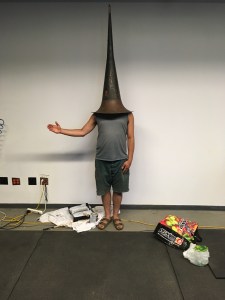
Image Credit: Topological Media Lab, 2016**
Aquaphoneia is a rich sound art piece – a manifesto by itself about innovation and inventiveness. The sound installation demonstrates that the main crafters Navid Navad and his partner Michael Montanaro, in collaboration with other members of the Topological Media Lab, swim easily into the multidisciplinary art. They are are not afraid to experiment and engage with the material, which results in an interlacing of forms, a mixture of historic references, and an interesting fusion of “low” and “high” technology. I was able to catch some of the build up of the art piece, and it was fantastic to witness the lab as a playful messy artistic field with a little team of scholars fusing their different backgrounds in convergence on the marriage of art and science.
Aquaphoneia, a sound installation which transmutes voice into water and water into air at Biennale Nemo in Paris runs until March 2018.
—
-
- NAVID NAVAB art direction, sound/installation concept and design, audiovisual composition, programming, behaviour design
- MICHAEL MONTANARO art direction, visual/installation concept, design and fabrication
- PETER VAN HAAFTEN electronics, sound, programming
- consulting assistants: Nima Navab (embedded lighting design) Joseph Thibodeau (electronics)
- research collaboration: Topological Media Lab
Featured Image: Aquaphoneia, Paris, Biennale Némo, 17 October 2017 – 18 March 2018, Credit: Navid Navad, 2017
—
Esther Bourdages works in the visual arts and technology art field as a writer, independent curator and scholar. Her curatorial research explores art forms such as site-specific art, installation and sculpture, often in conjunction with sound. She has authored many articles and critical commentaries on contemporary art. As a musician, she performs under the name of Esther B – she plays turntables, handles vinyl records, and records soundscapes. She works and lives in Montreal.
Navid Navab is a Montreal based media alchemist, multidisciplinary composer, audiovisual sculptor, phono-menologist, and gestureBender. Interested in the poetics of gesture, materiality, and embodiment, his work investigates the transmutation of matter and the enrichment of its inherent performative quali- ties. Navid uses gestures, rhythms and vibration from everyday life as basis for realtime compositions, resulting in augmented acoustical poetry and painterly light that enchants improvisational and pedestrian movements.
Navad currently co-directs the Topological Media Lab, where he leverages phenomenological studies to inform the the creation of computationally-augmented performance environments. His works, which which take on the form of gestural sound compositions, responsive architecture, site specific interven- tions, theatrical interactive installations, kinetic sound sculptures and multimodal comprovisational per- formances, have been presented internationally at diverse venues such as Canadian Center for Architec- ture, Festival du Nouveau Cinema, Ars Electronica Festival Linz, HKW Berlin, WesternFront Vancouver, McCord Museum, Musée d’art Contemporain de Montréal, Contemporary Arts Museum Houston, Inter- national Digital Arts Biennial, Musiikin Aika Finland, and Festival International Montréal/Nouvelles Mu- siques, among others. www.navidnavab.net
—
 REWIND! . . .If you liked this post, you may also dig:
Playing with Bits, Pieces, and Lightning Bolts: An Interview with Sound Artist Andrea Parkins — Maile Colbert
Sounding Our Utopia: An Interview With Mileece— Maile Colbert
Optophones and Musical Print–Mara Mills
Share this:

Re-orienting Sound Studies’ Aural Fixation: Christine Sun Kim’s “Subjective Loudness”
 Editors’ note: As an interdisciplinary field, sound studies is unique in its scope—under its purview we find the science of acoustics, cultural representation through the auditory, and, to perhaps mis-paraphrase Donna Haraway, emergent ontologies. Not only are we able to see how sound impacts the physical world, but how that impact plays out in bodies and cultural tropes. Most importantly, we are able to imagine new ways of describing, adapting, and revising the aural into aspirant, liberatory ontologies. The essays in this series all aim to push what we know a bit, to question our own knowledges and see where we might be headed. In this series, co-edited by Airek Beauchamp and Jennifer Stoever you will find new takes on sound and embodiment, cultural expression, and what it means to hear. –AB
—
A stage full of opera performers stands, silent, looking eager and exhilarated, matching their expressions to the word that appears on the iPad in front of them. As the word “excited” dissolves from the iPad screen, the next emotion, “sad” appears and the performers’ expressions shift from enthusiastic to solemn and downcast to visually represent the word on the screen. The “singers” are performing in Christine Sun Kim’s conceptual sound artistic performance entitled, Face Opera.
The singers do not use audible voices for their dramatic interpretation, as they would in a conventional opera, but rather use their faces to convey meaning and emotion keyed to the text that appears on the iPad in front of them. Challenging the traditional notions of dramatic interpretation, as well as the concepts of who is considered a singer and what it means to sing, this art performance is just one way Kim calls into question the nature of sound and our relationship to it.
Audible sound is, of course, essential to sound studies though sound itself is not audist, as it can be experienced in a multitude of ways. The contemporary multi-modal turn in sound studies enables ways to theorize how more bodies can experience sound, including audible sound, motion, vibration, and visuals. All humans are somewhere on a spectrum between enabled and disabled and between hearing and deaf. As we grow older most people move farther toward the disabled and deaf ends of the spectrum. In order to experience sound for a lifetime, it is imperative to explore multi-modal ways of experiencing sound. For instance, the Deaf community rejects the term disabled, yet realizes it is actually normative constructs of hearing, sound, and music that disable Deaf people. But, as Kim demonstrates, Deaf people engage with sound all of the time. In this case, Deaf individuals are not disabled but rather, what I identify as difabled (differently-abled) in their relationship with sound. While this term is not yet used in disability scholarship, it is not completely unique, as there is a Difabled Twitter page dedicated to, “Ameliorating inclusion in technology, business and society.” Rejection of the word disabled inspires me to adopt difabled to challenge the cultural binary of ability and embrace a more multi-modal approach.
Kim’s art explores sound in a variety of modalities to decenter hearing as the only, or even primary, way to experience sound. A conceptual sound artist who was born profoundly deaf, Kim describes her move into the sound artistic landscape: “In the back of my mind, I’ve always felt that sound was your thing, a hearing person’s thing. And sound is so powerful that it could either disempower me and my artwork or it could empower me. I chose to be empowered.”
For sound to empower, however, cultural perception has to move beyond the ear – a move that sound studies is uniquely poised to enable. Using Kim’s art as a guide, I investigate potential places for Deaf within sound studies. I ask if there are alternative ways to listen in a field devoted to sound. Bridging sound studies and Deaf studies it is possible to see that sound is not ableist and audist, but sound studies traditionally has suffered from an aural fixation, a fetishization of hearing as the best or only way to experience sound.
Pushing beyond the understanding of hearing as the primary (or only) sound precept, some scholars have begun to recognize the centrality of the body’s senses in sound experience. For instance, in his research on reggae, Julian Henriques coined the term sonic dominance to refer to sound that is not just heard but that “pervades, or even invades the body” (9). This experience renders the sound experience as tactile, felt within the body. Anne Cranny-Francis, who writes on multi-modal literacies, describes the intimate relationship between hearing and sound, believing that “sound literally touches us,” This process of listening is described as an embodied experience that is “intimate” and “visceral.” Steph Ceraso calls this multi-modal listening. By opening up the body to listen in multi-modal ways, full-bodied, multi-sense experiences of sound are possible. Anthropologist Roshanak Kheshti believes that the differentiation of our senses created a division of labor for our senses – a colonizing process that maximizes the use-value and profit of each individual sense. She reminds her audience that “sound is experienced (felt) by the whole body intertwining what is heard by the ears with what is felt on the flesh, tasted on the tongue, and imagined in the psyche” (714), a process she calls touch listening.
Other scholars continue to advocate for a place for the body in sound studies. For instance, according to Nina Sun Eidsheim, in Sensing Sound, sound allows us to posit questions about objectivity and reality (1), as posed in the age-old question, “If a tree falls in the forest and no one is there to hear it, does it make a sound?” Eidsheim challenges the notion of a sound, particularly music, as fixed by exploring multiple ways sound may be sensed within the body. Airek Beauchamp, through his notion of sonic tremblings, detaches sound from the realm of the static by returning to the materiality of the body as a site of dynamic processes and experiences that “engages with the world via a series of shimmers and impulses.” Understanding the body as a place of engagement rather than censorship, Cara Lynne Cardinale calls for a critical practice of look-listening that reconceptualizes the modalities of the tongue and hands.
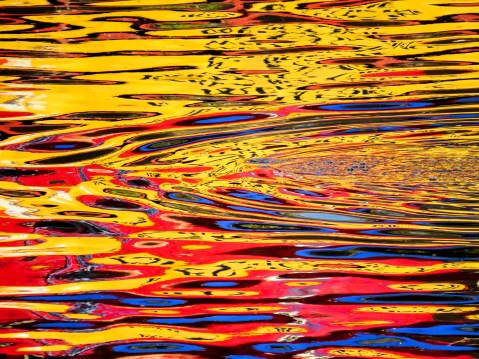
Vibrant Vibrations by Flickr User The Manic Macrographer (CC BY 2.0)
As these scholars have identified, privileging audible sound over other senses reinforces normative ideas of communication and presumes that individuals hear, speak, and experience sound in normative ways. These ableist and audist rhetorics are particularly harmful for individuals who are Deaf. Deaf community members actively resist these ableist and audist assumptions to show that sound is not just for hearing. Kim identifies as part of the Deaf community and uses her art to challenge the ableist and audist ideologies of the sound experience. Through exploring one of Christine Sun Kim’s performance pieces, Subjective Loudness, I argue that we can conceptualize sound studies in the absence of auditory sound through the two concepts Kim’s piece were named for, subjectivity and loudness.
In creating Subjective Loudness, Kim asked 200 Tokyo residents to help her create a musical score. Hearing participants were asked to use their bodies to replicate sounds of common 85 dB noises into microphones. The sounds Kim selected included: the swishing of a washing machine, the repetitive rotation of printing press, the chaos of a loud urban street, and the harsh static of a food blender. After the list was complete, Kim has the sounds translated into a musical score, sung by four of Kim’s closest friends. The noises then become music, which Kim lowers below normal human hearing range for a vibratory experience accessible to hearing and non-hearing individuals alike; The result is music that is not heard but rather felt. As vibrations shake the walls, windows, and furniture audience members feel the music.
Kim’s performance expands upon current understandings of the body in sound by incorporating multiple materialities of sound into one experience. Rather than simply looking at an existing sound in a new way, she develops and executes the sound experience for her participants. Kim types the names of common 85 dB sounds, what most hearing people may call “noise” on an iPad – a visual representation of the sound.
By asking participants to use their bodies to replicate these sounds – to change words into noise – Kim moves visual representation moves into the audible domain. This phase is contingent on each participant’s subjective experience with the particular sound, yet it also relies on the materiality of the human body to be able to replicate complex sounds. The audible sounds were then returned to a visual state as they were translated into a musical score. In this phase, noise is silenced as it is placed as musical notes on a page. The score is then sung, audibly, once again shifting visual into audible. Noise becomes music.
Yet even in the absence of hearing the performers sing, observers can see and perhaps feel the performance. Similar to Kim’s Face Opera, this performance is not just for the ear. The music is then silenced by reducing its volume beyond that of normal hearing range. Vibrations surround the participants for a tactile experience of sound. But participants aren’t just feeling the vibrations, they are instruments of vibration as well, exerting energy back into the space that then alters the sound experience for other bodies. The materiality of the body allows for a subjective experience of sound that Kim would not be able to as easily manipulate if she simply asked audience members to feel vibrations from a washing machine or printing press. But Kim doesn’t just tinker with the subjectivity of modality, she also plays with loudness.

Christine Sun Kim at Work, Image by Flickr User Joi Ito, (CC BY 2.0)
In this performance Kim creates a think interweaving of modalities. Part of this interplay involves challenging our understanding of loudness. For instance, participants recreate loud noises, but then the loud noise is reduced to silence as it is translated into a musical score. The volume has been dialed down, as has the intensity as the musical score isolates participates. The sound experience, as the score, is then sung, reconnecting the audience to a shared experience. Floating with the ebb and flow of the sound, participants are surrounded by sound, then removed from it, only to then be surrounded again. Finally, as the sound is reduced beyond hearing range, the vibrations are loud, not in volume but in intensity. The participants are enveloped in a sonorous envelope of sonic experience, one that is felt through and within the body. This performance combats a long-standing belief Kim had about her relationship with sound.
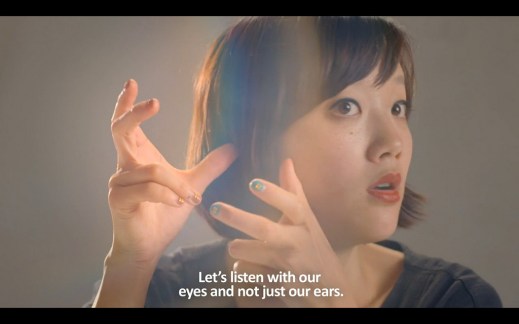
As a child, Kim was taught, “sound wasn’t a part of my life.” She recounted in a TED talk that her experience was like living in a foreign country, “blindly following its rules, behaviors, and norms.” But Kim recognized the similarities between sound and ASL. “In Deaf culture, movement is equivalent to sound,” Kim stated in the same talk. Equating music with ASL, Kim notes that neither a musical note nor an ASL sign represented on paper can fully capture what a music note or sign are. Kim uses a piano metaphor to make her point better understood to a hearing audience. “English is a linear language, as if one key is being pressed at a time. However, ASL is more like a chord, all ten fingers need to come down simultaneously to express a clear concept in ASL.” If one key were to change, the entire meaning would change. Subjective Loudness attempts to demonstrate this, as Kim moves visual to sound and back again before moving sound to vibration. Each one, individually, cannot capture the fullness of the word or musical note. Taken as a performative whole, however, it becomes easier to conceptualize vibration and movement as sound.
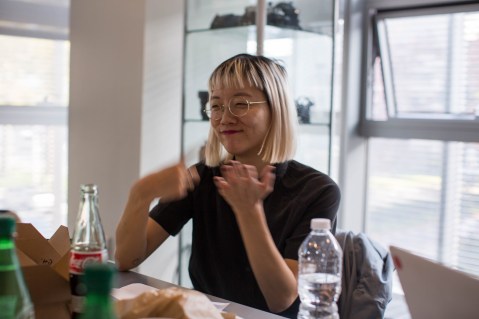
Christine Sun Kim speaking ASL, Image by Flickr User Joi Ito, (CC BY 2.0)
In Subjective Loudness, Kim’s performance has sonic dominance in the absence of hearing. “Sonic dominance,” Henriques writes, “is stuff and guts…[I]t’s felt over the entire surface of the skin. The bass line beats on your chest, vibrating the flesh, playing on the bone, and resonating in the genitals” (58). As Kim’s audience placed hands on walls, reaching out to to feel the music, it is possible to see that Kim’s performance allowed for full-bodied experiences of sound – a process of touch listening. And finally, incorporating Deaf and hearing individuals in her performance, Kim shows that all bodies can utilize multi-modal listening as a way to experience sound. Kim’s performances re-centers alternative ways of listening. Sound can be felt through vibration. Sound can be seen in visual representations such as ASL or visual art.
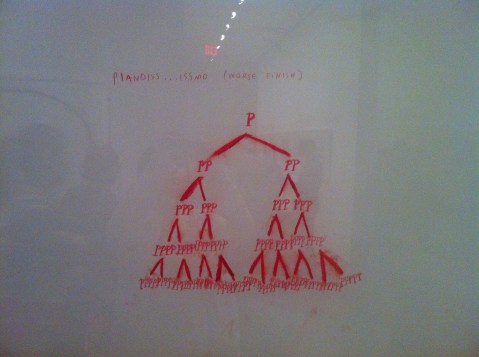
Image of Christine Sun Kim’s painting “Pianoiss….issmo” by Flickr User watashiwani (CC BY 2.0)
Through Subjective Loudness, it is possible to investigate subjectivity and loudness of sound experiences. Kim does not only explore sound represented in multi-modal ways, but weaves sound through the modalities, moving the audible to the visual to the tactile and often back again. This sound-play allows audiences to question current conceptions of sound, to explore sounds in multi-modalities, and to use our subjectivities in sharing our experiences of sound with others. Kim’s art performances are interactive by design because the materiality and subjectivity of bodies is what makes her art so powerful and recognizable. Toying with loudness as intensity, Kim challenges her audience to feel intensity in the absence of volume and spark the recognition that not all bodies experience sound in normative ways. Deaf bodies are vitally part of the soundscape, experiencing and producing sound. Kim’s work shows Deaf bodies as listening bodies, and amplifies the fact that Deaf bodies have something to say.
—
Featured image: Screen capture by Flickr User evan p. cordes, (CC BY 2.0)
—
Sarah Mayberry Scott is an Instructor of Communication Studies at Arkansas State University. Sarah is also a doctoral student in Communication and Rhetoric at the University of Memphis. Her current research focuses on disability and ableist rhetorics, specifically in d/Deafness. Her dissertation uses the work of Christine Sun Kim and other Deaf artists to explore the rhetoricity of d/Deaf sound performances and examine how those performances may continue to expand and diversify the sound studies and disability studies landscapes.
—
 REWIND! . . .If you liked this post, you may also dig:
Introduction to Sound, Ability, and Emergence Forum –Airek Beauchamp
The Listening Body in Death— Denise Gill
Unlearning Black Sound in Black Artistry: Examining the Quiet in Solange’s A Seat At the Table — Kimberly Williams
Technological Interventions, or Between AUMI and Afrocuban Timba –Caleb Lázaro Moreno
“Sensing Voice”*–-Nina Sun Eidsheim
Share this:


Current Top Posts





April 2021

January 2020

November 2019

October 2019

August 2019

April 2014

November 2017

March 2015

December 2017

October 2015
 Sounding Out!
Recent Comments