
My Time in the Bush of Drones: or, 24 Hours at Basilica Hudson
Ed. Note: We wanted to run this piece in advance of the Basilica Hudson’s SoundScape event taking place this Friday, September 14 – Sunday, September 16, 2018. Our Amplifying Du Bois at 150 forum will return next week.
—
“But why?”
Three weeks into a new semester and I am packing for another weekend of irresponsible travel. Irresponsible financially (because air travel on a graduate stipend is a decadence rarely rewarded) and irresponsibly professionally (because missing an annual department event, grading in a car, and sleeping on the ground for two days is a string of realities that stand sternly opposed to anything like good sense). I am doing all this in order to attend Basilica Hudson’s Soundscape: a wide and ranging line up of musicians and artists whose aesthetic commitments fall, shall we say, considerably aslant from the pop-cultural median. I am doing all this because of something that happened last year at this place, something I am still trying to work out. And this means, amongst concerned colleagues and family and friends, I’m again hearing that familiar, stuttering articulation of disbelief. Phrased, with equal parts confusion and concern, they rejoin:
Why?
This question first started popping up late last March. It came repeatedly, unblinkingly, and, I should add, not-unreasonably. What’s more, this was, in a very real way, my fault. For I had failed to develop a pithy ready-to-hand account of precisely why I was to travel from Chicago to New York City and New York City to Hudson, only to sleep on a thin mat on the concrete floor of a converted foundry while listening to loud, sustained bursts of noise (with varying degrees of harmonic familiarity) for an unbroken period of 24 hours.
Instead, I had only an intuition that failed to pass even the slightest of critical muster: Basillica Hudson’s 24-HOUR DRONE festival seemed weird and extreme and like something might happen there. On this basis, it seemed like a good thing to do.
I can now state with some clarity (though still lacking anything like critical poise) that something did in fact happen there, and it was indeed a good thing to do. Though what that “something” was remains frustratingly elusive.

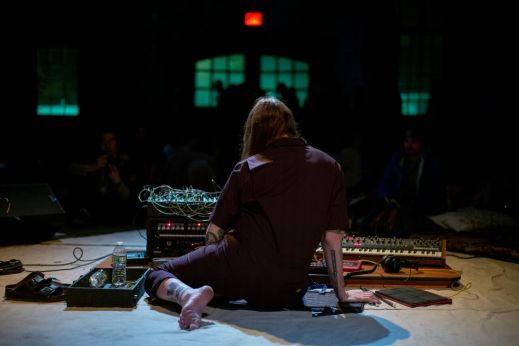
24-Hour Drone, Image by Alt
This piece thus began as a review, but ended necessarily quite differently. The conventions of a review call for evaluation and normative judgement; they require statements regarding the quality of an event or object. I can offer very little in this vein. I’m still trying to wrest from memory something stubbornly mute and fleeting — still trying to figure out what it was, precisely, that happened there.
The drive up remains clear enough in memory. The usual crackle of reunited conversation between dear friends long-separated by geography; a decision not to listen to the then-new Grouper album (we would have enough heart-dragging ambient texture in the coming hours, we concluded); the sounds of Brooklyn passing into that hushed early-Spring upstate on Route 84. We at one point, for reasons that need not become articulate, listened to the Gin Blossoms. But as we pulled into the graveled parking lot a sense of anticipation and confusion returned. What was this thing?
To begin, we might reasonably call it an event.
Basilica Hudson — an upstate New York-based non-profit for the arts that puts on the event annually — admirably describes it thus:
An immersive event and all-encompassing experience, 24-HOUR DRONE is a roving, international series presented by Basilica Hudson and Le Guess Who?, featuring musicians and sound artists experimenting within the spectrum of drone to create 24 hours of unbroken, uninterrupted sound.
Through this expanded programming, 24-HOUR DRONE strives to break down barriers across borders, offering an opportunity to connect diverse musical communities and traditions, offering a localized snapshot of DRONE within the larger context of an imagined universal sound.
The language here should scan as familiar to anyone accustomed to reading music and arts press. Roving, experimental, barrier-breaking, border-crossing: these terms all call up a restless energy, the excitement of the wholly new, the different, the thoroughly non-normative. As it turns out, all these attributes turn out to be more-or-less (if uninterestingly) true.
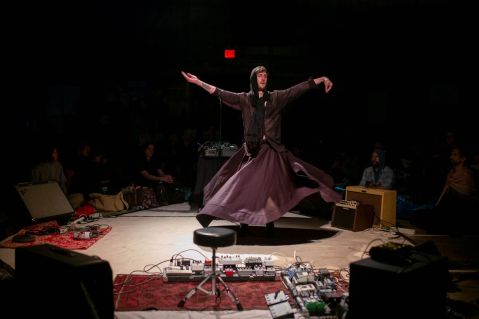
24-Hour Drone, Image by Alt
Over the course of the day and night, I heard the ethereal saxophone of PAUL, the whipping clangor of Pharmakon, and — I want to emphasize this — the absolutely breathless New Castrati, January Hunt’s exceptional and mournful work living up to her billing elsewhere as “synth, drones, and the annihilation of man.” A sentence above, though, still merits pause: “a localized snapshot of DRONE within the larger context of universal sound.” Roving energy and shattering experiment here take shape as a snapshot, the whirring and calamitous universal stalling for a moment in a discrete particular. 24-HOUR DRONE attempts to lends form to what was too diffuse to be seen.
So, modestly, in lieu of aesthetic judgement, a proposition: the value of Basilica Hudson’s 24-HOUR DRONE is to offer space to sound.
Indeed, for an event so centrally concerned with sound, 24-HOUR DRONE is as much about the Basilica — a converted nineteenth-century cathedral-esque foundry — as it is about sound. And for good reason: the Basilica has been beautifully repurposed — gutted of its original use and re-asserted as an malleable and improbably elegant arts space. Hundred-plus foot ceilings dwarf individual bodies, it’s begrimed upper windows modulate the midday sun into a speckled and hazy sepia, and the elaborate truss-work grids the scene in an industrial domework. The Basilica is a work of architecture meant to imagine and hold, however briefly, those fleeting shards and fragments of something yearning toward a “universal sound.”
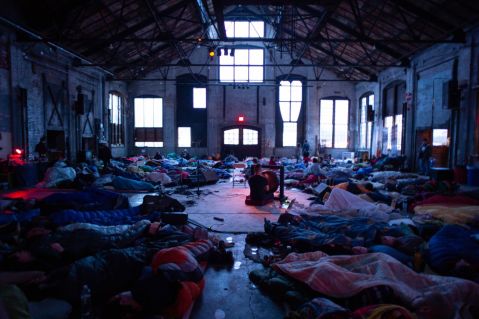
24-Hour Drone, Image by Alt
Though even as stunning a work of architecture as the Basilica can only ever confer a loose limit. These fragments are always clamoring for a more robust scene, always threatening to join the broader universal that awaits. Sound passes through walls, vibrates along concrete, penetrates skin and mingles among bodies. Spaces focalize sound’s capacities for the social and ethereal, by preserving and witnessing its constitutive ephemerality. Different spaces draw our attention to sound’s actually-existing materiality: a materiality that doesn’t quit, one that loosens our grip on our more ready-to-hand material worlds.
Grasping this materiality is not easy; it is maybe impossible. What possible cognitive torque will allows us to grasp at this overtopping universal? One option, it seems, is sheer brute force.
The term “endurance” rightly comes up repeatedly in press-documents and FAQs. For the event is knot of time and space (24 hours at the Basilica) which commands an attention to sound as a given, but sounding too as demanding an economy of attention wholly strange–a fidelity to sound that is without end. Limning out these ambitious parameters, to reign sound in, if for only a moment, requires something added.
Space, then.
Sonic spaces have a familiar, if knotty, history. Cathedrals invoke a beatific space, trussed by elaborate ornament and a spiritualized verticality. Music festivals inscribe traditions of sound and histories of capital — crowds and power, in Gina Arnold’s felicitous adaptation of Elias Canetti. Dwellings and offices, cafes and bars. Spaces arrange us in sound, and sound among us.
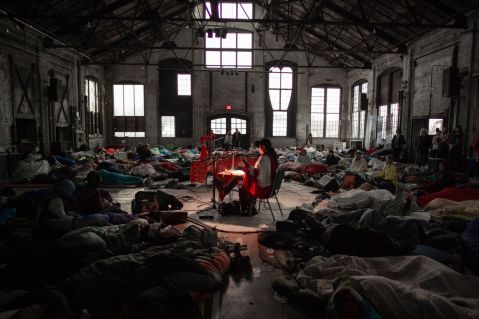
24-Hour Drone, Image by Alt
DRONE, then, is a provocation to think about sound — to think it over time, and to do so in a necessarily rarified space. This provocation worked; but I felt it only at an extreme limit.
At the twentieth hour (8 AM) I needed coffee. I had slept (kind of) through the night, rose to a bell ceremony, and walked immediately, groggily outside. As I passed through the door frame into the dewy and drizzly upstate morning, the sound — as if from a vacuum — muted and was voided of weight. I walked through the mostly empty streets.
These empty streets were, as it turned out, raucously loud. Distant cars motoring across country byways, the buzzing of a streetlight long past its prime; my tinnitus — a steadily pitched pulse acquired in those irresponsible salad days standing too-close to a crash cymbal — reminding me of all I may one day not hear. These sounds were, quite suddenly, clamoring for my attention, demanding my thought, straining for distinction. The espresso machine, the door hinges, the bathroom sink. Floorboards and rain and leaves and the Hudson and, and, and.
I walked back, not a little unsettled.
I had breakfast outside the venue among gravel-scraping shoes and overheard conversation.
Finally, I went back inside for what turned out to be the final act: Dronechoir Syllaba. The scene remains hauntingly clear.
A grouping of women entered, dressed entirely in white, each with one earbud in-ear, the other hanging loose. Some, if not all, had a length of yarn tied around their waist and dragging along the ground behind them a screw, nail, metal implement, which, as they walked produced a fragile, slender tone. They congregated in the center of the room and produced a careful and lush chord, its density piling up toward the far reaches of the ceiling. Slowly, the chord broke apart.
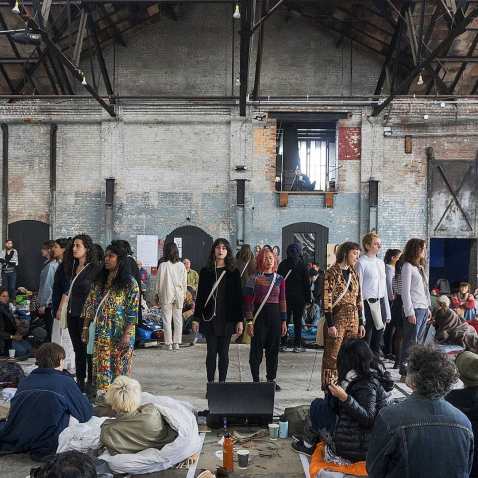
Dronechoir Syllaba, Basilica Hudson, 2018, Image by #noamplification
But, then, that’s not true.
I should say: slowly, the women moved apart, the chord remained, stretched and pitched against new and different coordinates, inhabiting the Basilica’s elastic space in a new configuration. Notes moved, their bearers slowly pacing around the exhausted and supine bodies of Droners along the floor.
A choir member approached me, holding out her free earbud. I shook my head, wearing a nervous grin. She insisted; I put it in. Playing quietly in that tinny bud was a reference tone for me to share. I looked at her as though I didn’t understand, and she smiled as if she did. Insisting. I managed a small hum, off-kilter and out of tune, before handing it back to her. Looking around, I saw the relationship I had repeated among others across the room. The chord kept mutating — dilating and contracting, swelling and receding, different tones calibrated along moving spatial coordinates. The choir returned to formation in center.
At noon, silence.
Everyone was smiling, dazed, like milkdrunk babies or punchdrunk lovers. We had slept amongst each other, passing a night in a shared space, while sound had enwrapped and enraptured us. We had borne witness to valences of sound hitherto under-noticed. We had joined a choir, if only for an offkilter moment in a space out-of-joint.
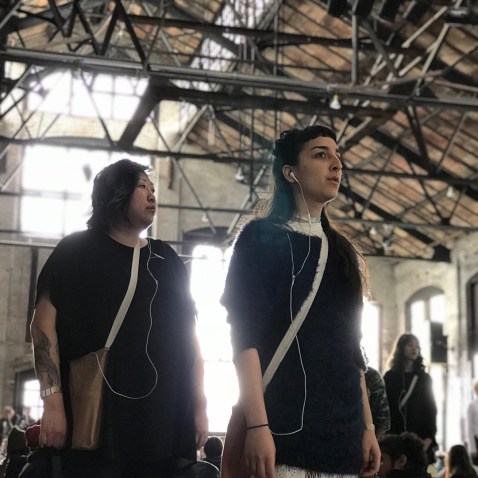
Dronechoir Syllaba, 24-Hour DRONE, Image by Andrew LaVallee via Instagram
***
We thought, my traveling companion and I, we thought the car ride back to the city would be for silence. For what else could you thirst after 24 such hours in the heart of sound? But this turned out to be deafening uncomfortable, weird. We were, in our own private ways, estranged from sound. Which is really another way of saying we were in different relation to sound and to the spaces it fills. There, a foundry. Here, a car. We put on, in lieu of silence, a little slice of magic, the condensation of all groove and beat, the most organized flash of pop brilliance this side of 1980. We of course put on Thriller.
As we roiled down the road to this joyous whispered desire — wanna be startin’ somethin’, got to be startin’ somethin’ — in a vehicle not made for dancing, the force of the Drone event began to take shape.
So, again: why?
To give attention to what we all already share — space and sound, history and music. To be adrift but not asleep in it all.
As for what happened?
I’ll try to grasp that next year.
—
Featured Image by Alt
—
Robert Cashin Ryan is a PhD candidate in the department of English at the University of Illinois-Chicago. He has written in various places about literary form and formalism, the relationship between Herman Melville and Charles Dickens, and Christmas as an intellectual problem. He curated and introduced a gathering of essays on music, sound, and noise for Post-digital forthcoming from Bloomsbury 2019.
—
REWIND!…If you liked this post, you may also dig:
This is Your Body on the Velvet Underground–Jacob Smith
Live Through This: Sonic Affect, Queerness, and the Trembling Body–Airek Beauchamp
Share this:

Listening to the Beautiful Game: The Sounds of the 2018 World Cup

DOI: https://doi.org/10.59350/d1hab-pjx27
I heard them before I saw them. Walking to my apartment in Moscow’s Tverskoy District, I noticed a pulsating mass of sound in the distance. Turning the corner, I found a huge swath of light blue and white and—no longer separated by tall Stalinist architecture—was able to clearly make out the sounds of Spanish. Flanked by the Izvestiia building (the former mouthpiece for the Soviet government), Argentinian soccer fans had taken over nearly an entire city block with their revelry. The police, who have thus far during the tournament been noticeably lax in enforcing traffic and pedestrian laws, formed a boundary to keep fans from spilling out into the street. Policing the urban space, the bodies of officers were able to contain the bodies of reveling fans, but the sounds and voices spread freely throughout the neighborhood.
Moscow is one of eleven host cities throughout Russia for the 2018 FIFA World Cup, which runs from June 14 to July 15. Over one million foreign fans are expected to enter the country over the course of the tournament, and it is an important moment in Vladimir Putin’s attempt to reassert Russia’s power on the global stage. Already, it has been called “the most political tournament ever,” and discussions of hooliganism, safety concerns, and corruption have occupied many foreign journalists in the months leading up to the start. So gloomy have these preambles been that writers are now releasing opinion pieces expressing their surprise at Moscow’s jubilant and exciting atmosphere. Indeed, it seems as though the whole world is not only watching the games, but also listening attentively to try to discern Russia’s place in the world.

Thus it comes as no surprise that the politics of sound surrounding the tournament have the potential to highlight the successes, pitfalls, and contradictions of the “beautiful game.” Be it vuvuzelas or corporate advertising, sound and music has shaped the lived experience of the World Cup in recent years. And this tournament is no exception: after their team’s 2-1 win over Tunisia on June 18, three England fans were filmed singing anti-semitic songs and making Nazi salutes in a bar in Volgograd. That their racist celebrations took place in Volgograd, formerly known as Stalingrad and the site of one of the bloodiest battles of World War II, added historical insult and even more political significance. The incident has shaped reception of England’s fans and their sounds across the country. As journalist Alec Luhn recently tweeted, police cordoned off singing England supporters in Nizhny Novgorod after their victory over Panama, ostensibly keeping the risk of hooliganism at bay. The incident stands in stark contrast with the police barrier around the Argentina fans, who were being protected not from supporters of other nationalities, but rather from oncoming traffic.
England fans in Russia sing songs…behind a line of police. Part of the reason there hasn’t been any hooligan violence pic.twitter.com/RwXz8XtLHf
— Alec Luhn (@ASLuhn) June 23, 2018
More than anything, however, sound has facilitated cultural exchange between fans and spectators. In recent years, historians and musicologists have paid more attention to the multivalent ways musical exchanges produce meaningful political and social understandings. Be it through festivals, diplomatic programs, or compositional techniques, music plays a powerful role in the soft power of nations and can cultivate relationships between individuals around the globe. More broadly, sound—be it organized or not—shapes our identity and is one of the ways by which we make meaning in the world. Sound, then, has the potential to vividly structure the experience of the World Cup—a moment at which sound, bodies, individuals, and symbolic nations collide.
At the epicenter of all of this has been Red Square, Moscow’s—and perhaps Russia’s—most iconic urban space. The site of many fan celebrations throughout the World Cup, Red Square’s soundscape brings together a wide variety of national identities, socio-economic considerations, and historical moments. To walk through Red Square in June 2018 is to walk through over five-hundred years of Russian history, emblematized by the ringing bells and rust-colored walls of the Kremlin; through nearly eighty years of Soviet rule, with the bustle and chatter of curious tourists waiting to enter Lenin’s tomb; and through Russia’s (at times precarious) global present, where fans from Poland join with those from Mexico in chants of “olé” and Moroccan supporters dance and sing with their South Korean counterparts. The past, present, and an uncertain future merge on Red Square, and the sonic community formed in this public space becomes a site for the negotiation of all three.

In the afternoon of June 19, I walked through Red Square to listen to the sounds of the World Cup outside the stadium. At the entrance to Red Square stands a monument to Grigory Zhukov, the Soviet General widely credited with victory over the Nazis in World War II. Mounted upon a rearing horse, Zhukov’s guise looms large over the square. In anticipation of that evening’s match between Poland and Senegal at Moscow’s Spartak Stadium, Polish fans were gathered at the base of Zhukov’s monument and tried to summon victory through chants and songs (Poland would end up losing the match 2-1.) Extolling the virtues of their star player, Robert Lewandowski, the fans played with dynamics and vocal timbres to assert their dominance. Led by a shirtless man wearing a police peaked cap, the group’s spirit juxtaposed with Zhukov’s figure reiterated the combative military symbolism of sporting events. Their performance also spoke to the highly gendered elements of World Cup spectatorship: male voices far outnumbered female, and the deeper frequencies traveled farther across space and architectural barriers. The chants and songs, especially those that were more militaristic like this one, reasserted the perception of soccer as a “man’s sport.” Their voices resonated with much broader social inequalities and organizational biases between the Women’s and Men’s World Cups.
From there, I walked through the gates onto Red Square and was greeted by a sea of colors and hundreds of bustling fans. Flanked by the tall walls of the Kremlin on one side and the imposing façade of GUM (a department store) on the other, the open square quickly became cacophonous. Traversing the crowds, however, the “white noise” of chatter ceded to pockets of organized sound and groups of fans. Making a lap of the square, I walked from the iconic onion domes of St. Basil’s cathedral past a group of chanting fans from Poland, who brought a man wearing a Brazil jersey and woman with a South Korean barrette into the fold. Unable to understand Polish, the newcomers were able to join in on the chant’s onomatopoeic chorus. Continuing on, I encountered a group of Morocco supporters who, armed with a hand drum, sang together in Arabic. Eventually, their song morphed into the quintessential cheer of “olé,” at which point the entire crowd joined in. I went from there past a group of Mexico fans, who were posing for an interview while nearby stragglers sang. The pattern continued for much of my journey, as white noise and chatter ceded to music and chants, which in turn dissipated either as I continued onward or fans became tired.
Despite their upcoming match, Senegalese fans were surprisingly absent. Compared to 2014 statistics, Poland had seen a modest growth of 1.5% in fans attending the 2018 World Cup—unsurprising, given the country’s proximity to Russia and shared (sometimes begrudgingly) history. Meanwhile, Senegal was not among the top fifty countries in spectator increases. That’s not to say, of course, that Senegalese supporters were not there; they were praised after the match for cleaning up garbage from the stands. Rather, geography and, perhaps, socio-economic barriers delimited the access fans have to attending matches live as opposed to watching them from home. With the day’s match looming large, their sounds were noticeably missing from the soundscape of Red Square.
Later that evening, I stopped to watch a trio of Mexico fans dancing to some inaudible music coming from an iPhone. Standing next to me was a man in a Poland jersey. I started chatting with him in (my admittedly not great) Polish to ask where he was from, if he was enjoying the World Cup so far, and so on. Curious, I asked what he thought of all the music and songs that fans were using in celebrations. “I don’t know,” he demurred. “They’re soccer songs. They’re good to sing together, good for the spirit.”
Nodding, I turned back toward the dancing trio.
“You are Russian, yes?” The man’s question surprised me.
“No,” I responded. “I’m from America.”
“Oh,” he paused. “You sound Russian. You don’t look Russian, but you sound Russian.”
I’d been told before that I speak Polish with a thick Russian accent, and it was not the first time I’d heard that I did not look Russian. In that moment, the visual and sonic elements of my identity, at least in the eyes and ears of this Polish man, collided with one another. At the World Cup, jerseys could be taken off and traded, sombreros and ushankas passed around, and flags draped around the shoulders of groups of people. Sounds—and voices in particular—however, seemed equal parts universal and unique. Emanating from the individual and resonating throughout the collective, voices bridged a sort of epistemological divide between truth and fiction, authenticity and cultural voyeurism. In that moment, as jubilant soccer fans and busy pedestrians mingled, sonic markers of identity fluctuated with every passerby.
I nodded a silent goodbye to my Polish acquaintance and, joining the crowd, set off into the Moscow evening.
—
Featured Image: “World Cup 2018” Taken by Flickr User Ded Pihto, taken on June 13, 2018.
—
Gabrielle Cornish is a PhD candidate in Musicology at the Eastman School of Music. Her research broadly considers music, sound, and everyday life in the Soviet Union. In particular, her dissertation traces the intersections between music, technology, and the politics of “socialist modernity” after Stalinism. Her research in Russia has been supported by the Fulbright Program, the Glenn Watkins Traveling Fellowship, and the Cohen-Tucker Dissertation Research Fellowship from the Association for Slavic, East European, and Eurasian Studies. Other projects include Russian-to-English translation as well as a digital project that maps the sounds and music of the Space Race.
—

REWIND! . . .If you liked this post, you may also dig:
Cauldrons of Noise: Stadium Cheers and Boos at the 2012 London Olympics–David Hendy
Goalball: Sport, Silence, and Spectatorship— Melissa Helquist
Sounding Out! Podcast #20: The Sound of Rio’s Favelas: Echoes of Social Inequality in an Olympic City–Andrea Medrado
—
Share this:




Current Top Posts





April 2021

January 2020

November 2019

October 2019

August 2019

April 2014

November 2017

March 2015

December 2017

October 2015
 Sounding Out!
Recent Comments