
Live Electronic Performance: Theory And Practice

This is the third and final installment of a three part series on live Electronic music. To review part one, “Toward a Practical Language for Live Electronic Performance” click here. To peep part two, “Musical Objects, Variability and Live Electronic Performance” click here.
“So often these laptop + controller sets are absolutely boring but this was a real performance – none of that checking your emails on stage BS. Dude rocked some Busta, Madlib, Aphex Twin, Burial and so on…”
This quote, from a blogger about Flying Lotus’ 2008 Mutek set, speaks volumes about audience expectations of live laptop performances. First, this blogger acknowledges that the perception of laptop performances is that they are generally boring, using the “checking your email” adage to drive home the point. He goes to express what he perceived to set Lotus’s performance apart from that standard. Oddly enough, it isn’t the individualism of his sound, rather it was Lotus’s particular selection and configuration of other artists’ work into his mix – a trademark of the DJ.
Contrasting this with the review of the 2011 Flying Lotus set that began this series, both reveal how context and expectations are very important to the evaluation of live electronic performance. While the 2008 piece praises Lotus for a DJ like approach to his live set, the 2011 critique was that the performance was more of a DJ set rather than a live electronic performance. What changed in the years between these two sets was the familiarity with the style of performance (from Lotus and the various other artists on the scene with similar approaches) providing a shift in expectations. What they both lack, however, is a language to provide the musical context for their praise or critique; a language which this series has sought to elucidate.
To put live electronic performances into the proper musical context, one must determine what type of performance is being observed. In the last part of this series, I arrive at four helpful distinctions to compare and describe live electronic performance, continuing this project of developing a usable aesthetic language and enabling a critical conversation about the artform. The first of the four distinctions between different types of live electronic music performance concerns the manipulation of fixed pre-recorded sound sources into variable performances. The second distinction cites the physical manipulation of electronic instruments into variable performances. The third distinction demarcates the manipulation of electronic instruments into variable performances by the programming of machines. The last one is an integrated category that can be expanded to include any and all combinations of the previous three.
Essential to all categories of live electronic music performance, however, is the performance’s variability, without which music—and its concomitant listening practices–transforms from a “live” event to a fixed musical object. The trick to any analysis of such performance however, is to remember that, while these distinctions are easy to maintain in theory, in performance they quickly blur one into the other, and often the intensity and pleasure of live electronic music performance comes from their complex combinations.

Flying Lotus at Treasure Island, San Francisco on 10-15-2011, image by Flickr User laviddichterman
For example, an artist who performs a set using solely vinyl with nothing but two turntables and a manual crossfading mixer, falls in the first distinction between live electronic music performances. Technically, the turntables and manual crossfading mixer are machines, but they are being controlled manually rather than performing on their own as machines. If the artist includes a drum machine in the set, however, it becomes a hybrid (the fourth distinction), depending on whether the drum machine is being triggered by the performer (physical manipulation) or playing sequences (machine manipulation) or both. Furthermore, if the drum machine triggers samples, it becomes machine manipulation (third distinction) of fixed pre-recorded sounds (first distinction) If the drum machine is used to playback sequences while the artist performs a turntablist routine, the turntable becomes the performance instrument while the drum machine holds as a fixed source. All of these relationships can be realized by a single performer over the course of a single performance, making the whole set of the hybrid variety.
While in practice the hybrid set is perhaps the most common, it’s important to understand the other three distinctions as each of them comes with their own set of limitations which define their potential variability. Critical listening to a live performance includes identifying when these shifts happen and how they change the variability of the set. Through the combination their individual limitations can be overcome increasing the overall variability of the performance. One can see a performer playing the drum machine with pads and correlate that physicality of it with the sound produced and then see them shift to playing the turntable and know that the drum machine has shifted to a machine performance. In this example the visual cues would be clear indicators, but if one is familiar with the distinctions the shifts can be noticed just from the audio.
This blending of physical and mechanical elements in live music performance exposes the modular nature of live electronic performance and its instruments. teaching us that the instruments themselves shouldn’t be looked at as distinction qualifiers but rather their combination in the live rig, and the variability that it offers. Where we typically think of an instrument as singular, within live electronic music, it is perhaps best to think of the individual components (eg turntables and drum machines) as the musical objects of the live rig as instrument.
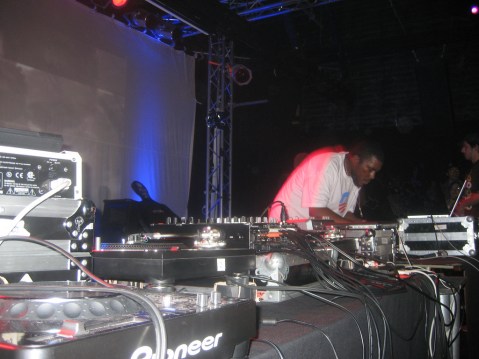
Flying Lotus at the Echoplex, Los Angeles, Image by Flickr User sunny_J
Percussionists are a close acoustic parallel to the modular musical rig of electronic performers. While there are percussion players who use a single percussive instrument for their performances, others will have a rig of component elements to use at various points throughout a set. The electronic performer inherits such a configuration from keyboardists, who typically have a rig of keyboards, each with different sounds, to be used throughout a set. Availing themselves of a palette of sounds allows keyboardists to break out of the limitations of timbre and verge toward the realm of multi-instrumentalists. For electronic performers, these limitations in timbre only exist by choice in the way the individual artists configure their rigs.
From the perspective of users of traditional instruments, a multi-instrumentalist is one who goes beyond the standard of single instrument musicianship, representing a musician well versed at performing on a number of different instruments, usually of different categories. In the context of electronic performance, the definition of instrument is so changed that it is more practical to think not of multi-instrumentalists but multi-timbralists. The multi-timbralist can be understood as the standard in electronic performance. This is not to say there are not single instrument electronic performers, however it is practical to think about the live electronic musician’s instrument not as a singular musical object, but rather a group of musical objects (timbres) organized into the live rig. Because these rigs can be comprised of a nearly infinite number of musical objects, the electronic performer has the opportunity to craft a live rig that is uniquely their own. The choices they make in the configuration of their rig will define not just the sound of their performance, but the degrees of variability they can control.
Because the electronic performer’s instrument is the live rig comprised of multiple musical objects, one of the primary factors involved in the configuration of the rig is how the various components interact with one another over the time dependent course of a performance. In a live tape loop performance, the musician may use a series of cassette players with an array of effects units and a small mixer. In such a rig, the mixer is the primary means of communication between objects. In this type of rig however, the communication isn’t direct. The objects cannot directly communicate with each other, rather the artist is the mediator. It is the artist that determines when the sound from any particular tape loop is fed to an effect or what levels the effects return sound in relation to the loops. While watching a performance such as this, one would expect the performer to be very involved in physically manipulating the various musical objects. We can categorize this as an unsynchronized electronic performance meaning that the musical objects employed are not locked into the same temporal relations.

Big Tape Loops, Image by Flickr User choffee
The key difference between an unsynchronized and s synchronized performance rigs is the amount of control over the performance that can be left to the machines. The benefit of synchronized performance rigs is that they allow for greater complexity either in configuration or control. The value of unsynchronized performance rigs is they have a more natural and less mechanized feel, as the timing flows from the performer’s physical body. Neither could be understood as better than the other, but in general they do make for separate kinds of listening experiences, which the listener should be aware of in evaluating a performance. Expectations should shift depending upon whether or not a performance rig is synchronized.
This notion of a synchronized performance rig should not only be understood as an inter-machine relationship. With the rise of digital technology, many manufacturers developed workstation style hardware which could perform multiple functions on multiple sound sources with a central synchronized control. The Roland SP-404 is a popular sampling workstation, used by many artists in a live setting. Within this modest box you get twelve voices of sample polyphony, which can be organized with the internal sequencer and processed with onboard effects. However, a performer may choose not to utilize a sequencer at all and as such, it can be performed unsynchronized, just triggering the pads. In fact, in recent years there has been a rise of drum pad players or finger drummers who perform using hardware machines without synchronization. Going back to our three distinctions a performance such as this would be a hybrid of physical manipulation of fixed sources with the physical manipulation of an electronic instrument. From this qualification, we know to look for extensive physical effort in such performances as indicators of the the artists agency on the variable performance.
Now that we’ve brought synchronization into the discussion it makes sense to talk about what is often the main means of communication in the live performance rig – the computer. The ultimate benefit of a computer is the ability to process a large number of calculations per computational cycle. Put another way, it allows users to act on a number of musical variables in single functions. Practically, this means the ability to store, organize recall and even perform a number of complex variables. With the advent of digital synthesizers, computers were being used in workstations to control everything from sequencing to the patch sound design data. In studios, computers quickly replaced mixing consoles and tape machines (even their digital equivalents like the ADAT) becoming the nerve center of the recording process. Eventually all of these functions and more were able to fit into the small and portable laptop computer, bringing the processing power in a practical way to the performance stage.

Flying Lotus and his Computer, All Tomorrow’s Parties 2011, Image by Flickr User jaswooduk
A laptop can be understood as a rig in and of itself, comprised of a combination of software and plugins as musical objects, which can be controlled internally or via external controllers. If there were only two software choices and ten plugins available for laptops, there would be over seven million permutations possible. While it is entirely possible (and for many artists practical) for the laptop to be the sole object of a live rig, the laptop is often paired with one or more controllers. The number of controllers available is nowhere near the volume of software on the market, but the possible combinations of hardware controllers take the laptop + controller + software combination possibilities toward infinity. With both hardware and software there is also the possibility of building custom musical objects that add to the potential uniqueness of a rig.
Unfortunately, quite often it is impossible to know exactly what range of tools are being utilized within a laptop strictly by looking at an artist on stage. This is what leads to probably the biggest misnomer about the performing laptop musician. As common as the musical object may look on the stage, housed inside of it can be the most unique and intricate configurations music (yes all of music) has ever seen. The reductionist thought that laptop performers aren’t “doing anything but checking email” is directly tied to the acousmatic nature of the objects as instruments. We can hear the sounds, but determining the sources and understanding the processes required to produce them is often shrouded in mystery. Technology has arrived at the point where what one performs live can precisely replicate what one hears in recorded form, making it easy to leap to the conclusion that all laptop musicians do is press play.
Indeed some of them do, but to varying degrees a large number of artists are actively doing more during their live sets. A major reasons for this is that one of the leading Digital Audio Workstations (DAW) of today also doubles as a performance environment. Designed with the intent of taking the DAW to the stage, Ableton Live allows artists to have an interface that facilitates the translation of electronic concepts from the studio to the stage. There are a world of things that are possible just by learning the Live basics, but there’s also a rabbit hole of advanced functions all the way to the modular Max for Live environment which lies on the frontier discovering new variables for sound manipulation. For many people, however, the software is powerful enough at the basic level of use to create effective live performances.

Sample Screenshot from a performer’s Ableton Live set up for an “experimental and noisy performance” with no prerecorded material, Image by Flickr User Furibond
In its most basic use case, Ableton Live is set up much like a DJ rig, with a selection of pre-existing tracks queued up as clips which the performer blends into a uniform mix, with transitions and effects handled within the software. The possibilities expand out from that: multi-track parts of a song separated into different clips so the performer can take different parts in and out over the course of the performance; a plugin drum machine providing an additional sound source on top of the track(s), or alternately the drum machine holding a sequence while track elements are laid on top of it. With the multitude of plugins available just the combination of multi-track Live clips with a single soft synth plugin, lends itself to near infinite combinations. The variable possibilities of this type of set, even while not exploiting the breadth of variable possibilities presented by the gear, clearly points to the artist’s agency in performance.
Within the context of both the DJ set and the Ableton Live set, synchronization plays a major role in contextualization. Both categories of performance can be either synchronized or unsynchronized. The tightest of unsynchronized sets will sound synchronized, while the loosest of synchronized sets will sound unsynchronized. This plays very much into audience perception of what they are hearing and the performers’ choice of synchronization and tightness can be heavily influenced by those same audience expectations.

A second performance screen capture by the same artist, this time using pre-recorded midi sequences, Image by Flickr User Furibond
A techno set is expected to maintain somewhat of a locked groove, indicative of a synchronized performance. A synchronized rig either on the DJ side (Serato utilizing automated beat matching) or on the Ableton side (time stretch and auto bpm detection sync’d to midi) can make this a non factor for the physical performance, and so listening to such a performance it would be the variability of other factors which reveals the artist’s control over the performance. For the DJ, the factors would include the selection, transitions and effects use. For the Ableton user, it can include all of those things as well as the control over the individual elements in tracks and potentially other sound sources.
On the unsychronized end of the spectrum, a vinyl DJ could accomplish the same mix as the synchronized DJ set but it would physically require more effort on their part to keep all of the selections in time. This would mean they might have to limit exerting control on the other variables. An unsychronized Live set would be utilizing the software primarily as a sound source, without MIDI, placing the timing in the hands of the performer. With the human element added to the timing it would be more difficult to produce the machine-like timing of the other sets. This doesn’t mean that it couldn’t be effective, but there would be an audible difference in this type of set compared to the others.
What we’ve established is that through the modular nature of the electronic musician’s rig as an instrument, from synthesizer keyboards to Ableton Live, every variable consideration combines to produce infinite possibilities. Where the trumpet is limited in timbre, range and dynamics, the turntable is has infinite timbres; the range is the full spectrum of human hearing; and the dynamics directly proportional to the output. The limitations of the electronic musician’s instrument appear only in electrical current constraints, processor speed limits, the selection of components and the limitations of the human body.
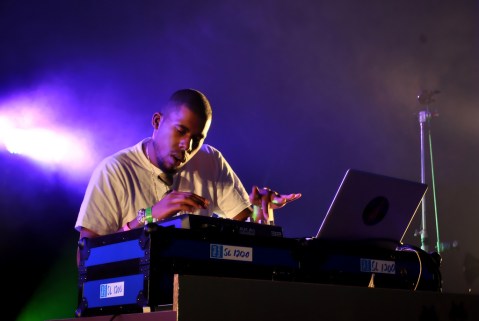
Flying Lotus at Electric Zoo, 2010, Image by Flickr User TheMusic.FM
Within these constraints however, we have only begun touching the surface of possibilities. There are combinations that have never happened, variables that haven’t come close to their full potential, and a multitude of variables that have yet to be discovered. One thing that the electronic artist can learn from jazz toward maximizing that potential is the notion of play, as epitomized with jazz improvisation. For jazz, improvisation opened up the possibilities of the form which impacted, performance and composition. I contend that the electronic artist can push the boundaries of variable interaction by incorporating the ability to play from the rig both in their physical performance and giving the machine its own sense of play. Within this play lie the variables which I believe can push electronic into the jazz of tomorrow.
—
Featured Image by Flickr User Juha van ‘t Zelfde
—
Primus Luta is a husband and father of three. He is a writer and an artist exploring the intersection of technology and art, and their philosophical implications. In 2014 he will be releasing an expanded version of this series as a book entitled “Toward a Practical Language: Live Electronic Performance”. He is a regular guest contributor to the Create Digital Music website, and maintains his own AvantUrb site. Luta is a regular presenter for theRhythm Incursions Podcast series with his monthly showRIPL. As an artist, he is a founding member of the live electronic music collectiveConcrète Sound System, which spun off into a record label for the exploratory realms of sound in 2012.
—
 REWIND! . . .If you liked this post, you may also dig:
Evoking the Object: Physicality in the Digital Age of Music–-Primus Luta
Experiments in Agent-based Sonic Composition–Andreas Pape
Calling Out To (Anti)Liveness: Recording and the Question of Presence—Osvaldo Oyola
Share this:

Digital Analogies: Techniques of Sonic Play

 Editor’s Note: Welcome to Sounding Out!‘s fall forum titled “Sound and Play,” where we ask how sound studies, as a discipline, can help us to think through several canonical perspectives on play. While Johan Huizinga had once argued that play is the primeval foundation from which all culture has sprung, it is important to ask where sound fits into this construction of culture; does it too have the potential to liberate or re-entrench our social worlds? Here, Roger Moseley challenges us to rethink the philosophical discourses of both sound and play and locates the moments in which they intersect and interface. From games of Telephone to Guitar Hero, Moseley considers the ways in which sonic play can help us understand the phantasmic binaries of the analog and digital.–AT
—
Throughout the distinguished intellectual lineage of play (where it is touched on by notable philosophers such as Plato, Montaigne, Kant, Schiller, Gadamer, Derrida, and Baudrillard), little attention has been paid to the parallels that can be drawn between sound and play as both media and phenomena. The very name of today’s most prominent cultural and technological locus of play, the video game, overtly privileges the eye at the expense of the ear. As recent research and creative work by such figures as Aaron Oldenburg, Aaron Trammell, George Karalis, and Enongo Lumumba-Kasongo indicates, a surge of interest in audio games, as well as video games that emphasize the importance of sound while eschewing or minimizing visual stimuli, is acting as a salutary corrective to this oculocentrism. In what follows, I suggest that bringing sonic and musical techniques to bear on this history might afford new insights into play and its myriad configurations. Conceiving of play sonically entails thinking of sound playfully. This intersectional logic can, I argue, unpick binarisms that enforce problematic distinctions and constrict thought. To demonstrate this, I conclude by deploying the concept of play to redefine the relationship between the digital and the analog—and vice versa.
How can play be defined in a manner that encompasses its farrago of meanings and associations? For video game designers and theorists Katie Salen and Eric Zimmerman, the answer is deceptively simple: play is “free motion within a more rigid structure” (Rules of Play, 304). To illustrate the flexibility of this definition, Salen and Zimmerman allude to the phenomenon of light playing upon the ocean waves. They leave unexamined, however, the intimacy and richness of the relationship between play and sound. From a scientific perspective, the patterned oscillation of which a sequence of sound waves is constituted consists of free motion within the limits set forth by the laws of physics. When disciplined and deployed as a cultural technique–take the play of musical instruments for example–sonic play is humanized and rendered transitive. But, we might also suggest that instruments play people, citing the sensation of automation with which fingers flash over fretboard or keyboard. Moving further away from anthropocentrism, we can observe how sonic technologies render play intransitive once more. From the barrel organ to the iPod, sound plays without human aid when mechanically reproduced. This way of framing reproduction invokes and extends Roger Caillois’s playful category of mimicry, which can be construed as faithful imitation, deceptive fakery, or even a Baudrillardian attempt to simulate a phenomenon that never existed.
In order to pay due attention to both the technologies through which sonic play is mediated as well as the cultural techniques imbue it with significance, I suggest that we supplement Salen and Zimmerman’s definition by thinking of freedom, motion, and structure in both digital and analogical terms. To an extent, the adoption of this modish epistemological framework acknowledges that conceptions of play are always constrained by their prevailing intellectual context. More importantly, however, I contend that technologies of sonic generation and representation from the seventeenth to the nineteenth centuries can be understood to play with the categories of the digital and the analog avant la lettre (ou le chiffre). The two categories are not mutually exclusive and to treat them as such would be to subjugate the granularity of the analog to the binary logic of the digital. Rather, they co-exist as modes between which sounds and players freely oscillate.
The origins of digital sonic play lie within the human body. As Johan Huizinga put it, “the link between play and instrumental skill is to be sought in the nimble and orderly movements of the fingers.” In the course of musical performance, human digits perform innumerable calculations. At its crudest level, musical performance from a score can be construed as a sort of algorithmic play through which mimetic fidelity is evaluated (and wrong notes relentlessly tallied). This ludic logic is at its most visible in rhythm-action video games such as Guitar Hero in which the score is no longer a text but rather a quantitative analysis. The iconography of these games usually indexes a set of digital technologies used primarily for the recording, editing, and playback of music. On the one hand, this relationship can be traced back to Leibniz’s exposition of ars combinatoria and his “invention” of binary; on the other, it is realized by the hydraulic organ and composing machine devised and programmed by the Jesuit polymath Athanasius Kircher, both of which are depicted in his Musurgia universalis (1650). In media-archaeological terms, the combination of Leibniz’s concepts and Kircher’s mechanisms gave rise to the hardware and software of Joseph Marie Jacquard’s revolutionary loom, Charles Babbage’s prototypical Analytical Engine, the player piano, the IBM punch card, and the MIDI sequencer before resurfacing in Guitar Hero, a piece of software that, in purely algorithmic terms, enlists the player’s digits to verify checksums.

An example of Kircher and Schott’s Organum, an early example of the digitization of music.
Such digital grids may constitute the field and the rules of sonic play, but they must be supplemented by analog elements if play is to flourish. As detailed in C. P. E. Bach’s Versuch über die wahre Art das Clavier zu spielen (1753/62), the clavichord and its descendants distinguished themselves from the harpsichord and the organ by endowing the keyboard with an infinite sensitivity to touch, thereby enabling a mimetic spectrum of emotional flow with unprecedented verisimilitude. Analogicity also provides another perspective on Caillois’s concept of mimicry, according to which one object or activity playfully stands in for another via imitation, deception, or make-believe. Additionally, the curves of Ernst Chladni’s figures, which materialized sound as sand, exemplify this sonic and mimetic trajectory as they rely on both Hermann von Helmholtz’s pioneering work on acoustics and the complex history of phonography to the development of analog synthesis.
In terms of sonic play, digital and analog elements can be chiastically recombined and reconfigured. A sonic communication game such as Telephone relies on the human propensity for analogy and its corrupting influence on the integrity of information transfer, playfully inverting the conditions and functions of the “real” telephone (which was engineered to compress informational content digitally without jeopardizing meaning). In much electronic dance music, the digital latticework, simultaneously visualized and rendered audible by the sequencer’s grid, constitutes a field of play overlaid with vocals, sweeps, and other analog elements that, in turn, have been captured via digital sampling. As a kind of meta-game, a mash-up plays with sonic elements whose relations can be parsed in the digital terms of Leibnizian recombinatorial play, but equally important are the unintended associations and analogies which inevitably emerge. And while games such as Guitar Hero foreground digital techniques of sonic reproduction, they simultaneously foster diverse forms of analogical play involving the player’s manipulation of the sonic (and social) behavior of her on-screen avatar—and vice versa.

Playing telephone. Image borrowed from diamondmanga @Wikimedia.
There is no doubt that the status of sound and its mediation through and as play have too often gone unacknowledged. As well as seeking to rectify this state of affairs by stressing the importance of sound in relation to the playful operations of other media, we might also dwell on the distinguishing features that set it apart: sound and the techniques that shape it are unique in the ways they simultaneously trace and are traced by the materials, technologies, and metaphors of play.
–
Roger Moseley is an Assistant Professor in the Department of Music at Cornell University. His most recent research brings a media-archaeological perspective to bear on musical performance and improvisation. He is particularly interested in how the concept of play informs sonic practices and cultural techniques. Active as a collaborative pianist on both modern and historical instruments, he has recently published essays on digital games in the contexts of musical and visual culture. His current book project is entitled Digital Analogies: Interfaces and Techniques of Musical Play.
—
 REWIND! . . .If you liked this post, you may also dig:
Papa Sangre and the Construction of Immersion in Audio Games– Enongo Lumumba-Kasongo
Playing with Bits, Pieces, and Lightning Bolts: An Interview With Sound Artist Andrea Parkins— Maile Colbert
Experiments in Aural Resistance: Nordic Role-Playing, Community, and Sound— Aaron Trammell
Share this:


Current Top Posts





April 2021

January 2020

November 2019

October 2019

August 2019

April 2014

November 2017

March 2015

December 2017

October 2015
 Sounding Out!
Recent Comments