
Within a Grain of Sand: Our Sonic Environment and Some of Its Shapers
“It devolves on us now to invent a subject we might call acoustic design, an interdiscipline in which musicians, acousticians, psychologists, sociologists, and others would study the world soundscape together in order to make intelligent recommendations for its improvement.”
–R. Murray Schafer
The Soundscape, Our Sonic Environment and the Tuning of the World
With those words, and with that book, Canadian composer, writer, educator, and environmentalist R. Murray Schafer introduced the concept of the soundscape…a sound, or combination of sounds, that forms or arises from an immersive environment. What follows is an exploration of how several key field recordists define and explore the notion of soundscape.
1. What do you do?
I capture moments.
I explore environments & structures using conventional & extended field recording methods. I also use instruments & small objects. Sometimes I perform live intuitive compositions, sometimes I install work & often I compose photographic scores.
For me it is the emotive impulse that most inspires.
I listen.
2. What can that tell us?
I believe passionately that one of the most important results of an exploration of overlooked detail in daily life (in terms of sound as well as visual elements) is how it can enhance ones life. It can allow us to engage with our surrounding in different ways & appreciate what remains & what has gone before or indeed is in danger of disappearing.
it can tell us that listening is a much, much broader vista than we all understand & one can spend a lifetime exploring.
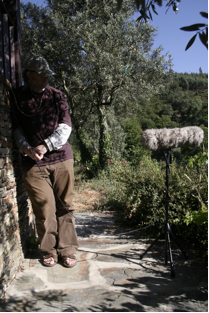
photo: carina martins
The study of the soundscape, called Acoustic Ecology, focuses on the relationship between living beings and their environment through sound. It’s a unique field in its interdisciplinary nature and beginnings, an interconnectivity between scientists, sociologists, anthropologists, and artists.
1. What do you do?
I am part of the organization Binaural/Nodar, which organizes educational and artistic creation events focused on a rural region in northern Portugal. Our creative focus is on sound and media arts that work with the natural and human environment of the region. As part of our activities, we organized a program of artist residencies dedicated to the river than passes through our region (Paiva river), which culminated in the Paivascapes festival, which took place in March this year. This was a multidisciplinary event that included a series of site-specific sound installations, a retrospective exhibition of sound and audiovisual works at a local museum, conferences on anthropological and environmental issues and nature walks. The festival had an itinerant nature, as it’s program was conceived to happen in several locations from the source to the mouth of the river.
2. What can that say?
The rural environment where we develop our activities has been inhabited for at least tens of thousands of years and each generation left their mark on the territory. So, we understand it as a infinitely complex, stratified and fragmented reality that most of the times cannot be fully comprehended if the approach is superficial, limited in time, based purely on a ‘naturalistic’ view of it that manifests itself for example on experiencing and recording the bucolic sights and sounds. It requires a more ‘relational’ approach, where what we see and listen to is mapped against other elements, stories, individual and collective memories, place names, old and new usages of the space, etc., which requires time, attention and empathy. We take these concerns on every aspect of our work such as which art projects to select, how and where to publicly present the works, how to mediate the relationship between the artists and the local communities.
-Rui Costa of Binaural/Nodar
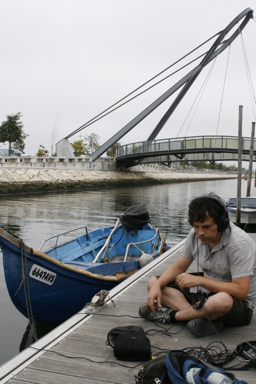
photo credit: Binaural/Nodar
Acoustic Ecology has branched out to give birth to a movement in sound art called phonography, a neologism referring to the art of field recording. It’s also shown a spotlight upon our changing sonic environment, and has become an important tool in bioacoustics and biomusicology, which help us to understand what these changes can mean. Birds communicate mainly with sound. When their calls cannot be heard, their reproduction decreases. Scientists are working with acoustic ecologists to record and study environments in which this is happening. Some of these bird calls may someday only survive on these recordings.
1. What do you do:
I am interested in the common, the everyday and the ordinary in my art practice; and in the unnoticed, the trivial and the repetitive that constitutes daily life. The birds I am interested in have ambiguous reputations and are considered pests or nuisances but they are also loved and respected. Seagulls, crows/corvids and pigeons are all very sociable species and are often much more audible than visible and they proliferate in the favorable conditions we have provided in urban centers.
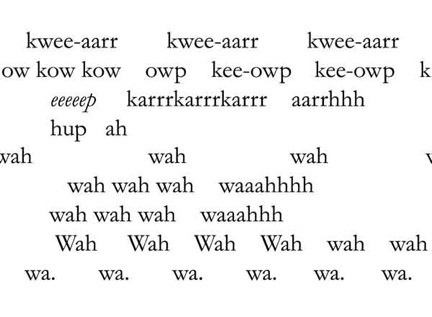
‘birdbrain’ focuses on our relationship with crows (corvids) and seagulls through voice (animal/human) and ideas about language (animal/human), including the spoken and written word. There is little philosophical discussion about animal voice, although the potential for animal language parallels current neurobiological research, which has identified that certain ‘motor and perceptual abilities’ essential for language in humans, also exist in birds.
2.What can that tell us:
The project has a number of components including an artist’s book that is posing as a mock field guide. The field guide comprises written texts of exchanges between a group of Little Ravens that I have transcribed over the course of a year using the phonetic words from conventional field guides.
The audio works consist of field recordings, mimicry and texts spoken by people with different accents. Scientific research tells us that birds also have regional accents and dialects, and that birds change their song according to place. Birds in cities sing more loudly to cope with urban noise and these songs tend to be simplified. Also, birds that have been introduced into different countries sing a song that is a variant from their brethren back in the homeland.
still from birdbrain, catherine clover
Cymatics is the study of sound waves made visible. Sound frequencies vibrate a surface and create distinct patterns. Sound needs a medium to vibrate, and the characteristics of the medium and sound wave will inform the shape. If you place a metal plate upon a speaker head, place sand upon that plate, and play certain frequencies through the speaker, you will see the sand vibrate into different patterns. If we could see sound around us, we would see expanding spheres with a kaleidoscopic-like pattern on its surface, effecting each other and all molecules in its path.
The interconnectivity of our world is often over looked, often not thought about. It is human nature to categorize, this is part of how we think and communicate. But what is lost when we consider our categories as islands, instead of a part of a whole, a pattern of overlapping systems? There is a saying that the whole of earth and ocean is found within one grain of sand.
1. What do you do?
I am an artist and composer who focuses on listening and the environment in my work. I am often recording my life and my travels, and the recordings or my observances from the recordings end up in my compositions, art installations, and soundwalks. In 2004, I was fortunate enough to find other people interested in sound and the environment and together, we formed The New York Society for Acoustic Ecology (NYSAE), a chapter of the World Forum for Acoustic Ecology. Through various organizations like the Whitney Museum, the Electronic Music Foundation, and free103point9, we have held events, panel discussions, and performances relating to sound and urban ecology. I am often asked how I “got into sound” and I usually don’t know how to answer it as it feels like I never got out of an interest in acoustics and space. I think that my interest in sound began when I carried around a tape recorder instead of a doll as a child. Perhaps not much has changed as I feel like my compositions reveal a layer of personal narrative conveyed through field recordings that describe how I relate to my environment. Often, my soundwalks do not include sounds that I have recorded; they are about sharing with others what I discovered about listening to the acoustics of a particular place. Points of interest are carefully arranged in guided tours with conceptual elements that emerge as sub-themes.
2. What can that say?
I am mostly interested in the relationship between people the sounds of the urban environment, particularly on how nature is defined by those who live in urban environments. When we slow down to listen to all that is in-between point A and point B, I think that we can begin to enjoy the fine details, even in a noisy city environment. I’ve worked with both children and adults in educational settings in cities who didn’t realize that they had birds living on their street until they were encouraged to listen. And I’ve discovered things like some people don’t like the sounds of birds at all, and they may prefer listening to the sounds of the subway. Sound can be just as subjective and adaptable of an art material as paint.
A drop of water falls into a puddle and creates a wave. A wave is a disturbance that travels through time and space. It affects everything it touches, it creates other waves, it continues colliding and transferring energy to molecules that do the same in turn to other molecules. It can be water, it can be light, it can be sound. It can be many things that collide into our molecules, and our system translates. The water is cold, the light is bright, the sound is loud. This is passive information. But when we actively feel how cooling the water is on a very hot day, when we actively consider how strong that sun is, and when we actively enjoy how the crash of an ocean wave makes our heart race…our world becomes so much richer.
1. What do you do?
Soundscape compositions, soundwalks, listening workshops, lectures, writing, editing, some mentoring of composition students, organizing as part of the World Forum for Acoustic Ecology (WFAE) and so on…
2.What can that say?
Everything I do seems to be focused on understanding the world through the act of listening and on the desire to share this understanding with as many people as possible. I believe that every sense perception gives us valuable and important connectedness to and information about the world in which we live. Our hearing sense has been underutilized (certainly in my lifetime, in our societies, nowadays) and a re-balancing of our senses may mean a re-balancing of how we approach life, environment, culture, politics and ideas. Experience in listening and composing has shown me ever new, changing and deepening approaches to space and time. And I wish this for everyone who learns to connect more consciously and deeply to his or her listening. What can that say: listening means noticing means inspiration means energy to do and act.
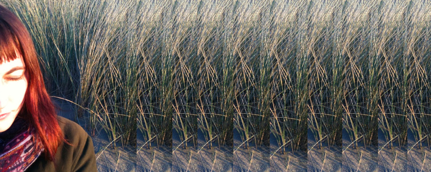
Hildegard Westkamp, Photo by Peter Grant
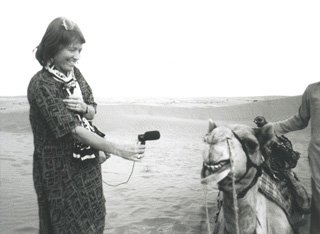
World Listening Day is July 18th. You can participate through the World Listening Day organization. Or just take the time, whatever you are doing, to stretch your ears and focus them on the rich acoustic world around you.
1. What do you do?
The World Listening Project maintains a website and online forum about its artistic and educational activities, including public workshops, forums, and lectures, as well as participating in exhibitions, symposiums, and festivals. Phonography and Acoustic Ecology inspired all of this. In the Chicago area, where we began, we formed the Midwest Society for Acoustic Ecology, a regional chapter of the American Society for Acoustic Ecology. We’re busy now inviting people to participate in the 2011 World Listening Day on July 18, the date of R. Murray Schafer’s birthday. If you visit our website you can learn how to celebrate. It’s quite open and last year the response was phenomenal.
2. What can that say?
Hearing tells us where to look. Wherever we are, every place on the planet has its own soundscape. From moment to moment the soundscape is always changing, often unpredictably. Depending on the time scale, dynamics, and frequency range we can choose to focus attention on. The World Listening Project suggests that listening is active, not passive: that listening means paying attention to the world. And when we do that we can begin to change it in a way conscious way. Bernie Krause has been a supporter. He’s making waves in the field of soundscape ecology. This is what Bernie says: “Western society bases most of what it knows on the visual. We actually ‘hear” what we ‘see.’ The World Listening Project aims to transform that perception in our otherwise urban centric and abstracted lives. At a time when we are facing not only a silent spring, but a silent summer, fall and winter, as well, it is clear that where a picture is worth a thousand words, a soundscape may soon be worth a thousand pictures.”
T


Share this:

Remixing Girl Talk: The Poetics and Aesthetics of Mashups
Peter DiCola’s analysis of Girl Talk is astute, on point, and insightful. So instead of quibbling with him about arcane or subjective matters, I’ll try to add a bit of aesthetic and cultural analysis to his legal and procedural observations.
Improvising vs. Composing
First of all, it’s important to point out that Girl Talk is not a typical mashup artist, and in fact many of the DJs I interviewed for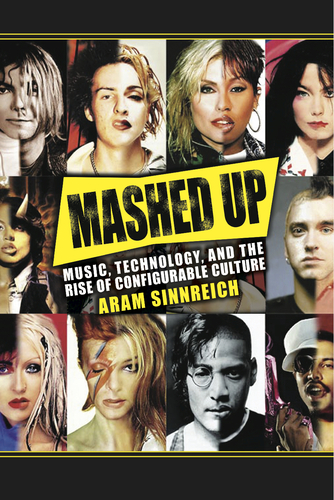 my book Mashed Up: Music, Technology, and the Rise of Configurable Culture (University of Massachusetts Press, 2010) don’t really view him as one of their own. This isn’t simply because he exceeds the standard, 2-song “A plus B” technique that serves as a basic template for the form; after all, Osymyso was mashing together hundreds of songs at a time back in the early 2000s, and he’s downright canonical. Rather, it’s because Girl Talk is more improvisatory, and less formalistic, than most other mashers.
Of course, improvisation has been a central element of DJing at least since Kool Herc first started beat juggling between two decks. And some contemporary mashup DJs, like Z-Trip and TradeMark G, are rooted in live, on-stage improvisation. But these are the exceptions, not the rule. If sample-based music describes a spectrum between what we traditionally think of as performance and composition, the vast bulk of mashup artists tend to see themselves on the composition side of the fence. They assemble the mashup in the studio, then play it “as is” in the club, just as they would play any other record. As DJ Earworm told me, “a good mashup artist is a good composer. Because, you know, you’re moving these parts around and giving it new form.” While Girl Talk certainly lives up to this description on albums such as “All Day,” his live, improvisatory performances are something else altogether.
Mashup vs. Cut-up
An interesting point DiCola raises is the prevalence of what he calls the “name-that-tune” critique of the mashup aesthetic, the claim that they “have no intertextuality or deeper meaning.” Not only is this claim unjustified, it completely misses the point. The problem is, these critics think of mashups as simply another example of paper-thin postmodernism. This couldn’t be further from the truth; in fact, you could call mashups post-postmodern.
To illustrate my point, let’s take a look at an earlier art form that looks a lot like mashup at first glance: the cut-up. Cut-ups were a kind of literary collage popular among avant-garde writers like William Burroughs and Brion Gysin in the mid-20th century. As the technique’s name suggests, writers would cut existing, finished texts into pieces, and then tape them back together in random fashion, thus generating surprising and provocative new juxtapositions and grammatical logics. The cut-up was the very essence of postmodernism: it aimed to disrupt the “master narrative” of linear thought and force the reader to confront its limits head-on. In other words, it was a reaction to, and an inoculation against, high modernism.
Mashups use similar techniques to achieve the opposite effect. We no longer live in a modern world, in which all information is forced to hew to a single, objectified model of reality. Postmodernism has not only successfully exposed and disrupted the hidden power dynamics of the master narrative, but produced a cultural environment in which an endless parade of symbols float unmoored in a sea of chaos and contradiction. The role of the mashup is to restore some semblance of order to this maelstrom, by stitching together the disparate symbols with a genealogical thread. Every sample in a mashup means something, and brings its entire cultural history trailing behind it. Thus, while the cut-up is named for its ability to sever signifier from signified, the mashup is named for its power to suture them back together (albeit in different combinations and permutations). This is the point that critics miss: the mashup isn’t an expression of postmodern nihilism, but an argument against it.
Whither Originality?
The final point of DiCola’s I’ll touch upon is the concept of originality, as it applies to a cultural form that consists entirely of “borrowed” work. As he observes, the question of whether a given mashup is original or not is almost moot when it comes to questions of transformativity and “fair use”; the very fact that people argue about it demonstrates that creative forces are at work.
Yet it’s also interesting to look at how the originality arguments play out. I devote an entire chapter of Mashed Up to exploring the various techniques DJs employ to differentiate between innovative and derivative work, as well as the ways in which they’ve moved beyond the distinction altogether. Commonly cited markers of originality in mashups include: how well a DJ selects his source materials; how the samples are arranged, both spatially and temporally; how the samples are transformed using digital processing techniques; and even textual interplay between the lyrics of the songs he’s chosen. In combination, these factors can describe a given DJ’s “signature” style, as distinctive as a saxophonist’s phrasing and tone, or a rapper’s rhyme and flow.
One could spend countless hours dissecting the mashup aesthetic and debating its legalities, and having done so myself, I can attest that it’s time well spent. Ultimately, however, the form’s significance outstrips even these weighty dimensions of analysis. What makes the mashup most interesting to me isn’t the question of what an individual work means, or whether it’s legitimate in the eyes of the copyright office, but rather how it’s produced (and reproduced) in the first place.
Our mode of musical production is always a harbinger of social changes to come, and the mashup has a lot to say about what lies in store for us as a globally connected, digital society. By blurring the lines between artist and audience, original and copy, the mashup fundamentally rejects the atomistic assumptions that undergird our legal, economic and political institutions. The millions of people who participate in the process of re-imagining a song comprise a kind of “collective subjectivity” as cohesive and amorphous as a storm cloud, and like a cloud, their actions only have meaning in aggregate.
This is why analyses that focus on a DJ like Girl Talk as though he’s a radical innovator or lone copyright renegade always tend to leave me cold. As Girl Talk himself would be the first to admit, his work neither begins or ends on his laptop; at best, he’s a highly entertaining conduit for an infinitely larger and more complex process. Or, to use his words (as I did in the epigraph to Mashed Up), “This shit is not about me, it’s about all of us, ’cause we’re the same motherfuckin’ person.”


Share this:


Current Top Posts





April 2021

January 2020

November 2019

October 2019

August 2019

April 2014

November 2017

March 2015

December 2017

October 2015
 Sounding Out!
Recent Comments