
Post-Soul Pusherman: Curtis Mayfield’s “Pusherman” and The Hangover 2

DOI: https://doi.org/10.59350/b8y2w-d6q29
My husband and I looked forward to seeing The Hangover 2 for our weekly movie date. A sequel to the wildly popular The Hangover, The Hangover 2 centers around Stu’s wedding (played by Ed Helms), bachelor party and its aftermath. Following the first film’s bottom line, The Hangover 2 unfolds after a drugged and drunken stupor leaves the friends unsure of the previous night’s events—and a missing brother-in-law. Sleazy motels, drug deals, homosexual encounters, and a monkey are the friends’ only clues about what happened and where Stu’s missing brother-in-law is located. Considering the awkward and absurd plot trying to pass for humor in The Hangover 2, I wasn’t surprised to see the monkey was a drug dealer. I was struck, however, by one of the monkey’s scenes where he completes a drug transaction. Sitting atop a light pole, a buyer signals for the monkey’s attention. The monkey struts across the wire and completes the transaction. After taking the buyer’s money, the monkey drops it off to his masters (two French men), eats an apple, goes back to his post, and lights a cigarette. The dope boy, er, monkey worked to the sonic backdrop of Curtis Mayfield’s “Pusher Man.” My husband laughed. I cocked my head to the side.
One of the most recognizable tracks from Mayfield’s extensive body of work, “Pusher Man” (which is street slang for “drug dealer”) was on the Super Fly soundtrack released in 1971. In its original context, “Pusher Man” provided insight into the purpose and agency of drug dealing in the inner city. However, in The Hangover 2 “Pusher Man” is subverted for comic relief and consumption by a multicultural audience. The result is that the film neutralizes “Pusher Man” and overrides the cultural significance behind the song for the film’s comedic purposes.
In order to discuss the subversion of “Pusher Man” in The Hangover 2, one must consider its original context as a sonic complement to Super Fly. A blaxploitation film directed by Gordon Parks, Jr. (son of famed African American photographer and Shaft producer Gordon Parks, Sr.), Supafly focused on the tug-and-pull of poverty, drugs, and the urban black experience in the immediate aftermath of the Civil Rights and Black Power movements. The plot revolves around the narrative of Priest, a dope dealer who wants to reform his ways and “do good.” Priest is continuously tempted throughout the movie by associates and friends who see drug dealing as the only way out of a hard inner city life. The film highlights drug dealing as a coping mechanism instead of an illegal activity. Although critics argue that the film glorifies pathological blackness through drug culture, Mayfield’s soundtrack provided hard-hitting social commentary that followed suit of similar themed albums like Marvin Gaye’s What’s Going On (1971).
Borrowing from and building upon a blues aesthetic showcasing an instrumental ensemble of percussions, horns, and guitars Mayfield updates the “bad man” trope to reflect the post-Civil Rights urban black experience. (By post-Civil Rights I’m suggesting that urban blacks encounter in this period more subtle forms of discrimination that are deemed irrelevant or non-existent due to the Civil Rights legislation put in place.) The immediate update to the trajectory of the bluesy/folkloric trouble man to reflect this shift is the drug dealer, whom is celebrated and highlighted in many of the 1970s blaxploitation films. Previous manifestations of the bad man reflected an opposition to open racial discrimination held in place by Jim Crow laws and other forms of white supremacy. In blaxploitation films, this type of racism is signified by “The Man,” an anonymous, “hands off” yet omniscient body of white (male) supremacy.
“Pusher Man,” complicates an anonymous drug dealer’s narrative by weaving introspective thoughts with popular and accepted characteristics of a drug dealer. The track opens with the latter, essentializing the power of a drug dealer in the inner city:
I’m your mama
I’m your daddy
I’m that nigga in the alley
I’m your doctor when in need
Want some coke?
Have some weed
You know me
I’m your friend
Your main boy
Thick and Thin
I’m your pusher man
The pusher man’s depiction of himself as a universal power – parent, healer, friend, brother – is established through hard hitting percussion and guitars. His delivery, however, is “cool,” signified in Mayfield’s soft voice. Aside from direct suggestions of black cool, i.e. “Ain’t I clean/bad machine” and “super cool/super mean,” Mayfield’s voice is critical in establishing this coolness. His smooth delivery symbolizes the tension between popular definition and the drug dealer’s humanity as well as opposing the hardness of the song’s sonic backdrop. The steady, quiet aggression of Mayfield’s voice – he never raises his voice – further solidifies the coolness of the track. The drug dealer’s reasoning for pushing illegal drugs, “silent life of crime/a man of odd circumstance/a victim of ghetto demands,” is afforded space through Mayfield’s voice and delivery. The loudness and “noise” of the instrumentals substitutes Mayfield’s voice as a gauge of the chaos and instability of the inner city. The song signifies the frustration of being urban, poor, and black with few options in a moment where racial equality should be heralded but has not yet been achieved. “Pusher Man” is tethered to the understanding that the laws changed but the social practices remained intact.
Yet this connection between the song and the social context is distorted if not lost by how The Hangover 2 situates the track into the plot. While the film maintains the surface narrative – drug dealing – numerous other signifiers have shifted to reflect this more contemporary moment of American culture and history. The track is globalized by providing background to a drug deal taking place in Bangkok (which, I hope, is not strictly for comedic purposes). It helps situates the reality that poverty is not necessarily black or American but global. The African American male drug dealer is replaced with a chain-smoking monkey. While it is possible that the film uses the track to emphasize the monkey’s drug dealing ways, it is also quite possible that the track’s original intentions and context are watered down in order to resonate with a multicultural audience.
Instead of making the audience think about the angst of the African-American working class, the song becomes a comedic prop. The humanity of Mayfield’s drug dealing protagonist, emphasized through the juxtaposition of Mayfield’s cool voice and gritty lyrics is overwhelmed by the inhumanity of the drug dealing monkey—not to mention the absurd situations the characters face. Even more disturbing, “Pusher Man” serves as a sonic signifier of the audience’s racial and social-economic detachment from the seriousness of the scene (and song) instead of an indicator of its social relevance. Instead of the focus being Mayfield’s attempt to shed light on the drug dealer’s harsh realities, the focus shifts to the monkey’s illegal activities as humorous.
Indeed, Curtis Mayfield certainly wrote his fair share of songs for films – Claudine and Sparkle immediately come to mind – but this particular song was a sharp piece of social commentary put to music.“Pusher Man” is reduced to background noise instead of a complement to the discourse struggling to remain intact despite the film’s efforts.
–
R.N. Bradley is a PhD candidate in African American Literature at Florida State University. She writes about African American literature, race and pop culture, Hip Hop, and her own awesomeness. She earned her BA in English from the Unsinkable Albany State University (GA) and a MA in African American and African Diaspora Studies from Indiana University Bloomington. Her dissertation project looks at negotiations of white hegemonic masculinity and race consciousness in 21st century African American literature and popular culture. You can read her work atAllHipHop, Newsone, TheLoop21, or her monthly column “The Race to Post” over atPopMatters. Scholar by day, unapologetic Down South Georgia Girl 24/7/365. Catch up with her awesomeness via twitter: @redclayscholar and her blog Red Clay Scholar (http://redclayscholar.blogspot.com).
Share this:

Pushing Play: What Makes the Portable Cassette Recorder Interesting?
DOI: https://doi.org/10.59350/hhafy-k9m70
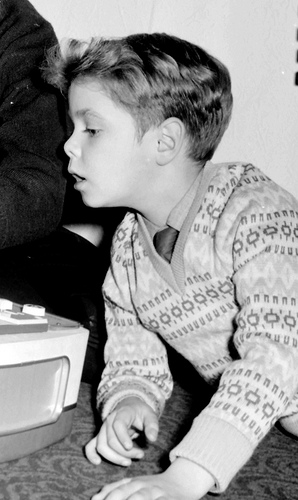
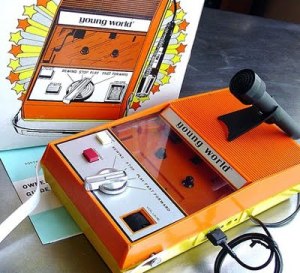
One of my earliest memories of sound recording is one of my earliest memories, period: an isolated image of my own index and middle finger trying to push down the “record” and “play” buttons on my father’s portable cassette tape recorder. More prominent than the visual element of this memory is the haptic one: I can still call up the sensation of the effort required to make the red button go down and latch and the stress on the top joint of my index finger as the resistance bent it backward. Also still with me is a trace sense of the threat of sharp pain, as if at some point previous I had been wounded (perhaps pinched?) by these buttons. How young must I have been to have experienced this degree of opposition from such a small, unassuming device? And whence this desire to persist in the face of it?And: how and where does this object–so unprepossessing with its five big buttons, volume slider, cartridge tray, and little speaker–fit into sound studies and the history of sound recording technology?
There’s a small, rich, growing body of work on tape recording–including work by scholars as different as Kathleen Hayles, Steven Connor, Michael Davidson, and this blog’s doyen, Jennifer Stoever-Ackerman–but almost invariably it focuses on the reel-to-reel recorder, the device the cassette recorder was meant to simplify and miniaturize, at the expense of sound quality. The reel-to-reel was a vital contributor to the development of stereo and hi-fi hobbyism; it was also the mechanism at the center of a series of bold modernist literary experiments with tape recording by Samuel Beckett, William S. Burroughs, David Antin, and others.
Aside from Andy Warhol’s use of it to tape huge swaths of his everyday life (in 1965, he “wrote” a novel consisting of 24 largely consecutive hours of transcribed cassettes) the cassette recorder has no such avant-garde pedigree. The name of the first model, the Norelco Carry-Corder 150, which appeared in 1963, shows the primary focus of its manufacturers’ vision. Ads and trade journal articles from around this time touted the ease with which the device could be toted around on a vacation with the aim of producing an “audio album” of the trip. Doubtless, such albums were made and some may even still exist. But I suspect that the most vibrant history of the Carry-Corder and its descendants lies in the device’s easy adapability into the play world of children. As I and many others of my generation remember it, the pleasure of playing with the device was the way it instigated various sorts of performance, usually based in mimicry of ones we’d consumed through other electronic media. In a manner not unlike Warhol, we created our own little media empires: Dj-ing, news announcing, sportscasting, hosting talk shows with the baby and the dog as guests, singing like Cher on TV, re-enacting TV comedy sketches, recording one’s own comedy sketches, and on and on.
It’s not obvious how sound figures in the context of children’s play. Certainly, the quality with which the tape recorder recorded and played back sound mattered little, if at all. What mattered was the way the device initiated and constructed scenes, provided roles to play. Analogously, as David E. James has noted, one of the most powerful aspects of Warhol’s practice of bringing his Carry-Corder 150 everywhere he went (he was an early adopter, purchasing one in 1964) was that it “ma(de) performance inevitable” and “constitute(d) being as performance” (Allegories of Cinema, page 69). Even playback itself was a matter of secondary interest; how many times do you think I listened to the tape of myself “broadcasting” two innings of a random mid-70s Mets game, delivered as I watched on TV with the sound turned down? My wager is on none. Still, sound is the raison d’etre of the cassette recorder. A few years later, kids might have done similar things with a video camera, but to a lot of kids, the early mass-marketed versions of that device felt much more formal, complicated, authoritative. That was the instrument through which the “official” history of the family was to be told; the tape recorder picked up the creative fragments, the bored interstices, the embarrassments, the extremes–parts of a world that wasn’t to appear before guests. Plus, the sound-based device actually offered greater reach and flexibility along with more forms of integration into other media like television.
My early memory of the recorder, however, seems more primal. Given its intensity, it seems clear that the tape recorder served as a vehicle toward several important forms of self-demarcation, helping me to discover and negotiate certain limits: of my body, of my agency vis-à-vis machines, of my relationships to my parents, of my family’s position in a larger social and economic world. (And in fact, the device was an important part of my family’s livelihood, vital to my father’s work as a radio reporter.) In retrospect, I seem almost impossibly young to be left to my own devices with the machine, and I also have a vague sense that I had been violating some prohibition, perhaps a decree that the recorder is “not a toy.” I wonder how much the force of such a decree originated precisely in the ease with which it could and did become a toy.
It’s unlikely that Friedrich Kittler was going to list “cassette tape recorder” next in his book title after “gramophone, film, and typewriter.” It’s unlikely he had an image of the device in mind when he wrote his bravura dictum, “media determine our situation.” Some technologies don’t stand up to such sweeping statements, toward which media studies sometimes seems particularly drawn. Certain devices, I think, necessitate a broadened and diversified understanding of the things both sound and technology do—even things that aren’t “about” sound in a conventional sense. For many historical narratives of sound reproduction, the cassette tape recorder is a regressive device, a drag on the pursuit of greater audio fidelity, with fidelity defined as “presence.” But the qualities of the cassette recorder that make it significant to our field are manifold, and some of them will be qualities that arise out of their adjacency to the central fact of recording and playing back sound. The “forgotten” areas of the history of sound reproduction technologies aren’t the notable failures—the 8-track players, which after all still draw camp-retro interest–but the most mundane successes. The portable cassette tape recorded never truly failed, it just got left back.
—
Gustavus Stadler teaches English and American Studies at Haverford College. He is the author of Troubling Minds: The Cultural Politics of Genius in the U. S.1840-1890 (U of Minn Press, 2006) and co-editor (with Karen Tongson) of the Journal of Popular Music Studies. His 2010 edited special issue of Social Text on The Politics of Recorded Sound was recently named a finalist for a prize in the category of “General History” by the Association of Recorded Sound Collections. He is currently working on Andy Warhol’s sound world, Woody Guthrie’s sexuality, and other stuff.
—
Share this:




Current Top Posts





April 2021

January 2020

November 2019

October 2019

August 2019

April 2014

November 2017

March 2015

December 2017

October 2015


Recent Comments