
“Music More Ancient than Words”: W.E.B. Du Bois’s Theories on Africana Aurality

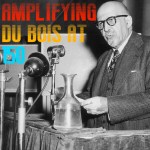 Inspired by the recent Black Perspectives “W.E.B. Du Bois @ 150” Online Forum, SO!’s “W.E.B. Du Bois at 150” amplifies the commemoration of the occasion of the 150th anniversary of Du Bois’s birth in 2018 by examining his all-too-often and all-too-long unacknowledged role in developing, furthering, challenging, and shaping what we now know as “sound studies.”
It has been an abundant decade-plus (!!!) since Alexander Weheliye’s Phonographies “link[ed] the formal structure of W.E.B. Du Bois’s The Souls of Black Folk to the contemporary mixing practices of DJs” (13) and we want to know how folks have thought about and listened with Du Bois in their work in the intervening years. How does Du Bois as DJ remix both the historiography and the contemporary praxis of sound studies? How does attention to Du Bois’s theories of race and sound encourage us to challenge the ways in which white supremacy has historically shaped American institutions, sensory orientations, and fields of study? What new futures emerge when we listen to Du Bois as a thinker and agent of sound?
Over the next two months, we will be sharing work that reimagines sound studies with Du Bois at the center. Pieces by Phillip Luke Sinitiere, Kristin Moriah, Aaron Carter-Ényì, Austin Richey, Julie Beth Napolin, and Vanessa Valdés, move us toward a decolonized understanding and history of sound studies, showing us how has Du Bois been urging us to attune ourselves to it. To start the series from the beginning, click here.
Readers, today’s post by Aaron Carter-Ényì delineates two central strands in Du Bois’s work that have proven key to what we now call sound studies–the historical and affective meanings that sound carries as well as its ability to travel great distances through time and space.
–Jennifer Lynn Stoever and Liana Silva, Eds.
I know little of music and can say nothing in technical phrase, but I know something of men, and knowing them, I know that these songs are the articulate message of the slave to the world. – W. E. B. Du Bois, The Souls of Black Folk (1903, p. 253)
W. E. B. Du Bois claimed to “know little of music,” yet his writings offer profound insights into aurality, foreshadowing the transdisciplinary of sound studies, by connecting language, music, sonic environments and aural communication. Du Bois published the souls of The Souls of Black Folk in 1903, less than a decade after becoming the first African American to receive a PhD from Harvard in 1895. In it, he addresses the color line, reflected in the policy of “separate but equal,” forming arguments that continue in Black Reconstruction in America. He also introduces themes that reappear in his later works including The World and Africa (1947), which formed the seeds of Afropolitanism and many modes of enquiry of Sound Studies. This short essay explores two concepts in Du Bois’s writings: that melodies may last longer than lyrics as cultural retentions; and, that drummed language may travel further than spoken language as communication.
By the time Du Bois published The Souls of Black Folk, what he termed the “Sorrow Songs” (alternatively Slave Songs or Spirituals) had entered the popular canon of American song. As incipits (or epigraphs) for each essay in the book, he entered the songs into a new literary and scholarly canon, ultimately changing the concept of what a book could be by fusing language and music in a new way. Even in a divided society following the U.S. government’s disinvestment in Reconstruction and the sharp uptick in lynching and other forms of racial terror, the “Negro folk-song” could not help but have a profound impact “as the most beautiful expression of human experience born this side the seas” (Souls XIV), particularly due to the efforts of Fisk’s Jubilee Singers. Du Bois’s choice to include musical transcriptions without lyrics at the opening of each essay in Souls reflects a view of melodies as having a life–and a value– of their own.

Du Bois paired a quote from “Childe Harold’s Pilgrimage ” by Lord Byron with a musical citation from the African American spiritual “The Great Camp Meeting” to open Chapter III, “Of Mr. Booker T. Washington and Others.”
Although Du Bois’s work quite clearly accounts for the development of what has usually been called the African American oral tradition, the concept of an oral tradition is credited to Harvard comparative literature scholars Milman Parry and Albert Lord, who popularized the term in American scholarship by establishing a binary theory of orality and literacy, that not only pitted the two against each other, but implied that they were hierarchical, evolutionary phases of “culture” (1960). This divide both widened and became more nuanced with Walter Ong’s recognition of “secondary orality” (1982), acknowledging that aspects of orality persist in literate societies.
But much earlier than these texts, Du Bois offers an alternate theory of how orality and literacy work, and even concepts similar to secondary orality, in the last essay of Souls, “XIV On the Sorrow Songs.” Notably, he describes his earliest experience with African music via a song that “travelled down” from his “grandfather’s grandmother”:
The songs are indeed the siftings of centuries; the music is far more ancient than the words, and in it we can trace here and there signs of development. My grandfather’s grand-mother was seized by an evil Dutch trader two centuries ago; and coming to the valleys of the Hudson and Housatonic, black, little, and lithe, she shivered and shrank in the harsh north winds, looked longingly at the hills, and often crooned a heathen melody to the child between her knees, thus:
The child sang it to his children and they to their children’s children, and so two hundred years it has travelled down to us and we sing it to our children, knowing as little as our fathers what its words may mean, but knowing well the meaning of its music (254).

Du Bois makes no mention of a spoken oral tradition throughout Souls. In fact, quite the contrary. In this passage, he implicitly argues it is not the meaning of the words, but the meaning of the music that survived the Trans-Atlantic Slave Trade. Instead of an “oral tradition”, Du Bois identifies four steps in the development of American Sorrow Songs: (1) African; (2) “Afro-American”; (3) blending of “Negro and Caucasian” (a creolization); and (4) songs of white America influenced by the Sorrow Songs (256). The search for continuity between African and American culture has been a quest for many, including African-born scholars such as Lazarus Ekwueme. It is clear that melody (both pitch and rhythm) is the most idiosyncratic element of a piece, more so than lyrics, and is the most durable when a people and their culture experience extreme duress. As language (and certainly the meaning of the language) can fade (or be violently submerged) in diaspora, melodies can often hold fast, and be held on to.
At an early date (1903), Du Bois already arrives at a point that is now a consensus: the Gullah-Geechee communities of the Sea Islands of South Carolina and Georgia have closely retained African practices, such as the ring shout.
Gullah-Geechee ring shout performed by McIntosh County Shouters (Carter-Ényì, Hood, Johnson, Jordan and Miller 2018)
Du Bois states that the Sea Island people are “touched and moulded less by the world about them than any others outside the Black Belt” (251–2). The Language You Cry In (1988), traces a Gullah song passed down back to its origins in Sierra Leone. Though separated by 200 years and 5000 miles, the melody was immediately recognizable to Baindu Jabati, a woman of the village, Senehum Ngola, even the lyrics were “strikingly similar.”

Sheet Music, “Old Folks At Home,” A project of the Digital Scriptorium Rare Book, Manuscript, and Special Collections Library, Duke University
The Gullah-Geechee are exceptional because of their linguistic retentions, documented by Lorenzo Dow Turner in his 1949 book. The preservation of linguistic features was possible because of relative isolation, but as Du Bois notes, this source of African music is fundamental to American music in steps (2), (3) and (4), of which he offers famous examples of each. It is the recognition of the crossing of the African and African-American influence across the racial divide into the music of white America, in songs such as Stephen Foster’s “Old Folks at Home” (more popularly known as “Swanee River”) that was the most controversial. Du Bois approaches this matter cautiously: “One might go further and find a fourth step in this development…” (256), but then goes full force: “a mass of music in which the novice may easily lose himself and never find the real Negro melodies” (257).
Racist musicologist George Pullen Jackson (1874-1953) fought hard against the position that white hymnody had been influenced by black spirituals for much of his career. In “White and Negro spirituals, their life span and kinship” (1944), he argued just the opposite, that black spirituals were derivative of white hymnody and conducted an early corpus study to prove it. William H. Tallmadge, in “The Black in Jackson’s White Spirituals” (1981), summarizes Jackson’s findings:
Jackson, after examining 562 white items and 892 black items, found only 116 pairs which he thought demonstrated tune similarities, and of these 116, only 70 pairs actually prove to have had a valid melodic relationship… These seventy items represent slightly less than eight percent of the 892 black spirituals (150).
Jackson could not find the empirical support for his claim to of primacy (perhaps supremacy) of white spirituals, even with some ample confirmation bias. In fact, his findings fit well into Du Bois’s account, particularly his identification of step 3 in the development of the Sorrow Songs: “blending of Negro music with the music heard in the foster land” (256). Essentially, it took a nearly a century for musicology to recognize what Du Bois laid out in 1903.
The aural tradition Du Bois describes, which includes various versions of songs and the steps of sorrow song development, is more sympathetic to Ngugi wa Thiong’o’s concept of “orature” than the Parry/Lord dichotomy. In “Notes towards a Performance Theory of Orature” (2007), Thiong’o points out that:
What is often arrested in writing is a particular version, a particular rendering, … as performed by a particular performers at a particular moment. Nature, then, in orature manifests itself as a web of connections of mutual dependence … in active communications within themselves and with others (5).
For example, the black and white spirituals with similar tunes in Jackson’s corpus both are and are not the same, which challenges the very notion of intellectual property (IP), and the flawed IP debate over spirituals that Jackson pursued. Even in a segregated society, under which racist laws separated the performers, a mutual dependence developed between black and white spirituals. Despite the affinity of the melodies and common heritage in the aural culture (and perhaps even common sources in either Africa or Europe), divisions were articulated in writing, through different hymnbooks and different words, once again supporting the veracity of Du Bois’s claim that the “music is far more ancient than the words.”

Waves on the Ghanaian Shore, Image by Flickr User Yenkassa (CC BY 2.0)
Later in his life, Du Bois’s attention turned more and more toward Africa. In The World and Africa (1947), he confronts colonialism and Eurocentric history, foreshadowing Afrocentrism and to some extent Afropolitanism. He also, very briefly, reprises his discussion of aurality, citing German musicologist and father of organology, Erich von Hornbostel, as affirmation of the virtues of both African and African American music from the 1928 article “African Negro Music”:
The African Negroes are uncommonly gifted for music-probably, on an average, more so, than the white race. This is clear not only from the high development of African music, especially as regards polyphony and rhythm, but a very curious fact, unparalleled, perhaps, in history, makes it even more evident; namely, the fact that the negro slaves in America and their descendants, abandoning their original musical style, have adapted themselves to that of their white masters and produced a new kind of folk-music in that style. Presumably no other people would have accomplished this. (In fact the plantation songs and spirituals, and also the blues and rag-times which have launched or helped to launch our modern dance-music, are the only remarkable kinds of music brought forth in America by immigrants (60).
Du Bois studied in Germany from 1892–94 before attending Harvard. According to Kenneth Barkin (2005), Du Bois’s “affection” for Imperial Germany has “remained a puzzle to historians” (285). Hornbostel too had a complicated relationship to Germany: though celebrated in his home country for much of his life, in 1933 he was forced into exile because his mother was Jewish; he died in 1935. The passage Du Bois cites from Hornbostel echoes some aspects of Souls XIV Sorrow Songs, particularly the centrality of the spirituals in American culture, but not all. In particular, “abandoning their original musical style … to that of their white masters” is incongruent with Du Bois’s earlier perspective. Though Hornbostel is clearly impressed with the musicality of black people(s), Hornbostel’s summary conclusions stated at the beginning of the same article do not mesh with Du Bois’s own (more insightful) work in Souls: “African and (modern) European music are constructed on entirely different principles, and therefore they cannot be fused into one, but only the one or the other can be used without compromise” (30).
Unfortunately, Du Bois does not contest Hornbostel with his narrative of continuity and “steps” of development from Souls. Du Bois recognized both the happenings and possibilities of creolization and syncretism in black culture of which Hornbostel only captures glimpses. Ultimately, despite a generally positive perspective on black music, Hornbostel’s position is one of not only continental, but racial, division, promoting segregation of musical practice as the only way. It is disconcerting that Du Bois cites this article and Hornbostel as a musical expert with its main argument when Du Bois identified the color line as the singular issue of the twentieth century.
In The World and Africa, Du Bois goal is a bit different: in the pursuit of repositioning Africa and moving towards both a corrected history and post-colonial future, there were stranger bedfellows than Hornbostel. A more pristine vision of recasting Africa and Africana aurality is found on the same page (99), in Du Bois’s mention of an astonishing form of music as communication, the talking drum: “The development of the drum language by intricate rhythms enabled the natives not only to lead in dance and ceremony, but to telegraph all over the continent with a swiftness and precision hardly rivaled by the electric telegraph” (99).
The recent intellectual current within African studies, Afropolitanism, is embodied in Du Bois’s juxtaposition of African tradition with modernity. A recent book on West African talking drums by Amanda Villepastour, Ancient Text Messages of the Yorùbá bàtá drum also draws an analogy to telecommunication. While Du Bois’s brief 1947 account is only a single sentence, Villepastour’s lengthy 2010 account confirms Du Bois conjecture was not a metaphor or empty comparison, the talking drum and telegraph share the same utility, and while we are keeping track, the talking drum came first and is a lot more efficient in terms of infrastructure.
Yorùbá talking drummers in Ọ̀yọ́, Nigeria (Carter-Ényì 2013)
For those unfamiliar with them, here are some rough calculations regarding how talking drums work. Singing or shouting is about 80 decibels (dB) at one meter. Drumming is over 100 dB at one meter. This 20 dB differential means that a speech surrogate (like a talking drum) could travel up to 10 times the distance under the same environmental conditions. With those intensities at the source, a loud voice could travel one kilometer before becoming inaudible (at around 20 dB), while a drum could reach 10 km, easily communicating with the next village.

Hausa Talking Drum, Image by African Studies Library BU (CC BY-NC 2.0)
Within a regional network of drummers that “speak” the same language—such as in the Yorùbá-speaking region of southwest Nigeria—long distance communication was possible, and much earlier than the telegraph. A recent study (2018) by Frank Seifert and his colleagues on Amazonian Bora drumming, “Reducing language to rhythm,” finds minute timing variations represent the placement of consonants suggesting there is detail in speech surrogacy, beyond the representation of lexical tone previously documented. Seifert’s findings suggest that the “precision” Du Bois described is exactly what talking drummers have (throughout the Global South). Now the “swiftness” part may have been a bit exaggerated (electric signals travel much faster than sound waves).
Du Bois’s practiced a transdisciplinary study of sound and understood Africa as Afropolitan long before most of the West. In addition to foreshadowing the interdisciplinary moves of sound studies—which also connects sound to speech to music and examines their coexistence—Du Bois’s thinking also prefigures the current intellectual (and urban-cultural) vogue of Afropolitanism, which has to some extent displaced the Pan-African movement that drew Du Bois to Ghana.In a 2016 interview, Achille Mbembe positions Afropolitanism as a way “in which Africans, or people of African origin, understand themselves as being part of the world rather than being apart.” Much like the African cultures he first encountered in melody in the nineteenth century and then heard firsthand as a contemporary when he moved to Ghana in 1961, Du Bois heard beyond Eurocentric disciplinary divides of music and language that served to portray African cultures as somehow always already outside of modernity, yet not the right color of “ancient.” Du Bois wholeheartedly believed music could change the narrative of Black life, history and culture, a message first crooned to him as a child between his grandmother’s knees, to which he never stopped listening.

Housatonic River, Great Barrington Massachusetts, W.E.B. Du Bois’s Home Town. Image by Flickr User Criana, (CC BY-NC-ND 2.0)
—
Featured Image: Brooklyn African Festival Drum, 2010, Image by Flickr User Serge de Gracia (CC BY-NC 2.0)
—
Aaron Carter-Ényì teaches music theory, class piano, and music appreciation in Morehouse’s Department of Music. He holds a PhD from Ohio State University (2016), was a Fulbright Scholar to Nigeria in 2013, and is a 2017 fellow of the American Council of Learned Societies (ACLS). Recent scholarship appears in Africa (Journal of the International African Institute), Ethnomusicology, Music Theory Online, Oxford Handbook of Singing and Tonal Aspects of Languages; or is forthcoming in Performance Research and Sounding Out! He is the director of the interdisciplinary Africana Digital Ethnography Project (ADEPt) and is currently developing the Video-EASE Toolbox and ATAVizM. During the summer, he is a STEAM instructor for federally-sponsored student enrichment programs including MSEIPand iSTEM for which he provides workshops and courses in the Morehouse Makerspace.
—
 REWIND! . . .If you liked this post, you may also dig:
Music Meant to Make You Move: Considering the Aural Kinesthetic–Imani Kai Johnson
Black Mourning, Black Movement(s): Savion Glover’s Dance for Amiri Baraka –Kristin Moriah
Share this:

“I Dreamed and Loved and Wandered and Sang”: Sounding Blackness in W.E.B. Du Bois’s Dark Princess

 Inspired by the recent Black Perspectives “W.E.B. Du Bois @ 150” Online Forum, SO!’s “W.E.B. Du Bois at 150” amplifies the commemoration of the occasion of the 150th anniversary of Du Bois’s birth in 2018 by examining his all-too-often and all-too-long unacknowledged role in developing, furthering, challenging, and shaping what we now know as “sound studies.”
It has been an abundant decade-plus (!!!) since Alexander Weheliye’s Phonographies “link[ed] the formal structure of W.E.B. Du Bois’s The Souls of Black Folk to the contemporary mixing practices of DJs” (13) and we want to know how folks have thought about and listened with Du Bois in their work in the intervening years. How does Du Bois as DJ remix both the historiography and the contemporary praxis of sound studies? How does attention to Du Bois’s theories of race and sound encourage us to challenge the ways in which white supremacy has historically shaped American institutions, sensory orientations, and fields of study? What new futures emerge when we listen to Du Bois as a thinker and agent of sound?
Over the next two months, we will be sharing work that reimagines sound studies with Du Bois at the center. Pieces by Phillip Luke Sinitiere, Kristin Moriah, Aaron Carter-Ényì, Austin Richey,Julie Beth Napolin, and Vanessa Valdés, move us toward a decolonized understanding and history of sound studies, showing us how has Du Bois been urging us to attune ourselves to it. To start the series from the beginning, click here.
Readers, today’s post by Kristin Moriah looks at Du Bois’s novel Dark Princess, and explores the relationship between sound and freedom in the text.
–Jennifer Lynn Stoever and Liana Silva, Eds.
Summer is come with bursting flower and promises of perfect fruit. Rain is rolling down Nile and Niger. Summer sings on the sea where giant ships carry busy worlds, while mermaids swarm the shores. Earth is pregnant. Life is big with pain and evil and hope. Summer in blue New York; summer in gray Berlin; summer in the real heart of the world!
W.E.B. Du Bois, Dark Princess (1928)

“Malcolm X BLVD” by Flickr user Alex Proimos, CC BY-NC 2.0
It is summer in Harlem now. Thick blankets of heat roil the city, and the pavement shimmers. Even the most die-hard city dwellers try to create distance between themselves and the noisy streets where political tensions threaten to boil over this season, as they always seem to. Airy tunes are often sung in vain here. More often than not, summer in New York City can be characterized by the sounds of the protests Julie Beth Napolin writes about so powerfully. At the moment, many of those protests are directed towards immigration detention centers and against forced family separation policies. Harlem, long a nexus for African diasporic and Latinx immigration and culture, has become a site of forced migration for migrant children separated from their families at the U.S. border and relocated to foster shelters like East Harlem’s Cayuga Center. Thus, contemporary nostalgia for Harlem as a site of creative freedom can be belied by reality.
But is there another place like this, not here, where one can go? An urban metropolis where one can be more attuned to sounds of the city and cries for justice? Where summer sings songs of freedom? Historically, there have been other options, especially for black travelers and migrants, and those options can tell us much about the way African American writers have conceptualized the relationship between sound and freedom. There was a strong correlation between sound and travel for African American intellectuals and performers during the Harlem Renaissance. During the brief period between Reconstruction and World War II, Europe, particularly Berlin, presented African Americans who traveled abroad with opportunities to hear and be heard differently. In The Sonic Color Line (2016), Jennifer Stoever has argued that W.E.B. Du Bois’s attention to the problem of the color line should inform our understanding of the centrality of sound in U.S. racial formations. But what happens to perceptions of the sonic color line once you cross the U.S. border? How have African American writers reflected on the sonic color line from a distance? W.E.B. Du Bois’s 1928 novel Dark Princess is an ideal place to begin exploring these questions.

Cover of Dark Princess, fair use
W.E.B. Du Bois fictionalized the experience of traveling to Berlin at the turn of the 20th century. As a whole, his work on travelling in Europe while black contributes to the discourse around race and sound by illustrating the importance of sounding blackness to political discourse. Du Bois continually accounted for sound in both his prose and fiction about his European travels during the early 20th century. For instance, in his autobiography Darkwater, Du Bois writes “as a student in Germany, I built great castles in Spain and lived therein. I dreamed and loved and wandered and sang; then after two long years I dropped suddenly back into ‘nigger’—hating America!” (16). Here and elsewhere, Du Bois portrays singing, performing, and listening–or what I identify here as sounding blackness–as crucial activities that foster intellectual development, creativity, and political awareness. In “Death Wish Mixtape,” Regina Bradley observes that contemporary instances of sounding blackness in popular culture are often linked to commodification and death. But the act of sounding blackness can be pliable, even as it signifies keen political awareness. In the Harlem Renaissance, sounding blackness was linked to black internationalism. In Du Bois’s work, sounding blackness involves testing the limits of blackness abroad and making African American culture audible by introducing blackness into political discourse for progressive purposes.
In the opening epigraph of the novel Dark Princess, at the beginning of this post, a summer journey begins with a song in the wake of tragedy. Written during the height of the Harlem Renaissance, in W.E.B. Du Bois’s Dark Princess, African American hero Matthew Towns travels to Europe to heal himself from racism’s psychic wounds, macroagressions, and foreshortened career prospects. Like Du Bois, Towns seeks respite from the systemic racism he encounters in the U.S. educational system, in this case at the University of Manhattan, a fictional Harlem medical school that is a stone’s throw from the City University of New York’s City College. In other words, Towns is a refugee of American racism.
Matthew Towns experiences new forms of freedom when he travels abroad. Fin-de-Siècle Berlin’s ambiguous racial boundaries allow Matthew Towns to practice American citizenship, perform an unfettered African American identity, and act as a spokesperson for the first time. Faced with the question of whether African diasporic “blood must tell,” or reveal its weaknesses through inarticulate discourse, Towns boldly asserts that it won’t tell “unless it is allowed to talk. Its speech is accidental today” (22). He begins to advocate for African Americans using various performative modes. Du Bois depicts Towns as what Alex Black might term a “resonant body,” a performer who uses embodied sound to shape the viewers’ perceptions of his or her humanity. In Berlin, Towns becomes a resonant body who sounds blackness outside the boundaries of the American color line in an attempt to ameliorate conditions for African Americans at home. As such, Towns echoes Du Bois’ insistence on the importance of song to the African American tradition and socio-political ambitions in The Souls of Black Folk (1903). Thus, Dark Princess picks up on the sonic themes Du Bois proposed in his earlier works.
As Du Bois’s novel unfolds, readers learn how Berlin could both confound and appeal to the African American imagination as a utopic site of black performance. Towns sings to a multi-ethnic group of elite political activists at a dinner party in Berlin. Invited by Princess Kautilya of Bwodpur, at first, “Matthew felt his lack of culture audible, and not simply of his own culture, but of all the culture in white America which he had unconsciously and foolishly, as he now realized made his norm” (24). Initially, American racism prevents Towns from sounding blackness and participating in global discourses around race and freedom. And yet, at the same party in Berlin, Towns is also overcome by the memory of Negro spirituals. He becomes a resonant body by reclaiming black working-class sensibility and pride: “it was as if he had faced and made a decision, as though some great voice, crying and reverberating within his soul, spoke for him and yet was him” (23). For Matthew Towns, sounding blackness abroad is not just personally empowering; sounding allows him to imagine himself as a key contributor to larger social movements and, potentially, black liberation. In both examples, the acts of hearing, verbalizing, and singing are depicted as necessary modes of political awareness and engagement. Without access to these sonic forms, Matthew is divorced from meaningful political participation.
Eventually, Matthew finds his way into the conversation by making a powerful argument for the cultural achievements of African Americans, or “the black rabble of America,” (26) by way of Negro Spirituals: “silence dropped on all, and suddenly Matthew found himself singing. His voice full, untrained but mellow, quivered down the first plaintive bar…” (26). It is the most striking instance of black performance in the novel:
The blood rushed to Matthew’s face. He threw back his head and closed his eyes, and with the movement, he heard again the Great Song. He saw his father in the old log church by the river, leading the moaning singers in the Great Song of Emancipation. Clearly, plainly he heard that mighty voice and saw the rhythmic swing and beat of the thick brown arm. Matthew swung his arm and beat the table; the silver tinkled. (25)
Du Bois continues: “He forgot his audience and saw only the shining river and the bowed and shouting throng […] Then Matthew let go of restraint and sang as his people sang in Virginia, twenty years ago. His great voice, gathered in one long deep breath, rolled the Call of God” (26).
Towns’s newfound ability to sound blackness in Berlin, or in other words vocalize African American claims to citizenship and freedom, stand in contrast to his earlier inability to respond coherently to Northern racism in New York City, where he is left “sputtering with amazement” at his exclusion from a medical school at which he has rightfully earned his place. In that instance, Matthew is rendered speechless. When “his fury had burst its bounds” it resulted in not a stream of invectives or vain pleas for justice, but a physical response. He throws “his certificates, his marks, and commendations straight into the drawn white face of the Dean” (4). Afterwards, isolated and alone, he stalks New York City. If there is a distinct sonic dimension to this flight from discrimination, readers are not privy to it. The sounds of Matthew’s footsteps, and cries of righteous indignation, fade into the background of Harlem’s streets. They are perhaps indiscernible amidst the ebb and flow of any number of similar city sounds and experiences. In this instance, Du Bois seems to suggest that the sound that emanates from physical gestures loses potency in certain urban contexts.
When Matthew Towns returns to Harlem, we are told that it’s with a renewed ear and life purpose. Standing on Seventh Avenue, with City College to his left, “he turned east and the world turned too – to a more careless and freer movement, louder voices and easier camaraderie” (41). From the sounds of church music to the accents of West Indian immigrants, he is much more attuned to the city’s diverse African diasporic presence. Hearing these African diasporic connections in a new way, he is fueled for black leadership and political activism.
Thus, Towns’s experiences sounding blackness abroad are a pivotal step in his political awakening and activism on U.S. soil. In locating the project of sounding blackness between Harlem and Berlin, Du Bois’s fiction makes space for the privileged summer traveler, the forced migrant, and immigrant. All are bound by the desire for social progress on local and global scales. Finally, I argue that the dynamic relationship between sound, space, justice and travel that Du Bois maps out has striking relevance to contemporary political and ethical crises. As in Dark Princess, justice in the here and now can be measured by the ability to sound aloud and effect social change the world over and on street corners.
—
Featured image: “Mapping Courage” by Flickr user Laurenellen McCann, CC BY-NC 2.0
—
Kristin Moriah is an Assistant Professor of African American Literary Studies in the English Department at Queen’s University. She is the editor of Black Writers and the Left (Cambridge Scholars Press, 2013) and the co-editor of Adrienne Rich: Teaching at CUNY, 1968-1974 (Lost & Found: The CUNY Poetics Document Initiative, 2014). Her work can be found in American Quarterly, PAJ: A Journal of Performance and Art, Theater Journal, and Understanding Blackness Through Performance (Palgrave Macmillan, 2013). Her research has been funded through grants from the Social Science and Humanities Council of Canada, the Freie Universität Berlin, the CUNY Graduate Center’s Advanced Research Collaborative and the Harry Ransom Center. In spring 2015 Moriah was a Scholar-in-Residence at the NYPL Schomburg Center for Research in Black Culture.
—
REWIND! . . .If you liked this post, you may also dig:
Black Mourning, Black Movement(s): Savion Glover’s Dance for Amiri Baraka –Kristin Moriah
“Most pleasant to the ear”: W. E. B. Du Bois’s Itinerant Intellectual Soundscapes — Phillip Luke Sinitiere
The Noise You Make Should Be Your Own–Scott Poulson-Bryant
Share this:


Current Top Posts





April 2021

January 2020

November 2019

October 2019

August 2019

April 2014

November 2017

March 2015

December 2017

October 2015
 Sounding Out!
Recent Comments