
Finding My Voice While Listening to John Cage

Editor’s Note: Today I bring you installment #4 of Sounding Out!‘s blog forum on gender and voice! Last week Regina Bradley put the soundtrack of Scandal in conversation with race and gender. The week before I talked about what it meant to have people call me, a woman of color, “loud.” That post was preceded by Christine Ehrick‘s selections from her forthcoming book, on the gendered soundscape. We have two more left! In the next few weeks we’ll have A.O. Roberts with synthesized voices and gender, and lastly Robin James with an analysis of how ideas of what women should sound like have roots in Greek philosophy.
This week guest writer and professor Art Blake shares with us a personal essay. He talks about how his experience shifting his voice from feminine to masculine as a transgender man intersects with his work on John Cage. So, lean in, close your eyes, and try not to jump to conclusions before you listen. –Liana M. Silva, Managing Editor
—
When I walked into the packed lecture theatre at the start of the Fall term 2012 I was hoping, more than any other year, to sound convincing. I had been teaching for 11 years by that time so I knew what I was doing. But I was walking into class as a man, for the first time. I was not sure if my newly thickening vocal chords would hold me at a convincing “male” pitch or if I would be able to project that developing voice to the back of the room. I thought I looked “manly” enough; but would I sound manly?
I had been researching and teaching about sound since 2003 but had not confronted myself as a potential object of study until I was preparing to return to teaching in 2012 following the early phase of my transition from female to male. My notions of “masculinity” have never been conventional: as a somewhat incompetent butch-ish lesbian I’d attempted but never “mastered” the appropriate vocal or bodily swagger. I abandoned those conventions to evolve my own more elfin, more queer swish. But on that first day back in the classroom, and for much of that term, I felt I needed to produce “normal guy”—a gender-identity category I didn’t believe in or want to become—so I might feel secure enough later to explore and tweak my newly gendered voice and body. I wanted a baseline from which I could re-build. I wasn’t ready to be out as trans* in the classroom. Yes, I was in a closet; but I needed it to serve as a dressing room, a place of private preparation, rather than as a long-term hiding place.
I started testosterone therapy in January 2011, on a low dose as is the standard of care. As my doctor increased my dose over the months, I noticed the beginning of the physical changes I’d been waiting for: more body hair, muscle development, and a hoarsening voice. I earnestly weighed and measured myself, worked out at the local YMCA, chose a new name and made it legal … and dealt with months of severe anxiety and depression. Puberty isn’t fun, and doing it again in my forties, as part of gender transition, was not the seamless story of celebration familiar from the YouTube videos I’d watched obsessively charting other guys’ transitions. Those videos were mostly about looking male, not sounding male, and rarely addressed transitioning at work, within a profession.
I spoke to a transman, also an academic, to discuss the challenges of transitioning in our profession. His version of masculinity was more conservative than I had expected, and a bit homophobic, but what really worried me was his concern about my voice: “I really hope for your sake your voice changes,” he said. What did he mean? Would I fail the test of public masculinity not only because I wasn’t wearing a jacket and tie but because I sounded feminine?

“Byron Pitts Lecture” by Flickr user roanokecollege, CC BY 2.0
All those images of authoritative, sonorous, academic masculinity flooded me with panic. Testosterone wasn’t going to make me any taller, give me an Adam’s apple, or bigger hands and feet. I was going to be a small guy, standing at the front of the classroom with years of academic expertise, but a mismatched voice might undermine that basic authority. Female academics, like most female professionals, have to work harder for the respect of students as well as colleagues; we all have seen or know of evidence for this sexism. Men, just by being perceived as male, get more generous teaching evaluations from undergraduates. As I transitioned I found myself grasping for that authority in a way I hadn’t imagined before.
In search of help, I went to see Dr. Gwen Merrick, a therapist in the Speech Pathology section of Toronto’s St. Michael’s Hospital. Gwen is known in the trans* community and trans* health networks for her work with transwomen. To my surprise I was her first transmale patient. While admitting her lack of experience she also welcomed the challenge to help masculinize my voice and lessen my anxiety around my vocal-gender dysphoria.
So we began: she examined my vocal chords (properly “vocal folds”). We then moved on to discuss my goals and concerns, and began the process of recording my voice—measuring its volume and tone, listening to the digital recordings, and training me to hear and then adjust my vocal pitch and speech rhythms. She gave me vocal exercises for homework, and taught me how to relax and move my larynx lower in my throat to lengthen it and create a lower pitch. Gwen also encouraged me to imagine myself into the vocal change I sought. I tried taking up more space as I sat in her office, head up and chest out, adopting an attitude of greater confidence, channeling the burliest and butchest of my cismale friends.
My scholarly life took a nosedive during those months on medical leave. The first piece of scholarship I re-engaged with during this time was something I’d been thinking about for years: an article about the composer John Cage‘s voice. I wanted to write about the disconnect I had heard between Cage’s speaking voice and my assumptions about him based on his appearance. I sought to hear Cage’s voice in the context of the post-1945 period when he rose to great prominence as a composer. What I gradually came to hear as I returned to this research was how and why Cage’s voice, within the context of the 1950s in particular, spoke to me so profoundly as I emerged publically as trans*.

“Photograph of John Cage talking to another guest at a drinks reception at the Cage/Cunningham Residency at the Laban Centre, Laurie Grove, London, July 1980” by Flickr user Laban Archive,
I first heard his recorded speaking voice while teaching some of his work in an early iteration of my sound studies seminar. I’d seen photographs of Cage as a middle-aged and older man; from those images of a tall, craggy-faced guy in a sports jacket or woolly sweater, I had expected to hear a baritone, chest-resonant, rich “masculine” voice. Instead, Cage’s voice was light, with very little chest register, almost breathy sometimes, and inflected with the rhythm and occasional sibilance of what I “recognized” as a gay male (American) voice.
How had Cage navigated the homophobia of the 1950s with a voice like that? Was what I heard as his audible difference perceived that way in the postwar period as he rose to prominence as a modernist composer? According to some older gay men I’d interviewed for my 2004 radio documentary on the early gay leather scene in the 1950s, they had consciously altered their voices in everyday situations where they didn’t want (or couldn’t risk) being heard as gay. As one guy mentioned, for such circumstances he adopted his “gas station voice”—a vocal pitch and style to get him through such commonplace moments of public masculinity as talking to the gas station attendant. I wondered if Cage also kept one voice in the closet and adopted another one he needed based on circumstance.
As I sought my own “gas station voice” in the fall of 2012, returning to Cage and listening to his voice in his 1956 composition Indeterminacy helped gradually lessen my anxiety about audibly “passing.” Listening to Indeterminacy, a series of stories occasionally interwoven with a piano, allowed me to not only hear but also admire Cage’s voice and the political resonance it may have held in McCarthy-era America.
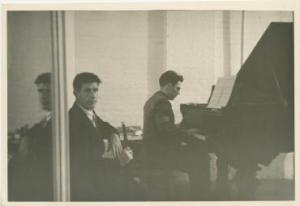
John Cage with David Tudor
I looked for examples of Cage speaking outside of his own compositions, someplace more public—someplace where I might hear him put his voice in the closet and butch himself up for the public ear. I looked for ways to contextualize Cage’s voice in the era of determinacy — mainstream 1950s America, high modernist, planned, and in love with postwar military-industrial efficiency and the performance of expertise.
My urban history self focused on New York in the 1950s, listening for other voices resonant with the era’s “structure of feeling.” If heard by a 1958 resident of New York City, Indeterminacy might have sounded somewhat familiar. The experience of listening to all or parts of Indeterminacy resonated with the interruptions, the drowned-out words, the overlapping and oppositional sounds, the proximity of people and machinery, which characterized Manhattan (in particular) in the late 1950s. Cage spent periods of time in New York City as well as upstate in the 1950s, moving between different art scenes. What did New York sound like in the 1950s? The Puerto Rican migration and urban renewal re-shaped the city’s soundscape on the west side, as documented by sound recordist Tony Schwartz and re-presented through the musical West Side Story. I had written about those encounters with audible difference but now wanted to listen more closely. What did the city’s infamous urban planner, master of urban renewal, Robert Moses sound like? What did his outspoken critic Jane Jacobs sound like? And how might I hear their contemporary John Cage in this context with reference to the notion of “indeterminacy”?
Within a Cold War-McCarthyist context, voices represented an aspect of the suspect-self available for investigation, interrogation, and pathologizing. I identified, to an extent, with such a predicament, such a fear of exposure and of the negative consequences I presumed would follow. While I listened to John Cage’s and others’ voices from this period, I listened for how Cold War authorities may have heard them. John Cage’s voice offers indeterminacy itself, hovering in the margins of the tonal, rhythmic, and pitch ranges of conventionally “masculine” and “feminine” voices at mid-century. Despite our contemporary resistance to stereotyping, one hears in Cage’s gendered oscillation, mixing minor chest resonance with the higher, softer, breathier sounds, a definitive type of “gay” male voice: the sissy voice. As Craig Loftin has argued in “Unacceptable Mannerisms: Gender Anxieties, Homosexual Activism, and Swish in the United States, 1945-1965,” during the 1950s gay men as well as the heteronormative majority, produced intense hostility to the archetype of the “sissy,” whose voice and body movements marked him as politically problematic in the context of both homophile activism and Cold War homophobia.
Paul J. Moses aimed to analyze in his 1954 book, The Voice of Neurosis (one of the many works in the field of “personality studies” popular in the 1950s) the personality from the speaking voices of his subjects with a method he called “creative hearing.” Moses’s work suggested that the voice revealed the “true” personality, belying a person’s efforts to disguise themselves through dress, work or relationships. Such secrets could be heard, or listened for, through Moses’ “creative hearing.” Of course, when he published his work in 1954, the Cold War made aural surveillance, the use of listening devices, as well as the “creative hearing” of expert listeners, a crucial weapon in a war of secrets.

“IGASLogo” by Source. Licensed under Fair use via Wikipedia –
In January 1960 John Cage appeared as a contestant on the popular television game show I’ve Got a Secret (CBS, 1952-1967), a show that perfectly channeled concerns about hidden identities at the heart of public and Congressional anti-Communism within Cold War politics in the United States. Derived from the radio show What’s My Line in which a celebrity panel tried to discover a person’s job, in I’ve Got a Secret the panel tried to uncover the contestant’s “secret,” normally something unusual or perhaps embarrassing. The I’ve Got a Secret format played with the tension between who knew and who did not know the contestant’s “secret.” After being introduced by name and hometown, the show’s host asked each contestant to whisper their secret in his ear. During the on-camera intimacy of mouth-to-ear divulgence, text of the revelation scrolled up over the TV screen for the viewers at home and was visible to the studio audience. The panel of celebrity inquisitors could only observe the studio audience’s responses of laughter, shock, or titillation.
John Cage’s appearance on the show was devoted to the performance of his “secret.” Cage whispered to host Garry Moore that he had made a musical composition using a bathtub, jugs, a blender, radios, a piano, a tape recorder, a watering can, and other common household objects. In an absurdist version of a laboratory experiment, Cage darted from one to the other object, pressing buttons, pouring liquids, hitting radios, putting flowers in a bathtub, all the while holding and responding to the stopwatch in his hand. Cage performed inefficiency and absurdity, inviting laughter, the opposite of industrial modernism’s demand for logic, order, and compliance to norms. Cage’s non-compliant, queer performance and composition satirized the efficiency experiments of twentieth century time-management experts; the “Water Walk” “instruments”, all objects from everyday life, bear no productive relation to each other and are not arranged in a manner producing efficiency. Cage thus queered the modern, as typified in mid-20th century American industry, corporate capitalism, and national infrastructure projects such as urban renewal.
Cage’s voice provides an added and unexpected queer flourish to his TV appearance on I’ve Got a Secret. The sound of Cage’s voice (soft, higher-pitched, lilting, slightly sibilant) contrasts with his formal attire and hetero-normative environment. Cage’s voice reveals a “secret”—his homosexuality—different from the “secret” featured on the show. Like most Cold War secrets, it was not a secret to him or his close friends but was supposed to function as a secret in that historical context. Cage resisted, consciously or not, the vocal closet; he made no attempt, as far as I can hear, to alter his voice in the very public context of a live television show. John Cage appears happy, playful, and delighted to perform for the audience. His antic performance of “Water Walk” endeared him to a mid-century audience who came ready to enjoy the show’s pleasurable revelation of secrets.
Other “hearings” of Cage’s non-normative self might well have produced a less relaxed response from those same audience members: his voice at a Congressional HUAC hearing; his voice overheard on the street or in a cafe. The gay or gender non-conformist audience members may have thrilled to Cage’s double-edged performance of his “secrets,” or they may have cringed at such possible revelations, in fear of their also being heard as different but lacking the protection of Cage’s (albeit limited) celebrity.
Standing at the front of the lecture theatre in September 2012, I felt I too had a secret, and my heart pounded, my stomach jittered for fear of its revelation. But, as I continued to listen to Cage’s voice on a recording of Indeterminacy, and to think through his TV performance on I’ve Got a Secret, I grew more able to let go of my fear of being heard as trans*. I heard and saw Cage as a man who resisted convention and a culture of fear and judgment.
Four years on, I no longer worry whether or not my voice signals my transmasculinity. I can’t control how my students or anyone else hears me, or the joy, confusion, curiosity, or disgust their hearing me may produce in them. My last term’s teaching evaluations, from Fall 2014, for that same large lecture class I first taught in Fall 2012, included many positive comments about my teaching; they also included a student’s written comment describing my voice as “gentle” and thus sometimes harder to hear. I will wear a microphone for volume, if needs be, to increase my audibility. But I feel no need to alter what that student heard as “gentle.” I can live with gentle, for which I thank John Cage.
—
Featured image: from Issue Project Room
—
Art Blake is an Associate Professor in the Department of History at Ryerson University, Toronto, where he also teaches and supervises grad students in the Communication and Culture program. He is completing his second book, Talk To Me: Mediated Voices in 20th Century America. His new research concerns contemporary international urban “maker” cultures.
—
 REWIND!…If you liked this post, you may also dig:
Music to Grieve and Music to Celebrate: A Dirge for Muñoz—Johannes Brandis
On Sound and Pleasure: Meditations on the Human Voice—Yvon Bonefant
Sound as Art as Anti-environment—
Share this:

The “Tribal Drum” of Radio: Gathering Together the Archive of American Indian Radio
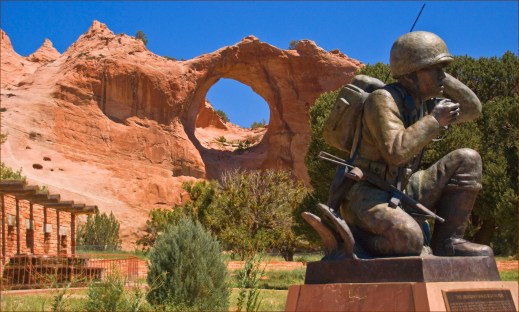

Over the next few weeks, Sounding Out! is proud to offer a new Thursday series spotlighting endangered radio archives across the United States, the kind of resources whose recognition and preservation could not only change media history, but also how we conceive of media history – and the voices that belong in it.
Our writers are part of an effort that is historic in its own right, the Radio Preservation Task Force (RPTF), part of the National Recording Reservation Plan at the Library of Congress. Over the past six months, under the guidance of Christopher Sterling (George Washington University) and Josh Shepperd (Catholic University), the RPTF has drawn together more than 120 faculty researchers and advisors from across the country who in turn have spread the word to create a network of more than 270 archives that hold recordings of broadcast radio, with the goal of creating a national inventory of finding aids and encouraging preservation and modernization through digital access.
If you’ve got archival broadcast radio that can’t be got online and maybe nobody even knows about — in any format or genre, national or local, high-powered or low, commercial or college, in a display or a shoebox – then we want you.
The coming months will see a second campaign of archive recruitment – I’ve taken on a role as Network Director to help coordinate that – as the RPTF rolls out a new working association with the American Archives of Public Broadcasting and gears up for a conference at the Library of Congress in early 2016, for which radio historian Michele Hilmes will be the Program Director.
Drawing on this vast effort, SO! will be bringing you stories of gaps in the record, voices we’ve long missed and need to recover, and some we are in danger of losing for good. We begin with a post by Josh Garrett-Davis, a PhD Candidate at Princeton University pursuing unique research into the long-unrecognized and uncatalogued history of Native American broadcasting.
Pursuing that history requires hard work and persistence; it also requires reimagining what counts as an archive in the first place.
— Special Editor Neil Verma
—
Despite dire poverty across most of the archipelago of semi-sovereign Native American land often called “Indian Country,” radio receivers had become a normal part of life there by the Great Depression. For example, as contemporary publications and later memoirs and oral histories reveal, after work hours in the camps of the Indian Emergency Conservation Work program (the Indian CCC) from northern Minnesota to the Southwest and the West Coast, many men and women listened to the wider world—even following Admiral Richard Byrd’s broadcasts from as far away as Little America, Antarctica.
Listeners, yes. But when did Native people take up the means of production, so to speak, and generate broadcasts themselves? In his history of Native radio, Signals in the Air, Michael C. Keith quotes several sources suggesting little sustaining programming existed until the first Native-owned and -oriented station appeared in New Mexico in 1972. As a sort of internal colony of the United States, Indian Country heard only imperial broadcasts for half a century. The “right to establish their own media in their own languages” in addition to “access to all forms of non-indigenous media without discrimination”—as described in the U.N.’s 2007 Declaration on the Rights of Indigenous Peoples—arrived remarkably late, and are still not fully granted to Native people. Quite recent are the 53 stations catering to Indian communities, and vital national programs like Native America Calling.
But Native people did speak and sing over the airwaves in earlier decades. In some cases a direct or indirect archive even exists, and undoubtedly more will emerge as radio archives more generally are preserved and cataloged through efforts such as the Radio Preservation Task Force of the National Recording Preservation Plan. The trouble is that the cumulative archive of early Indian radio has not been identified as a valuable record or really as a coherent archive at all, perhaps due to compounded misconceptions of radio as an inconsequential documentary record, and of American Indians as technological naïfs. In this post I call attention to the scattered fragments of this archive, which should be recognized as an important heritage for the recent progress in Indigenous media, echoing the various ways Native people seized limited opportunities once broadcast technology appeared.
Here is an initial attempt to quilt a few of those pieces into a pattern:
Widespread broadcasting started at about the same moment—the 1920s—as the first agitation toward tribal political sovereignty in the (constrained) twentieth-century sense. In March 1925, the Cayuga statesman Levi General, who held the ceremonial title Deskaheh, delivered an address from a Rochester, New York, studio. As transcribed in the Haudenosaunee (Iroquois Confederacy)–produced book A Basic Call to Consciousness, he began, “Nearly everyone who is listening to me is a pale face, I suppose,” and went on to appeal to those palefaces for Iroquois sovereignty on land that, like his radio signal, straddled the Canada–U.S. border (18). He urged his listeners to write to representatives in both governments and “ask them to tell you when and how they got the right to govern people who have no part in your government and do not live in your country but live in their own” (22). General certainly grasped the democratic and transnational possibilities of the new medium as he spoke directly to the citizens of two newcomer nations and plainly described to them a Haudenosaunee sovereignty that must have seemed radical.
Around the same time, the Yakama/Cherokee singer Kiutus Tecumseh (aka Herman Roberts) used his celebrity to perform on radio stations across the country, adding political commentary on Indian policy between songs. Often the songs he performed were Indianist compositions by non-Indian composers; Tecumseh was, in historian John Troutman’s words, “‘playing Indian’ with a pointed, political message” (250). Ojibwe bass singer Chief Roaring Thunder (aka George LaMotte), meanwhile, performed on KVOO from Tulsa in the 1920s, as mentioned in the contemporary press.
So far no audio transcriptions of any of these pioneering broadcasts have turned up, though in the 1970s the publication Akwesasne Notes produced a reenactment of General’s address and sold it on reel-to-reel, cassette, and cartridge.
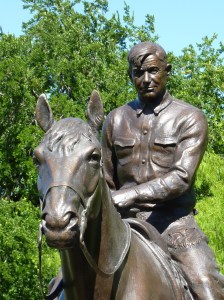
“Soapsuds and Will Rogers” by Flickr user Granger Meador, CC BY-NC 2.0
One Native radio voice of whom an audio archive remains is the humorist Will Rogers (Cherokee). Historians Lary May and Amy M. Ware have convincingly argued that Rogers espoused Cherokee values—which informed his communitarian politics—and sometimes advocated directly on Native issues. Part of the task of creating and preserving an Indigenous media archive is to recognize Rogers’s place in a genealogy: He united oratory like Levi General’s with the vaudeville sensibility of Kiutus Tecumseh and Chief Roaring Thunder. (Rogers could also stand in for a number of mainstream performers whose Indian heritage was not widely recognized, from Lee Wiley to Hank Williams to Jimi Hendrix.)
World War II brought about vast changes in Indian Country, including increased exposure on the air. Great numbers of Native people served in the war effort—notably, in terms of radio, the Navajo and Comanche “code talkers.” But back home, the first sustained radio program, aptly named the Indians for Indians hour, began in 1941 on WNAD in Norman, Oklahoma. Don Whistler (aka Kesh-Ke-Kosh), the first Sac and Fox chief elected under the reforms of the “Indian New Deal,” created the show as a model of participatory programming and (fortunately for later generations) recorded more than a hundred programs on acetate discs before he died in 1951. Indians for Indians, which served and drew performers from perhaps twenty tribal communities and several Indian boarding schools in Oklahoma, persisted in various forms until the 1980s. The only show available online is one from 1976.
I have listened to most of the extant shows from the first decade—which are not endangered except insofar as they have been ignored—and it is a remarkable institution that adopted Will Rogers’s humor and brio while also foreshadowing the vibrant Native radio networks of today.
Archives are more scarce from elsewhere in Indian Country, but traces endure in archives and history books: The renowned Chiricahua Apache artist Allan Houser performed on the air in New Mexico as “the Apache Kid.” In the 1930s and ’40s, students from Santa Fe Indian School and Flandreau Indian School performed on radio shows in Santa Fe and Omaha, respectively. I have not found any recordings of any of these instances, but a few audio archives suggest transcriptions yet to surface: A Tuscarora farm family can be heard singing “By the Waters of the Minnetonka” on Major Bowes and His Amateur Hour on NBC in 1935. NBC also covered an American Indian Exposition and the Flagstaff All-Indian Powwow in the ’30s, which gave Native singers and speakers a national hearing. A non-Indian couple recorded Hopi and Zuni singers on an unidentified station in 1955 and 1956 from Parks, Arizona, a tape which was dubbed by an anthropologist and deposited in the Archives of Traditional Music at Indiana University.
There must be many other fragments, and we can hope that broad efforts like the Radio Preservation Task Force—as well as archival efforts originating among Indigenous organizations like Native Public Media, Koahnic Broadcast Corporation, Native Media Resource Center, and Vision Maker Media—could turn up records of them.
Marshall McLuhan once wrote ominously of the “tribal drum of radio” leading the masses to totalitarianism. But that message, like the medium itself, could be interpreted in a much more constructive sense. When we gather together the early history of Native radio and assemble the intertribal quilt proposed above, the product seems to squarely refute the racial logic McLuhan implied. We may find instead that Indian people themselves recognized right away the importance this “drum” could and would have for maintaining vibrant language, musical, and oral traditions in the face of colonialism.
The Red Power movement is generally thought to begin with the occupation of Alcatraz Island in 1969–71. Part of that action was the Santee Dakota poet and activist John Trudell’s creation, “Radio Free Alcatraz” on KPFA in Berkeley, California. We might hear these programs (preserved in the Pacifica Network’s archives) as heralding a new era of reservation stations and media advocacy by Native people. We could also hear them as descending from efforts—still unrecognized and uncatalogued—by Native innovators over the previous half century.
—
Josh Garrett-Davis is a PhD candidate in history at Princeton University. His dissertation, “Resounding Voices: American Indians and Audio Technology, 1890–1969,” examines Native American use of phonograph and radio technology from the earliest ethnographic and commercial phonograph records to the founding of Indian-run labels and radio shows in the mid-twentieth century. He is the author of Ghost Dances: Proving Up on the Great Plains (Little, Brown, 2012), and a member of the collective M12, which promotes and creates art in rural places.
—
 REWIND! . . .If you liked this post, you may also dig:
A Tribe Called Red Remixes Sonic Stereotypes— Christina Giacona
Chicana Radio Activists and the Sounds of Chicana Feminisms — Monica De La Torre
Radio de Acción: Violent Circuits, Contentious Voices: Caribbean Radio Histories— Alejandra Bronfman
__
__
Special thanks to Daniel Murphy for the RPTF Logo.
Share this:


Current Top Posts





April 2021

January 2020

November 2019

October 2019

August 2019

April 2014

November 2017

March 2015

December 2017

October 2015
 Sounding Out!
Recent Comments