
Decolonizing the Radio: Africa Abroad in the Age of Independence
I never meant to write about radio. Film, video, music, the Internet, television even– but radio had not made a dent in my scholarship or teaching, for embarrassing reasons: it seemed nostalgic even to think about it. It was a residual technology, obsolete even at mid-century, I thought.
And then I stumbled onto the transcripts of “Africa Abroad,” part of The Transcription Centre archives at The Harry Ransom Center.
I was doing research on African American playwright Adrienne Kennedy when two of the fantastic staff at the HRC (Molly Schwartzburg, now Curator at the UVA Special Collections Library, and archivist Gabby Redwine) shared their working African Collections finding aid with me. The description of The Transcription Centre caught my eye, as a radio and public media presence across Africa and the metropolitan diaspora at mid-20th century, whose work included the short variety radio program Africa Abroad (1962-1965) as well as Arts festivals and other cultural events based in London and headed by a former BBC employee. Africa Abroad, a variety show dedicated to the music, art, theatre, literature, and politics of Africa and the African diaspora, offers a compelling glimpse at Independence-Era Africa and some of the technologies that made it, briefly, the center of contemporary diaspora politics.
The transcripts of Africa Abroad document the progressive hope that theorists like Frantz Fanon had for the revolutionary potential of radio in the hands of the (semi)proletariat with cheap access to both production and distribution networks. The background materials on the Centre document its inception as the brainchild of the Congress for Cultural Freedom, a CIA-funded effort to fund anti-communist, pro-democracy sentiment on the continent (a continent who was also being wooed by Russia and China at the time). Africa Abroad then stands as an attempt to rethink the relationship between politics and culture in a difficult, compromised time, self-consciously negotiating the media and mediated trade on Africa as a place and Africa as an international symbol. The radio program takes this moment of African celebrity and finds in it not teleology but proliferation, and a self-aware critique of ‘Africa’ and its public image as it is employed by the diaspora.

released on Riverside Records, 1961.
By the second installment of Africa Abroad on the 26th of April, 1962, what becomes the standard format of the programming emerges, one that begins to place culture as the center of diaspora identity—and politics. There is usually a musical lead—by the 4th installment to become the same “signature tune,” “African Waltz” by Canonball Adderley)—after an announcement of the location (London) and organization of the broadcast. The music and the site identification augurs the emphasis on the multiple and conflicting sites of the black diaspora that are performed within each episode and across the radio series as it continues, starting with an invocation of “Mother Africa”; in this particular episode, James Baldwin calls for the revision of the “American Negro” breaking free of representational binds via “the rise of Africa in world affairs,” then moving to a commentary on a Max Roach jazz piece by Nigerian Aminu Abdullahi that emphasizes the role of pan-African politics in Jazz music, then to a review of Ezekiel (later Es’Kia) Mphahlele’s book The African Image from a Nigerian literature Ph.D. in London, finally leading to a brief interview with Robert Resha, “one of the leaders for the ANC [African National Congress] which has been banned in South Africa, on the eve of his leaving London for a tour of African countries.” This eclectic mix becomes Africa Abroad’s signature format, and its particular concerns—that of the keen recognition that the world’s eyes are on Africa anew during this period of independence, and that Africa is starting to work as a symbolic geography of hope for African America as well as Caribbean emigres to Britain—are also those that inform the rest of its run.

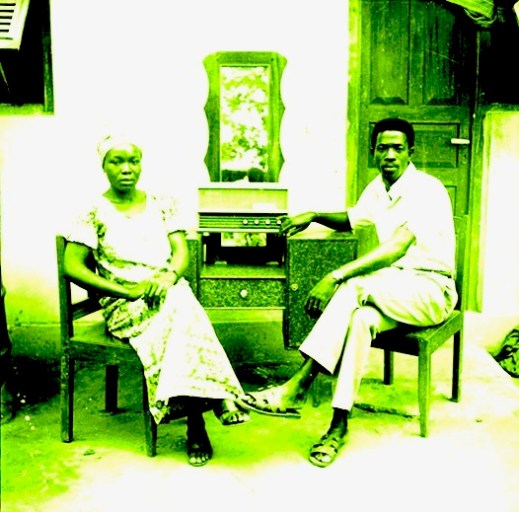
Two friends listen to the radio in the Ivory Coast, 1960s, image courtesy of the BBC Archives
While the range of listeners for Africa Abroad is still hazy—transcripts and recordings were made available across the continent, but there is no record of where they landed or when or if they aired—the way that even its material presence in London acted as a hub for political, literary, and cultural figures from Africa and the diaspora winds up as another meaningful site of contradiction. The programs’ circulation of major literary and cultural figures began to construct and map the canon of African authors we recognize today as the “fathers” of the African renaissance. That gendering is specific as it reflects the kind of access to travel, education, promotion, and connection that was required to be a recurring part of Africa Abroad’s brief run—with a limited number of women being sent to London for education in the time period, and even fewer representing those in privileged political exile. Though what amounts to a handful of women are interviewed on the program, rarely are women writers and thinkers featured beyond actresses. Such representation helped to solidfy a generation of African writers and politics that were defined by the questions of an elite, masculine imagination around what the continent, and art from the continent, should or could be—and this vision of diaspora art and politics circulated via the radio.
In other words, Africa Abroad was produced through and as a representation of the new celebrity of the continent, with the radio program serving as the ideal format to showcase and interrogate the global phenomenon of African Independence and as a harbinger of the postcolonial struggle for its resources that would ensue. As independence struggles adopt and adapt new technologies into forms of “combat,” to use Fanon’s terms from “This is the Voice of Algeria,” radio moves from strictly a medium of the colonizer to a tool, “a system of information, . . . a bearer of language, hence of message” (73). But it is also already “obsolete” by 1962 as a residual cultural form in the Western metropole, taken over in the mainstream by television. Hence, like the flexible political strategies of the Cold War that relied on more than just force, radio at this moment becomes both a tool of cultural revolution (and new-found global relevance) and one of stealth colonial influence. As a program rooted in the West but disseminated across and produced by African continental interests, “Africa Abroad” maintains the complex, contradictory desire of communication post World War II that media communications could both connect us all in a progressive intimacy or hail us into, effectively, sheep. Africa Abroad sounds out this tension in form and in content, through the radio.
As the range of scholars I’ve thankfully met post my encounter with radio attest to, this significant, one might say descendent, moment in radio history is constantly weighted by race, gender, and empire. Ivy Wilson is working on sound and the Transcription Centre on the actual recordings of Africa Abroad. Judy Coffin is mapping the complex work that radio did in the careers of Fanon, Simone de Beauvoir, and other intellectuals of the mid-century. Emily Bloom is tracing BBC radio alongside modernism’s literary pathways. This interdisciplinary community of scholars I’ve discovered alongside of radio signifies the important work being done to think through the possibilities for this medium after its dominant rise and into its political and cultural repurposing in the age of the Cold War—outside of the mainstream center at the same time that it serves to support and traverse new geographic and cultural fronts.
—
Featured Image: original from a BBC collection of images from the Ivory Coast, 1960s
—
Samantha Pinto is an Assistant Professor of English at Georgetown University. She is the author of Difficult Diasporas: The Transnational Feminist Aesthetic of the Black Atlantic (forthcoming from NYU Press) and is working on a new project on early black celebrity and human rights discourse. This research on radio is part of an in-process series of articles on institutional failure in the African Diaspora, Women’s Studies, and other critical sites of progressive political desire.
Share this:

Listening to Whisperers: Performance, ASMR Community and Fetish on YouTube
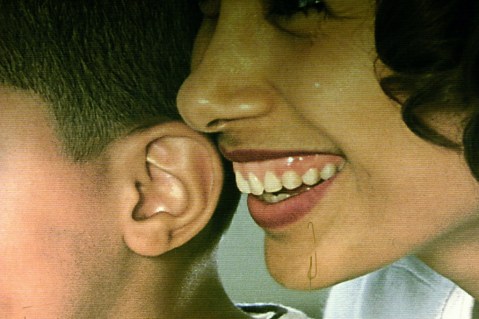
Imagine this, only virtual. Image borrowed from Genista @Flickr.
PercussiveThoughts is giving me a facial. The voice tells me about the “little scrubbies” in the exfoliant, and I begin to hear their delicate sibilance on my temples. If I’m lucky, a pleasurable, tingling sensation might begin somewhere on the back of my head and travel down my spine, turning my facial into something closer to a massage. The sole caveat is that I’m not really being touched at all.
This is ASMR, “Autonomous Sensory Meridian Response,” a pseudo-medical designation whose native soil is YouTube. The term pulls together a range of physiological and affective states: goosebumps, chills, relaxation, melting, tingles, and so forth. PercussiveThoughts and her fellow vloggers (I call them “Whisperers” here and explain why below) aim to trigger these frissons through a cornucopia of techniques. Sound is paramount; Whisperers scratch rough surfaces with their fingernails and percuss everyday objects with fingertip drum-rolls. And, of course, they whisper, sometimes using lozenges or gum to increase the opportunities for swallowing and lip-smacking.
What’s interesting about these videos is how they manage to traverse the gap between the sonic and the haptic. There is, of course, something familiar about this leap. Like the magician’s hat that produces rabbits and endless handkerchiefs, an audio speaker produces a volume and variety of sound out of proportion with its small, blank visage. In the case of Whispering, however, sound is transduced into touch, and the taut membranes of the listener’s headphones become coterminous with his own skin.
Apart from Steven Novella’s suggestion that ASMR might be a mild form of seizure, it does not yet appear to be a subject of scientific research. So Whisperers have taken on the role of amateur scientists themselves, with YouTube serving as a public petri dish. For this very reason, Novella has also cautioned against the assumption that ASMR is a real physiological phenomenon at all, since feedback loops of suggestion on the Internet might create “the cultural equivalent of pareidolia.”
Whisperers, however, have no doubts. And while the ASMR acronym is a recent development, many Whisperers say their first encounters with the phenomenon occurred sometime before their first exposure to the Internet and often before adulthood: during make-believe tea parties, while watching their classmates draw or braid each other’s hair, and, perhaps most commonly, while watching The Joy of Painting with Bob Ross.
The audience for Whispering is anyone who can have this experience, which apparently isn’t everyone. Contrary to the soporific themes of their videos, Whisperers and their fans identify themselves as having awakened to a special form of pleasure. Some have even made videos recounting their first experiences. The downside of this ability is the anxiety about its social acceptance. Whisperers sometimes opt for anonymity in their videos, revealing their faces only after much encouragement from fans. Rarely do they they let their family and friends in on the secret.
That this familiar, tingly feeling has assumed a pseudo-medical acronym is hardly coincidental. ASMR isn’t just pleasurable, it’s therapeutic. Hundreds of YouTube comments attest to the power of ASMR to help relieve them of insomnia, anxiety, and panic attacks. Nor has this dimension been overlooked by Whisperers themselves, who regularly perform as doctors or therapists in their roleplay videos. This is particularly interesting in light of recent scholarship on human/machine interactions. In Addiction By Design, Natasha Schüll shows how therapy for video-poker addiction can take the same format as the gambling itself, namely, “ongoing technological self-modulation to maintain equilibrium” (250).
Homemade Whisper videos, while habit-forming, are clearly not the sort of intricately-engineered machines that Schüll writes about. Nor do they wreack the same sort of havoc (depletion of one’s life-savings, deterioration of one’s physical health, etc.). And yet, both are arranged in problematic feedback loops of self-medication. The slow-paced, low-volume respite that Whisper videos offer is made all the more necessary by the fact that viewers must go online to watch them. This paradox is amplified by YouTube’s advertisements, which will sound especially abrasive because viewers tend to turn the volume up while listening to Whisper videos. That some of the more popular Whisperers earn money from their videos only complicates things further.
*
“No, we don’t get as many men here as women,” PercussiveThoughts says, as though responding to a question from me. Of course, I wouldn’t be so rude as to contradict her – I know better. To judge from the comments below, she gets plenty of male visitors. And her colleague ASMR Velous confided during an interview that around 70 percent of her viewers are men. For this reason, some Whisperers have made gender–neutral or male-oriented videos.
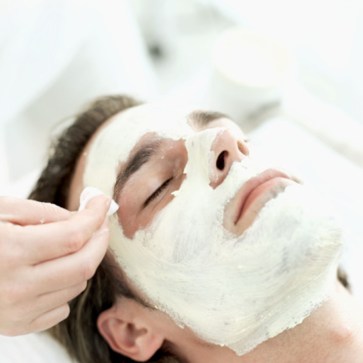
A man getting a facial. Borrowed from FoundryParkInn @Flickr.
Gender is a major, and sometimes contentious, topic of discussion in the Whisper Community. In the YouWhisper web forum, the discussion topic “Gender Preference?,” has the greatest number of views (more than 170,000). In general, female Whisperers are more popular than their male counterparts. The three most popular male Whisperers that I could find–WhisperMister1, MaleSoothe, and TheLyricalWhispers–each have fewer than 5,000 subscribers and their per-video view-counts tend to peak around ten or twenty thousand.
Not long ago, GentleWhispering, one of the better-known names in the Whisper community, set off a series of heated back-and-forths with her ~FeminineGrace & Charmforsleep~ video. In it, she discusses universal traits of femininity while brushing her hair absent-mindedly. Whatever one might think of her opinions, the fact that GentleWhispering’s viewership dwarfs all other Whisperers to date suggests that something in her technique is working. My guess is that it has a great deal to do with her hands.
While giving Russian language lessons on a chalkboard, she points to a word with her middle, ring, and pinkie fingers while keeping the chalk poised delicately between her thumb and index finger. When she is about to touch the fabric of an armchair, her fingers arch back–rather than claw forward–as though to ensure that the contact is as light as possible. And, like so many other Whisperers, she takes any opportunity to tap hard objects with her well-kept fingernails.
The “femininity” of GentleWhispering’s hands is the performance of a soothing, caring touch, and her whispering voice is the transubstantiation of this touch through sound. Sometimes, she even short-circuits the analogy by massaging the microphone directly.
*
But even the performance of gendered touching does not quite explain how these sounds and images manage to reach through the speaker and screen. After a second glance at these videos, we might wonder if the preponderance of partial objects has something to do with it.
I’m talking about all of those disembodied hands stroking opposite hands or displaying objects detached from their collections. Often, for the sake of anonymity, the Whisperer’s eyes are kept out of frame, leaving only an expressive mouth, like CalmingEscape’s, with its signature tics and swallows. If even the mouth is too revealing, the camera gazes down at covered breasts, ”objects,” in a Freudian panoply of sexual cathexis (is it a coincidence that some Whisperers even roleplay as the viewer’s doting mother?). One has to wonder what effect is achieved by this strange summation of partials.
In spite of widespread insistence that these videos are not sexual, the comparison with sexual fetish is too obvious not to make. Sticking with Freud for a moment, the hyper-presence of the Whisperer would seem to disavow the separation implicit in internet communication. Her mouth speaks individually into each of the listener’s ears while also hovering on screen. Her hands animate dead objects through rappings and close-ups. In her omnipotence, she can even tell us what to do.
Fetish or not, the word “whisper” is a perfect synecdoche for this fragmentary whole, and that’s why I’ve used it instead of ASMR. A whisper is, by definition, “unvoiced.” The cheeks, mouth, teeth, and tongue accomplish the acoustic filtering that gives words their shapes, but the larynx produces noise rather than tones. Lacking pitch, a whisper might be called only a “part of speech.” And yet it speaks volumes by shifting the register of communication. Whatever is said in a whisper gains the aura of genuineness, honesty, and intimacy.
Of course, in a YouTube video, these qualities are suspect from the moment one clicks the play button. But perhaps this is what makes Whispering work. One hears in these videos, above all, the effort of performance. It is the performance of gender, as discussed above, but more generally the performance of interaction, intimacy, and proximity. What every Whisper video whispers is “Let’s pretend!” And nothing proves this better than the fact
that some popular Whisper videos contain rather unpleasant sounds. Consider TheWhiteRabbitASMR’s dentist appointment video. If one is willing to grit one’s teeth through the long sections of abrasive drilling, it’s because she so adeptly crafts the intimate space of fantasy in which it takes places.
The pleasure of pretending was made clear to me when ASMR Velous recounted her childhood tactic for inducing ASMR. “I would constantly trick people into pretending to do things. I had this little play kitchen set, and I would cook up imaginary food for people and make them pretend-eat it really slowly and make those eating sounds like [chewing sounds], and I would just sit there and be all tingly. And I just loved it….I made up this game with my friends, where we would basically mime a profession and the other person would have to guess the profession you were miming. That was another way for me to trick my friends into pretending to do stuff.”
*
PercussiveThoughts is wrapping things up. “That completes your facial… So you can sit up. Well, thank you. Thank you so much. I’m really glad you enjoyed it.”
I did enjoy it! But thank goodness it’s not really over; I can just hit the reload button. No matter how many times I do, I know that my pores won’t be any cleaner when I look in the mirror. But that’s not the point. Rather, Whisper fans take pleasure in the intimacy and complicity of pretending. That complicity applies even to the skin of the listener, a surface as vibrant as the skin of the speaker.
—
Share this:


Current Top Posts





April 2021

January 2020

November 2019

October 2019

August 2019

April 2014

November 2017

March 2015

December 2017

October 2015
 Sounding Out!
Recent Comments