
“To Unprotect and Subserve”: King Britt Samples the Sonic Archive of Police Violence
Author’s note: In line with the ethics of listening considered below, I’ve chosen not to embed the videos of police violence that I discuss. But I’ve linked to them when available for readers who’d like to see/hear their content.–Alex Werth
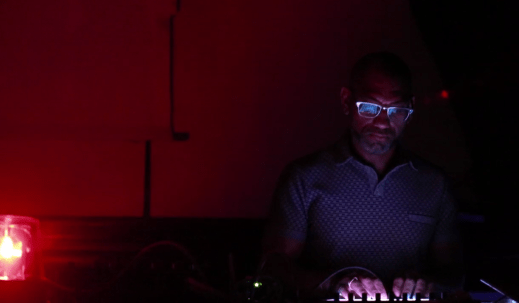
“I’m scared to death of these police.” Dave Chappelle’s voice—pitched down, but nonetheless recognizable—calls from the speakers, cutting through the darkness of Oakland, CA’s Starline Social Club. It’s closing night of the 2016 Matatu Festival of Stories, an annual celebration of Black diasporic narratives, technologies, and futures routed through the San Francisco Bay Area. King Britt—an eclectic electronic pioneer and producer, and former DJ for Digable Planets—has landed with the third version of “To Unprotect and Subserve: A Sonic Response.” (It was first performed after a march for Mike Brown in Ferguson in 2014.) I can barely see Britt, his solemn look bathed in the dim glow of electronic consoles and the red-and-blue pulse of police lights. “First money I got,” Chappelle continues, “I went out and bought me a police scanner. I just listen to these mothafuckas before I go out, just to make sure everything’s cool. ‘Cause you hear shit on there: ‘Calling all cars, calling all cars. Be on the lookout for a Black male between 4’7” and 6’8”.’” With this double invocation, Britt invites us to listen. Specifically, à la Chappelle, he invites us to listen back—to attune to the agents of a racialized security state that, from ShotSpotter to CIA surveillance, profile and police the world’s sonic landscapes.
This essay considers the ethical effects/affects in King Britt’s work of sampling what I call the sonic archive of police violence. From Oakland to Ferguson, the Movement for Black Lives has raised critical questions about the mass surveillance of Black and Brown communities, the undemocratic control of data in cases of police misconduct, and the use of smart phones and other recording devices as means to hold the state accountable. But the failure to indict or even discipline cops in police killings where audio/video evidence was not only available but overwhelming, from Eric Garner to Tamir Rice, casts doubt upon the emancipatory power of simply recording our race-based system of criminal (in)justice. And when re-presented ad nauseum on the news and social media, these recordings can retraumatize those most vulnerable to racist state violence. Indeed, at a discussion among Black artists at Matatu, each panelist admitted to limiting their exposure to what poet Amir Sulaiman called “e-lynching.”
What, then, can we learn from Britt about the praxis and politics of listening back when the circulation of what KRS One dubbed the “sound of da police” is now daily, digital, and ubiquitous? How can we make sense of audio recording when it’s come to signal repression, resistance, and painful reprisal all at the same time?
Back in the darkness of the club, Chappelle’s voice dissolves into a conversation between Darrin Wilson and a dispatcher from the Ferguson Police, who sends him to find the body of Mike Brown—a “Black male in a white t-shirt,” reportedly “running toward QuikTrip” with a stolen box of Swishers. The optimistic waves of sound that open the piece resolve into a throbbing pulse of 1/32nd notes that sounds like a helicopter. Britt begins to loop in other elements: a low bass tone, a syncopated stab. With kicks and reverb-heavy snares, he builds a slow, head-nodding beat (60 bpm) that coalesces around the vocal sample—swaddling, softening, and ultimately subsuming it with high-pitched legato tones. The synths are sorrowful. But the mesmerizing beat embraces listeners in their mourning.
This act of listening to the state differs from the one parodied at the start. Chappelle attends to the police scanner as a form of precaution, checking whether it’s safe for him to enter a realm where he can be marked as criminal (“Staying in the crib tonight! Fuck that!” he concludes). But Britt’s sonic bricolage is more therapeutic than protective. He uses repetition, reverb, and improvised melody to score a sonic altar—to open space, rather than control time—where we can meditate on the archive of police violence with the intention to heal. “Sometimes to push through the trauma we need to experience it in a different context,” he tells me over email. “There is room for healing within the chords and sounds that are carefully curated.” Britt thus reactivates the pathos buried inside this archive—reclaiming what Susan Sontag, in “On Photography,” recognizes as an “ethical content” of representational form that can fade from careless repetition (21).
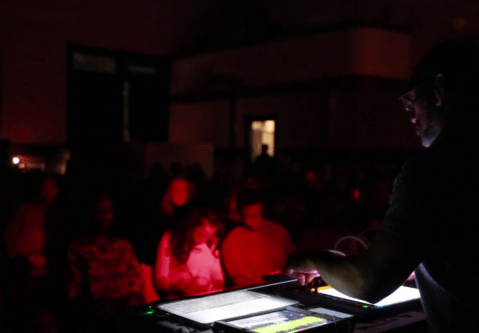
Picture of King Britt courtesy of Eli Jacobs-Fantauzzi for the Matatu Festival of Stories.
After removing the loops one-by-one, until the helicopter sound is all that remains, Britt releases a new sample into the mix. It’s audio from a cell-phone video taken in 2013 by two Black men as they’re harassed by White cops during a stop-and-frisk in Philadelphia (Britt’s hometown). He scores the somber scene with dissonant organs and an offbeat percussive note that reminds me of stress-induced arrhythmia—a heartbeat out-of-place, aggravated, precarious . Vibrating with anxiety, the soundscape temporarily snatches listeners from mourning, demanding that we listen in witness, instead.
The video reveals that the police tear the two men apart, pinning them to the cruiser. But the violence of the encounter is verbal as much as physical. The cops’ language and tone become increasingly abusive as the men contest their treatment in a sounding of agency that Regina Bradley, writing about Black women, calls “sonic disrespectability.” Philip Nace, the more audible of the officers, embodies a double bind built into what Jennifer Lynn Stoever calls the “sonic color line.” He threatens one of the men when he speaks out (“You’re gonna be in violation if you keep running your mouth when I split your wig open.”). But he turns around and ridicules him when, instead, the man refuses to speak (“You don’t know what we know…Right? Right?! What, you don’t hear now?”). As Stoever notes, the demand that African Americans speak when spoken to, but in a way that sounds their submission to Whites, is a feature of anti-Black oppression stemming from the “racial etiquette” of slavery (30-32).
Britt’s manipulation of vocals speaks to the centrality of sampling in hip-hop. According to Tricia Rose, hip-hop artists have long prioritized the sample as a way to recognize and renovate a communal repertoire of songs and sounds (79). And given the realities of anti-Black oppression in the U.S., this repertoire has often entailed the “sound(s) of da police.” From sirens to skits to verses, rappers and producers have remixed the sounds of the state to characterize, caricature, and critique the country’s criminal justice system. But Britt’s trespass on the state’s sonic sovereignty differs from classics like “Fuck tha Police,” in which N.W.A. conducts a mock trial of “the system.” Whereas N.W.A. reappropriates the rituals of legal testimony and judgment to condemn the police (“The jury has found you guilty of being a redneck, white-bread, chicken-shit mothafucka.”), Britt’s musical re-mediation of police violence favors grief over moralizing, dirge over indictment.
In this vein, the musical/ethical demand to witness waxes but then wanes. The soundscape becomes more and more dissonant until the vocals are consumed by a thunderous sound. Suddenly, the storm clears. Britt hits a pre-loaded drum track (136 bpm) with driving double-time congas and chimes over a steady sway of half-time kicks. He starts to improvise on the synth in an angelic register, revealing the impact of his early encounters with Sun Ra on his aesthetic. The catharsis of the scene is accentuated by the sporadic sound of exhalation. This sense of freedom dissolves when the beat runs out of gas…or is pulled over. In its stead, Britt introduces audio from the dashboard camera of Brian Encinia, the Texas State Trooper who arrested Sandra Bland. Encinia and Bland’s voices are pitched down and filtered through an echo delay, lending an intense sense of dread to his enraged orders (“Get out of the car! I will light you up!”).
Here, I sense the affective resonance of dub. Like the musicians on rotation in Michael Veal’s Dub, Britt manipulates the timbre and texture of voices in a way that demands a different sort of attention from listeners who, like me, may be desensitized to the sonic violence of the racialized security state as it’s vocalized and circulated in and between Ferguson, Philly, and Prairie View. Britt reworks the character and context of the vocals into a looping soundscape, and that soundscape sends me into a meditative space—one in which the vibes of humiliation and malice “speak” to me more than Encinia’s individual utterances as an agent of the state. According to Veal, the pioneers of dub developed a sound that, while reverberating with the severity of the Jamaican postcolony, “transport[ed] their listeners to dancefloor nirvana” and “the far reaches of the cultural and political imagination” (13). Now, conducting our Matatu, Britt is both an engineer and a medicine man. Rather than simply diagnose the state of anti-Black police violence in the American (post)colony, he summons a space where we can reconnect with the voices (and lives) lost to the archives of police violence amid what Veal refers to as dub’s Afro-sonic repertoire of “reverb, remembrance, and reverie” (198).
What Sontag once wrote about war photography no doubt holds for viral videos (and the less-recognized soundscapes that animate them). Namely, when used carelessly or even for gain, the documentary-style reproduction of the sonic archive of police violence can work to inure or even injure listeners. But in Britt’s care-full bricolage, sampling serves to literally re-mediate the violence of racialized policing and its reverberations throughout our everyday landscapes of listening. It’s not the fact of repetition, then, but the modality, that matters. And Britt draws upon deep traditions of scoring, hip-hop, and dub to sonically construct what he calls a “space to breathe.”
—
Featured image of King Britt’s performance courtesy of Eli Jacobs-Fantauzzi for the Matatu Festival of Stories.
—
Alex Werth is a doctoral candidate in the Department of Geography at UC Berkeley. His research looks at the routine regulation of expressive culture, especially music and dance, within the apparatuses of public nuisance and safety as a driver of cultural foreclosure in Oakland, CA. It also considers how some of those same cultural practices enable forms of coordination and collectivity that run counter to the notions of “the public” written into law, plan, and property. In 2016, he was a member of the curatorial cohort for the Matatu Festival of Stories and is currently a Public Imagination Fellow at Yerba Buena Center for the Arts in San Francisco. He lives in Oakland, where he dances samba and DJs as Wild Man.
—
 REWIND!…If you liked this post, you may also dig:
Music to Grieve and Music to Celebrate: A Dirge for Muñoz— Johannes Brandis
Singing The Resistance: January 2017’s Anti-Trump Music Videos–Holger Schulze
Black Mourning, Black Movement(s): Savion Glover’s Dance for Amiri Baraka –Kristin Moriah
Share this:

If You Can Hear My Voice: A Beginner’s Guide to Teaching

 Here at Sounding Out! we like to celebrate World Listening Day (July 18) with a blog series. This year, we bring your attention to the role of listening when it comes to the sounds of the K-12 classroom, and by extension, the school.
Any day in a K-12 school involves movement and sounds day in and day out: the shuffling of desks, the conversations among classmates, the fire drill alarm, the pencils on paper, the picking up of trays of food. However, in many conversations about schools, teaching, and learning, sound is absent.
This month’s series will have readers thinking about the sounds in classrooms in different ways. They will consider race, class, and gender, and how those aspects intersect how we listen to the classrooms of our past and our present. More importantly, the posts will all include assignments that educators at all stages can use in their classrooms.
Time’s up, pencils down, and if you can hear Caroline Pinkston‘s voice, you should clap once for this personal essay. –Liana Silva, Managing Editor
Editorial Note (7/17/2017, 11:55 am): After careful consideration, I have changed the last photo of the post, as it was from a NATO Flickr account, and it could be seen as supportive of military presence in Afghanistan. I have added a different photo that compliments better the original intention of the author and the editorial mission of SO!.–Liana Silva, Managing Editor
[C]ontrolling who has the floor is the mark of your authority and a necessity to your teaching.
Doug Lemov, Teach Like a Champion: 49 Techniques That Put Students on the Path to College
I am twenty two, new to New York City and new to teaching. In six weeks, I will be in charge of my own classroom, and like most new teachers, I am worried about classroom management. In my summer pedagogy classes I soak up the advice I am given, dutifully taking notes. Controlling my classroom, I learn, means controlling noise: my own and my students’. My words should be clear, carefully chosen, purposeful. I should eliminate words altogether when I can, using hand signals instead: students who need to use the bathroom, for example, can simply raise their hand with two fingers crossed. I should determine when and how students will answer my questions. I should memorize the names of different participation strategies: cold call, popcorn, call and response. Students should not speak out of turn, even if their responses are well intentioned or correct. Even nonverbal sound should be prevented. “Don’t let them suck their teeth at you,” a veteran teacher cautions me. Unsanctioned noise, I learn, can signal rebellion.

“Student Raising Hand” by Flickr user UC Davis College of Engineering, CC BY 2.0
I should never, under any circumstances, talk over my students, or let them talk over me. I learn techniques to quiet large groups efficiently. “If you can hear my voice, clap once,” I learn to say. “If you can hear my voice, clap twice.”
On the first days of school, learn to begin many of your sentences with, “You will … “ An alternative would be, “The class procedure is…” The first few days are critical. This cannot be stressed enough.
Harry K. Wong & Rosemary Wong, The First Days of School: How To Be An Effective Teacher
For the first few weeks, I write my lessons in complete sentences, rehearsing them in advance like a play. In the lesson plans I write each night, I attempt to impose order on the noise of the classroom the next day with scripted responses. I plan for periods of speaking and silence. I write out the questions I will ask, giving thought to the most effective wording, and I try to anticipate every possible answer. I think through how I might address a misunderstanding, correct a behavior, dole out consequences. In my lesson plans I speak, students respond, and we go back and forth together.

“iPad class” by Flickr user Michael Coghlan, CC BY-SA 2.0
But in the classroom, noise emerges in less predictable ways, bubbling up through the cracks in ways I haven’t planned for. I am listening for outbursts, students speaking out of turn, challenging my authority: the sorts of sounds I’ve been trained to respond to. But mostly, there are pencils tapping on desks. My tongue tripping over names that are at first unfamiliar to me. My voice, to my dismay, shaking. The door, swinging open and shut. Students arriving late, administrators stepping in: sorry to interrupt but could I borrow…? The fire alarm. The crackling loudspeaker.
My voice is tired and hoarse at the end of each day. The hand signal to use the bathroom does not go over well.
Quiet Power. When you get loud and talk fast, you show that you are nervous, scared, out of control. You make visible all the anxieties and send a message to students that they can control you and your emotions… Though it runs against all your instincts, get slower and quieter when you want control. Drop your voice, and make students strain to listen. Exude poise and calm. (Lemov, Teach Like a Champion)
In October of my first year, something strange happens at the beginning of B period. I’ve come into class a little late, flustered and overwhelmed and tired of pretending so hard that I know what I’m doing, to be calm and authoritative and in control. I open my mouth to say the right words to get class started, but instead I find myself laughing—I’m not sure why, really—and then I can’t stop laughing, and I laugh till I cry a little, and I have to step out into the hallway to compose myself.

“Students laughing” by Flickr user Medill DC, CC BY 2.0
Outside, I am sobered by the thought of what I’ve just done: whatever authority and professionalism I had gained, gone. I’ll have to start all over. But when I walk back in, my students are laughing, too, at me, and with me, and through that laughter something tiny but important shifts. It is one of the best days of teaching I’ve had all year.
The soundscape begins to shift. The less I try to extinguish every noise I hear, the more I begin to hear things I hadn’t noticed before: singing in the hallways, laughing. Students asking me about my day.
[K]eep in mind that all students – no matter what age – respond to authenticity. They crave teachers who see them as real people, and they do back flips for the ones whose interactions with them are based on sensitivity and respect. Remember to let them know – this is my single greatest pearl of wisdom, Caroline – let them know every single day that you like them. Laugh with them. Lift their spirits. Sing with them!
(Marsha Russell, personal email).
I observe a veteran teacher whose class of seniors is putty in her hands. At her request, they even burst into song, in unison. How do you get them to do that? I ask. And she tells me: You just have to believe that they will.
She writes me an email of classroom management tips. I print out my favorite part and keep it; I unfold it and I reread it and I put it in my pocket and I pass it along to other teachers.
Sing with them! It’s a revelation, that teaching could be conducting, that learning could be music.
Economy of Language. Fewer words are stronger than more. Demonstrating economy of language shows that you are prepared and know your purpose in speaking. Being chatty or verbose signals nervousness, indecision, and flippancy. It suggests that your words can be ignored. (Lemov, Teach Like a Champion)
My second teaching post is at a private, Episcopal school, where students transition between classes to the sound of music playing through the loudspeakers. In daily chapel, the whole community marks a moment of silence, signaled by a bell that reverberates through the rafters. We sit together patiently, four hundred people breathing. I wonder what combination of school culture and privilege and training creates a student body this quiet and calm, and what unseen tradeoffs might come with such silence. It’s peaceful, but I also find myself nostalgic for the stream of noise I’d grown accustomed to in New York, constant and lively and joyful.

“King’s College London Chapel 2, London ” by Wikimedia user DAVID ILIFF, CC-BY-SA 3.0
I am finally confident in my ability to quiet a classroom, but the skill proves unhelpful in this new space, where on the first day my seniors sit quietly and wait for me to begin. I find this a little unnerving, like I’ve stepped into a game I thought I knew well, only to find that the rules have changed.
Ineffective teachers say things like:
“Where did we leave off yesterday?”
(Translation: I have no control.)
“Open your books so that we can take turns reading.”
(For what reason?)
“Sit quietly and do the worksheet.”
(To master what?)
“Let’s watch this movie.”
(To learn what?)
“You can have a free period.”
(Translation: I do not have an assignment for you. I am unprepared.)
(Wong & Wong, The First Days of School)
F period teaches me that silence can be deadening, too. They answer when I ask them to, but they wait to be asked, or for one of their classmates to resign themselves to raising their hands, again. And the moment of waiting, the stillness that follows the question, punctures the energy in the room as perfectly as a needle: we arrive at an answer, but something important has been lost along the way.
I’m learning that sometimes controlling noise is easier than producing it, creating sound where before there was silence. And sound is not enough: I must layer speech on top of speech to build a conversation, which is something altogether different and more precious. We have to create something, together. That’s the real challenge.
Teaching isn’t magic, says every classroom management book I’ve ever read. And it isn’t, if you’re talking about technique, about participation strategies, about getting everyone quiet or deciding who speaks. But at the center of all that structure is something elusive and harder to describe or replicate — a moment all those management books try to help you approach, when you and your students arrive at something powerful and important together. I’m not sure that moment requires a lively classroom or a silent one, and I don’t think you can conjure it. It comes unbidden. It might be chance. It might happen like this.

“IMG_6010.20161202” by Flickr user Sage Ross, CC BY-SA 2.0
You’ll be in second period English, reading King Lear, at the part when Kent tells Lear to see better. You’ll be telling a story about the very first days of your teaching, when you were too concerned about controlling your classroom to really notice the students in front of you, to see them as real, whole people. You use the story to talk about sight, about what it might mean to see better, how what we pay attention to shapes what we think we know. This story matters to you. You believe in it.
And on this afternoon, for whatever reason, the intensity of your students’ attention will be so sharp and clear it will raise goosebumps on your arms. You’ll feel it and look up, and they will be listening exactly the way you’re talking about seeing, and the room will be so quiet that it almost hums. It’s the kind of quiet you can’t get from silencing noise, just like you can’t create a conversation by making students speak. It grows from the ground up, a momentary enchantment brought on through some alchemy of their interest and your story and the book and the weather that day.
You’ll yield to it, listening, holding your breath in case it disappears.
—
Featured image: “Inside My Classroom” by Flickr user Marie, CC BY-SA 2.0
—
Caroline Pinkston is a PhD candidate in American Studies at the University of Texas at Austin. Her work brings education into conversation with childhood studies and cultural memory. She holds a B.A. in American Studies and English from Northwestern University (2008), an M.S. in English Education from Lehman College (2010), and an M.A. in American Studies from the University of Texas (2014). A former high school English teacher, she has taught and worked in public, private, and nonprofit settings in New York City and Austin, Texas.
—
REWIND! . . .If you liked this post, you may also dig:
A Listening Mind: Sound Learning in a Literature Classroom–Nicole Furlonge
Audio Culture Studies: Scaffolding a Sequence of Assignments–Jentery Sayers
The Sounds of Anti-Anti-Essentialism: Listening to Black Consciousness in the Classroom–Carter Mathes
Share this:


Current Top Posts





April 2021

January 2020

November 2019

October 2019

August 2019

April 2014

November 2017

March 2015

December 2017

October 2015
 Sounding Out!
Recent Comments