
Echoes of Ian Curtis: Film and the Punk Voice

Image of Alice Bag used with her permission (thank you!)
For full intro and part one of the series click here. For part two, click here. For part three click here. For part four click here. For part five click here.
Our Punk Sound series implicitly argues that sound studies methodologies are better suited to understanding how punk works sonically than existing journalistic and academic conversations about musical genre, chord progressions, and/or genealogies of bands. Alexandra Vasquez’s sound-oriented work on Cuban music, for example, in Listening in Detail (2014) opens up necessary conversations about the “flashes, moments, sounds” in music that bear its meanings and its colonial, raced, classed, and gendered histories in material ways people can hear and feel. While retaining the specificity of Vasquez’s argument and the specific sonic archive bringing it forth, we too insist on “an ethical and intellectual obligation to the question: what do the musicians sound like” (12) and how do folks identifying with and through these musical sounds hear them?
In this series, we invite you to amplify varied historicized “details” of punk sound–its chunk-chunk-chunk skapunk riffs, screams, growls, group chants, driving rhythms, honking saxophones–hearing/feeling/touching these sounds in richly varied locations, times, places, and perspectives: as a pulsing bead of condensation dripping down the wall of The Smell in Downtown LA (#savethesmell), a drummer making her own time on tour, a drunk sitting too near the amp at a backyard party, a queer teenager in their bedroom being yelled at to “turn it down” and “act like a lady[or a man]”. . .and on and on. In today’s essay Landon Palmer shows us how film may be just as responsible as music for how we remember the punk voice.
SOUND!
–Aaron SO! (Sounding Out!) + Jenny SO! (Sounding Out!)
—
In Joy Division’s 1979 song “Transmission,” singer Ian Curtis embodied several aspects of what made the group’s post-punk sound unique with the chorus, “Dance, dance, dance, dance, dance, dance to the radio.” As a piece of music, its repetition is intense and rousing, working as a compelling instruction that, when played loud enough, can be felt to the bone via Curtis’s deep timbre. At the same time, Curtis’s voice is robotic and distant, the signature of the group’s bleak sound that signified the post-industrial alienation of Thatcher-era Manchester. A historically specific critique of media, “Transmission” plays out a loss of agency. In the 21st century, however, the song has circulated more as a self-referential testament to Joy Division’s – and Curtis’s – musical skill, a container and a summary of myth.
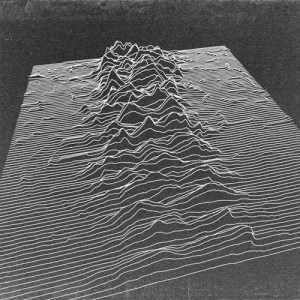
Image by Ho-Teng Chang @Flickr CC BY.
To adopt Alexandra Vasquez’s question that has framed this series, what happens to representations of punk sound as they change over time? I argue that the cinematic techniques employed in presenting Ian Curtis and his voice in both 24 Hour Party People (Michael Winterbottom 2002) and Control (Anton Corbijn 2007) help us to understand the construction of a mythic punk voice.
Punk’s avoidance of comprehensibility, identification, and what Dave Liang calls “the prettiness of the mainstream song” have existed in awkward relation to narrative cinema, which requires legibility as a central component of storytelling (70, 71). While displacing the voice through fragmentation and asynchronous sound work has proven vital to theorizing and subverting cinematic norms, rarely has depicting a well-known punk singer’s voice in cinema translated to a cinematic punk aesthetic, as Stacy Thompson argues regarding the narrative and documentary Sex Pistols biopics Sid & Nancy (Alex Cox 1986) and The Filth and the Fury (Julien Temple 2000) (49-50). Even the revered punk documentary The Decline of Western Civilization (Penelope Spheeris 1981) renders punk voices legible by providing lyric subtitles. However, the two most notable cinematic portrayals of Ian Curtis–24 Hour Party People and Control, released during the band’s resurgence in 21st century popular culture–demonstrate competing interpretations for a punk voice’s place within filmmaking and put into play the question of how to interpret it.

Image by a town called malice @flickr CC BY.
Despite Curtis’s short lifetime, his voice continues to be amplified throughout popular culture. These extended echoes of his voice have participated in shaping its meanings and myth. In his book Joy Division’s Unknown Pleasures, Chris Ott writes that Joy Division’s music “defied imitation” (xiii); however, imitation (and citation) have fueled public memory of the band and augmented the myth of Ian Curtis. By the time Joy Division’s two LPs were re-released by Rhino in 2007, several contemporary bands–The Killers, Editors, Interpol and She Wants Revenge–built music careers that are openly indebted to this Manchester sound but distinct from its socio-historical context. Public memory of the group has been interpreted through uses of their music in the 1980s-set period pieces like Donnie Darko (Richard Kelly 2001) and Netflix’s Stranger Things (2016). The contemporary circulation of Joy Division’s music has extended to films that resurrect Curtis himself.
To start, 24 Hour Party People self-consciously stages an inquiry into Ian Curtis’s meanings and his contemporary resonance as part of the post-punk scene writ large. Chronicling the ‘70s-‘80s Manchester music scene through Tony Wilson (Steve Coogan), the attention-seeking TV personality and unlikely underground music patron who formed Factory Records, the film fits several tenets of Thompson’s definition of punk cinema in its “engage[ment] with history” and “critique [of] its own commodification” (64). A tongue-in-cheek historical guide, Wilson narrates via a fourth-wall-breaking blend of mythmaking, footnotes, and commentary that reflects upon the film’s historiography as he articulates it, and in so doing overtly selects myth over “truth,” stating, “When you have to choose between truth and the legend, print the legend” (itself a quote dubiously credited to John Ford). The film’s self-conscious performance of history extends to its musical numbers, where Winterbottom liberally blends imitation with the genuine article through a mix of archival and staged footage, thus overtly staging encounters with key moments in Manchester musical history. The film’s play with historiography does not go so far as to trouble its reinforcement of a canonical timeline.
It is in this spirit that 24 Hour Party People brings actor Sean Harris’s portrayal of Ian Curtis to life. In re-creating Joy Division’s performance of “Digital” at the Hacienda Club, Harris invokes Curtis’s jittery-mechanical dance style while his “voice” remains Curtis’s. Additionally, the film mixes ambient crowd noises with a band of actors performing in synch to the song’s studio recording. 24 Hour Party People not only preserves Curtis’s voice as an inimitable icon of this history, but places the studio recording of “Digital” as the authoritative version of the song within the nascent period of the Manchester scene, thus mapping this studio recording onto the band’s live sound (rather than implementing an existing live recording). Curtis’s voice is reproduced only through the most valuable, resonant historical record of it–the recorded commodity.

Image by bixentro @Flickr CC BY.
The retrospective framing implied by this choice speaks to the film’s greater approach to Ian Curtis as a figure best understood (or perhaps inevitably shrouded) via his posthumous legacy, and thus foregrounds Curtis’s transformation into myth. Due to the timing of his passing, there exists a relatively limited media archive of the actual Curtis compared to other late-20th century rock singers of similar influence. Beyond official performances on television, music video, and records, scant recordings of Curtis performing and speaking are available via silent 8mm home movies and archival audio interviews. Thus, 24 Hour Party People cannot resort to the historical record(ing) in all instances, and thus Harris’s voice proves central to interpreting Curtis off-stage. In recalling Joy Division’s notorious first encounter with Wilson, 24 Hour Party People portrays Curtis as intimidatingly sure-footed, confronting Wilson through quick, direct speech and locked eyes. Harris conveys the actorly qualities that so often typecast him in villain roles. Further complicating Curtis’s public image, Coogan’s Wilson provides a counter-narrative of the singer following his suicide, asserting to the audience that Curtis was not exactly the “dark and depressive…prophet of urban decay and alienation” that his music suggested, and recounts a rousing collective rendition of “Louie Louie” with the band to prove his point. The only instance in which Harris’s actual voice is used as Curtis’s singing voice, this cacophonous chorus depicts a Curtis participating in a deliriously muddled punk sound. Yet even this counter-narrative does not challenge the mythmaking of Ian Curtis, for it reinforces Curtis’s suicide as central to his meaning and value as a musician.
Music biopics have long bolstered definitive interpretations of a popular performer’s biography. In contrast to 24 Hour Party People’s self-conscious approach to mythmaking, Control is adapted from Deborah Curtis’s autobiography and directed by a former Joy Division photographer. Control’s most conventional choices as a rock biopic are the narrative associations the film makes between events in Curtis’s life and his songwriting, connecting Curtis’s music directly to his troubled marriage and the distress caused by his epilepsy. Control juxtaposes Curtis’s interior life with his production of music, cutting to the recording of “She’s Lost Control” after he learns that a client in his unemployment office has died of epilepsy, and featuring a performance of “Love Will Tear Us Apart” following a scene in which he tells his wife (Samantha Morton) that he no longer loves her. Control thus connects the singer’s authorial voice to the film’s narrative voice, arguing that the sounds Ian Curtis left behind are legible remnants of his biography. In so doing, the film deterministically situates his life through the framework of his death, his music serving a seemingly inevitable path to his suicide and thus transformation into musical myth (staged at the end with a crane shot rising up to the Manchester skyline during “Atmosphere,” indicating a ubiquitous echo of Curtis that has transcended the corporeal).

Punks in Manchester. Image by agogo @Flickr CC BY.
The film’s voicing of Curtis is articulated through Sam Riley’s performance, not through archival audio of the singer. As with 24 Hour Party People, Corbijn initially planned to have Riley and the supporting actors mimic their performances. However, during preproduction the band of actors rehearsed together until they were confident enough to play live shows for Joy Division fans. This convinced Corbijn to utilize them as a sort-of legitimate cover band for the purposes of embodying Joy Division’s history. Riley’s voice is notably higher than Curtis’s and is thus distinctive enough that it resonates comfortably alongside the numerous bands of this century whose leads “sound like” Curtis. Indeed, the resonance of Curtis throughout contemporary alternative rock may have helped make Riley more palatable as an authorized substitute for Corbijn and Joy Division fans. Such homage through imitation is reinforced by Control’s end credits, which features The Killers’ cover of “Shadowplay.” Both of these invocations of Curtis locate his value in his contemporary influence, not his historic place, an approach evident in Control’s less overt interest in post-punk’s socio-cultural context than 24 Hour Party People.
Control is uninterested in recreating the details of Joy Division’s history with exacting verisimilitude, forgoing the archive for a resonant aura of the band’s history. This approach is evident in Corbijn’s visual decisions – shooting the film in black-and-white memorializes the band through the stark photography with which Corbijn captured them – as well as his musical ones. In Control’s depiction of the band’s breakthrough performance on Tony Wilson’s (here played by Craig Parkinson) Granada Television program So It Goes, for example, Corbijn’s Joy Division perform the enduringly popular “Transmission” rather than “Shadowplay,” the song they actually played. Joy Division’s breakthrough television moment was further recast through “Transmission” in a fan-made Playmobil animation that curiously combines introductory audio of Parkinson’s Wilson from Control with Joy Division’s 1979 performance of “Transmission” on BBC2’s Something Else. Control not only situates Curtis’s singing voice coherently within authorial and narrative legibility, but also reflects and participates in contemporary popular memorialization of Joy Division regardless of the historical accuracy of such choices.
Pamela Robertson Wojcik argues that the human voice and its mediation through recording technologies is an important but overlooked component of cinematic performance. It is also vital to consider how famous voices travel and gain meaning through processes of imitation and citation–tropes of authenticity which pervade the musical biopic. While 24 Hour Party People and Control avoid many clichés of the musical biopic, narrative cinematic imperatives of legibility, coherence, and individual-centered storytelling motivate each film to participate in the production of rock star myth despite efforts at historical critique in the former or the austere style of the latter. Even in punk, rock star death is the most compelling biographical framework. The punk voice has long held a discordant relationships to cinematic norms, and these two films demonstrate how the translation of punk sound into cinematic soundscapes presents the inherent problem of recounting punk’s history.
–
Featured image “scream” by be.refreshed @Flickr CC BY-NC-ND.
–
Landon Palmer is a PhD Candidate studying Film and Media in the Department of Communication and Culture at Indiana University and recently defended a dissertation on the cross-industrial history of casting rock stars on film titled “Rock Cinema: A Transmedia History, 1956-1986.” He has published on popular music and moving image media culture in Music, Sound, and the Moving Image, iaspm@journal: Journal of the International Association for the Study of Popular Music, and Celebrity Studies.
–
 REWIND! . . .If you liked this post, you may also dig:
G.L.O.S.S., Hardcore, and the Righteous White Voice – Chris Chien
If La Llorona Was a Punk Rocker: Detonguing The Off-Key Caos and Screams of Alice Bag – Marlen Ríos-Hernández
Riot-Grrrl, Punk and the Tyranny of Technique – Tamra Lucid
Share this:

If La Llorona Was a Punk Rocker: Detonguing The Off-Key Caos and Screams of Alice Bag

Image of Alice Bag used with her permission (thank you!)
For full intro and part one of the series click here. For part two, click here. For part three click here. For part four click here.
Our Punk Sound series implicitly argues that sound studies methodologies are better suited to understanding how punk works sonically than existing journalistic and academic conversations about musical genre, chord progressions, and/or genealogies of bands. Alexandra Vasquez’s sound-oriented work on Cuban music, for example, in Listening in Detail (2014) opens up necessary conversations about the “flashes, moments, sounds” in music that bear its meanings and its colonial, raced, classed, and gendered histories in material ways people can hear and feel. While retaining the specificity of Vasquez’s argument and the specific sonic archive bringing it forth, we too insist on “an ethical and intellectual obligation to the question: what do the musicians sound like” (12) and how do folks identifying with and through these musical sounds hear them?
In this series, we invite you to amplify varied historicized “details” of punk sound–its chunk-chunk-chunk skapunk riffs, screams, growls, group chants, driving rhythms, honking saxophones–hearing/feeling/touching these sounds in richly varied locations, times, places, and perspectives: as a pulsing bead of condensation dripping down the wall of The Smell in Downtown LA (#savethesmell), a drummer making her own time on tour, a drunk sitting too near the amp at a backyard party, a queer teenager in their bedroom being yelled at to “turn it down” and “act like a lady[or a man]”. . .and on and on. In today’s essay Marlen Rios-Hernandez discusses how all the politics of punk sound, queer chicana identity, and feminism can be found in the scream.
SOUND!
–Aaron SO! (Sounding Out!) + Jenny SO! (Sounding Out!)
—
Mexican cultural theorist Carlos Monsiváis looked at various aspects of Mexican youth subcultures in the early 80s and revealed how youth relied on “caos” or chaos as a way to attain pleasure within disruption, spontaneity, and noise (68-79). How does the scream emerge through caos as a instrument of resistance? Alongside scholars like Fred Moten, I argue that the scream ruptures caos and allows us to glimpse the pleasure of resistance. In Alice Bag’s scream we find this medley of pleasure, interruption, and spontaneity. Bag explains, “once the Bags hit the stage and the music started, ego checked out and id took over, channeling my libido, my inner rage, whatever… I was free to be myself with no holds barred. It was the ultimate freedom” (221). These elements epitomize what I consider a queer Chicana feminist exorcism of tonality.
As explained in Bag’s memoir, particular to punk, there is a general reliance on informal/community-based ear training where musicians teach each other (183). European traditions of musical analysis both negate the horizontal learning central to punk while also normalizing the historical colonial presence within the Borderlands. In order to reveal how Bag’s scream exorcises these Eurocentric traditions, I consider her performance of “Violence Girl” at the Whiskey (1978), footage of “Gluttony” from The Decline of Western Civilization Part 1 (1981), and a brief clip of The Bags’ “Survive” in What We Do is Secret (2007). Because of how the scream disrupts formal analysis, there is an urgency to understand how it works against the grain.
In the face of Chicana women being politically silenced by the Chicano Movement and Women’s Movements during the late 70s and 80s, it was important for Chicanas to speak up for increased autonomy and access to space. Thus, Alice Bag’s caos is informed by an intersectional ethic of Chicana feminism. At the time queer Chicanas were largely absent from Chicano nationalist organizing. Between the Chicano Movement and unruly Chicana punks, the screaming voice became a multi-layered instrument of protest and empowerment necessary to invert normative gender and sexual politics within punk, the Chicano movement, and second wave feminism. The ability of the Chicana scream to contest oppression is not new. Such a linage can be drawn from La Llorona–– the villanized folkloric mother that drowns her children and haunts Mexico’s shores by wailing in the night.
Drawing on Latinx scholarship and a sonic reimagining of La Llorona’s wailing (as a feminist cry and public display against patriarchy), this post reimagines Alice’s scream as simultaneously resistance and pleasure. This aligns with Gloria Anzaldúa’s notion of deslengualidad. Suturing Anzaldúa’s concept of deslengualidad (detonguing)–which I define as Chicanas speaking with an orphan tongue–with caos shows how Chicanas can claim visibility through the scream. Deslengualidad and caos account for colonial interventions within the Chican@ identity, they demand the preservation and celebration of the mestiza language and help to provide visibility to Chican@ art.
Though the voice has been rendered repeatedly as a gendered instrument, usually legible via lyrics, and always harmonic, some examples tell us otherwise. For example, Alice’s scream is interrupted by her microphone malfunctioning in her performance of “Violence Girl” at the Whiskey (1978). This multi-layered recording with it’s already grainy inaudible features, helps us to understand the scream as a stand alone act of caos. Although the scream is interrupted by multiple forms of dissonance, it also persists as a public gesture of empowerment. The quality of the recording is poor and in it Alice experiences technical issues on stage. These distortions lead Alice to artfully perform a sonic delengualidad by making use of silence, inaudible screaming, and the body. She continues to move, interrupt, and most importantly still is accompanied by stable beat of the Bags despite singing without a microphone. Yet, in the absence of aurally decipherable lyrics (like the absence of a singular Chicana language) a lyrical analysis here wouldn’t serve any other purpose than to organize that which is on its own refuses order––her voice.
The seminal footage of “Gluttony” in The Decline of Western Civilization Part 1 (1981), features an aural scream. It helps us think about how the Chicana scream goes beyond mere aurality. Michelle Habell-Pallán’s notion of “el grito,”–the shout–relates to Alice’s shriek in “Gluttony.” Both punctuate emotional drama and harken back to Ranchera music. I suggest, however, that Bag’s shriek in “Gluttony” also signifies a growing concern with the homogeneity of white suburban beach punks who had infiltrated the scene. In her memoir Bag shares, “as I looked out into the audience, I could see that the once quirky men and women artists who prized originality above all else were being replaced by a belligerent, male dominated mob…playing for a belligerent group of individuals can be quite satisfying. What I didn’t like was the sameness” (308). Pushing back against the scene’s homogeneity, Bag does not end “Gluttony with a full closed cadence. Rather, she ends abruptly, leaving the listener with a sense of incompleteness.
The combination of repeated interruptions throughout “Gluttony” and the inability to conclude pushes the listener to a place of discomfort, where they are left yearning for some kind of ending. The musicologist Susan McClary argues that the absent cadences in Carmen signify how the cadence represents a return to normality and a satisfying feeling of closure. By withholding a full cadence in “Gluttony” and using her “grito” to celebrate difference, Bag enacts caos by rejecting the emerging uniformity of the scene. Much like Bag’s performance of “Violence Girl” at The Whiskey, the scream is less about being musical and ordered but instead a gesture to making do with what one has, a similar manifestation of deslengualidad.
The brief sound clip of the Bags’ “Survive” in What We Do is Secret (2007) illustrates how Alice’s scream offers a genealogy of caos via her disruption of the story of L.A. punk. The Bag’s “Survive” for the duration of a few seconds plays in the background during a scene in which fans are getting ready to watch The Germs perform at The Masque. In this clip, Alice’s voice isn’t immediate because of how it resonates within the background music. Hence, her voice refuses containment by emanating from the periphery. Alice’s voice emerges as delengualidad within the film precisely because women are written out of the story of L.A. punk. They are depicted as secondary players in the film. Fred Moten’s In The Break reminds us that the site “where shriek turns speech turns song–– remote from the impossible comfort of origin–– lies the trace of our descent.” Within the shriek also lies our resistance tactics as Chicanas. The map of our survival through loudness–though heavily stereotyped–is a testament to the unwavering and inherited conocimiento that silence has never protected us. It is the task of women of color to interrupt, archive, and preserve their roles in the L.A. scene.
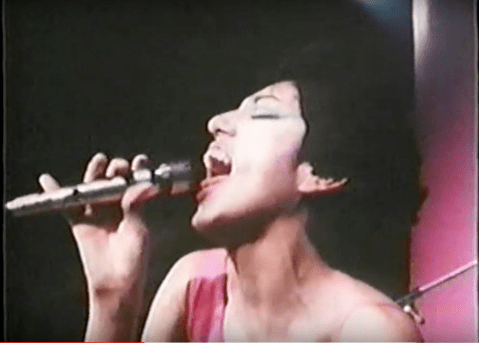
Screenshot from Alice Bag Band’s video “Gluttony.” Image used for purposes of critique.
Within Bag’s screaming from the Whiskey performance, Decline, to What We Do is Secret are snapshots or sonic/visual testimonios of queer Chicana women during the early 80s. These sonic snapshots/testimonios speak to the severely gendered and racialized repression of queer Chicana youth while still reconfiguring what empowerment looked like in the aftermath of the major socio-political movements of the 60s and 70s. In a casual conversation with Alice in a panel I guest moderated, she mentioned that watching “Gluttony” today was irksome to her because she was off-key. Perhaps, being off-key is one way that Chicana feminisms audibly reject neoliberal (and gendered) state repression. When we are surrounded by noise, we must remain enveloped in its infinite shape and simply listen. In noise we can resist, interrupt, and move away from orthodoxy and order. In today’s political climate, we need this framework now more than ever.
The return to Alice’s voice in this current moment is no coincidence. In preparation for this piece, I reflected on my brother’s deployment to Iraq during George W. Bush’s term. I was in community college taking a music appreciation course and I was searching for a paper topic that would be palatable to me as both a newly politicized queer Chicana and a former regular in the South Gate punk scene. It was through an interview with Teresa Covarrubias of The Brat and Alice Bag in an issue of Los Angeles Magazine that I heard Alice’s scream for the first time. It was the description of these women’s careers that led me to look up Chicana punk and come across the Whiskey performance of “Violence Girl.” To this day, Alice’s voice reminds us that if “Alice Bag was born from chaos” (310) then the Chicana punk voice remains a testament to punk’s resilience in the face of political uncertainty.
–
Featured image “Alice Bag Performing at Club Lingerie with the Cambridge Apostles” (CC BY 2.0)
–
Marlen Ríos-Hernández is a Ph.D. Candidate in the Ethnic Studies Department at the University of California, Riverside. Her current research revolves around queer Chicana/Mexicana punks in Mexico and Los Angeles from 1977-early 2000s respectively. Her dissertation aims to theorize and argue how Alice Bag, an innovator of the 1970s Los Angeles punk scene alongside other Mexicana punks, utilized noise to correlate the systemic disenfranchisement of womxn of color with the desire for transformational change integral to the survival of Mexicanas and first generation Chicana womxn especially during the Reagan and Bush Administrations. Via Ethnic Studies as her area of study along with her humanities and arts training as a Musicologist, Marlen investigates the relationship between unruly Chicana/Mexicana performing bodies and bisexuality, swapmeets, police brutality, photography, and film as instruments of noise-making.
–
REWIND! . . .If you liked this post, you may also dig:
G.L.O.S.S., Hardcore, and the Righteous White Voice – Chris Chien
Feeling Through the Keen and Grind: Team Dresch’s Personal Best – Gretchen Jude
Riot-Grrrl, Punk and the Tyranny of Technique – Tamra Lucid
Share this:


Current Top Posts





April 2021

January 2020

November 2019

October 2019

August 2019

April 2014

November 2017

March 2015

December 2017

October 2015
 Sounding Out!
Recent Comments