
The Sweet Sounds of Havana: Space, Listening, and the Making of Sonic Citizenship

 Welcome to the third and final installment of Unsettling the World Soundscape Project, a series in which we critically investigate the output of early acoustic ecology and assess its continuing value for today’s sound studies. In our first post, Mitchell Akiyama addressed the WSP’s ten-hour Soundscapes of Canada radio series from 1974 to situate the broadcast’s innovative work historically and explore how it attempted to represent a diverse nation by way of sound. In my follow-up post, I focused on the WSP’s Vancouver research, their only output since returning from Europe in 1975, assessing shifts in the ideologies and practices over its two official releases and arguing for the best path that future iterations of the project might follow.
In this final entry, Vincent Andrisani puts the “world” back into the World Soundscape Project by carrying his experience as the recordist for the WSP’s last archiving mission in Vancouver out into his solo doctoral research in Havana, Cuba. Andrisani lends an unsettled ear to one of the city’s most beloved sounds, the tune of the ice cream vendor, unpacking its social and historical significance to make an argument about the role that sound plays in local self-definitions of citizenship. Inspired by the WSP’s continuing quest to discover how people’s relationship to places can be defined through sound, Andrisani’s work offers an example of what contemporary soundscape research can be while demonstrating how to deal with many of the concerns raised about the WSP’s output over the course of this series.
It has been a great pleasure acting as editor for this series over the past few weeks and it is our hope that these posts will provide further fuel for celebrating, expanding, critiquing and rethinking the work of acoustic ecology in the broader context of contemporary sonic research.
— Guest Editor Randolph Jordan
—
To conceive of Havana in sound is to think not of the material spaces of the city, but rather, across them. From inside the home, residents participate in conversations taking place in the streets, while those in the streets often call for the attention of their friends or family indoors. Through windows, open doors, and porticoes, residents engage in interpersonal exchanges that bring neighbourhood communities to life. To listen across these spaces is to listen trans-liminally from the threshold through which sounds must pass as they animate the vibrant social life of the city. Such an act is made most apparent by the voices of vendedores ambulantes, or, mobile street vendors. “¡El buen paquete de galleta!” (“The good packs of cookies!”), “¡Se compran y se vendan libros!” (“I’m buying and selling books!”), and most famously, “¡Mani! ¡Mani!” (“Peanuts! Peanuts!”) are some of the pregones—the musical cries—heard through the streets and into the home.
But not all vendors are pregoneros. El heladero, the ice cream vendor, uses the jangly melodies of the electronic music box to make ears perk up, mouths water, and children’s shoes hit the ground running. The sound signals a respite from the sweltering Caribbean heat and is symbolic of a novelty food item for which Cubans have a strong cultural affinity. But most of all, the ice cream vendor’s melodic tunes bring people out of their homes and into the street, giving life to a moment that is as social, participatory, and convivial as it is savory.
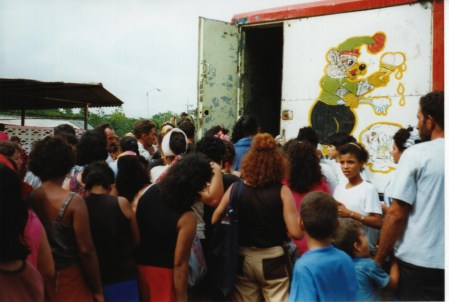
Ice Cream Vendor in Cuba, 2008, Courtesy of Flickr User berg_chabot
For over a century, ice cream vendors have been heard on the streets of Havana. Throughout this time, the city’s spaces have been contested by external regimes of power that include the Spanish Crown, U.S. business interests, Cuba’s own socialist government, the Soviet Union, and since the 1990s, Cuba’s resurgent tourist economy. Yet, in spite of the exclusionary logic imposed by each of these systems of power, the sound of the ice cream vendor still remains. To listen to it is to listen to Havana according not to the agenda of outside interests, but rather, according to the collective interests of residents themselves.
Borrowing from the work of Saskia Sassen (2006) who maintains that “citizenship practices have to do with the production of ‘presence’ of those without power and a politics that claims rights to the city” (315), I regard the tacit, communicative, trans-liminal act of listening as a means through which residents assert their embodied presence amidst both the spatial and political landscapes of the city. Listening to the sound of the ice cream vendor, I argue, constitutes an act of citizenship—an act of sonic citizenship—that momentarily claims Havana’s spaces according to the aims, aspirations, and desires of those who live there.
Citizenship, in this sense, is conceived of not as an institution bound to the political-juridical architecture of the nation-state, but rather, as a place-based “practice and project” (Sassen, p281) that, over time, has the potential to condition changes in the formalized institution itself. It emerges in the everyday, rather ordinary moments during which the city’s spaces are produced and given meaning by those with unequal access to political power. Just as Jennifer Stoever (2011) and Michael Francis O’Toole (2014) have discussed elsewhere, I too contend that citizenship is articulated in sound, but in order to hear it, we must listen historically to—and through—the spaces of Havana’s built environment.
The above clip, which I captured while conducting fieldwork in Havana, represents a moment of everyday life in the municipality of Centro Habana. While speaking about it with friends, colleagues, and acquaintances, I came to realize that only recently had the ice cream vendor’s heralding music become part of the local soundscapes. “Where was it before that?”, I asked. “Before that,” they all said, “it was gone.” In 1990, the Soviet Union collapsed and brought Cuba’s economy along with it. Shortages of food, petrol, and material resources were so severe that satisfying basic needs took precedence over the delivery of frozen novelties. The result was the loss of the ice cream vendor—and its corresponding sound—which, for decades, was part of the ongoing, everyday life of the city.
Fittingly, the collective sentiment surrounding that loss is captured in song. “Helado Sobre Ruedas,” or “Ice Cream on Wheels” by Gema y Pavel was released in 1994, during the height of Cuba’s economic crisis. In it, the duo lament the disappearance of the ice cream vendor from the streets of Havana and reflect on what it meant not only to them, but to all residents of the city. They speak about the presence of the ice cream vendor as a ‘refreshing’ event on hot days; as a source of joy, pleasure, and happiness that offered much more than a simple respite from the heat, but as one that “made family problems disappear.” The “sweet melody” of the vendor was the cause for celebration in neighbourhoods across the city, and is a sound that the duo recalls with both warmth and affection.
Throughout most of the twentieth century, ice cream sales in Havana looked and sounded much like it did in the United States. Minnesota-based Nichols Electronics developed the technology of the electronic music box in the mid-1950s, and within a few years, its chime-y sounds were heard on the streets of Havana. The frozen novelty itself can be traced back to 1920 in Youngstown, Ohio. Harry Burt, the eventual founder of the Good Humor brand paired, first, the lollipop’s wooden stick with chocolate covered vanilla ice cream, and subsequently, ice cream sales and automobility. In Havana, brands such as Hatuey, Guarina, and El Gallito borrowed Burt’s developments, and by the time the city underwent its westward suburbanization in the 1940s and ’50s, mobile ice cream sales were booming.
But if we listen further still into Havana’s past, we can discern the ways in which the ice cream vendor’s music echoes the complex history of the city. During Cuba’s struggle for independence in the late 1800s, American traditions and customs such as baseball, Protestantism, and new habits of hygiene began emerging in Havana. At once a rejection of the perceived backwardness of Spanish culture and an appeal to modernizing the island, this cultural appropriation was, as both Louis A. Pérez Jr. (1999) and Marial Iglesias-Utset (2011) have carefully observed, a way for residents to perform acts of citizenship with the intent of defining the customs of the impending nation.
It is perhaps no coincidence, then, that the practice of street side ice cream vending arrived in Havana at this very moment following its proliferation in cities such as Barcelona, London, and notably New York. These vendors performed a series of decisive functions amidst the city’s political geography, the most discernible of which was that they offered an opportunity for the working class to indulge in what historically was a bourgeois delight. Of equal importance however, was that ice cream vendors were also participants in Havana’s project of cultural modernization, and their street side presence enabled locals to inhabit the acoustic spaces of the city on their own terms and not those of the Spanish Crown.

Ice cream vendor on the streets of Havana between 1890 and 1910. Courtesy of the Library of Congress Archives.
This photograph, taken in Havana some time between 1890 and 1910, can be read not only as a silent image, but as an audiovisual text. Without any visible technology with which to herald his presence, it’s likely that this vendor relied on his own voice in the form of a pregón. We might imagine the slow rumble of the cart’s wooden wheels as they rolled over the unpaved road, glass cups jangling as the cart bounced along, and enthusiastic voices congregating in the street to buy what was known as a “penny lick.” Each of these sounds moved across the liminal spaces of the built environment, each marking a moment of savory indulgence and neighborly dialogue in the life of the city—as they do again today.
Listening to, documenting, and as historian Bruce R. Smith (2004) terms it, “un-airing” the history of Havana’s ice cream vendors offers a means through which to cultivate unexplored encounters with the city. It animates a narrative grounded not in political rupture, but in historical continuity; it locates a geography characterized not by unequivocal exclusion, but one that, quite simply, belongs to those who live there; and in so doing, it develops an account of the city not from the top-down, but rather, from the bottom-up. Such an approach renders audible the enactment of citizenship by listening for the sounds that firmly ground citizens in the very spaces that, time and again, have been destabilized by forces imposed from above.
To hear the ways in which citizens inhabit the city of Havana, we must simultaneously listen trans-liminally, across the open spaces of the built environment, and into the city’s history, which resonates through the sounds of neighbourhood communities, interpersonal dialogue, and social interaction. The heralding music of the ice cream vendor is one sound that does precisely that: for some, it offers a sense of childhood nostalgia, for others, it conjures the taste of a delicious frozen snack. But in every case, to listen to it is to enact a form of civic memory that orients residents according to both the spaces they inhabit, and the social and cultural history to which they belong. It comprises a moment, liminal as it may be, during which the city is lived, experienced, and imagined according to the interests of no one other than citizens themselves.
Acknowledgements: A sincere thanks to my extended family in Havana, to the academic community at Fundación Fernando Ortiz, and in particular, to Dr. Aurelio Francos Lauredo for his time, guidance, and for his attentive and compassionate ear.
—
Vincent Andrisani is a PhD Candidate and an instructor in the School of Communication at Simon Fraser University. He has written and lectured on the topics of popular music, broadcast media, and the politics of audio documentation in the context of Soundscape Studies, and has presented his research in a number of artistic and academic venues; the most recent of which was at the Pan-American Mobilities Conference in Santiago, Chile in 2014. Intersecting the areas of Sound Studies, Urban Geography, and Cuban Studies, Vincent’s doctoral research explores the relationship between sound, space, and citizenship in the city of Havana. In addition to the ice cream vendor, the sounds of water pipes, international travelers, and street musicians performing “Guantanamera” and other likely tunes form the basis of the study. http://www.vincentandrisani.com.
—
Featured image:Ice cream vendor in Havana, courtesy of University of Miami Libraries, Cuban Heritage Collection.
—
 REWIND! . . .If you liked this post, you may also dig:
Radio de Acción: Violent Circuits, Contentious Voices: Caribbean Radio Histories — Alejandra Bronfman
Snap, Crackle, Pop: The Sonic Pleasures of Food — Steph Ceraso
Listening (Loudly) to Spanish-Language Radio — Doloris Inés Casillas
Share this:

As Loud As I Want To Be: Gender, Loudness, and Respectability Politics

 Editor’s Note: Here’s installment #2 of Sounding Out!‘s blog forum on gender and voice! Last week we hosted Christine Ehrick‘s selections from her forthcoming book; she introduced us to the idea of the gendered soundscape, which she uses in her analysis on women’s radio speech from the 1930s to the 1950s. In the next few weeks we’ll have SO regular writer Regina Bradley, with a look at how music is gendered in Shonda Rhimes’ hit show Scandal, A.O. Roberts with synthesized voices and gender, Art Blake with his reflections on how his experience shifting his voice from feminine to masculine as a transgender man intersects with his work on John Cage, and lastly Robin James with an analysis of how ideas of what women should sound like have roots in Greek philosophy.
As I planned for SO!’s February forum, I wondered about my own connection to the topic: how is the loudness of a voice gendered? Does it matter who we call “loud”? As a Latina, I’m familiar with the stereotypes of the loud Latina, and as a Puerto Rican I faced them at every gathering. So for this week I decided to reflect upon my experiences in a personal essay. Lean in, close your eyes, and don’t let the voices startle you.–Liana M. Silva, Managing Editor
—
I was 22 years old when someone called me deaf. I was finishing my bachelor’s degree at the University of Puerto Rico, Rio Piedras campus. After four years of living in San Juan, I still hadn’t gotten used to the class and race microaggressions I encountered regularly because I was a brown girl who grew up in the country and was going to school in the urban capital, el área metropolitana. These microaggressions were usually assumptions about who I was based on how I talked: I called pots a certain way, I referred to nickels in another way, and I couldn’t keep my voice down–all indications, according to my “urban” friends, that I grew up in the country. But being called “deaf” was a new one.
My boyfriend at the time had no cellphone, and his mother would call me regularly to see if he was on his way home from a gig or to ask him to run an errand. She and I were not close, but we were cordial. I always felt we didn’t click on some level. This particular weekend day, she had called to ask if he had left San Juan already to come visit her, and I told her I had just seen him that morning before he left. Somehow she and I went from small talk into a conversation.
In my head, I thought I was making headway with her and that this was a huge step forward in our relationship. We talked about his gig the night before, about how my family was doing, things like that. Then she asked me if my family had a medical history of people losing their hearing. “No? I don’t think so. Why do you ask?” I said in Spanish.
“Because you talk so loud, and so do your father and your sister. Your mom isn’t loud.”
That was over 10 years ago, but the comment still stings. I am certain that wasn’t the only time someone called me “loud” or pointed out the tone of my voice, but it’s the one time that still rings in my ears when I think about the intersection of gender and sound. It wasn’t just that I spoke at a high volume, it was that I was a woman who spoke at a high volume. I was the girlfriend who was loud.
Of course we’re not born loud- or soft-speakers – we learn to use the volume level that prevails in our culture, and then turn it up or lower it depending on our subculture and peer group.
-Anne Karpf, The Human Voice
What does “loud” mean, anyway? Denotations fade into connotations. As I write this, I struggle to think of how to describe loud in a way that doesn’t feel negative. Because every time I think of “loud” its negative connotations float up to the surface. Just take this Merriam-Webster online dictionary entry for “loud.” Aside from the reference to volume, “loud” also means sounds that are offensive, obtrusive—annoying.
To be fair, I’ve always been self-conscious of my voice, and not in the way most people hate the sound of their voice. I always felt my voice was not girly enough. I always felt as a teenager and a young adult not “pretty” enough, not thin enough, not “feminine” enough, so my insecurities also extended to my voice.
Growing up, I heard people tell me time and time again to keep my voice down, that I was talking too loud, that people next door could hear me, et cetera. Grandparents, cousins, parents, friends: I got it from every corner. Shush. But I don’t recall anybody saying that about the boys/men I hung out with. Add to that the comments I got about my appearance: “you’re too fat,” “your hair is too frizzy,” ‘you’re ugly.” I associated being loud with being unattractive. Just another flaw.
It’s no coincidence then that describing a woman as loud is almost never said as a compliment. Although a man can be loud—he might even be expected to have a deep, booming, commanding voice, as the above video describes—when a woman is described as loud, it’s almost never in a good light. Karpf mentions in The Human Voice: The Story of a Remarkable Talent that “Loudness certainly seems to be judged differently depending on the sex of the speaker. Talking loudly is considered an act of aggression in women, but in men as no more than they’re entitled to.” In other words, society deems men to be allowed to be loud, and by extension loudness comes off as a masculine feature. So loudness, something that at its base means high volume, ends up being constructed as more than just decibels. Women who are “loud” become noisy, rude, unapologetic, unbridled.
Mija pero que duro tu hablas.
In Puerto Rico, the word for “loud” was alto (high) but also duro (hard). I knew early on that when someone told me that I spoke duro they didn’t mean it in a kind way. The voice was described as hard, harsh, shards of glass. It hurt to be called loud. It hurt to be called hard. Especially when you understand that society accepts only certain ways of being a woman: soft, delicate, fragile, dainty. It was never meant as a compliment to have someone call your voice “hard.”
If I was listening to my mother and my aunts or cousins speaking, and then chimed in, I would get the “shhhh” or if they wanted to be discreet they would make a gesture with their hands to indicate to me that I should bring my voice down. I learned early on that a lower voice was more appealing than the loud voice hiding in my vocal box.

I am Puerto Rican, and even though I was born in New York City, I was raised in a small town on the western side of Puerto Rico. I was already well-aware of stereotypes and digs about my being born in New York, even at a young age. My cousins would tell me I was stuck up, I thought I was better than other people because I had cable, I only listened to music in English (I guess that was a bad thing to them). When I moved to San Juan, I was no longer a displaced Nuyorican but a country bumpkin. Peers, friends, and new acquaintances would not classify me as a Nuyorican but, because I was living in San Juan at the time, would categorize me as an islander, de la isla, which basically meant I was not from el “area metro.” I was, in short, a country bumpkin to them.
The loudness of my voice was not just a marker of where I came from (the country, with all of the classicism that the phrase entails) but for me became conflated with gender. I knew that even when I wasn’t living in the city, I had been called loud. It’s just that when my peers asked me to lower my voice or to not speak so “duro” it was also because they thought of me as jíbara, country.
Sometimes I would get carried away when I was telling a joke among my female roommates, or I’d be excited to share some news, and eventually someone would tell me to tone it down. Baja la voz. As I reflect upon my college years living with roommates in a crowded apartment in a crowded city, I remember that we often got together and laughed, talked over each other, shouted across the apartment. But I would get carried away and then someone would say something about it. Mira que nos van a mandar a callar. Someone’s gonna tell us to shut up.
It was in college, however, that I learned to modulate my voice. I am physically capable of whispering, but when I spoke in English in a classroom setting (I was an English major in a school whose language of instruction was Spanish) I felt even louder in English. So I made the effort to tone down my voice, literally. I equated English with career, and by extension with my professional persona.
Ultimately, English would be the language I spoke (and still speak) in academic circles; with the language came also the tone and the volume. Men in my classes seemed more often to initiate conversations in my classes, and sometimes even in the ones where they were a minority. Meanwhile, the driven graduate student that I was, I wanted to step in but not stand out because of my voice. I didn’t want to give them (or the professor for that matter) a chance to discount me because I was a loud Puerto Rican woman at an American school. Eventually I learned how to switch back and forth. So did my fellow female classmates.
I remember as a teacher modulating my voice so I would be less loud and less abrasive in a college classroom. I wanted to assert my authority. If some women resort to vocal fry in order to be taken seriously, as this 2014 article in The Atlantic (online) suggests, I resorted to modulating my voice. That was my way of passing: passing for creative elite, passing for feminine, passing for authoritative. I tried to assert my credibility as a burgeoning scholar and professor by tweaking my voice. I laughed a little softer, I spoke a little slower, I sounded a little lower. I teetered between trying to sound feminine and trying to downplay my femininity through my voice.
Was I trying to sound more like the stereotype of a woman so I could be more credible in the classroom? Was this my own version of respectability politics? “Don’t be so loud and they’ll listen to you”?
“White supremacy grants white people the ability to be understood as expressing a dynamic range; whites can legitimately shout because we hear them/ourselves as mainly normalized. At the same time, white supremacy paints black people as always-already too loud.”
-Robin James, “Some philosophical implications of the “loudness war” and its criticisms”
The negative rhetoric about women and loudness is also connected to respectability politics. Take for example the stereotype of the angry black woman (which is in the vicinity of the loud Latina). If women must be delicate and feminine, being loud would be unattractive, unseemly. Loud also means “not being silent,” in other words, speaking when not spoken to. Robin James touches upon “loudness” in contemporary music, and how the turn toward less loud tracks also has to do with racialized ideas about who can speak and who can be loud–in other words, what counts as noise and what counts as harmonious sound. She cites Goldie Taylor’s piece in The Daily Beast about how, regardless of how angry she felt about the racial injustices in the United States, she would never be able to scream and shout without consequences. Loudness is something racialized people cannot afford.
The stereotype of the angry woman points to how the notion of who is loud and what tone of voice is considered loud are constructed. Although there are studies that point out that the sound of one’s voice indicates to others that one is in a position of authority or that one’s voice can make or break one’s career, there is yet to be a study that shows how the biology of the body that produces the voice affects what one can or cannot do. In other words, the connection between voice and our abilities, or our social class, is constructed—in our heads.
Assertive, aggressive, leader: these descriptions benefit men, for the most part. Aggressiveness is seen as a masculine trait, and along with that a loud tone of voice is also seen as masculine. (This idea is also problematic, for it sets anything that isn’t aggressive and assertive as female, and therefore negative.) The opposite applies to women; the same way our society associates fragile delicate things with femininity, a fragile, soft, low tone of voice is the acceptable range for a woman. And James and Taylor’s comments point to how race also changes the equation. Damned if we speak, damned if we don’t.
***
Over the years, I’ve become more comfortable with the way I sound. I’ve also become more comfortable switching between my aural codes, like I do with English, Spanish, and Spanglish. I know that there’s a volume that I use in certain spaces. I also know that in other spaces I don’t have to watch over how loud I am. If I am in a familiar space, with people I am close to, I feel less inclined to watch myself. I feel safe, not judged. I can be as loud as I want to be. But loudness is also an accepted way of speaking around my family. If I spoke in a low tone, I’d probably be picked on for that. My father, for one, has a booming, deep, loud voice, and so do many of my family members.
For me, embracing my voice is also a kind of body acceptance. My body, plus-sized and all, takes up space. My voice takes up space too. As a teenager and an adult I was constantly shamed for the way I look (skin too brown, voice too loud, face too painted, hair too short), and for a time tweaking my voice became a way to try to fit in. But I later learned how to respond to the remarks. I learned to be sarcastic. I learned to make jokes. I learned to talk back. I didn’t find my voice; I embraced my voice.
Dear readers, let us know in the comments: have you been chastised for being loud? Or for not speaking loudly enough?
—
Featured image: property of the author.
—
Liana M. Silva is co-founder and Managing Editor of Sounding Out!.
—
REWIND! . . .If you liked this post, you may also dig:
I Been On: BaddieBey and Beyoncé’s Sonic Masculinity–Regina Bradley
Learning to Listen Beyond Our Ears: Reflecting Upon World Listening Day—Owen Marshall
An Ear-splitting Cry: Gender, Performance, and Representations of Zaghareet in the U.S.–Meghan Drury
Share this:


Current Top Posts





April 2021

January 2020

November 2019

October 2019

August 2019

April 2014

November 2017

March 2015

December 2017

October 2015
 Sounding Out!
Recent Comments