
A Conversation With Themselves: On Clayton Cubitt’s Hysterical Literature
 Welcome to our second installment of Hysterical Sound. Last week I discussed silence and hysteria in relation to Sam Taylor-Johnson’s silent film Hysteria, suggesting that the hysteric’s vocalizations go unheard because we have tuned them out. In upcoming weeks Veronica Fitzpatrick will explore how the soundtrack of The Texas Chainsaw Massacre can be considered hysterical in its rejection of language and meaning and John Corbett, Terri Kapsalis and Danny Thompson share an excerpt from their performance of The Hysterical Alphabet.
Today, Gordon Sullivan, considers the video art series Hysterical Literature in relation to a long history of women’s vocalizations serving as aural fetishes for the pleasure of male listeners. In doing so he troubles the dichotomies raised by the project, dichotomies between masculine visual pleasure and feminine aurality, between language and bliss.
— Guest Editor Karly-Lynne Scott
—
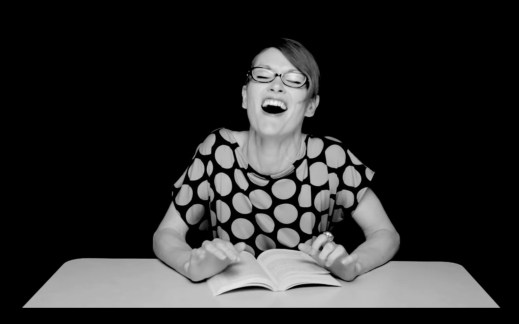
Each video in filmmaker and photographer Clayton Cubitt’s Hysterical Literature series (2012-) – which consists of 11 “sessions” so far – appears deceptively simple. We see a black and white frame with a clothed woman seated at a table, visible from the sternum up, holding a book of her choosing. She announces her name and the title of the book before beginning to read. While reading, the subject generally begins to stumble, the speeding of reading slowing down or speeding up, changes in pitch and emphasis growing more pronounced. Eventually, she is able to read no more and gives in to sighs, groans, or silent, eye-closing paroxysms. When she returns to herself, she announces again her name and the title of the book before the “session” ends.
Despite the consistency of the concept, the 11 “sessions” have been viewed a combined 45 million times, and perhaps much of the appeal of the series is in what it doesn’t show. What we do not see – and indeed do not hear – is the “assistant” beneath the table with an Hitachi Magic Wand physically stimulating the subject. What might have been errors or difficulties in the reading are retroactively understood as evidence of the difficulty of “performing” under the attention of the vibrator.
According to Cubitt, the series’ title and conceit nod at the Victorian-era propensity for naming “unruly” female behavior as “hysterical,” where the cure was often the application of a vibrating device to produce “release.” Female sexuality is therefore the absent center of Hysterical Literature – it is there, but can be disavowed (at least visually), a trend that places it firmly in a culture that has an ambiguous relationship to female pleasure and its sounds.
As John Corbett and Terri Kapsalis note in “Aural Pleasure: The Female Orgasm in Popular Sound,” the sounds of female pleasure are “more viable, less prohibited, and therefore more publically available form of representation than, for instance, the less ambiguous, more easily recognized money shot” that characterizes “hard core” pornography (104). Certainly Hysterical Literature’s home on YouTube would seem to confirm Corbett and Kapsalis’ claim that sounds of female pleasure “occur in places…that would otherwise ban visual pornography” (104).
Indeed, the question of pornography looms over Hysterical Literature, as Cubitt seeks to push on YouTube’s “Community Guidelines” by exhibiting female pleasure sonically (See also Joshua Hudelson for a discussion of sexual fetish and the ASMR community on Youtube). Here the sound of the subject’s voice echoes Linda Williams’s description in Hard Core: Power, Pleasure, and “The Frenzy of the Visible,” where the female voice “may stand as the most prominent signifier of female pleasure” that can stand in for the pleasure we are denied access to visually (123). In this way, the sound of female pleasure is, as Corbett and Kapsalis suggest, always evidentiary (104). For them, a woman’s pleasure may/must be corroborated by her sounds (For an alternative view of gender and sound as it relates to women, see Robin James’ “Gendered Voice and Social Harmony”).
This pleasure calls to mind Roland Barthes, who saw the possibility of bliss and representation as fundamentally incompatible. For Barthes, the “grain” of the voice is a bodily phenomenon, not one of language and signification. For him, “the cinema capture[s] the sound of speech close up…and make[s] us here in their materiality, their sensuality, the breath, the gutturals, the fleshiness of the lips, a whole presence of the human muzzle” (67). This “materiality” has a single purpose: bliss. This bliss doesn’t reside in language, with its representational aims, but in those aspects of the voice that are not ruled the signifier/signified dynamic.
What draws me to these discussions – and their relation to Hysterical Literature – is the almost overwhelming insistence on dichotomy. The visual “evidence” of hard core pornography is juxtaposed to the aural “evidence” of female pleasure. Male pleasure (on the side of the visible) is opposed to female pleasure (on the side of the invisible). Representation is incompatible with “bliss.”
This logic is not confined to discussions of sound, but is echoed in some of the writing on Hysterical Literature as well. In her profile (which included her own “session”), dancer and writer Toni Bentley argues that the series “juxtaposes the realm of words literally atop the realm of the erotic.” In her view, this immediately becomes a conflict: “Who would win the inevitable war? Upper body or lower? Logic or lust? Prefrontal cortex or hypothalamus?” Though her list of oppositions may seem idiosyncratic, she still insists on division before suggesting that what might emerge instead is that they “meld together.”
Bentley is not alone in understanding the videos this way, as other subjects find a clean break between “I am reading” and “I am orgasming” that would suggest a strict dichotomy between, as Barthes would put it, representation and bliss. For Bentley, this is a “literate, and literal, clitoral monologue that renders the Vagina Monologues merely aspirational.” I’m not sure that “monologue” captures the depth of what is happening in each Hysterical Literature session. Cubitt’s goal is to reveal something about his subjects, to use “distraction” as a means for revelation that ultimately removes him from the scene. Indeed, the participation of the vibrator-wielding “assistant” and Cubitt’s status as filmmaker argue that instead of a monologue, the series facilitates what Cubitt calls “a conversation with themselves.”
Though Cubitt and his subjects seek to maintain the division between the subject and her distraction, the series is far more interesting than that dichotomy would suggest. Hysterical Literature is interesting not because it juxtaposes “reading” and “orgasm,” but rather because of the rigor with which it is willing to dwell in between these two (apparently) opposed states. There is no cut, no switch in which a subject goes from reading to not-reading. Every video begins and ends the same way – we open on a woman telling us her name and her book, and end the same way, orgasm over with. In between, however, we have a combination of the book chosen by the subject and her augmented reading. Rather than the sighs and groans that supposedly evidence the subject’s pleasure, the more interesting elements are the sounds of the book transformed. The cadence that slows down, speeds up, gets lost, and must repeat. The drawn out vowels that teeter between a gracefully pronounced word and the abyss of unintelligibility. That the “struggle” will end in orgasms and the loss of speech is less significant than the attempt to maintain a voice in the face of what cannot be denied.
If we grant a gulf between “representation” and “bliss,” Hysterical Literature suggests that such a gulf is a productive place to be.
—
Gordon Sullivan is a PhD candidate at the University of Pittsburgh, currently writing a dissertation on questions of sensation and the political in exploitation films.
—
Featured image taken from “Hysterical Literature: Session Four: Stormy“.
—
 REWIND! . . .If you liked this post, you may also dig:
Echo and the Chorus of Female Machines — AO Roberts
This Is How You Listen: Reading Critically Junot Díaz’s Audiobook — Liana M. Silva
Standing Up, For Jose — Mandie O’Connell
Share this:

Resounding Silence: Learning to Hear the Hysteric’s Voice


This week we are pleased to welcome Guest Editor Karly-Lynne Scott kick off the last Thursday Series that Sounding Out! is running in 2015. Over the last ten months, this stream has reconsidered historical figures from radio preacher Elder Michaux to folklorist Alan Lomax, found new ways to tune in the weird voices in literature from Joseph Conrad to H.P. Lovecraft, and featured unsettled soundscapes from Vancouver to Havana.
All year, our Thursday authors have been challenging sonic archives and remaking historical and contemporary problems. That trend continues with Scott’s exciting work and that of her authors in Hysterical Sound.
— Special Editor Neil Verma.
—
Hysteria, the infamous and now-discredited psychological disorder that was a common diagnosis for women during the 19th century, has important sonic dimensions that have often been overlooked. Indeed, sound holds a prominent place in both the symptoms and treatment of hysteria: from the silence of hysterical aphonia to the hysteric’s vocal ejaculations, from fits triggered by sound to auditory hallucinations, from the hysteric giving up speech to the implementation of the talking cure.
Our four part series Hysterical Sound brings together writers and artists to explore hysteria’s sonic dimensions, as well as its continued legacy and importance for sound studies. In the coming weeks, Gordon Sullivan will consider the video art series Hysterical Literature in relation to a long history of women’s vocalizations serving as aural fetishes of female sexuality for the pleasure of male listeners. Veronica Fitzpatrick will explore the hysterical quality of the horror film soundtrack in its rejection of verbocentrism—the privileging of language and meaning. Finally, John Corbett, Terri Kapsalis and Danny Thompson share an excerpt from their performance art project The Hysterical Alphabet.
Today, I kick off this series with a discussion of what it means to listen to the silence of the hysteric. Looking at Sam Taylor-Johnson’s silent film Hysteria I argue that the hysteric is not mute, rather her vocalizations go unheard because we have tuned them out.
— Guest Editor Karly-Lynne Scott
—
The silence of Sam Taylor-Johnson’s eight-minute film Hysteria announces itself loudly. As the film holds in close-up the face of a woman as she cries and laughs indiscriminately, and with abandon, it is difficult to ignore that the woman’s voice is missing.
Today, Taylor-Johnson is famous for directing feature films like Nowhere Boy (2009) and Fifty Shades of Grey (2015), but she first rose to prominence in 1990s as a fine art photographer, film and video artist creating works like Hysteria. In the film, the image and absent soundtrack function together to conflate the two sonic extremes symptomatic of hysteria: the loss of voice (including dysphonia, aphonia and aphasia), and the sound of hysterical fits, irrepressible yet inarticulate vocal ejaculations—moans, cries, murmurs and screams— that we might call hysterical vocalizations. The resulting silent scream recalls Jean-Martin Charcot’s Iconographie photographique de la Salpêtrière, in particular Plate XV “Onset of the Attack—Scream.”
In this post, I want to consider these two works together, asking not only how they figure the silent hysteric each in its own way, but also how we can ‘learn to listen’ to this silence in both cases.

Plate XV “Début de L’attaque—Cri” (Onset of the Attack—Scream) from Iconographie photographique de la Salpêtrière, public domain
Jean-Martin Charcot was a celebrated nineteenth century French neurologist and professor of pathological anatomy, best known today for his work with hysteria at the Salpêtrière Hospital in Paris. Describing himself as a visuel, or a “man who sees,” Charcot demonstrated little concern for the sounds of hysteria (11). “You see how hysterics shout,” Charcot said, “Much ado about nothing” (53). Focusing on the visual dimensions of hysteric’s symptoms at the expense of her voice, Charcot photographed the physical symptoms of hysteria, creating an archive of still, silent women. Martha Noel Evans tells that Charcot “would have the patients brought into his office and stripped naked; he would observe them, ask them to perform certain movements, stare, meditate, and then have them led out. … he rarely exchanged words with the patients” (20).
As Janet Beizer explains in Ventriloquized Bodies: Narratives of Hysteria in Nineteenth Century France, because the hysteric’s vocalizations were nonverbal they were considered meaningless in themselves. It was deemed necessary for someone to speak for her in order to make sense of her incoherence, to interpret and translate her nonverbal communication into meaningful speech. Medical professionals exhibited a verbocentrism—a bias privileging language and meaning over other types of vocalizations—that not only caused the voice of the hysteric to go unheard, but also led to her being ventriloquized by others, particularly male doctors.
To rectify this history Beizer asserts, “I cannot hope to reintegrate the nineteenth-century hysterical body with its voice; I can only mouth the voicelessness and strive to expose the discourse that spoke in its place” (12). This is precisely the approach taken by Taylor-Johnson’s film. It does not attempt to reintegrate the hysterical body with its voice, a gesture that might function only to further ventriloquize the hysteric. Instead, in removing the soundtrack, it mouths the hysteric’s voicelessness, emphasizing it to the point that it can be heard.
In Iconographie, the stillness of the photographs allows their silence to be easily ignored, not only because we are accustomed to still photography’s absence of sound, but because silence, stillness, and death go hand-in-hand. The living body, however, is never truly silent. For that reason, the uncanniness of the silent, moving body in Taylor-Johnson’s film draws attention to not only the film’s absence of sound, but the silencing of the hysteric.
 .
.
Although Hysteria is without a soundtrack, to say that it is silent misses something crucial. As Michel Chion asserts in The Voice in Cinema what we call silent cinema, films without soundtracks, might be better termed “deaf cinema” (7). “It’s not that the film’s characters were mute,” Chion explains, “but rather that the film was deaf to them” (8). As he explains, spectators watching a film without a soundtrack know that the characters are speaking, even in the absence of sound, because they see them speak. We not only see the woman of Hysteria shout and laugh, scream and cry, but close-ups of her mouth agape make visible the movement of her tongue and pharynx. Thus, although we cannot hear the noise she is making, we see that she is making it. Chion quotes filmmaker Robert Bresson, who speaking to this idea said, “For the characters did in fact talk, only they spoke in a vacuum, no one could hear what they were saying’” (8). It is not that the hysterical woman is silent, but that we, like Charcot, have tuned her out.
Reframing the hysteric’s silence this way, it is no longer she that is deficient for being unable to speak in a meaningful way. Rather, it is we who lack the ability, or willingness, to listen. She screams and shouts, moans and laughs, but her vocalizations are lost on us. What Hysteria makes perceptible through its image-track is that the hysteric is speaking—we cannot hear her because she has been stripped of her voice, as the film has been stripped of its soundtrack, but she is not silent. The film encourages us to learn to perceive vocalizations that have been silenced with our other senses, to recognize and acknowledge their existence even when we cannot hear them. In bringing our attention to the hysteric’s silence Hysteria helps us learn to listen her and, in doing so, reveals that this silence in fact speaks volumes.
—
Karly-Lynne Scott is a Ph.D. candidate in Screen Cultures at Northwestern University. Her dissertation considers pornography in relation to philosophical conceptualizations of the body and the history of sexology. Her work appears or is forthcoming in Porn Studies, In Media Res, and World Picture, where she is an assistant editor.
—
REWIND! . . .If you liked this post, you may also dig:
Vocal Gender and the Gendered Soundscape: At the Intersection of Gender Studies and Sound Studies — Christine Ehrick
Quiet on the Set?: The Artist and the Sound of a Silent Resurgence — April Miller
Eye Candy: The Absence of the Female Voice in Sports Talk Radio — Liana M. Silva
Share this:


Current Top Posts





April 2021

January 2020

November 2019

October 2019

August 2019

April 2014

November 2017

March 2015

December 2017

October 2015
 Sounding Out!
Recent Comments