
Straight Outta Compton . . .Via New York

Sounding Race in Rap Songs explores the production of musical identity in hip hop’s first two decades as a commercial genre. Although I don’t ignore lyrics or visual imagery, my main purpose is to analyze rap music as music, to understand how specific artistic decisions contribute to racial meaning in particular songs. My methods revolve around the study of how producers manipulate breakbeats, also commonly known as “breaks.” Initially understood as short, percussion-heavy passages that appear in many songs recorded in the 1960s and 1970s, breaks have been central to hip hop from the music’s earliest days in the South Bronx when DJs began isolating and looping them on their turntables to the delight of dancers. Since then, producers have tried out new approaches to working with breakbeats: hiring studio musicians to re-record them; programming drum machines to imitate them; and using sampling-sequencing technology to capture and rearrange them.
 Throughout the book, I describe how producers use breaks and give rise to musical-racial codes that can be manipulated to project a variety of identities and attitudes. The following excerpt from the third chapter of Sounding Race, explains how the style of beat making popularized by the New York-based Bomb Squad (Public Enemy’s production team) provided a blueprint for pioneering west coast gangsta rap group N.W.A’s depiction of Compton, California. By layering multiple loops into a dense, cacophonous mix, N.W.A transposed Public Enemy’s “too black, too strong” sound onto the world of Los Angeles’s postindustrial streets.
N.W.A and its former members have been in the news recently thanks to the biopic Straight Outta Compton. Yet one aspect of the group’s development downplayed in the film is the way that its members formulated their identities in relation to east coast rap. In the mid-1980s, New York was the undisputed center of the industry, and its influence on L.A.-based acts is easy to see and hear. Ice Cube’s first group C.I.A. ( Cru’ In Action) used a nasal, hocket style approach to rapping cribbed directly from the Beastie Boys 1986 album License to Ill. And the cover of N.W.A’s first album N.W.A and the Posse, features numerous group members posing with the giant clock necklaces made famous by Public Enemy’s Flavor Flav. In similar fashion, the beat Dr. Dre produced for “Straight Outta Compton” (the title track to their breakout 1988 album) followed the Bomb Squad’s potent formula for signifying militant blackness. —Loren Kajikawa
—
The following is an excerpt from Chapter Three “‘Let Me Ride’: Gangsta Rap’s Drive Into The Popular Mainstream,” of Loren’s Kajikawa’s Sounding Race in Rap Songs, with thanks to The University of California Press. Any notes have been included in the text to conform to Sounding Out!‘s style sheet.
We [Public Enemy] were in Vegas and they [N.W.A.] were on tour with us, and I had just got the vinyl in. That’s what this is all about. Because Run-DMC and LL Cool J gave me energy. And if our energy happened to be transferred to N.W.A., then that’s what this whole thing is for.” Chuck D as quoted in Brian Coleman, Check The Technique: Liner Notes For Hip-Hop Junkies (New York: Villard Books, 2007), 354.
According to Chuck D, Public Enemy’s musical style directly influenced Dre, and he recalls giving the first two copies of It Takes a Nation of Millions To Hold Us Back to Dr. Dre and Eazy-E prior to the album’s official release. The recorded evidence supports Chuck D’s recollection. For many of the tracks on Straight Outta Compton, Dr. Dre seems to have borrowed from the “loops on top of loops” style of Public Enemy’s Bomb Squad.
In fact, when Ice Cube left N.W.A. in 1989, he hoped that Dre would continue to make beats for his solo project. When this proved impossible due to Dre’s contractual obligations to N.W.A., Ice Cube began collaborating with the Public Enemy’s Bomb Squad, which served as the production unit for his album Amerikkka’s Most Wanted (1990). N.W.A.’s breakthrough was finding a way to put a distinctive spin on these influences, and the artistic strategy that they arrived at for their first Ruthless Records release was designed to put themselves on the map—both literally and figuratively.
Rather than shout out the multiplicity of neighborhoods where their members were actually from (as they had done in “Panic Zone”), N.W.A. chose to center their identity around Dr. Dre and Eazy-E’s hometown of Compton, California. The sound of Compton as Dr. Dre imagined it, however, drew on musical practices and artistic decisions similar to those found in Public Enemy’s “Rebel Without a Pause.” To construct the rhythmic foundation of “Straight Outta Compton,” Dre looped the breakbeat from The Winstons’ “Amen Brother” (1969), one of the most sampled beats in hip hop, that also served as the foundation for dozens of songs in the UK’s “jungle” (aka “drum and bass”) genre.

Like other heavily sampled breaks from this era, the one-measure loop features a syncopated interlocking of snare and bass hits that is reminiscent of James Brown’s “Funky Drummer (featuring Clyde Stubblefield’s famous beat). As if he were following the Bomb Squad’s exact formula, Dr. Dre layered a drum machine (Roland TR-808) over this break.

The 808 was programmed to add its characteristic bass boom to the first two drum kicks of the “Amen” loop, and to tick off a 16-count hi-hat pulse with a closing hi-hat clasp on the downbeat of every other measure. The “Amen” break and the two hi-hat parts, provide the rhythmic foundation around which Dr. Dre places numerous other repeating sounds. Two other ingredients stand out in this beat: a guitar ostinato and a low drone on what sounds like a baritone sax or trombone (or perhaps a downwardly pitched sample of another instrument). The guitar ostinato, which plays straight eighth-notes on E-flat except for a one step descent to D-flat on the “and” of every fourth beat, churns out tight 1-measure units of sound.

The horn drone (also on E-flat) has a raw, muddled quality, and casts an ominous cloud over the track.
By combining these layers with the dense percussion track, Dre created a tightly packed funk groove with many sonic similarities to Public Enemy’s Bomb Squad. Like “Rebel Without a Pause,” the track to “Straight Outta Compton” features tight 1-measure loops stacked on top of one another to create a thick and intense groove.

Comparison of layers of looped sound in Public Enemy’s “Rebel Without a Pause” and N.W.A.’s “Straight Outta Compton”
Except for the drone, most of the elements in the track have a punchy feel, full of rhythmic stabs and staccato attacks, including the automatic gunfire that Dre samples to follow Ice Cube’s reference to an AK-47 assault rifle. Due to the “noisiness” of the beat, the way sonic space seems filled to maximum capacity, the members of N.W.A.—similar to Public Enemy’s Chuck D and Flavor Flav—practically yell their verses, as if they must raise their voices in order to be heard over the cacophony. Even before the actual words to “Straight Outta Compton” are digested, the sound of the track and the group’s vocals evoke the palpable tension of imminent conflict, which reinforces the theme of violent confrontation in the song’s lyrics. For the chorus of “Straight Outta Compton,” Dr. Dre strings together a series of samples with rapid-fire precision. The sound of screeching car tires from Davy DMX’s “One for the Treble” is followed by turntable scratching; the scratching leads directly to a choppy sample of the words “City of Compton” from Ronnie Hudson’s “Westcoast Poplock,” which is then followed by more scratching. The whole chain of musical events is deployed over the breakbeat from Funkadelic’s “You’ll Like It Too,” which Dr. Dre splices into the beat just for the chorus. The rapid cutting from one sample to the next exemplifies the “rupture” Tricia Rose identifies as fundamental to hip hop’s post-industrial aesthetic in Black Noise: Rap Music and Black Culture in Contemporary America (39).
Thus, the music and lyrics for “Straight Outta Compton” depict the city as a place of extremes, where things happen fast and change is sudden and complete. It is a place where one is either equipped to deal or left behind. In this way, Dr. Dre exploited the spatial characteristics encoded in Public Enemy’s music to depict Compton as place. The sonic characteristics that animated Public Enemy’s militant blackness were rerouted and effectively transposed onto N.W.A.’s depiction of Los Angeles gangstas.
—
Loren Kajikawa has served on the faculty at the University of Oregon’s School of Music and Dance since 2009. His main area of research and teaching is American music of the twentieth and twenty-first centuries, and he offers a variety of courses in music history, ethnomusicology, and musicology. Kajikawa’s writings have appeared in American Music, Black Music Research Journal, ECHO: a music-centered journal, Journal of the Society for American Music,and Popular Music and Society, among others. His recent book Sounding Race in Rap Songs (University of California, 2015) explores the relationship between rap music’s backing tracks and racial representation.
—
 REWIND! . . .If you liked this post, you may also dig:
“‘I’m on my New York s**t’: Jean Grae’s Sonic Claims on the City”––Liana Silva
Love and Hip Hop: (Re)Gendering The Debate Over Hip Hop Studies–Travis Gosa
Caterpillars and Concrete Roses in a Mad City: Kendrick Lamar’s “Mortal Man” Interview with Tupac Shakur–Regina Bradley
Share this:

Unsettling the World Soundscape Project: Soundscapes of Canada and the Politics of Self-Recognition

 Welcome to Unsettling the World Soundscape Project, a new series in which we critically investigate the output of early acoustic ecology and assess its continuing value for today’s sound studies. The writings and subsequent musical compositions of original WSP members like R. Murray Schafer, Barry Truax, and Hildegard Westerkamp have been the locus of much critical engagement; ubiquitous references to their work often contain tensions born from the need to acknowledge their lasting influence while critiquing the ideologies driving their work. Yet little attention has been paid to the auditory documents produced by the WSP itself as its members experimented their way through the process of developing methodologies for soundscape research. Drawing on the notion of “unsettled listening” that I wrote about here on Sounding Out! last summer, we pay particular attention to issues of cross-cultural representation in the work of the WSP and ask how their successes and failures can inform new investigations into the sonic environments of the world.
— Guest Editor Randolph Jordan
—
In October of 1973, two young sound recordists embarked on an ambitious field trip across Canada, traversing over 7000 kilometers to commit the national soundscape to tape. From St. John’s, Newfoundland to the harbor of Vancouver, British Columbia, Bruce Davis and Peter Huse pointed their microphones at the things they felt best exemplified their vast country.
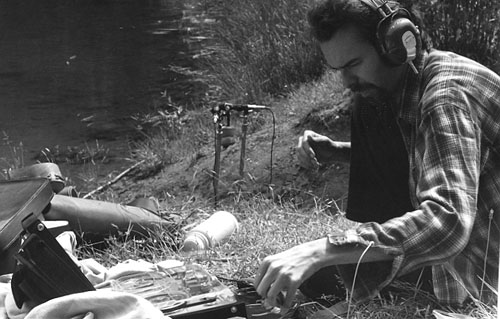
Bruce Davis recording in the field, June 1974
These recordings would become the backbone for Soundscapes of Canada, a series of ten hour-long radio programs carried across the country by the national broadcaster, the CBC. Conceived and produced by the World Soundscape Project (WSP)—a research group formed at Vancouver’s Simon Fraser University in the late 1960s and helmed by the composer and sound theorist, R. Murray Schafer—in its entirety Soundscapes of Canada was an impressively sprawling, eclectic document. Comprised of guided listening exercises and avant-garde sound collages, the program’s stated goal was to open the ears of Canadian listeners to the importance of sonic experience, and to alert them to what they warned was the degradation of the soundscape thanks to the mounting din of industrial modernity.
But there was much more happening out of earshot. Created at a time when Canada’s cultural identity was rapidly changing thanks to an unprecedented swell in immigration from non-European countries, the WSP’s portrait of the nation all but ignored its First Nations and its “visible minorities,” as they would come to be known. While the series was an important statement in the WSP’s larger efforts to bring sound to the forefront of cultural conversation, it is arguably more important to listen to Soundscapes of Canada for what it leaves out, for voices silent and silenced.
For Schafer, the industrialized world had grown measurably louder and qualitatively noisier, which troubled him for both environmental and social reasons. In his 1977 book, The Tuning of the World, Schafer would write, “For some time, I have…believed that the general acoustic environment of a society can be read as an indicator of social conditions which produce it and may tell us much about the trending and evolution of that society” (7). Given the worryingly poor state of the soundscape, for Schafer it followed that society was in bad shape. He was wistful for quieter times, for the days of Goethe, when the cry of the half-blind night watchman of Weimer was within earshot of every one of the town’s inhabitants. Unstated, but implied, here, was the notion that as communities expanded beyond every member’s ability to hear a familiar sound, their common identity would necessarily be eroded. And for Schafer, this was precisely what was happening to Canada.
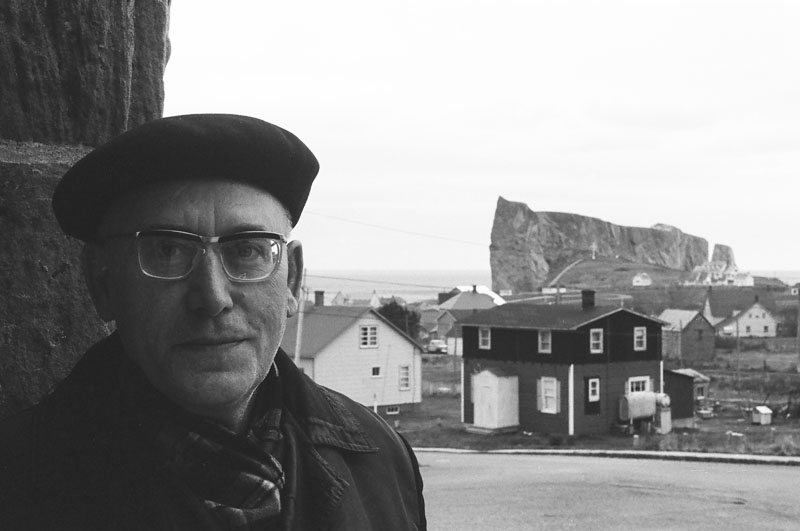
Father Jean Racine, Percé, Québec, 1974
The WSP’s discussion of “soundmarks” in parts three and four of the series was perhaps their most powerful statement about the stakes for preserving and promoting the nation’s sonic heritage. A “soundmark” is, in the WSP’s lexicon of neologisms, roughly analogous to a landmark: it’s a sound that is supposedly instantly recognizable to members of a community, an irreplaceable acoustic feature of a particular place. In the conclusion to program three, “Signals, Soundmarks and Keynotes,” Schafer intoned, “It takes time for a sound to take on rich, symbolic character—a lifetime perhaps, or even centuries. This is why soundmarks should not be tampered with carelessly. Change the soundmarks of a culture and you erase its history and mythology. Myths take many forms. Sounds have a mythology too. Without a mythology, a culture dies.”
So it seems fair to ask: exactly whose mythology stood to be snuffed out? For Schafer, Canadian culture was (or ought to be) synechdochal with the land, with the nation’s vast, largely uninhabited expanses that stretched all the way to the North Pole. Canadians were (or ought to be) a rugged, self-reliant people—stoic pioneers who shunned cosmopolitan (read ethnic) urban centers, opting for a quiet life in harmony with the country’s settler heritage. This was certainly reflected in program four, “Soundmarks of Canada.” Over the course of an hour CBC listeners would have heard an austere montage almost entirely comprised of mechanical alarms (foghorns and air sirens) and church bells. Each sound presented, carefully, discreetly as though displayed in a museum, free from any traffic noise or sidewalk bustle that might distract the listener. Anyone unfamiliar with the Canadian soundscape would be forgiven for coming to the conclusion that the world’s second largest nation was a bastion of early industrial machinery, a sanctuary for quiet, self-reliant, God-fearing folk.
“Soundmarks of Canada” not only omitted the soundmarks of Canadian cities, it also excluded any sonic trace of the country’s vibrant ethnic and First Nations communities. Produced in the years following the passage of the 1971 Multiculturalism Policy of Canada—which had been adopted in response to a boom of immigration from non-European nations—their portrait of a pastoral, post-colonial British outpost shunted the country’s sizeable non-Christian, ethnic population squarely out of earshot. It should also go without saying that the soundmarks they so prized were deeply entangled with a silencing of Canada’s indigenous population; of a protracted, often violent and brutal, campaign of assimilation that replaced one set of sonic practices with another. For generations of Indigenous Canadians, the sounds of church bells would likely not have connoted community or belonging, but would have rather reverberated with echoes of the “reeducation” in settler religion and language that many were forced to endure in Canada’s residential schools—church-run institutions to which countless children were spirited away against their parents and communities’ wishes.

Canada’s First Protestant Church Bell
This is not to say that any of this was intentional, that the WSP deliberately plugged their ears to Canada’s marginal communities, or that they intended to slight these groups in any way. It may be more accurate to ascribe ignorance and omission to the project, structural forms of inequality that dog even the most well meaning white settlers. Regardless of intent, however, the result is the same.
Soundscapes of Canada shows a troubling politics of self-recognition in action that is far too common throughout the nation’s history. By disproportionately representing the voices and sounds of European Canadians the series necessarily supported the idea that they were, if not the only ones, then at least “ordinary” and incumbent. Projects like these promote and condition a sense of unity and similarity that constitute the nation’s imagination of itself. Benedict Anderson famously observed that nations come into being and are maintained through the cultural work that leads its citizens to identify with the state. Institutions and practices from censuses, maps, nationally available print journalism, etc. all allow people in far-off locales to imagine themselves constituting a limited and sovereign community. In his classic book, Imagined Communities, Anderson proposes that nations have also historically been conceived, created, and ratified through sound. Writing specifically of national anthems, Anderson coins the term “unisonance” to describe the power that sound can have to seemingly erode the boundaries between self and other: “How selfless this unisonance feels! If we are aware that others are singing these songs precisely when and as we are, we have no idea who they may be, or even where, out of earshot, they are singing. Nothing connects us all but imagined sound” (149).
It is significant that the WSP chose the radio—the CBC in particular—as the vehicle for their ambitious project. In the mid-1970s, not only did radio offer the widest reach of any sonic medium, but it also had a particular cultural resonance for Canadians. A nation as vast and varied as Canada could have only come about thanks to mediation; its vastness has always required means of traversing or shrinking space to secure its borders, both psychic and geographical. The westward expansion of the post-indigenous nation was accomplished first by canoe, then by rail, and, beginning in the 1920s, by radio. Appropriately, it was the Canadian National Railway (CNR) that produced the first transnational radio broadcast in 1927—the national anthem performed by bells on the carillon of the Peace Tower—broadcasting the event to railway passengers and home listeners alike. Since the middle part of the 20th century, the national broadcaster has been understood as something of a bulwark against encroaching American culture.
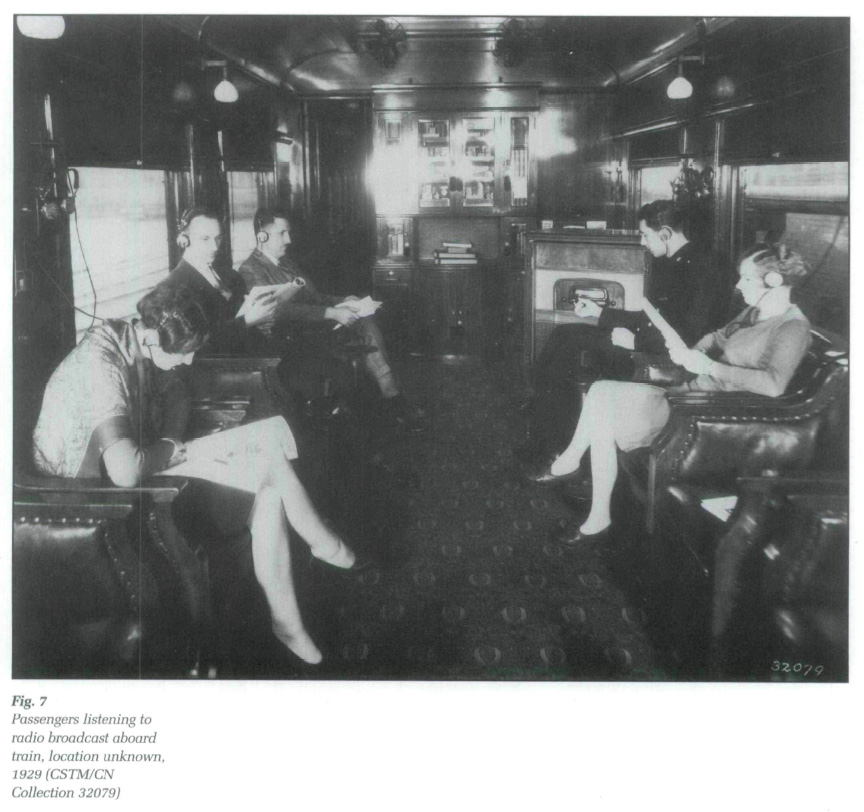
Passengers listening to radio broadcast aboard train, location unknown, 1929
The history of the Canadian airwaves is profoundly mired in struggles to promote, produce, and foster content that might keep the national identity from being completely subsumed under the sprawl and heft of the American culture industry. Schafer had mixed feelings about the medium. On the one hand, he was skeptical of his one-time teacher and mentor, Marshall McLuhan’s, analysis that radio, by its very nature, enfolded listeners in a shared acoustic space, effectively “retribalizing” society. Schafer felt that the airwaves had been packed to such a dense and frenetic level that they actually created “sound walls” that effectively isolated listeners in their own solipsistic, acoustic bubbles. But there was hope for the radio in that it could also facilitate a return to a more wholesome and connected state of being and of listening. Schafer noted this duality in his essay “Radical Radio,” writing, “If modern radio overstimulates, natural rhythms could help put mental and physical well-being back in our blood. Radio may, in fact, be the best medium for accomplishing this” (209). Sonic technology was a source of ambivalence for Schafer; he coined the term “schizophonia” to describe the separation of sound from source that recording effected. He believed that it was problematic to populate the world with copies he deemed inherently inferior to the “original” sonic event. Given the opportunity to reach such a wide swath of the Canadian public, Schafer swallowed his distaste for the schizophonic medium and offered a sonic missive on how to compose a healthy and prosperous nation.
Forty years on, Soundscapes of Canada still stands as a unique experiment in imagining how to build and maintain a nation through sound. But in the same regard it also serves as a troubling reminder of how sonic media can work to occlude the voices of marginal citizens, thereby preventing them from fully finding the place in the national soundscape, simply by ignoring their soundmarks and aural practices. If a nation needs a myth, it can do better than telling stories about the necessity of shoring up a colonial legacy whose time has come.
Readers interested in listening to the full series can stream all ten episodes through the website of the Canadian Music Centre.
—
Mitchell Akiyama is a Toronto-based scholar, composer, and artist. His eclectic body of work includes writings about plants, animals, cities, and sound art; scores for film and dance; and objects and installations that trouble received ideas about perception and sensory experience. Akiyama recently completed his Ph.D. in communications at McGill University. His doctoral work offers a critical history of sound recording in the field and examines an eclectic range of subjects, from ethnographers recording folksongs in southern American penal work camps to biologists trying determine whether or not animals have language to the political valences of sound art practices.
—
Featured image: “Toronto” by Flickr user Kristel Jax. All other images via the author.
—
REWIND! . . .If you liked this post, you may also dig:
À qui la rue?: On Mégaphone and Motreal’s Noisy Public Sphere — Lilian Radovac
Sounding Out! Podcast Episode #7: Celebrate World Listening Day with the World Listening Project — Liana M. Silva
Within a Grain of Sand: Our Sonic Environment and Some of Its Shapers — Maile Colbert
Share this:


Current Top Posts





April 2021

January 2020

November 2019

October 2019

August 2019

April 2014

November 2017

March 2015

December 2017

October 2015
 Sounding Out!
Recent Comments