
Sound Designing Motherhood: Irene Lusztig & Maile Colbert Open The Motherhood Archives

A Conversation Article in Chat with Irene Lusztig, Director of The Motherhood Archives and Sound Designer Maile Colbert
In 2011 filmmaker Irene Lusztig contacted me about designing sound and composing for her film project, The Motherhood Archives.
Irene had spent several years buying discarded educational films on eBay and working in historical archives to amass an unusual and fascinating collection of archival films aimed at teaching women how to be pregnant, give birth, and look after babies. The Motherhood Archives uses this extraordinary archival treasure trove to form a lyrical essay film excavating hidden histories of childbirth in the twentieth century, illuminating our changing narratives of maternal success and failure, and raising questions about our social and historical constructions of motherhood.
I was immediately intrigued by her concept and construction process as well as her desire to work with sound design in a very collaborative manner at an earlier stage in the project than most filmmakers would. Geographically distant, Irene and I mostly worked by “satellite,” using email, chat, Skype, phone, and file sharing software to communicate and send files. We did manage to have a few production weeks in New York and Santa Cruz, but the majority of the work was woven back and forth across an ocean and continent…California to Lisbon, Portugal, West Coast to West Coast. Rather than hindering, this method lent itself to an exquisite corpse nature to the work. In the creation of this article we followed much the same process, using an initial Gmail chat.
Maile Colbert (MC): So, I’m both shy and excited about asking this… why me, Irene?
Irene Lusztig (IL): I had heard your work in both Adele Horne’s film [The Tailenders, 2005] and Rebecca Baron’s [How Little We Know of Our Neighbors, 2005], both films with beautiful sound.
.
The sound in How Little We Know of Our Neighbors in particular does something with natural / unnatural that I was really interested in – field recordings that somehow become other kinds of things as they are layered, transformed, and processed. I think of myself as a documentary maker / artist who is invested in actuality, but not very invested in traditional documentary form, and I think your sound has similar investments and disinvestments. It begins with the sounds of the real world but takes those sounds to very unexpected places that are often quite far from their original context.
.
MC: I love that you brought up the “natural/unnatural.” It not only really describes well my work and approach in general, but also the experience we get in your film with mediated motherhood. We would often talk about certain sections being very science fiction…then you think, wow, this really happened, this is part of a history that led up to our experience now, and one I’m currently having, having recently become pregnant for the first time!
IL: I think there is a lot to say about science fiction and sound! First, there is a great tradition of feminist science fiction that I feel like our work is very connected to: Margaret Atwood, Ursula Le Guin, and even stuff like Shulamith Firestone’s futuristic vision of external uteruses. A lot of that work has in common a willingness to “make strange” or denaturalize aspects of female reproduction and mothering in ways that feel radical.
MC: I’m not sure if I was able to contain my excitement when you first mentioned a section felt sci-fi to you. This is something that I think has a root back in my childhood. My father was and is an obsessive science fiction film watcher: I grew up with a soundtrack of The Day the Earth Stood Still and Lost in Space. These soundscapes that “weren’t” became such a part of what I wanted to listen to.
.
IL: I always thought I had no interest in science fiction when I was younger, but I think growing a human inside my own body probably shifted my relationship to that!
I think science fiction is almost always expressing our anxieties about the future, about our technologies, about things that we struggle to control. And of course questions and anxieties about trying and failing to control things are completely at the heart of our experiences with pregnancy, birth, and learning to be new mothers in the 21st century. As are questions around technological mediations that we feel ambivalent about, whether it’s fertility technologies, medicalized birth technologies, or things like baby monitors or worrying about whether the iPad is rewiring your baby’s brain. So science fiction feels like a sonic space that totally makes sense for negotiating these maternal anxieties.
MC: One of our biggest struggles was trying to make sure things weren’t too dark for the audience.
IL: People often respond with anxiety to the film and its sound design. I’ve never before made a film where the sound comes up so often in post-screening discussions, and generally the question is something like “why is the sound so dark / scary / anxiety-provoking?” It seems very specific to the subject of The Motherhood Archives – how anxious we are societally about the whole topic, and also how uncomfortable we are being open about these anxieties.
MC: I’m still shocked at how shocked I am when I realize how some people react to this film, how uncomfortable they are. U.S. society seems just as afraid of birth as death in this manner! We speak of each in such a similar way and we’re not allowed the complexity of, for example, being simultaneously anxious about how this will affect our careers and identity, and how in love we are when we hear that heartbeat!
IL: Do you think of yourself as a feminist artist? I ask because becoming a mother (and making art about motherhood) has made me much more aware of myself as a feminist artist.
MC: I absolutely consider myself a feminist– it’s woven into every part of my life and my work. I’m also beginning to feel this in a new way with the pregnancy: I recently lost a gig I was really looking forward to because there was an assumption that I couldn’t do it somehow because I was pregnant. A recent interviewer asked me about how I navigate motherhood and my work, and I couldn’t help consider that this question would never come up with a male artist.

My recent recordings of my future daughter growing and moving have been wonderful to listen to: watery and subdued, you still feel like you’re only getting a little of her sonic world, so mysterious. But it reminds me of when I was a child – in any body of water I loved to dive down to the bottom, let go of my breath and just rest there as long as I could…it was an ultimate peace. I loved the visual perspective of the world above me, but most loved the deep gentle filter of everything aural coming through this watery world. Some might argue that peace refers to our first soundscape experienced…and listening to my own active womb, it doesn’t seem far-fetched.
IL: There are a lot of watery sounds in the film! My friend Irene Gustafson made this great connection between all the water in the soundtrack and the voiceover passage in the twilight sleep section about how the “soothing sound of running water muffles newborn cries to prevent the formation of what are called islands of memory.” That description of water literally being used to erase memory allows all the water sounds throughout the film to become a metaphor for the erasure of historical memory… the fact that we no longer remember the historical moment where feminists were advocates for anesthetic drugs and medicalized childbirth, for instance…the many ways that the histories in the film are now forgotten.
.
MC: I think sounds are like cells in a way…they carry a memory, even though abstracted.
That’s why I love working with natural sources initially, something comes through from that palette, a shadow is carried from its initial source. As animals, we use sound for information, much processing and translation happens that we aren’t even aware of. So I do feel like when a sound is removed by processing, it still carries its source information with it, and we pick up on some of that.
IL: Talking about cellular memory makes me think about the section of the film that a friend described as “crispy cells:” the image is from a very early 20th century educational film about reproduction – sheep cells that are dividing and reproducing – and the sound is the sound of the magnetosphere, which I love!
.
MC: I find listening to the magnetosphere sort of grounds me. I use a VLF recorder very often when I travel. If there are lightening storms or space weather, like solar storms, you get these very beautiful and strange soundscapes. I often use the recordings in my work, but your film is the first that seemed to demand them as a sound source! That section just called out for them, in their “pure” form. When you placed them there and sent it to me, I was blown away…it seemed like that was the sound of the video itself somehow.
I’ve been collecting and working on my sound library for over a decade now, and I’ve never been in a situation where a client or collaborator was interested in it in such a hands-on way. It seemed so right to share it with you and build upon it together for this project. For each sound – some of them going way back – I still remember the source, recording conditions, what was surrounding it (or rather what it was surrounding usually!). They become symbols, but also memory triggers. Now some of them have changed and were saved with this project, so there are generations as well. And the historic archival sounds you added to it…they come with their own history and memory; your film and their use is then added to that.
IL: Speaking of archival sound, one of the most amazing (to me) moments in our collaboration was really close to the end when you sent me the end credit sound. We’ve actually never talked about this because as soon as you sent it I totally intuitively and immediately knew that it was perfect. The sound is a backwards transformation of the wax cylinder Chopin Waltz recording that is used earlier in the film during the pregnant ballet sequence. There’s something so brilliant about your instinct to bring back that very polite, restrained music at the end, but have it reversed – both because it turns something familiar and half-remembered on its head, but also because I think it says something about history that is so attuned to the way the film works. The film thinks about histories of childbirth, but the chronological structure is circular, not linear – which I think of as a kind of challenge to the conventional forward-marching progress narrative. History is always haunting the present, and history is always circular. It makes amazing and beautiful sense that this music that we’ve heard before returns at the end in this uncanny backwards form.
—
Maile Colbert is a multi-media artist with a concentration on sound and video who relocated from Los Angeles, US to Lisbon, Portugal. She is a regular writer for Sounding Out!
—
 REWIND! . . .If you liked this post, you may also dig:
Wayback Sound Machine: Sound Through Time, Space, and Place— Maile Colbert
Sounds Like a Baby— Liana Silva-Ford
Playing with Bits, Pieces, and Lightning Bolts: An Interview with Sound Artist Andrea Parkins— Maile Colbert
Share this:

A Tribe Called Red Remixes Sonic Stereotypes


Welcome back to “The Wobble Continuum,” a three part series here on Sounding Out!. When we last left you, Mike D’Errico had brought us to the intersection of patriarchal cultural norms, music production practices and aesthetics, and the Military Entertainment Complex. His particular focus was on the sounds and practices of brostep (be sure to check out D’Errico’s SO! Comment Klatsch from last week on gendered sounds, too), and some of those sounds leak through to today’s post from Christina Giacona. Giacona turns her ear to the group A Tribe Called Red in order to hear how they reappropriate and redress the sounds of colonization and racism.
As the series’ title suggests, her essay entails another journey to the low end, where things will once again get wobbly.
Guest Editor Justin D. Burton
—
Since first contact, Native Americans have consistently needed to combat the European stereotypes that portray them as inferior and uncivilized. Barraged with echoes of the same handful of Native tropes since Buffalo Bill’s Wild West Shows, contemporary American society often treats the stereotypical Native American princess, chief, and savage as historical truths, represented recently in Johnny Depp’s portrayal of Tonto in The Lone Ranger. But it is not just the visual image of the Native American that has been stereotyped, so has their sonic sensibility. As documented in the film Reel Injun, Native languages and musics have consistently been “faked” by Hollywood with tricks like backwards English, pig-Latin, and Westernized imaginings of a ubiquitous Native music based on a pan-Indian society that never actually existed. Hollywood often uses Native American music to show a “primitive” society where music’s sole function is to prepare for war. However, the “Indian” drumbeat that accents the first beat of a group of four cannot be found in any traditional Native American or Aboriginal music.
While Native American-directed motion pictures such as Smoke Signals, Powwow Highway, and Atanarjuat: The Fast Runner finally gave agency to Natives in film, it was the all-Native DJ collective A Tribe Called Red’s self-released album and popularization of the Electric Powwow that directly challenges the perception of Native American music in modern society. In this post, I analyze the sonic composition of ATCR’s song “Braves,” exploring how A Tribe Called Red challenges North American stereotypes of Native Americans through the cultural re-appropriation of racist sounds.

“A Tribe Called Red – Hall 4 (1)” by Flickr user Trans Musicales, CC BY-NC 2.0
After World War I, intertribal powwow gatherings served as a place to celebrate newfound unity among Native Nations returning home from the war. By the 1950s intertribal powwows had spread throughout North America. With the continued strength and importance of the powwow in contemporary Native society, urban Natives in locations like New York City and Ottawa, Canada, have begun to search for ways to create the same sense of unity in urban venues. In 2008, DJs NDN and Bear Witness formed the DJ collective “A Tribe Called Red” and began curating performances in Ottawa the second Saturday of every month called the Electric Powwow: a “wild party” focused on showcasing native talent and aboriginal culture. ATCR’s website describe the music as “ the soundtrack to the contemporary evolution of the powwow.“ Bear elaborates in an interview with NOW magazine, “[the Electric Powwow] was also about creating a space for our community within the club environment.” Hip-hop DJ and turntable champ DJ Shub was invited to join the group in 2010, and the trio spent the next two years evolving the sound of the Electric Powwow into a mash-up of powwow and First Nations music with contemporary club sounds including hip-hop, dubstep, and dance hall.

“Tribe Called Red” by Flickr user Dav Yaginuma, CC BY-NC-SA 2.0
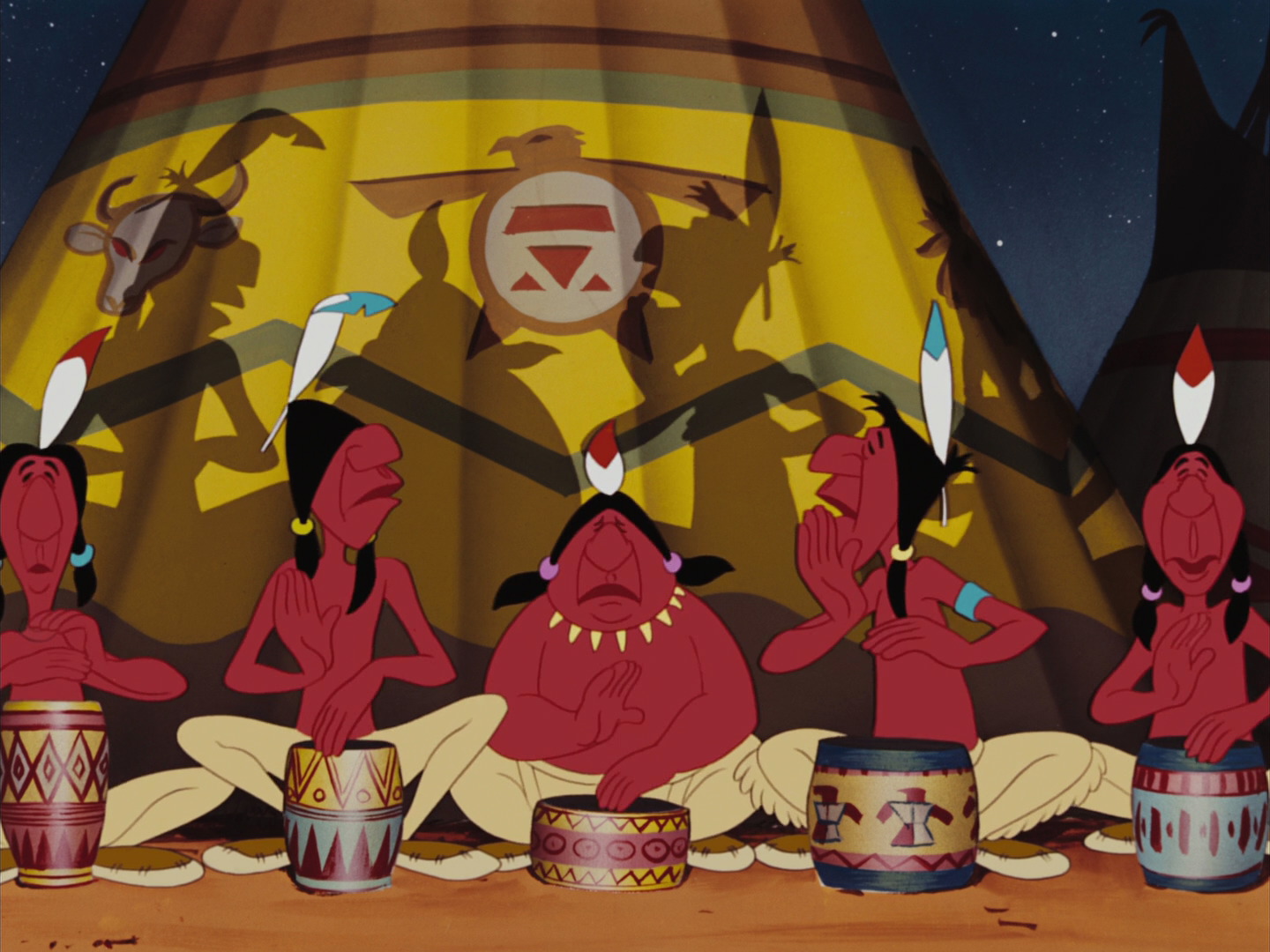
Much like Fela Kuti’s popularization of Afrobeat in the 1970s, made up of a combination of traditional Nigerian Yoruba polyrhythms with a blend of Western jazz and funk, and Reggaeton’s fusion of Caribbean rhythms with the aesthetics of American hip-hop in the 1990s, the Electric Powwow merges a historically traditional and non-syncretic music with popular and cosmopolitan music in a way that both honors cultural heritage and makes it relevant to a new generation. As NDN points out on Noisey, even their name follows this trend, simultaneously referencing the introduction of Nations at powwows and famous Afrocentric hip-hop group A Tribe Called Quest. The Electric Powwow events are not just about the creation of a new genre of music, but they also serve as a site for ATCR to speak publicly about aboriginal issues and represent themselves as a contemporary face for the urban Native youth renaissance. ATCR’s music videos and live-show projections extensively sample racist imagery from movies and cartoons including old westerns, Back to the Future III, Bugs Bunny, and Disney’s Peter Pan. As a result of their audio-visual activism, the group has become the unofficial soundtrack for the Idle No More movement, which is attempting to reassert Indigenous sovereignty rights and previously signed treaties in Canada.
By taking both visual and sonic symbols that depict racist stereotypes out of their cultural contexts, ATCR draws attention to both the specific racism of each individual image and the ubiquity of racist stereotypes. In their track “Braves,” A Tribe Called Red takes on the U.S. baseball team the Atlanta Braves by remixing the baseball organization’s Tomahawk Chop anthem, itself adopted from Florida State University.
ATCR’s version transforms the innocuous-sounding chant by showcasing its core as a Hollywood-esque stereotype of Native American song. By re-contextualizing the anthem, “Braves” prompts listeners to reinterpret this facet of American sports culture as a racist pageantry of “savage violence.”
The association of the “war chant,” the motion of the Tomahawk Chop, and the fact that these actions call for one team to attack all make it clear that American sports culture appropriates Native Culture as an example of “savagery” and “uncivilized” behavior. The Tomahawk Chop also forgoes the use of a language-based text entirely and instead chooses to use vocables that cannot be attributed to any particular Native nation, ceremony, or meaning. Like Hollywood’s use of backwards English and the war drumbeat to represent “Indians,” the Tomahawk Chop bears no resemblance to any real Native Nation’s music, acting as yet another imagined primitive stereotype that marginalizes actual Native American music.
On A Tribe Called Red’s SoundCloud page, “Braves”’s description reads, “We wanted to make a song for all the racist and culturally inappropriate sports teams that are still used today!” The group accomplishes this by creating dissonance between contemporary electronic drumbeats and the “traditional” paramilitary marching band arrangement of the “Tomahawk Chop.” “Braves” utilizes a standard dubstep song structure in 4/4 at 140 beats per minute that includes an intro, two main sections that include melodic materials, a breakdown/buildup section, a vocal “drop” which announces and is followed by the climax of the piece, and an outro that brings the track to a close. However, “Braves” does differ from other dubstep songs in the marked separation and interaction between the Tomahawk Chop samples performed by voices and marching band and the composed elements of the song performed as the Wub—a deep, wobbly synthesized sound—and accompanied by a HiHat cymbal pecking away at syncopated rhythms. Even though all the melodic content of “Braves” is based on variations of the Tomahawk Chop melody, ATCR never fully integrates actual samples of the Tomahawk Chop into the composition. The marching band and chant samples are treated as an unwanted and unexpected visitor to a party; they seem important at the entrance, but they are given an increasingly diminished role until they finally exit with a whimper.
Written as a protest against racist sports organizations to help convince them to stop using characterized ceremonies and mascots, “Braves” contains that struggle within the composition itself: dubstep, sounded as the Wub and HiHat, eventually renders the Tomahawk Chop sonically impotent. The “Tribe” drop, when ATCR marks the song by saying “tribe,” acts as the turning point in “Braves.” After this point the Wub and HiHat consistently overwhelm the sampled material. In a standard dubstep song, the tribe drop would be followed by the climax: the strongest, most complex musical section of the piece. However, the Tomahawk Chop sample that follows this drop is immediately swallowed up by a low-pass filter that rubs out the tune, starting with the highest pitched sounds, over the course of sixteen measures, heightening the lower end of the sonic spectrum. Only then does the true climax occur. The Wub and HiHat appear here for the first time without the sample band or vocalizations. After the “Tribe” drop, the samples of the Tomahawk Chop are either dominated by the Wub or swallowed up by low-pass filters and fades.

“Tomahawk” by Flickr user Lorianne DiSabato, CC BY-NC-ND 2.0
In this way, “Braves” acts as a three-minute sonic story of reappropriation. The marching band arrangement and vocables represent the common stereotypes of Native American music perpetuated by Western Culture. The Wub and HiHat act as disapproving commentary on these stereotypes. “Tribe,” the only word used in the entire song, not only sounds ATCR as a group, but also marks the point in the song when ATCR begins to create their own image of Native music while simultaneously disempowering the strength of the marching band.
Just like the rebel American marching band’s reappropriation of the song Yankee Doodle in the Revolutionary War, A Tribe Called Red employs irony: in order to get the song the audience has to understand the racism, and while that sort of understanding seems to represent a steep learning curve for a culture so saturated in racist stereotypes, it is also exactly the sort of understanding a multicultural nation needs in order to thrive. Like Afrobeat, Reggaeton, and the more recent alternative hip-hop group Das Racist, ATCR is an underground voice within American popular culture that speaks with reverence for its own traditions while challenging the popular perception of race relations and breaking new ground in contemporary art. “Braves” proves that the reappropriation of sonic space is a powerful tool in the fight for cultural agency.
—
Featured image: “ATCR 4” by Flickr user MadameChoCho, CC BY-NC-SA 2.0
—
Christina Giacona is the Director of the Los Angeles New Music Ensemble and Instructor of Music at the University of Oklahoma. Dedicated to performing and researching the music of her generation, Christina teaches courses in Native American, World, and Popular Music. Since founding the Los Angeles New Music Ensemble in 2007, Christina has commissioned and premiered over twenty new works for the ensemble; run an international composers competition, recorded three albums, and collaborated with DJs, MCs, animators, choreographers, projectionists, and film producers.
—
 REWIND!…If you liked this post, you may also dig:
“One Nation Under a Groove?: Music, Sonic Borders, and the Politics of Vibration”-Marcus Boon
“Live Electronic Performance: Theory and Practice”-Primus Luta
“Remixing Girl Talk: The Poetics and Aesthetics of Mashups”-Aram Sinnreich
Share this:




Current Top Posts





April 2021

January 2020

November 2019

October 2019

August 2019

April 2014

November 2017

March 2015

December 2017

October 2015
 Sounding Out!


Recent Comments