
Norman Corwin: Radio at the Intersection of Art and Commerce
 Editor’s Note: Today, Shawn VanCour continues our summer series “Tune In to the Past,” which explores the life and legacy of radio broadcaster Norman Lewis Corwin, the “poet laureate of radio” who died last summer at the age of 101. Sounding Out!‘s three-part exploration of his legacy by radio scholars Neil Verma (June), VanCour (July), and Alex Russo (August) not only gives Corwin’s work new life (and critique), but also speaks to the growing vitality of radio studies itself. And now, a word from our sponsor, Shawn VanCour.–JSA
—
An experiment in radio is something nobody ever tries except strange people with a funny look. Good businessmen know better than to try experiments . . . . on account of you can’t play too safe when it comes to trying out new things.
–Unaired passage from script for “Radio Primer,” Twenty-Six by Corwin, May 4, 1941
The story of Norman Corwin is by now a familiar one: joining such illustrious figures as Irving Reis, William Robson, and Orson Welles, Corwin led a new generation of sound artists in developing pioneering techniques of radio drama that exploited the medium’s potential as a “theater of the mind” and inaugurated the celebrated “Golden Age” of network broadcasting. In death as in life, Corwin has been much praised for these contributions, and for his signature style so eloquently analyzed by Neil Verma in the opening volley of this SO! series.
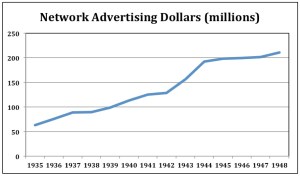
Advertising dollars spent on network radio programming from 1935-1948, based on data compiled in the 2002 edition of Christopher Sterling and John Kittross’s Stay Tuned: A History of American Broadcasting. Advertiser investment climbed sharply, spurred by a corresponding growth in network affiliates.
However, as Erik Barnouw notes in his preface to LeRoy Bannerman’s biography of this broadcasting legend, Corwin’s story is also bound up with a larger economic history of radio, unfolding during a period of intensified growth in and controversy surrounding commercial broadcasting. From Corwin’s first show for CBS in 1938 to his last network broadcast in 1947, the percentage of affiliated stations in the country grew from 52 to 97, while investment by commercial advertisers more than doubled. To answer critics of commercialism and give its network signs of distinction, CBS dramatically increased its public service commitments (what David Goodman refers to as “radio’s civic ambition”), investing heavily in “sustaining” (unsponsored) shows that gave producers like Corwin room for unprecedented aesthetic experimentation.
This second, institutional dimension of Corwin’s story warrants further consideration. Observing the Marxist adage that history is made by individuals not in conditions of their own making, I propose that assessing Corwin’s legacy for radio and sound studies demands we attend not only to the what of that legacy–the techniques Corwin pioneered and programs he produced–but also to its how and why: the institutional context that spawned and encouraged these aesthetic innovations. How, in other words, did commercial concerns at the structural level shape and enable the rise of the “Corwinesque” as a viable mode of sonic expression? What peculiar set of economic relations undergirded these grand experiments in twentieth century sound art, and what lessons might this period offer for understanding creativity and aesthetic innovation in subsequent eras such as our own?
Sounds of Commerce
Corwin’s 1941 play, “A Soliloquy to Balance the Budget,” opened with the sounds of an adding machine and voice of a “soliloquist” tabulating the cost of each musical note and on-air gag. Such is the secret soundtrack of every broadcast since commercial radio’s inception, as one of the past century’s largest and most successful industries dedicated to the business of packaging and selling sounds for corporate profit.
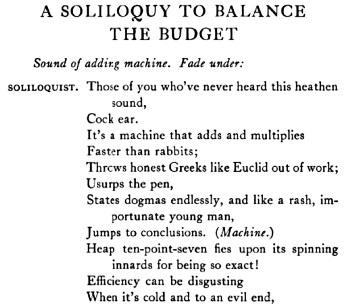
Excerpt from script for “A Soliloquy to Balance the Budget,” broadcast on CBS’s Twenty-Six by Corwin series, June 15, 1941.
Rather than seeing the flowering of the Corwinesque as a brief but “golden” reprieve from an otherwise dark history of commercial mediocrity, I propose we use the case of Corwin to critically interrogate presumed antipathies between opposing forces of art and commerce in U.S. broadcasting, and seemingly intractable tensions between competing goals of public service and corporate profit. Might we see in Corwin, instead, an instance where concerns with profit margins in fact facilitated aesthetic innovation, and where goals of public service and commercial success entered into strategic (if temporary) alignment?
This perspective is by no means intended as a neoliberal apologia for the commercial system. Yet, at the same time, the modes of aesthetic experimentation in which Corwin engaged were never so antithetical to run-of-the-mill commercial forms as traditional histories have implied. Corwin contributed to both sustaining and commercial programs, and the techniques he developed were eagerly copied by radio ad-writers. Moreover, public service programming for CBS was no mere loss leader, but rather offered opportunities for financial profit both in its own right and as part of a larger system of coordinated transmedia flows. Listening for the sounds of commerce in these programs demands a more sophisticated grasp of industry economics than the reductive binaries of traditional histories allow, beginning with an interrogation of the Romantic ideology of art on which those binaries rest.
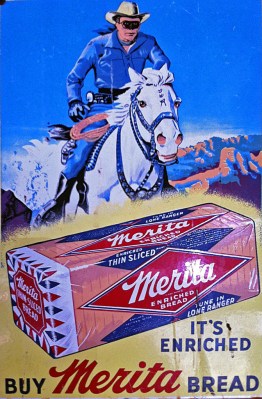
Merita was a longtime sponsor of The Lone Ranger on radio and television beginning in 1938. Image by Flickr user Jeffrey.
De-Romanticizing Radio Art
Unlike other radio greats such as Robson and Welles who worked extensively on commercial series, what distinguishes Corwin in traditional accounts is his alignment with a protected sphere of noncommercial programming. Hired by CBS to work on sustaining series such as the Columbia Workshop, Corwin was celebrated by contemporaries like Richard Goggin as “pleasantly isolated from ‘commercial’ broadcasting,” with its “struggle for sales and maximum audiences” (63-4). His official biographer similarly praised him as an artist who “flourish[ed] in a freedom of ‘sustaining’ programming [that was] the hallmark of the Golden Age” and “refused to forsake this liberty for commercial earnings, although corporations clamored for his talent” (5).
Corwin himself directly contributed to this anti-corporate mythos. In a 1944 book on radio writing, he advised those aspiring to work in radio to “Do the opposite of what a sponsor or an agency executive tells you, if you want to write originally and creatively” (53), while including regular jabs at network and advertising executives in scripts for sustaining shows such as his “Radio Primer” or “Soliloquy to Balance the Budget.” But by 1947, Bannerman explains, “the contest for higher ratings” had won out, and Corwin exited the network arena for greener pastures and a new job with the United Nations (10). In a 1951 article for The Writer, Corwin now recommended that “the writer who wants to do the best work in his power, in defiance of formula,” simply “forget radio,” and “until such time as [it] returns to a constructive attitude toward public service and the esthetic values in writing, look upon [it] as a trade outlet, not an art” (1, 3).
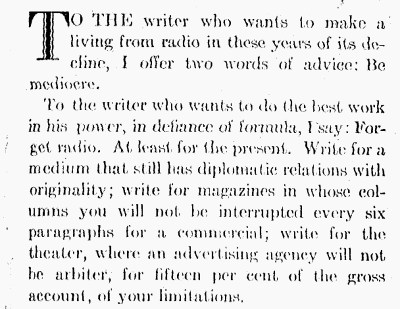
Opening lines of February 1951 essay by Corwin for The Writer, in which aspiring writers who wish to exercise their creative freedom are advised to “forget radio” and look elsewhere.
Setting aside the dubious merit of a narrative that denies any real aesthetic achievements for the 15 years preceding and 65 years following Corwin’s ten-year run in network radio–the apogee of a tragically brief “Golden Age”–we may recognize the conception of creativity espoused here as a distinctly Romantic one. Within this view, so-called “true art” flouts the rules and formulas on which commercially driven mass art depends, and is pursued for purposes other than financial gain. This Romantic ideology of art has been repeatedly challenged, from earlier work by M. H. Abrams, to more recent critiques by Noel Carroll and R. Keith Sawyer. My own concern is not with its veracity per se, but rather with the historical exclusions needed to sustain its underlying binaries of art/commerce and public service/commercialism vis-à-vis the work of Norman Corwin. These exclusions (acts of forgetting on which remembrances of Corwin’s legacy are grounded) may be grouped into three basic categories: the selective operations of canon-formation, cross-fertilization of techniques in commercial and sustaining programming, and profitability of public service within the CBS business model.
Canon-Formation
The received view immediately works to remove Corwin from the sphere of commercial programming, marginalizing his contributions to sponsored series such as the Cresta Blanca Carnival—whose ad agency Corwin himself commended for checking the customary “fear of anything suggesting artistic endeavor” (402)—or Dupont’s Cavalcade of America, for which he wrote his “Ann Rutledge” play, better known from its later revival on the Columbia Workshop. So, too, does it single out among his many production credits a comparatively small list of broadcasts for which he wrote his own scripts, while limiting its purview to his radio works at the expense of his contributions to other media. (For a comprehensive list of Corwin’s creative works, including his many commercial film and television productions, see the appendix in this volume.) As with all processes of canon-formation–a crucial component of what Michel Foucault calls the “author-function”–bids for Corwin’s artistry thus entail a series of selective filtering operations. The totality of the individual’s creative labor is negated within a synecdochical logic of “best” works that renders the exceptional as typical and relegates the typical to the realm of historical oblivion. What other “Corwins” might further scrutiny reveal?
Cross-Fertilization
Efforts to preserve the purity of Corwin’s art by maintaining its opposition to and inherent tension with commercial broadcasting also ignore the extent to which the advertising industry itself embraced Corwin’s techniques. In 1942, trade magazine Broadcasting reported with much clamor Corwin’s acceptance of a bronze medal at New York’s Annual Advertising Awards Dinner, given to honor an “individual, who by contemporary service has added to the knowledge or technique of radio advertising” (22). Authors of popular radio writing manuals noted, in particular, the impact of Corwin’s technique of “choral speech,” which Barnouw in his 1945 Radio Drama in Action claimed was “so successful with listeners that . . . producers of dramatized commercials . . . [now] use [it] for spot announcements to sell soap flakes” (204-5).
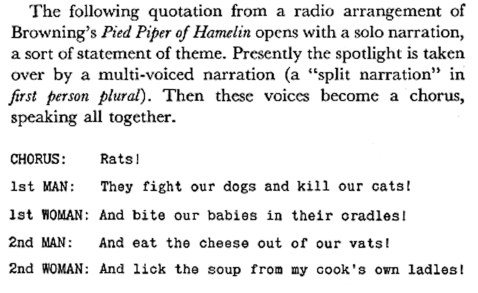
Example of choral speech from script for episode of Corwin’s 1938-39 Words Without Music, reproduced in Barnouw’s 1939 Handbook of Radio Writing
Choral Speech in ad for Ajax household cleanser, late 1940s
Omitted from later accounts, such lost tales of cross-fertilization suggest not simply blind spots in the received view, but a fundamental abnegation: the separation of art and commerce as much an achievement of historical memory as historical fact.
Profitability of Public Service
Positioning the art of Corwin in contradistinction to growing tendencies toward commercialism also ignores the tremendous profitability of public service programming within CBS’s business model, both in its own right and as part of a system of carefully coordinated, cross-platform media flows. As Barnouw notes in Vol. 2 his 1968 History of Broadcasting series, CBS ramped up its investment in sustaining programming during the 1930s as part of a race with NBC to attract affiliates and expand its national network. Whereas NBC charged affiliates for sustaining shows to defray production costs, CBS provided stations with sustaining programs at no charge in exchange for guaranteed carriage of its sponsored series. (NBC stations, by contrast, were given right of refusal for any sponsored shows they wished to opt out of.) For CBS, sustaining shows presented not a financial burden but a path to commercial profitability. Attracting stations eager for free “quality” programming, the network drew fresh revenue in membership fees for each new affiliate it added. Eager to capitalize on these expanded economies of scale and willing to pay the corresponding ad rates, sponsors in turn flocked to the network, giving CBS valuable new accounts and further revenue boosts.
Recognizing their economic value, CBS heavily promoted sustaining stars like Corwin as talented auteurs who represented the network at its best, while working to parlay their products across multiple media platforms. In a 1942 Broadcasting ad promoting Corwin’s newly published script collection, Thirteen by Corwin, the network highlighted his artistry while tracing its corporate signature into his own, reminding readers that these plays were “written and produced under the sponsorship of the Columbia Broadcasting System,” as a new “literature of the air . . . . [whose] first editions . . . [are] printed in decibels instead of type” (62-3).
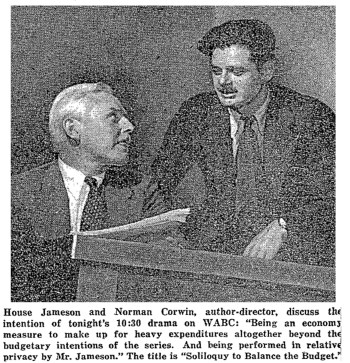
Images of a well-oiled network publicity machine at work. Newspapers such as the New York Times frequently printed network-supplied publicity stills and promotional copy in their radio sections. Here’s a publicity still of Corwin with actor House Jameson preparing for the the “Soliloquy” episode of Twenty-Six by Corwin (6-15-41).
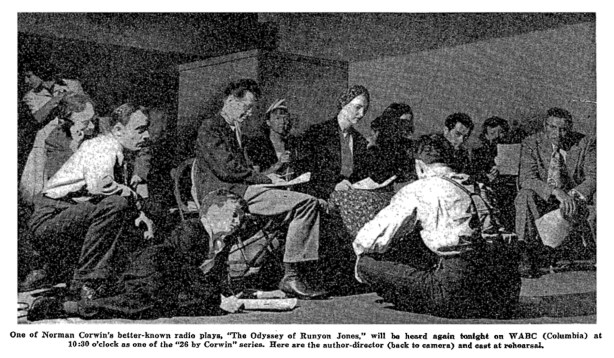
Publicity still of actors rehearsing for an encore presentation of Corwin’s critically acclaimed radio play, “Odyssey of Runyon Jones” (11-26-41).
Corwin’s 1945 VE-Day celebration, “On a Note of Triumph,” was released not only in print, but also on disc by Columbia Records, converting an otherwise ephemeral sustaining feature into a source of direct profit while advancing the larger Columbia brand.
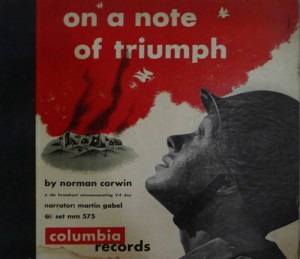
Cover art for 1945 Columbia Records release of Corwin’s “On a Note of Triumph” – leveraging content across media platforms for increased profit potential.
Whether attracting new affiliates and sponsors, or offering opportunities to improve brand recognition and exploit ancillary markets, CBS’s public service programming thus operated not in opposition to commercial forces but rather in the service of the network’s larger bid for economic competitiveness.
Lessons for Radio and Sound Studies
My remarks here are not intended to impugn Corwin’s artistic integrity, nor to imply a lack of commitment to loftier civic goals by CBS executives. The question, again, is a structural one: within what institutional context do the forms of aesthetic expression associated with “the Corwinesque” become possible and desirable? Put simply, how and why, from a structural perspective, do innovations in radio and sound art occur, and what forms can they take under given conditions?
Such inquiries are ill-served by presuming ipso facto oppositions between art and commerce or public service and commercial profit. Indeed, while often resting uneasily together, in the American system they have been bedfellows from the very beginning. To presume, moreover, that aesthetic innovation demands a protected space of noncommercial programming, or that such a space inherently fosters meaningful alternatives to commercial fare, would be a mistake. Within the received view, the legacy of Norman Corwin can be read only as a tale of lament: the death of public service and triumph of commercialism over art. Instead, I suggest we critically interrogate both present and past alike: the “Golden Age” is gone and likely never was, while closer scrutiny of earlier or subsequent eras may reveal aesthetic and institutional complexities hitherto unsuspected.
In a historical moment characterized by an unprecedented proliferation of new media outlets and alternative distribution platforms, but also an extreme concentration of media ownership, can we chart a critical trajectory that avoids both the Scylla of knee-jerk anti-capitalism and Charybdis of hyberbolic neoliberal and techno-utopian praise?

Conflicting attitudes toward contemporary sound industries. User-generated images responding to the SodaHead.com post, “Is Hannah Montana a Tool of the Devil?”, offer excoriating views on the cultural effects of commercialization and conglomeration.

Meanwhile, popular books such as Start and Run Your Own Record Label celebrate opportunities for creative autonomy and aesthetic innovation afforded by niche marketing and digital distribution technologies.
The proper course, whether studying conditions and possibilities for sound art in Corwin’s era or our own, lies somewhere in between.
—
Featured Image Credit: Julia Eckel, Radio Broadcast, 1934, Courtesy of the American Art Museum. An idealized representation, it contains no scripts in hand, no call numbers on the microphone and, importantly, no sponsors’ symbols on the wall.
—
Shawn VanCour is a media historian and lecturer in Film and Media Studies at the University of South Carolina. He has published articles on radio music and sound style in early television, as well as essays on Rudolf Arnheim’s radio theory and the origins of American broadcasting archives. He is currently completing a book on production practices and aesthetic norms for early radio programming and pursuing work for a second project on the radio-television transition of the 1940s-1950s.
Share this:

The Specialty Record Shop

Harold Kelley holds "Blue Danube," a 78 record. Single 78s are visible on the rack below. Behind him is the store's soundproof listening booth. Circa 1949.
In 1947, my grandparents converted a room connected to their small home in downtown Richmond, Indiana, into a record shop. According to my grandmother, my grandfather—perhaps enamored with the family’s new “Airline” table model automatic phonograph (purchased from Montgomery Ward the year before)—somehow managed to persuade her, my great aunt Ina, and my great uncle Henry to embark on the venture. On May 12, 1947, the Monday after Mother’s Day, the Specialty Record Shop opened its doors. It would become the first black owned and operated retail establishment in the area to serve both black and white customers. (The store closed in 1980.)
Many years later, so many things strike me about this ambitious undertaking. Mostly, I realize that their actions were, particularly at that time, a very bold step across a profoundly demarcated color line in American life and music, even in Richmond, which was, with its Quaker history, somewhat more tolerant of African Americans. While Richmond’s public schools had been integrated by 1947, official segregation in the City of Richmond didn’t end until 1965. Long after my mother graduated from high school (1957), blacks and whites lived mostly separate lives—and listened to different music.

The shop's second location on Main Street in Richmond, Indiana, circa 1955.
This seems especially true in the early days of the shop, although among the nearly 100 78 rpm, ten-inch breakable shellac records that comprised the store’s first inventory were records by Nat King Cole, who by 1947 had himself made it across the color line into popular music. For the week ending January 3, 1947, King Cole’s “I Love You (For Sentimental Reasons)” was among Billboard’s top ten “Honor Roll of Hits,” a tabulation of the most popular tunes in the nation. Other popular songs carried by the shop on opening day were Alvino Rey’s “Near You” and Tex Williams’s “Smoke! Smoke! Smoke! (That Cigarette).”
.
Specialty would come to distinguish itself from its five Richmond competitors by carrying all kinds of music and special ordering any sound a customer wanted: classical, country and western, bluegrass, jazz, R&B, spiritual, folk. Music that other stores didn’t stock, Specialty carried, and its inventory eventually included more than 400 different labels. White customers who listened to sounds outside of mainstream popular music of the day found a home at Specialty, but on occasion would still feel the need to discreetly whisper their requests for the latest country and western or bluegrass hit, as if embarrassed by their own musical tastes. Such was the climate in those early days.
.In the 1950s, the Specialty Record Shop, which had from its inception boasted the “Greatest Variety in Recordings,” was in its advertisements not only marketing all genres of music but also both white and black musicians. A November 24, 1954, advertisement, for example, promotes Specialty’s wide variety of “albums and single records of popular, children’s, classical, religious, western, rhythm and blues, and jazz.” And an earlier advertisement from May 19, 1954, for example, promotes Tommy Dorsey (“Little White Lies”), Artie Shaw (“Special Delivery Stomp”), Fats Waller (“Honeysuckle Rose”), Duke Ellington (“Solitude”), Jimmie Lunceford (“Jazznocracy”), and Coleman Hawkins (“Body and Soul”).

A "Tips on Tops" Specialty advertisement promoting music by Perez Prado, Sarah Vaughn and Dinah Shore, Johnny Desmond, Les Baxter and Roy Hamilton, and Sauter-Finegan. This ad also features Specialty's outlet store in Connersville, Indiana. Richmond Palladium-Item, May 11, 1955.
Still, what’s painfully clear from the majority of advertising during that time is that mainstream music of the day reflected “popular” (that is, white) tastes. While black teenagers like my mother listened to “Ain’t That a Shame” by Fats Domino, her white counterparts listened to “Ain’t That a Shame” by Pat Boone. On and on, two versions of records—black and white—and two audiences: Among black songs covered by white artists that my mother remembers from her youth (most certainly carried in my grandparents’ store in both incarnations) are “Fever” by Little Willie John and “Fever” by Peggy Lee, “Long Tall Sally” by Little Richard and “Long Tall Sally” by Pat Boone, “Good Night, Irene” by Leadbelly and “Good Night, Irene” by the Weavers, and “Hound Dog” by Big Mama Thornton and “Hound Dog” by Elvis Presley.
.
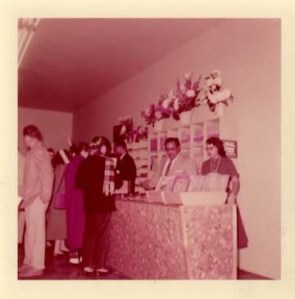
Marilyn Kelley, fifteen, helping customers with Henry Bass and Harold Kelley at the Main Street shop, 1955.
The R & B sounds that my mother, Marilyn Kelley, favored in musical artists in the 1950s were the familiar sounds of (or “sepia” as it was called early on), gutbucket, and melisma—black musical sounds and pronunciation not acceptable to the parents of white teenagers (although white youth were of course becoming familiar with these sounds). Covers changed that sound and made popular rhythm and dance music acceptable to white parents while satisfying white teens and keeping them “inside the fold.” White people (and black people) regularly heard and saw Dinah Shore, Peggy Lee, Pat Boone, Elvis Presley, and other white performers on radio and television, as the record companies heavily promoted these artists and their versions of popular songs. Black performers, on the other hand, were much harder for black people (or everybody else, for that matter) to discover. In the Midwest you had to catch Randy, a white disc jockey out of Nashville, who played black performers’ records and sold them through mail order (see WLAC—Radio). My mother listened to Randy’s show from her bedroom nearly every Saturday night.
.
I had never heard of Little Willie John or his version of “Fever” until my mother mentioned it, but when I listened to his voice for the first time I immediately understood what compelled my parents as teenagers to desire this song, even without lots of radio play or the benefit of television. When I sent my mother a link to Gayle Wald‘s review of a book about the musician (Fever: Little Willie John: A Fast Life, Mysterious Death and the Birth of Soul), she remarked that as a young girl in the rural Midwest she knew not a single thing about him except for the sound of his voice on that one song, which has stuck in her memory all these years. Few people in rural America knew what budding black artists looked like in those days. For listeners like my mother it was all about sound because there was practically nothing else. Pure sound drove her to enjoy these artists and made her want to hear their music again and again.
Into this world jumped two ordinary black couples, moved by their own phonograph player and records to turn a space they had leased to a succession of black beauty parlor operators into a small storefront: Harold Kelley, my grandfather, a carpenter by training who tended as carefully to the foundations of the store as to its customers; my grandmother, Elizabeth, who handled the register and advertising; my great aunt Ina, who mostly worked behind the scenes as the bookkeeper; and my great uncle, Henry Bass, known among the family as “the promoter,” likely as much for his knowledge of music, particularly jazz, as for a habit of walking up and down the street talking to people (a young African-American man named John would join the four after first lingering in the shop as a customer, then helping as a volunteer, until finally becoming an invaluable employee in 1955.)

Kelleys and Basses: Left to right: Henry Bass, Mary Ina Bass, Elizabeth Kelley, and Harold Kelley, co-owners of the Specialty Record Shop, circa 1963.
Benefiting first from their proximity to downtown at 611 South A Street, beneath a rose-colored neon sign, and later in the more spacious Main Street shop—with its “high fidelity” room in the basement—that I remember, the Kelleys and Basses managed to put several other record stores out of business, but more significantly they forged a small community—white and black—around music at the heyday of a vast industry and at one of the peaks of cultural segregation, which even now, so many decades later, seems like no small accomplishment.
Last year, my mother and I traveled to Richmond to visit both Specialty locations, maybe thinking that in all their metaphorical glory they would inspire us to write down what we remember. We went first to the storefront on Main Street, the place that I knew, and then to the small frame house on South A Street, the early shop and my mother’s childhood home. The drabness of the place knocked any hint of nostalgia out of both of us: The bushes and flowerbeds were gone, and the building looked cold and empty, slightly seedy, and a little miserable—these days no doubt valued more for the land it sits on than for the property itself. Thinking now of how my mother must have felt to see her childhood home diminished so mercilessly by time and progress still pains me.
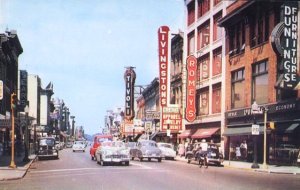
Main Street, Richmond, Indiana in the 1950s
She said then and I write with certainty now that it was more than it looked, which brings me back to what Specialty was, which must be something larger than what stands in our memories or I would not be writing this. It is difficult to attach particular significance to the place in a simple essay about music except to say that as with sound with Specialty meaning was everywhere, and as with music, Specialty reached everyone, at least in Richmond. Its soundproof booth, five-by-five feet square, drew high-fidelity enthusiasts to listen longer than perhaps should have been allowed. A single door connecting the store to my grandparents’ home, sometimes left open by chance, invited curiosity and even boldness from some customers who, stumbling upon the family’s dining room table with its treasure trove of uncataloged records may well have lingered too long in a private space but were never scolded or turned away. The record company representatives who, swept up in the excitement of Specialty’s open house in 1955, began helping customers buy any record, regardless of its label. Taken together, these shared experiences become a narrative of human experience as intricate and complicated as music itself, not so unlike the tapestry of sound that compelled my mother to listen to the magnetic voice of Little Willie John.
In the musical amalgam of today, it is at times difficult to imagine an America so rural, isolated, and segregated, at least in these particular ways. These days “black” music—that is, music by African-American performers—is likely more accepted by and certainly more fully integrated into mainstream America than is the black population itself. Virtual musical communities like turntable, Spotify, Grooveshark, and Pandora are as much growing purveyors of music as are iTunes and Amazon, the new corner record stores, and as such hold much promise for unprecedented global musical cross-pollination and exchange.
 As we may rightly celebrate the cultural integration of more sounds into a larger and perhaps more democratic musical landscape, it is also appropriate to mourn the passing of brick and mortar record stores (and bookstores and libraries, too, I might add) like Specialty, as much for their fidelity as for the ephemeral things these spaces once contained: qualities that bring kinship and serendipity to human experience—sound, yes, but also light, smell, touch, and color, with all its complications.
—
Jacqueline Dowdell received a B.A. from the University of Michigan and an M.F.A. from Cornell University. She is a communications coordinator at Cornell Law School. Thanks to her mother’s memories, her grandmother’s meticulous archive of Specialty history, and a newfound enthusiasm for sound, she is working on a memoir about the Specialty Record Shop.
.
Share this:


Current Top Posts





April 2021

January 2020

November 2019

October 2019

August 2019

April 2014

November 2017

March 2015

December 2017

October 2015
 Sounding Out!
Recent Comments