
Sound at SEM 2014

Hot on the heels of the American Musicological Society and Society for Music Theory’s joint annual meeting in Milwaukee, the Society for Ethnomusicology will hold its 59th Annual Meeting in Pittsburgh, November 13-16, 2014, hosted by the University of Pittsburgh. SEM is arguably one of the conferences most hospitable to sound studies, and several panels feature strong papers.
On Wednesday, Nov. 12, the “Music and Labor” pre-conference symposium features some fascinating papers of interest to sound scholars and includes a keynote address by Dr. Marcus Rediker, Distinguished Professor of Atlantic History at the University of Pittsburgh. With panels titled “(Re) Conceptualizing Music and Labor,” “The Labor of Music in Transitioning Economies,” “Art as Work: Defying Capitalist Hegemony and National Narrative through Musical Activism and Creative Adaptation,” and “Transformation of Music Labor Regimes in Socialist and Post-Socialist Southeastern Europe,” even the papers that aren’t especially sound studies-related have the potential to demonstrate deft interdisciplinary approaches that would be applicable (and fruitful) in sound studies research.
One of the first sound studies events of the conference program is the annual meeting of the Sound Studies Special Interest Group. Dr. Allen Roda, Jane and Morgan Whitney Research Fellow at the Metropolitan Museum of Art in New York City, and I are currently co-chairs of the SIG; anyone interested in sound studies will not want to miss our meeting on Thursday, November 13 at 12:30-1:30 PM in the Duquesne Room. This year’s meeting will mark the SIG’s 6th anniversary since it was formed in 2009. The group now has over 100 members and is represented on several panels at the 2014 conference in Pittsburgh. One co-chair seat will become vacant this year, and the group will hold elections to fill this position at the meeting; we also plan to discuss plans for more visibility online and among the academic community.
Before the meeting, come early to the 8:00-10:30 AM session in that same room to catch Molly McBride’s paper, “The Sounds of Humor: Listening to Gender in Early Barn Dance Radio,” or see a whole sound studies panel titled “Auditory Histories of the Indian Ocean: Hearing the Soundworlds of the Past” in the Alleghany Room.
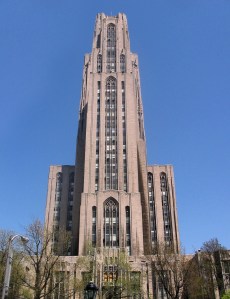
“The Cathedral of Learning at UPitt” by Flickr user Carlos Hernandez, CC BY-NC-SA 2.0
If you can’t make those early panels on the first day, the convention boasts numerous, high-quality sound studies sessions, many of which convene simultaneously. There have been several sound studies-related panels and individual papers at past meetings, but the number of high-quality papers is certainly trending in favor of more sound studies.
Also, the last several annual meetings have featured a soundwalk hosted by the Sound Studies SIG. This year is no different; however, rather than having a guided walk around the host city, this year’s soundwalk will be self-guided. Using the Twitter hashtag #semsoundwalk, participants will listen to Pittsburgh, the acoustic environment of the conference itself, the coffee shop where they stop for refreshment, or wherever they happen to find themselves between 1:15 – 6:00PM on Friday, Nov. 14. Be sure to follow the hashtag – even if you’re not in Pittsburgh – to “listen” along with conference participants.
I am delighted to see that this year’s conference unites the SEM’s commitment to the study of world musics and cultures and sound studies, particularly in panels such as “Auditory Histories of the Indian Ocean: Hearing the Soundworlds of the Past,” “Contemplating Voice in Cross-Cultural Perspective,” and “Regulating Space, Regulating Sound: Musical Practice and Institutional Mediation in São Paulo, Brazil.” This year also highlights the SEM’s strong interdisciplinary bent and makes even more room at the epistemological table for the examination of technoculture and its implications for sound studies and the larger ethnomusicological community.
Because of the sheer volume of sound studies activities, rather than listing my “picks” for the conference, I’ve listed most of the relevant papers and sessions, leaving the hard decision up to you. In fact, there are so many genuine sound studies panels and papers (or papers on closely related topics) its easy to see why the blurry line that demarcates “sound studies” from “music studies” seems blurriest at SEM. For those who cannot attend the conference, some of this year’s panels will be live-streamed. The Special Interest Groups for Sound Studies and Ecomusicology are also co-hosting a roundtable on Saturday morning. For more information about the conference and to catch the live-streamed sessions, visit the conference website at http://www.indiana.edu/~semhome/2014/.
—
Michael Austin is Assistant Professor of Media, Journalism, and Film and coordinator of the Interdisciplinary Studies Program in the School of Communications at Howard University where he teaches courses in music production, sound design for film and audio production. He holds a Ph.D. in Humanities – Aesthetic Studies (with a specialization in Arts and Technology) from the University of Texas at Dallas and music degrees from UT-San Antonio and UT-Austin. He is also affiliated with the Laboratoire Musique et Informatique de Marseille, an audio/music technology and informatics lab in Marseille, France, and is co-chair of the Society for Ethnomusiciology’s Special Interest Group for Sound Studies.
—
Featured image: “Musician” by Flickr user Joanna, CC BY-NC 2.0
—

“Cathedral of learning/Stephen Foster Memorial – Painted by Light” by Flickr user Sriram Bala, CC BY-NC 2.0
WEDNESDAY, November 12
8:00 am – 8:00 pm
Ballroom 3, Wyndham Grand Pittsburgh Downtown Hotel
Pre-Conference Symposium: “Music and Labor”
THURSDAY, November 13
8:30 – 10:30 am
Duquesne Room
“The Sounds of Humor: Listening to Gender on Early Barn Dance Radio,” Molly McBride, Memorial University of Newfoundland
Alleghany Room
Session: Auditory Histories of the Indian Ocean: Hearing the Soundworlds of the Past
“Wonders and Strange Things: Practices of Auditory History before Recorded Sound,” Katherine Butler Schofield, King’s College London
“Notes in the Margins: Sumatran Religious Hybridity and the Efficacy of Sound, “ Julia Byl, King’s College London
“Contact, Contestation and Compromise: Sound and Space in 19th-Century Singapore,” Jenny McCallum, King’s College London
“A ‘Wayang of the Orang Puteh’?: Theatres, Music Halls and Audiences in High-Imperial, Calcutta, Madras, Penang and Singapore,” David Lunn, King’s College London
10:45am -12:15 pm
Sterling 3 Room
“Sounding Neoliberalism in the Richmond City Jail,” Andrew C. McGraw, University of Richmond
Heinz Room
“The Color of Sound: Timbre in Ralph Ellison’s Invisible Man,” Sydney A. Boyd, Rice University
12:30 – 1:30 pm
Duquesne Room
Special Interest Group for Sound Studies
1:45 – 3:45 pm
Sterlings 1 Room
“Radio Archives and the Art of Persuasion: Preserving Social Hierarchies in the Airwaves of Lima” Carlos Odria, Florida State University
Ft. Pitt Room
Session: Mediated Musics, Mediated Lives
“Uploading Matepe: The Role of Online Learning Communities and the Desire to Connect to Northeastern Zimbabwe,” Jocelyn A. Moon, University of Washington; Zachary Moon, Independent Scholar
“Staging Overcoming: Disability, Meritocracy, and the Envoicing of Dreams,” William Cheng, Dartmouth University
“As Time Goes By: Car Radio and Spatiotemporal Manipulations of the Travel Experience in 20th-Century America,” Sarah Messbauer, University of California, Davis
“’How Can We Live in a Country Like This?’ Music, Talk Radio, and Moral Anxiety,” Karl Haas, Boston University
Sterling 3 Room
Session: Oxide and Memory: Tape Culture and the Communal Archive
Oxide and Memory: Tape Culture and the Communal Archive
“Magnetic Tape, Materiality, and the Interpretation of Non-Commercial Cassette and Reel-to-Reel Recordings from Quebec’s Gaspé Peninsula,” Laura Risk, McGill University
“Family Sense and Family Sound: Home Recordings and Greek-American Identity,” Panayotis League, Harvard University
“The Memory of Media: Autoarchivization and Empowerment in 1970s Jazz,” Michael C. Heller, University of Massachusetts, Boston
“Reimagining the Community Sound Archive: Cultural Memory and the Case for ‘Slow’ Archiving in a Gaspesian Village,” Glenn Patterson, Memorial University of Newfoundland
4:00 – 5:30 pm
Sterlings 1 Room
Panel: Contemplating Voice in Cross-Cultural Perspective
“The Gravest of Female Voices: Women and the Alto in Sacred Harp,” Sarah E. Kahre, Florida State University
“Re-sounding Waljinah: Aging and the Voice in Indonesia,” Russ P. Skelchy, University of California, Riverside
“Katajjaq: Between Vocal Games, Place and Identity,” Raj S. Singh, York University
Sterlings 3 Room
Session: Rumors, Sound Leakages and Individual Tales: Disruptive Listening in Zones of Conflict
“From the Struggle for Citizenship to the Fragmentation of Justice: Reflections on the Place of Dinka Songs in South Sudan’s Transitional Justice Process,” Angela Impey, School of Oriental and African Studies (SOAS), University of London
“Internet Rumors and the Changing Sounds of Uyghur Religiosity: The Case of the Snake Monkey Woman,” Rachel Harris, School of Oriental and African Studies (SOAS), University of London
“The Cantor and the Muezzin’s Duet at the Western Wall: Contesting Sound Spaces on the Frayed Seams of the Israel-Palestine Conflict,” Abigail Wood, University of Haifa
Heinz Room
Session: Historiography, Historicity, and Biography
“A Sonic Historiography of Early Sample-Based Hip-Hop Recordings,” Patrick Rivers, University of New Haven
“Biography as Methodology in the Study of Okinawan Folk Song,” Kirk A. King, University of British Columbia
“Sounding the Silent Image: Uilleann Piper as Ethnographic Object in Early Hollywood Film,” Ivan Goff, New York University
Untitled by Flickr user David Kent, CC BY-NC-ND 2.0
FRIDAY, November 14
7:00 – 8:00 am
Special Interest Group for Voice Studies
8:30 – 10:30 am
Commonwealth 1-2 Room, live streaming
Session: Sound Networks: Socio-Political Identity, Engagement, and Mobilization through Music in Cyberspace and Independent Media
*Sponsored by the Popular Music Section and Special Interest Group for Sound Studies
“Technological Factors Conditioning the Socio-Political Power of Music in Cyberspace,” Michael Frishkopf, University of Alberta
“Cyber-Mobilization, Informational Intimacy, and Musical Frames in Ukraine’s EuroMaidan Protests,” Adriana Helbig, University of Pittsburgh
“Countering Spirals of Silence: Protest Music and the Anonymity of Cyberspace in the Japanese Antinuclear Movement,” Noriko Manabe, Princeton University
“Living (and Dying) the Rock and Roll Dream: Alternative Media and the Politics of ‘Making It’ as an Iranian Underground Musician,” Farzaneh Hemmasi, University of Toronto
Sterling 1 Room
Session: Affective Environments and the Bioregional Soundscape
*Sponsored by the Special Interest Group for Ecomusicology
“’Landscape is Not Just What Your Eyes See’: Battery Radio, the Technological Soundscape, and Sonically Knowing the Battery, Kate Galloway, Memorial University of Newfoundland
“Re-sounding Caribou: Musical Posthumanism in Being Caribou,” Erin Scheffer, University of Toronto
“Cold, Crisp, and Dry: Inuit and Southern Concepts of the Northern Soundscape,” Jeffrey van den Scott, Northwestern University
Discussant, Nancy Guy, University of California, San Diego
Duquesne Room
“The Sound of Affective Fact,” Matthew Sumera, University of Minnesota
1:15 – 6:30 pm
Soundwalk: A Sonic Environmental Survey of the SEM Annual Meeting
*Sponsored by the Special Interest Groups for Sound Studies and Ecomusicology. Follow the walk on Twitter: #semsoundwalk
(Meet in Wyndham Grand main lobby at 1:15pm. Reconvene in lobby at 6:00)
1:45 – 3:45 pm
Smithfield Room
Session: Strident Voices: Material and Political Alignments
*Sponsored by the Special Interest Group for Voice Studies
“Registering Protest: Voice, Precarity, and Assertion in Crisis Portugal,”Lila Ellen Gray, University of Amsterdam
“Quiet, Racialized Vocality at Fisk University,” Marti Newland, Columbia University
“’The Rough Voice of Tenderness’: Chavela Vargas and Mexican Song,” Kelley Tatro, North Central College
Discussant: Amanda Weidman, Bryn Mawr College
4:00 – 5:30 pm
Heinz Room
Session: Celebratory Sounds and the Politics of Engagement
“Creating Zakopower in Postsocialist Poland,” Louise J. Wrazen, York University
“Merry-Making and Loyalty to the Movement: Conviviality as a Core Parameter of Traditionalism in Aysén, Chile,” Gregory J. Robinson, George Mason University
“Sounding the Carnivalesque: Changing Identities for a Sonic Icon of the Popular,” Michael S. O’Brien, College of Charleston

“Musical Mystery” by Flickr user Robert Wilhoit, CC BY-NC-SA 2.0
SATURDAY, November 15
8:30 – 10:30 am
Sterlings 1 Room
Roundtable: Sound Studies, Ecomusicology, and Post-Humanism In/For/With Ethnomusicology
*Sponsored by the Special Interests Groups for Ecomusicology and for Sound Studies
P. Allen Roda, The Metropolitan Museum of Art
Jennifer Post, University of Arizona
Mark Pedelty, University of Minnesota
Michael Silvers, University of Illinois at Urbana-Champaign
Ben Tausig, Stony Brook University
Zeynep Bulut, King’s College London
10:45 am – 12:15 pm
Benedum Room, live streaming
Musical Instruments, Material Cultures, and Sound Ecologies
“Bulgarian Acoustemological Tales: Narrativity, Agrarian Ecology, and the Kaval’s Voice,” Donna A. Buchanan, University of Illinois at Urbana-Champaign
Sterling 1 Room
Session: Theorizing Sound
“Water Sounds: Distance Swimmers and Ecomusicology,” Niko Higgins, Columbia University
“Telephone, Vacuum Cleaner, Couch: Senses and Sounds of the Everyday in Postwar Japan,” Miki Kaneda, Boston University
Discussant: Benjamin Tausig, Stony Brook University
SUNDAY, November 16
8:30 – 10:30 am
Birmingham Room
Session: Regulating Space, Regulating Sound: Musical Practice and Institutional Mediation in São Paulo, Brazil
*Sponsored by the Latin American and Caribbean Section
“Music under Control? São Paulo’s Anti-Noise Agency in Action,” Leonardo Cardoso, University of Texas at Austin
“Music Producers in São Paulo’s Cultural Policy Worlds,” Daniel Gough, University of Chicago
“’Small Universes’: The Creation of Social Intimacy through Aesthetic Infrastructures in São Paulo’s Underground,” Shannon Garland, Columbia University
Discussant, Morgan Lurker, Reed College
Heinz Room
“Hear What You Want: Sonic Politics, Blackness, and Racism-Canceling Headphones,” Alex Blue, University of California, Santa Barbara
Alleghany Room
“Sound and Silence in Festivals of the French Revolution: Sonic Analysis in History,” Rebecca D. Geoffroy-Schwinden, Duke University
10:45 am – 12:15 pm
Liberty Room
Session: Sounding Nations
“Building the Future through the Past: The Revival Movement in Iranian Classical Music and the Reconstruction of National Identity in the 1960s and the 1970s,” Hadi Milanloo, Memorial University of Newfoundland
“Sounding Citizenship in Southern Africa: Malawian Musicians and the Social Worlds of Recording Studios and Music Education Centers,” Richard M. Deja, University of Illinois
“Unity in (Spite of) Diversity: Tensions and Contradictions in Performing Surinamese National Identity,” Corinna S. Campbell, Williams College

“Music” by Flickr user Rich McPeek, CC BY-NC 2.0
Share this:

Brasil Ao Vivo!: The Sonic Pleasures of Liveness in Brazilian Popular Culture

 After a rockin’ (and seriously informative) series of podcasts from Leonard J. Paul, a Drrty South banger dropped by SO! Regular Regina Bradley, a screamtastic meditation from Yvon Bonenfant, and a heaping plate of food sounds from Steph Ceraso, our summer Sound and Pleasure series gets even louder with Kaleb Goldschmidt‘s work on live events in Brazil. Brasil Ao Vivo! –-JS, Editor-in-Chief
—
Brazilians pray, cheer and celebrate in public and often in close physical proximity to each other. From the nearly 3 million people that flocked to Copacabana Beach to hear Pope Francis lead a mass in 2013 to the huge crowds that regularly turn out for concerts at Maracanã stadium, Brazilians earn their global reputation for large-scale public events. Of course there is Carnival in Rio de Janeiro and Salvador; the largest LGBT Pride Parade in the world held in São Paulo; and then there is football.
The relationship between large-scale public events and sound hit home as the country reacted to the national team’s humiliating loss to Germany in the semi-final round of the 2014 FIFA World Cup. The world witnessed a different kind of public outpouring as the Brazilian public mourned. Within hours of the initial shock at the lopsided score, images of Brazilian football fans weeping and screaming in the stadium and on the street became a humorous meme with music and sound playing a prominent role. By the next day, most Brazilian football observers were taking pleasure in the public spectacle of weeping fans. With the abundance of images featuring hysteria, videos mocking the intensity of the crying went viral with dramatic musical scores. One observer proclaimed : “essa capacidade de rir de nós mesmos é uma das melhores qualidades”; the capacity to laugh at ourselves is one of our best qualities. That Brazilians express all varieties of emotions and annual passages together in public for everyone to witness, even when they border on campy excess, allow for everyone to feel the pleasures of community and the power of public performance.

“Abschlussfeier Maracana Fifa WM 2014” by Flickr user Marco Verch, CC BY 2.0
All of this led me to believe that such a public culture has an effect on the aesthetics of what performance studies scholar Philip Auslander calls “liveness” in recorded music and related viral media. Auslander argues that the appeal of liveness for television broadcasts, concerts, and other stage performances allows audiences to feel the immediacy of the moment even if the presence of mediation, such as screens and on-air censorship, is obvious. The international spectacle of Brazilians emoting en masse, then, has a direct relationship with Brazilian sonic aesthetics. Nowhere, I argue, is this more prominent than in the (sometimes viral) popularity of live recordings.
That immediacy Auslander speaks of spreads to many aspects of Brazilian popular culture, including the popularity of concert DVDs and albums which are regularly listed among the most popular domestic recordings. In fact, concert records tend to be more popular than the studio albums that inspire the tour. These live albums often carry the designations Ao Vivo, live or MTV Acústico (the equivalent of the Unplugged albums popular in the United States), and they are often recorded in such a way so as to feature the interaction of the crowds. In place of the draw for authenticity (a value that permeates the MTV Unplugged recordings) is the love for community, and for experiencing big emotions together no matter how obviously they are mediated through cameras, microphones and other technology. Through the example of the continued popularity of live albums in Brazil, there is an opening for a different theorization for sounding liveness; in place of celebrating canonic performances and virtuosity, the valorization of liveness in Brazil reinforces the importance of crowds and the so-called “popular classes” at the root of the politicized singer-songwriter genre MPB or Música Popular Brasileira.
The pleasure and preference for live recordings also extends to social media. For meme chasers, a good example of this is Michel Teló’s 2011 hit “Ai Se Eu Te Pego.” The song and video were recorded ao vivo before a crowd dominated by young women. A close listen reveals that sounds of Teló’s female audience members are just as important as his voice even if his voice is only slightly louder in the mix. There is barely a moment in the recording when the audience stops making itself heard; the engineering revels in their presence. This is especially obvious during the opening seconds of the track when Teló and his audience sing “Nossa, nossa / assim você me mata / Ai, se eu te pego / Ai, ai, se eu te pego” [Wow, wow / you kill me like that / Ah, if I could get you / ah, ah, if I could get you] in unison at nearly the same volume in the mix. When the accordion and electric bass (crucial instruments for the song’s forró style) finally enter over the screaming audience, there is a noticeable break in the tension set up by the audience and Teló singing together. Their cries, like those in other live recordings, illustrate Teló’s appeal to the crowd in that moment while also allowing other listeners to imagine themselves there.
Teló’s song went viral (as of this writing, the official version currently has nearly 580 million views on YouTube and over 72 million plays on Spotify), with alternate video versions teaching the song’s dance steps and others highlighting global football stars dancing and singing along to the song. At one point Neymar, the national team’s biggest hope for World Cup victory, sang with Teló in front of a crowd. In general, Teló’s live songs easily outpace his studio recordings in terms of virality, and, I would argue, that a major part of the appeal of “Ai Se Eu Te Pego” is its provenance in a concert setting. It is just as important that the screaming throngs of women are audible as it is for those dance steps to be easy and recognizable. The liveness of the recording is so important, in fact, that the screaming audience appears as sampled snippets in the Pitbull remix. In its viral form, Teló’s song united the popularity of live spectacle with Brazil’s enthusiasm for other live events, merging concert goers with football fans.
The popularity of Teló’s live song is not an isolated incident. Look, for example, at record sales figures for all time. Two are live albums by artists who do not appear elsewhere on the list. Other albums that have sold more than 2 million copies in Brazil alone are by Roberto Carlos (Acústico MTV) and the teen pop/rock duo Sandy and Júnior (As Quatro Estações ao Vivo and Era Uma Vez… Ao Vivo). In 2011, five of the top ten albums in Brazil fit the ao vivo mode with little regard to genre: MPB stars Caetano Veloso and Maria Gadú are there alongside sertanejo artists Paula Fernandes and Luan Santana. In 2012, three of the top 20 best-sellers were live albums. Meanwhile, DVDs of concerts in Brazil continue to be strong sellers. Thus, the communal pleasure palpable on-screen translates to that experienced in the home.

“Eric Clapton – Unplugged” by Flickr user Ian Alexander Martin, CC BY-NC-ND 2.0
Compare this with the status of live records in the United States in the last few years where they have rarely seen any chart success. If anything, liveness continues in YouTube clips and Spotify Sessions but not in physical sales and downloads. This is probably because live albums for U.S. based artists are embedded with different values having to do with the rock authenticity rather than communal pleasure. These performances demonstrate the chops of the musician and valorize the concerts (and tours) as events. The double live albums from the 1970s such as as Frampton Comes Alive, Lynyrd Skynyrd’s One More From The Road, and Kiss Alive! hold a prized place in the classic rock canon, often as much for extended guitar solos rather as the screaming throngs of fans. In the late ‘80s and early ’90s live albums, especially MTV Unplugged, re-inscribed a love of liveness through acoustic instruments and songs that reached back into the roots of American popular music. Eric Clapton’s Unplugged (1992) even topped the Billboard album charts and won 6 Grammy awards including Album of the Year while other records such as Nirvana’s MTV Unplugged in New York and U2’s Rattle and Hum were multi-platinum hits. While there is the occasional top-40 live single, these songs are the exception to a genre of that has has moved liveness to YouTube rather than streaming and MP3 markets.
SO! contributor Osvaldo Oyola has noted there is a tension between the efforts recording engineers often go through to make studio recordings sound as immediate as possible, and those that call attention to the recording process. Live records replace the need to sound polished with the need to sound spontaneous, often reveling in mistakes and banter. That immediacy is something I enjoy when listening to live recordings and it has a parallel for many people who participate in the reception of major events in real time through social media.
In Brazil, audiences enjoy the immense power of participation in live events. As part of a larger work in progress I’m particularly fascinated by how this power and pleasure is mediated through the sonic experience of recordings and viral social media. Whether they are sharing tears over an international football loss or singing along to “Ai Se Eu Te Pego” Brazilians extend Auslander’s liveness by prolonging and replaying the immediacy of the crowds to experience that shared sonic moment, again and again.
—
Kaleb Goldschmitt is a Visiting Lecturer in the Faculty of Music at University of Cambridge. Her scholarly work focuses on Brazilian music, modes of listening, and sonic branding in the global cultural industries. She has published in the Oxford Handbook of Mobile Music Studies, Popular Music and Society, American Music, Yearbook for Traditional Music, and Luso-Brazilian Review and contributes to the South American cultural magazine, Sounds and Colours.
—
Featured image: Adapted from “Gloria” by Flickr user Lourenço Fabrino, CC BY-NC-SA 2.0
—
 REWIND! . . .If you liked this post, you may also dig:
Sound-politics in São Paulo, Brazil— Leonardo Cardoso
Calling Out To (Anti)Liveness: Recording and the Question of Presence–Osvaldo Oyola
Hello, Americans: Orson Welles, Latin America, and the Sounds of the “Good Neighbor“– Tom McEnaney
Share this:


Current Top Posts





April 2021

January 2020

November 2019

October 2019

August 2019

April 2014

November 2017

March 2015

December 2017

October 2015
 Sounding Out!
Recent Comments