
“Hey Google, Talk Like Issa”: Black Voiced Digital Assistants and the Reshaping of Racial Labor
.
DOI: https://doi.org/10.59350/9cbp8-49610
In summer 2021, sound artist, engineer, musician, and educator Johann Diedrick convened a panel at the intersection of racial bias, listening, and AI technology at Pioneerworks in Brooklyn, NY. Diedrick, 2021 Mozilla Creative Media award recipient and creator of such works as Dark Matters, is currently working on identifying the origins of racial bias in voice interface systems. Dark Matters, according to Squeaky Wheel, “exposes the absence of Black speech in the datasets used to train voice interface systems in consumer artificial intelligence products such as Alexa and Siri. Utilizing 3D modeling, sound, and storytelling, the project challenges our communities to grapple with racism and inequity through speech and the spoken word, and how AI systems underserve Black communities.” And now, he’s working with SO! as guest editor for this series (along with ed-in-chief JS!). It kicked off with Amina Abbas-Nazari’s post, helping us to understand how Speech AI systems operate from a very limiting set of assumptions about the human voice. Today Golden Owens explored what happens when companies sell Black voices along with their Intelligent Virtual Assistants. Tune in for a deep historical dive into the racialized sound of servitude in America. Even though corporations aren’t trying to hear this absolutely critical information–or Black users in general–they better listen up. –JS
—
In October 2019, Google released an ad for their Google Assistant (GA), an intelligent virtual assistant (IVA) that initially debuted in 2016. As revealed by onscreen text and the video’s caption, the ad’s announced that the GA would soon have a new celebrity voice. The ten-second promotion includes a soundbite from this unseen celebrity—who states: “You can still call me your Google Assistant. Now I just sound extra fly”— followed by audio of the speaker’s laughter, a white screen, the GA logo, and a written question: “Can you guess who it is?”
Consumers quickly speculated about the person behind the voice, with many posting their guesses on Reddit. The earliest comments named Tiffany Haddish, Lizzo, and Issa Rae as prospects, with other users affirming these guesses. These women were considered the most popular contenders: two articles written about the new GA voice cited the Reddit post, with one calling these women Redditors’ most popular guesses and the other naming only them as users’ desired choices. Those who guessed Rae were proven correct. One day after the ad, Google released a longer promo revealing her as the GA’s new voice, including footage of Rae recording responses for the assistant. The ad ends with Rae repeating the “extra fly” line from the initial promo, smiling into the camera.
Google’s addition of Rae as an IVA voice option is one of several recent examples of Black people’s voices employed in this manner. Importantly, this trend toward Black-voiced IVAs deviates from the pre-established standard of these digital aides. While there are many voice options available, the default voices for IVAs are white female voices with flat dialects. This shift toward Black American voices is notable not only because of conversations about inclusion—with some Black users saying they feel more represented by these new voices—but because this influx of Black voices marks a spiritual return to the historical employment of Black people as service-providing, labor-performing entities in the United States, thus subliminally reinforcing historical biases about Black people as uniquely suited for performing this type of work.
Marketed as labor-saving devices, IVAs are programmed to assist with cooking and grocery shopping, transmit messages and reminders, and provide entertainment, among other tasks. Since the late 2010s they have also been able to operate other technologies within users’ homes: Alexa, for example, can control Roomba robotic vacuums; IVA-compatible smart plugs or smart home devices enable IVAs to control lights, locks, thermostats, and other such apparatuses. Behaviorally, IVAs are designed and expected to be on-call at all times, but not to speak or act out of turn—with programmers often directed to ensure these aides are relatable, reliable, trustworthy, and unobtrusive.
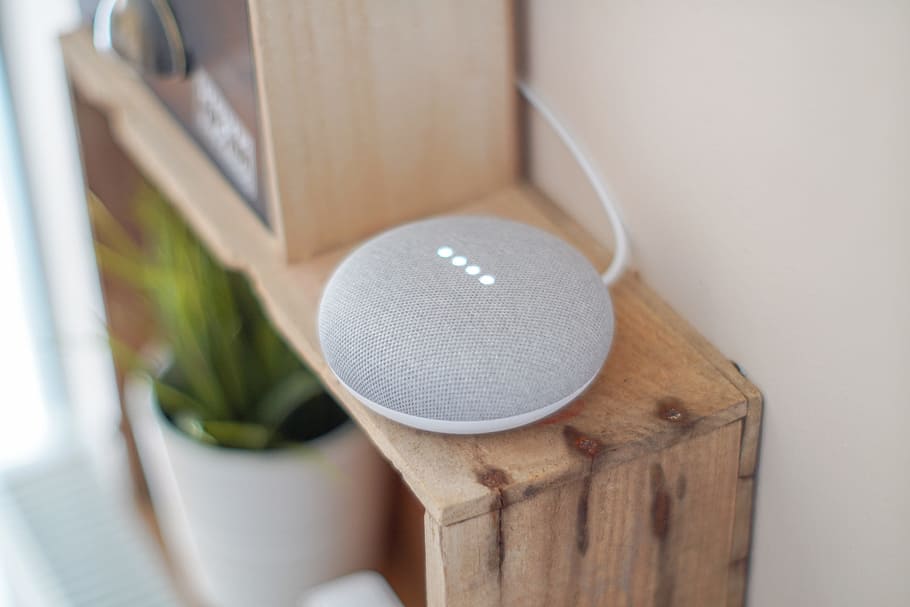
Far from operating in a vacuum, IVAs eerily evoke the presence of and parameters set for enslaved workers and domestic servants in the U.S.—many of whom have historically been Black American women. Like IVAs, Black women servants cooked, cleaned, entertained children, and otherwise served their (predominantly white) employers, themselves operating as labor-saving devices through their performance of these labors. Employers similarly expected these women to be ever-available, occupy specific areas of the home, and obey all requests and demands—and were unsettled if not infuriated when maids did not behave according to their expectations.
White women being the default voices of IVAs has somewhat obfuscated the degree to which these aides have re-embodied and replaced the Black servants who once predominantly executed this work, but incorporating Black voices into these roles removes this veil, symbolically re-implementing Black people as labor-performing entities by having them operate as the virtual assistants who now perform much of the labor Black workers historically performed. Enabling Black people to be used as IVAs thus re-aligns Black beings with the performance of service and labor.

While Black women were far from the only demographic conscripted into domestic labor, by the 1920s they comprised a “permanent pool of servants” throughout the country, due largely to the egress of white American and immigrant women from domestic service into fields that excluded Black women (183). Black women’s prominence in domestic service was heavily reflected in early U.S. media, which overwhelmingly portrayed domestic servants not just as Black women, but as Black Mammies—domestic servant archetypes originally created to promote the myth that Black women “were contented, even happy as slaves.” Characters like Gone with the Wind’s “Mammy” pulled both from then-current associations of Black women with domestic labor and from white nostalgia for the Antebellum era, and specifically for the archetypal Mammy—marking Black women as idealized labor-performing domestics operating in service of white employers. These on-screen servants were “always around when the boss needed them…[and] always ready to lend a helping hand when times were tough” (36). Historian Donald Bogle dubbed this era of Hollywood the “Age of the Negro Servant,” referenced in this reel from the New York Times.
—-
.
Cinema and television merely built from years of audible racism on the radio—America’s most prominent form of in-home entertainment in the first half of the 20th century—where Black actors also played largely servant and maid roles that demanded they speak in “distorted dialect, exaggerated intonation, rhythmic speech cadences, and particular musical instruments” in order to appear at all (143). This white-contrived portrayal of Black people is known as “Blackvoice,” and essentially functions as “the minstrel show boiled down to pure aurality” (14). These performances allowed familiar ideals of and narratives about Blackness to be communicated and recirculated on a national scale, even without the presence of Black bodies. Labor-performing Black characters like Beulah, Molasses and January, Aunt Jemima, and Amos and Andy were prominent in the Golden Age of Radio, all initially voiced by white actors. In fact, Aunt Jemima’s print advertising was just as dependent on stereotypical representations of her voice as it was on visual “Mammy” imagery.

When Black actors broke through white exclusion on the airwaves, many took over roles once voiced by white men and/or were forced by white radio producers and scriptwriters to “‘talk as white people believed Negroes talked’” so that white audiences could discern them as Black (371). This continuous realignment undoubtedly informs contemporary ideas of labor, labor performance, and laboring bodies, further promoted by the sudden influx of Black voice assistants in 2019.
Specifically, these similarities demonstrate that contemporary IVAs are intrinsically haunted by Black women slaves and servants: built in accordance with and thus inevitably evoking these laborers in their positioning, programming, and task performance. Further facilitating this alignment is the fact that advertisements for Black-voiced IVAs purposefully link well-known Black bodies in conjunction with their Black voices. Excepting Apple’s Black-sounding voice options for Siri, all of the Black IVA voice options since 2019 have belonged to prominent Black American celebrities. Prior to Issa Rae, GA users could employ John Legend as their digital aide (April 2019 until March 2020). Samuel L. Jackson became the first celebrity voice option for Amazon’s Alexa in December 2019, followed by Shaquille O’Neal in July 2021.
The ads for Black-voiced IVAs thus link these disembodied aides not just to Black bodies, but to specific Black bodies as a sales tactic—bodies which signify particular images and embodiments of Blackness. The Samuel L. Jackson Alexa ad utilizes close-ups of Jackson recording lines for the IVA and of Echo speakers with Jackson’s voice emitting from them in response to users. John Legend is physically absent from the ad announcing him as the GA; however, his celebrity wife directs the GA to sing for her instead, after which she states that it is “just like the real John”—thus linking Legend’s body to the GA even without his onscreen presence. Amazon has even explicitly explored the connection between the Black-voiced IVA and the Black body, releasing a 2021 commercial called “Alexa’s Body” that saw Alexa voiced and physically embodied by Michael B. Jordan—with the main character in the commercial insinuating that he is the ideal vessel for Alexa.
By aligning these bodies with, and having them act as, labor-performing devices in service of consumers, these advertisements both re-align Blackness with labor and illuminate how these devices were always already haunted by laboring Black bodies—and especially, given the demographics of the bodies who most performed the types of labors IVAs now execute, laboring Black women’s bodies. That the majority of the Black celebrities employed as Black IVA voices are men suggests some awareness of and attempt to distance from this history and implicit haunting—an effort which itself exposes and illuminates the degree to which this haunting exists.
In some cases, the Black people lending their voices to these IVAs also speak in a way that sonically suggests Blackness: Issa Rae’s “Now I’m just extra fly,” for example, incorporates Black American slang through the use of the word “fly. As part of African American Vernacular English (AAVE), the term “fly” dates back to the 1970s and denotes coolness, attractiveness, and fashionableness. Because of its inclusion in Hip Hop, which has become the dominant music genre in the United States, the term, its meaning, and its racial origins are widely known amongst consumers. By using the word “fly,” Rae nods not only at these qualities but also at her own Blackness in a manner that is recognizable to a mainstream American audience. Due in part to Hip Hop’s popularity, U.S.-based media outlets, corporations, and individuals of varying races and ethnicities regularly appropriate AAVE and Black slang terms, often without regard for the culture that created them or the vernacular they stem from. The ad preceding Issa Rae’s revelation as the GA specifically invited users to align the voice with a celebrity body, and users’ predominant claims that the voice was a Black woman’s suggest that something about the voice conjured Blackness and the Black female body.

This racial marking was also likely facilitated by how people naturally listen and respond to voices. As Nina Sun Eidsheim notes in The Race of Sound, “voices heard are ultimately identified, recognized, and named by listeners at large. In hearing a voice, one also brings forth a series of assumptions about the nature of voice” (12). This series of assumptions, Eidsheim asserts in “The Voice as Action,” is inflected by the “multisensory context” surrounding a given voice, i.e., “a composite of visual, textural, discursive, and other kinds of information” (9). While we imagine our impressions of voices as uniquely meaningful, “we cannot but perceive [them] through filters generated by our own preconceptions” (10). As a result, listening is never a neutral or truly objective practice.
For many consumers, these filters are informed by what Jennifer Lynn Stoever terms the sonic color line, “a socially constructed boundary that racially codes sonic phenomena such as vocal timbre, accents, and musical tones” (11). Where the racial color line allows white people to separate themselves from Black people on the basis of visual and behavioral differences, the sonic color line allows people “to construct and discern racial identities based on voices, sounds, and particular soundscapes” and to assign nonwhite voices with “differential cultural, social, and political value” (11). In the U.S., the sonic color line operates in tandem with the American listening ear, which “normalizes the aural tastes and standards of white elite masculinity as the singular way to interpret sonic information” (13) and therefore marks-as-Other not only the voices and bodies of Black people, but also those of non-males and the non-elite.

Ironically, the very listening practices which make consumers register particular voices and vocal qualities as Black also make Black voices inaccessible to Alexa and other IVAs. Scholarship on Automated Speech Recognition (ASR) systems and Speech AI observes that many Black users find it necessary to code-switch when speaking to IVAs, as the devices fail to comprehend their linguistic specificities. A study by Christina N. Harrington et al. in which Black elders used the Google Home to seek health information discovered that “participants felt that Google Home struggles to understand their communication style (e.g., diction or accent) and language (e.g., dialect) specifically due to the device being based on Standard English” (15). To address these struggles, participants switched to Standard American English (SAE), eliminating informal contractions and changing their tone and verbiage so that the GA would understand them. As one of the study’s participants states,
You do have to change your words. Yes. You do have to change your diction and yes, you have to use… It cannot be an exotic name or a name that’s out of the Caucasian round. …You have to be very clear with the English language. No ebonic (15).
This incomprehension extends to Black Americans of all ages, and to other IVAs. A study by Allison Koenecke et al. on ASR systems produced by Amazon, Google, IBM, Microsoft and Apple discovered that these entities had a harder time accurately transcribing Black speech than white speech, producing “an average word error rate (WER) of 0.35 for black speakers compared with 0.19 for white speakers.” (7684). A study by Zion Mengesha et al. on the impact of these errors on Black Americans—which included participants from different regions with a range of ages, genders, socioeconomic backgrounds and education-levels—discovered that many felt frustrated and othered by these mistakes, and felt further pressure to code-switch so that they would not be misunderstood. Koenecke et al. concluded that ASR systems could not understand the “phonological, phonetic, or prosodic characteristics of” AAVE (7687), and that this ignorance would make the use of these technologies more difficult for Black users—a sentiment that was echoed by participants in the study conducted by Mengesha et al., most of whom marked the technology as working better for white and/or SAE speakers (5).
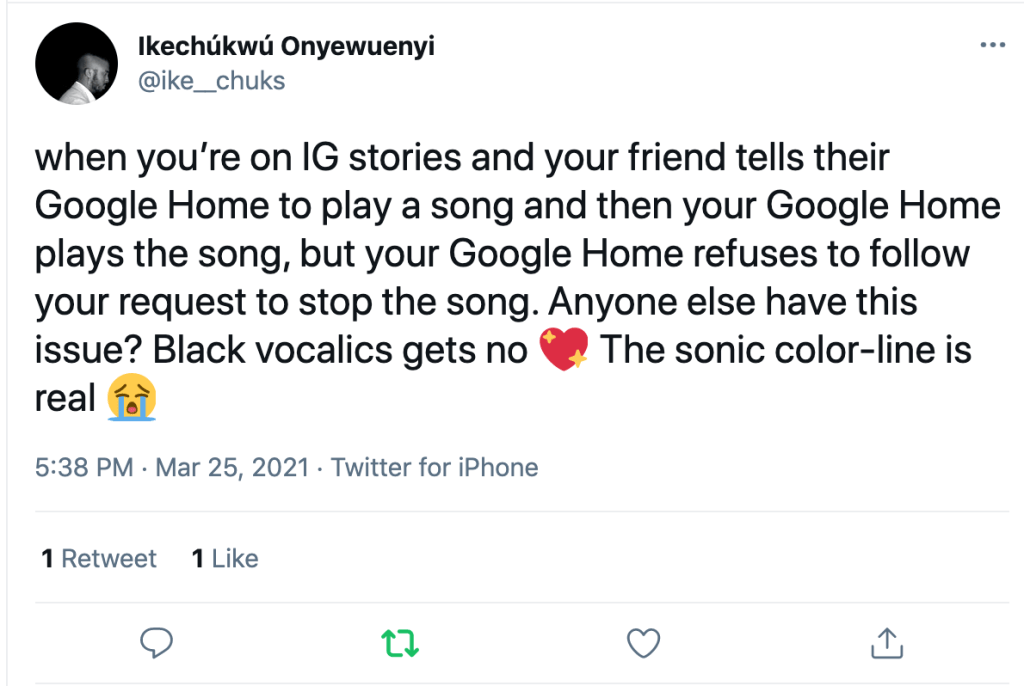
The speech recognition errors these technologies demonstrate—which also extend to speakers in other racial and ethnic groups—illuminate the reality that despite including Black voices as IVAs, these assistant technologies are not truly built for Black people, or for any person that does not speak Standard American English. And where AAVE is largely associated with Blackness, SAE is predominantly associated with whiteness: as a dialect widely perceived to be “lacking any distinctly regional, ethnic, or socioeconomic characteristics,” it is recognized as being “spoken by the majority group or the socially advantaged group” in the United States—both groups which are solely or primarily composed of white people. SAE is so identified with whiteness that Black people who only speak Standard English are often told that they sound and/or “talk” white, and Black people who deliberately invoke SAE in professional and/or interracial settings (i.e., code switching) are described as “talking white” or using their “white voice” when doing so. That IVAs and other ASR systems have such trouble understanding AAVE and other non-standard English dialects suggests that these technologies were not designed to understand any dialect other than SAE—and thus, given SAE’s strong identification with whiteness, were designed specifically to assist, understand, and speak to white users.
Writing on this phenomena as a woman with a non-standard accent, Sinduja Rangarajan highlights in “Hey Siri—Why Don’t You Understand More People Like Me?” that none of the IVAs currently on the market offer any American dialect that is not SAE. And while users can change their IVA’s accents, they are limited to Standard American, British, Irish, Australian, Indian, and South African—which Rangarajan rightly highlights as revealing who the IVAs think they are talking to, rather than who their user actually is. That most of these accents belong to Western, predominantly white countries (or to countries once colonized by white imperialists) strongly suggests that these devices are programmed to speak to—and perform labor for—white consumers specifically.
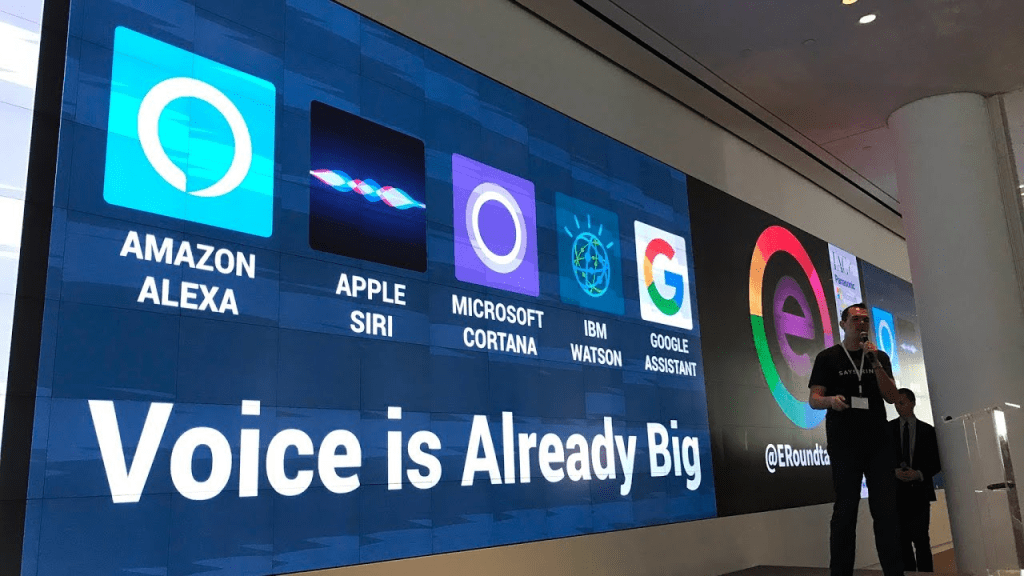
When considering the primary imagined and target users of IVAs, the sudden influx of Black-voiced IVAs becomes particularly insidious. Though they may indeed make some Black users feel more represented, cultivating this representation is merely a byproduct of their actual purpose. Because these technologies are not built for Black consumers, Black-voiced IVAs are meant to appeal not to Black users, but to white ones. Rae, Jackson, and the other Black celebrity voices may provide a much-needed variety in the types of voices applied to IVAs, but they primarily operate as “further examples of technology companies using Black voices to entertain white consumers while ignoring Black consumers.” Black-voiced assistants, after all, no better understand Black vernacular English than any of the other voice options for IVAs, a reality marking Black speech patterns as enjoyable but not legitimate.
By excluding Black consumers, the companies behind these IVAs insinuate that Blackness is only acceptable and worthy of consideration when operating in service of whiteness. Where Black people as consumers have been delegitimized and disregarded, Black voices as labor-saving assistants have been welcomed and deemed profitable—a reality which further emphasizes how historical constructions of Black people as labor-performing devices haunts these contemporary technologies. Tech companies reinforce historical positionings of white people as ideal consumers and Black people as consumable products—repeating historical demarcations of Blackness and whiteness in the present.
In imagining the futures of IVAs, the companies behind them would need to reconsider how they interact—or fail to interact—with Black users. Both Samuel L. Jackson and Shaquille O’Neal, the last of the Black-celebrity-voiced IVAs still currently available to users, will be removed as Alexa voice options by September 2023, presenting an opportunity for these companies to divest. Whether or not the brands behind these IVAs take this initiative, consumers themselves can be critical of how AI technologies continue to reestablish hierarchical systems, of their own interactions with these devices, and of who these technologies are truly made for. In being critical, we can perhaps begin to envision alternative, reparative modes of AI technology—modes that serve and support more than one kind of user.
—
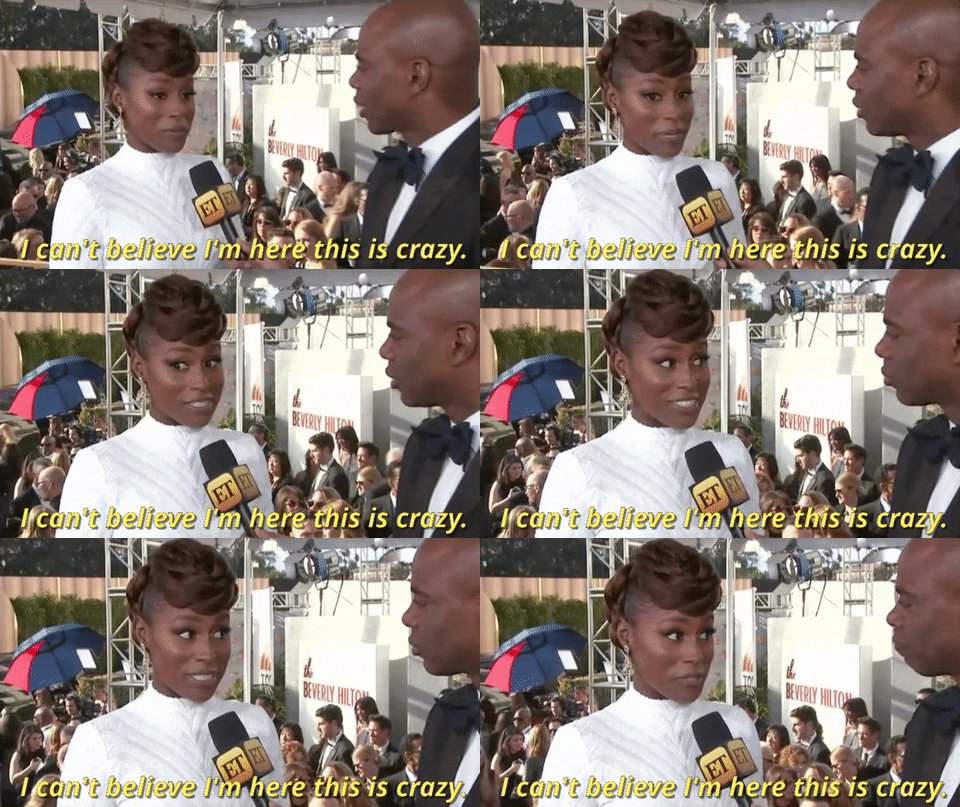
Featured Image: Issa Rae gif from the 2017 Golden Globes
—
Golden Marie Owens is a PhD candidate in the Screen Cultures program at Northwestern University. Her research interests include representations of race and gender in American media and popular culture, artificial intelligence, and racialized sounds. Her doctoral dissertation, “Mechanical Maids: Digital Assistants, Domestic Spaces, and the Spectre(s) of Black Women’s
Labor,” examines how intelligent virtual assistants such as Apple’s Siri and Amazon’s Alexa evoke and are haunted by Black women slaves, servants, and houseworkers in the United States. In her time at Northwestern, she has had internal fellowships through the Office of Fellowships and the Alice Kaplan Institute for the Humanities. She currently holds an MMUF Dissertation Grant through the Institute for Citizens and Scholars and Ford Dissertation Fellowship through the National Academy for Sciences, Engineering, and Medicine.
—

REWIND! . . .If you liked this post, you may also dig:
Beyond the Every Day: Vocal Potential in AI Mediated Communication –Amina Abbas-Nazari
Voice as Ecology: Voice Donation, Materiality, Identity–Steph Ceraso
Mr. and Mrs. Talking Machine: The Euphonia, the Phonograph, and the Gendering of Nineteenth Century Mechanical Speech – J. Martin Vest
Echo and the Chorus of Female Machines—AO Roberts
Black Excellence on the Airwaves: Nora Holt and the American Negro Artist Program —Chelsea Daniel and Samantha Ege
Spaces of Sounds: The Peoples of the African Diaspora and Protest in the United States–Vanessa Valdes
On Whiteness and Sound Studies–Gus Stadler
—
Share this:

What Do We Hear in Depp v. Heard?

DOI: https://doi.org/10.59350/rs39m-04519
As you probably know—whether you want to or not—the jury reached a verdict earlier this summer in the trial between Amber Heard and Johnny Depp. The trial, in the Fairfax County Circuit Court in Virginia, involved defamation and counter-defamation claims by the two actors. Heard published a 2018 op-ed in The Washington Post in which she claimed to be “a public figure representing domestic abuse.” Depp sued her for defamation, she counter-sued, and a seven-week spectacle of celebrity, misogyny, and power followed, in which Depp substantially prevailed.
What does a close listening to Depp v. Heard tell us about this particular trial, as well as about sex and power in the courtroom more generally?
Depp v. Heard did not just randomly become a media circus. As Joanne Sweeny noted in Slate, the judge made two procedural rulings that led to the ensuing frenzy—and greatly tipped the scales toward the plaintiff. Firstly, the judge allowed cameras in the courtroom to broadcast the proceedings. The Code of Virginia leaves this decision largely up to the court’s discretion, but also stipulates that coverage of “proceedings concerning sexual offenses” is prohibited. Despite the content and high-profile nature of this case, Judge Penney Azcarate decided to proceed with the broadcast.

Azcarate’s decision is strikingly at odds with the court’s emphasis on silence and decorum. Court order CL-2019-2911 stated, for example, that “Quiet and order shall be maintained at all times. Audible comments of any kind during the court proceedings … will not be tolerated.” In fact, Azcarate interrupted proceedings during trial to tell courtroom spectators to keep their mouths shut. During trial, extraneous noise is heard not just as uncivil but as a threat to impartiality and fairness. However, according to the judge’s logic, this threat is only perceived within the courtroom.
This brings us to the second procedural ruling of consequence here. Despite the frenzy enveloping the case, Azcarate decided not to sequester the jury. Jury sequestration involves the members of the jury being isolated from public and press during a trial, in order to avoid accidental or deliberate exposure to outside influence or information. Video from the courtroom flooded the internet and, as commentators have argued, likely and unduly influenced the jury, who were not isolated and prevented from accessing TV or social media. As Depp’s legions of supporters raged online, social media effectively became part of his legal team. This work was done in great part through sound.
Social media online commentary forensically dissected Heard’s oral testimony, noting changes in her breathing patterns or her speech cadence. Often they would hone in on the fact that she “exhale[d] erratically,” or “can talk so fast,” as seen in this Entertainment Tonight compilation:
The online jury adjudicated on all these vocal elements as proof that she was lying. One internet article described her in audiotape evidence as “cackle[ing] like a witch” and alternating between “laugh[ing] hysterically” and using a “baby voice.” Heard’s detractors took her voice as proof that she was emotionless, robotic, calculated, too well-rehearsed—but also that she was chaotic, nervous, crazy.
In contrast, commentators described Depp’s voice as “calm,” “calming,” and “soothing,” with Tik Tok users hash-tagging ASMR to audio of him. One fan even posted a ninety-minute ASMR video of his testimony. Multiple Twitter users claimed that “you can hear the pain” in his voice, from an audiotape admitted during trial. At other times, he is applauded for “giggling” and laughing during the trial, with fans hearing it as evidence of his authenticity and “kind soul.” One YouTube commentator, Grandma WHOa, writes that they wish he would record an audiobook so they could “listen to his calming, sexy soothing man voice.”
So far, so predictable. These are well-established, recognizable patterns about how we hear men’s vs women’s voices in public life—e.g. critiques of Hilary Clinton’s shrill, whiny voice. But listening in to the trial also reveals that this isn’t just a case of online fan culture on overdrive. Instead, it shows how broader social dynamics around gender and power don’t just create outside noise, but are built into formal legal practice within the courtroom.
Much of the conflict here follows a common pattern in defamation cases involving sexual violence claims, with questions around who gets to be a victim (see in my forthcoming piece in HAU: Journal of Ethnographic Theory titled “The Tone of Justice: Voicing the Perpetrator-as-Victim in Sexual Assault Cases”). Depp claimed to have suffered through the defamatory statement and through a longer history of abuse by Heard. His fans framed him as a hero and a victim, using the social media hashtag #HeardIsAnAbuser. On the other hand, they refused to believe Heard’s claims of having suffered abuse. This determination was based at least in part on Heard’s vocal performance and courtroom testimony, with detractors hearing duplicity in her exhalations, her rapid pace, the occasional firmness and confidence of her tone. As one Depp supporter commented on a video of Heard’s testimony, “There’s no way a victim sounds like this.”
Yet in a key strategic move, Depp’s lawyers chose to make Heard sound precisely as sexual assault victims often do during trial. Seeking to dismantle her credibility, they looked to the toolkit of how to deal with a victim in court, mobilizing a well-worn set of legal techniques used to interrogate survivors of sexual violence. In one cross-examination, for example, the plaintiff’s counsel declares that Heard’s “lies have been exposed to the world multiple times.” This claim is then manifested through a series of vocal disciplinary tactics to undermine Heard’s testimony and depict her as a false witness.
For instance, the lawyer, Camille Vasquez, repeatedly employs a common interrogation technique of speaking over and cutting off Heard as she is replying to a question. As legal scholars and sociologists have shown, such techniques are often used in sexual assault cases to intimidate and shape perceptions of the complainant. In a pioneering study on courtroom talk during rape trials, Gregory Matoesian, in Reproducing rape: Domination through talk in the courtroom (1993) describes how lawyers reproduce patriarchal relations of dominance and subordination by “usurping” the witness’ ability to respond (186). As he notes, questions—wielded like weapons of attack by skillful lawyers—are more powerful than answers.
Vocal technique and dynamics are key here. In Vasquez’s cross-examinations, she repeatedly raises her voice to interrupt Heard, disciplining her before the jury and spectators. She laughs at her testimony and infantilizes Heard, at times speaking to her in calm tones before quickly shifting to a harsher timbre. At one point, Vasquez snaps her notes shut and walks back to her seat while Heard is still answering her question. Heard is forced into abrupt silence. Unable to respond to the question she was asked, she audibly loses control of the narrative being spun. Vasquez also frequently speaks over her and directly to the judge, objecting that Heard is being non-responsive. The lawyer performs for the judge and jury her refusal to listen to Heard.
At other moments, Vasquez’s voice and affect telegraph exasperation, as she audibly sighs while Heard attempts to answer a question. As Heard and Vasquez go back-and-forth over a line of questioning, Vasquez’s voice bristles with irritation as she speaks in clipped tones, with sharp inflection at the end of each line: “Yes?” “Right?” “Yes or no?” These interjections add an aural layer of interpretation to Heard’s testimony in real-time, guiding the jury to hear the witness as evasive and therefore unreliable. Vasquez’s expressions are all part of a careful vocal strategy, implicitly saying to the jury, “Can you believe this woman?”
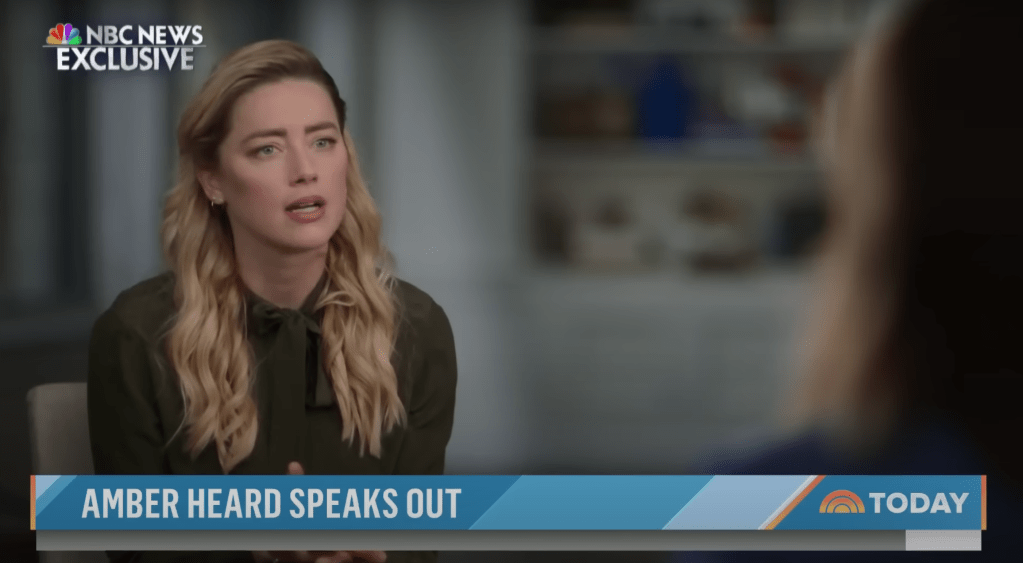
Of course, the answer is no. Jessica Winter, writing in The New Yorker, points out that Heard lost in part because of her “tearless crying,” the fact that she appeared insincere. Winter acknowledges that successful testimony is about “affect and presentation”, a reality that is no secret. In fact, jury instructions in Depp v. Heard clearly state that determinations of witness credibility are based in part on witnesses’ “appearance and manner.” Jurors must use their “common sense” to “determine which witnesses are more believable.”
But how is “common sense” established? Listening closely to this trial reminds us that such understandings are constructed and regulated through sound as well as through determinants of “appearance and manner,” both in and out of the courtroom. Vasquez’s performance, Heard’s subordinated testimony, and the commentary of millions of avid consumers underline that Heard and Depp sound to many people exactly as common sense and conventional norms would dictate.
A woman claiming abuse and assault at the hands of a more powerful man is always subject to patriarchal ways of listening, even if she is rich, famous, straight, and white. These ways of listening are contradictory. Research shows that “masculine” voices are heard as more authoritative and dominant, while women are often heard as weak, uncertain, lacking confidence. The public ear hears other racialized and gendered voices through similar power inequities, including queer, nonbinary, and LGBT voices or voices of people of color. In the context of sexual assault adjudication, however, Heather Hlavka and Sameena Mulla show in their Law & Society Review article “That’s How She Talks”: Animating Text Message Evidence in the Sexual Assault Trial” “that a confident voice and calm performance can work against a victim-witness in court, by suggesting that she is not passive or meek enough to be a ‘real’ victim.” On the other hand, they note that a victim-witness who cries on the stand may give the impression of performing or acting. Lawyers audibly manipulate these perceptions, as the examples here show, and men (particularly heteronormative, white men in positions of power) reap huge benefits from them.
Many observers of Depp v. Heard have noted the toxic social media sludge around the case, as well as the danger that the verdict poses to survivors of domestic abuse and sexual assault. But listening closely to the proceedings shows us that these outcomes aren’t random and aren’t just part of informal processes like trial by Tik Tok.
Instead, formal court proceedings manipulate and mobilize social scripts around survivors of sexual assault and domestic violence, and around women and marginalized others, to reach their outcomes. We can hear how this strategy plays out through sound and voice, from sighing and interrupting to laughter and silence. The jury instructions in Depp v. Heard state that “Our system of law does not permit jurors to be governed by sympathy, prejudice, or public opinion.” But despite claims that the legal system is based on objectivity and impartiality, we can hear that the law never exists in a bubble – and lawyers often and successfully rely on this very fact.
—
Featured image: “Courtroom” by Flickr user Karen Neoh, CC BY 2.0
—
Nomi Dave is a former lawyer, interdisciplinary researcher, and co-director of the Sound Justice Lab at the University of Virginia, where she is Associate Professor of Music. She is currently co-writing and co-directing a documentary film, Big Mouth, on a defamation lawsuit connected to a sexual violence case in Guinea.
—

REWIND!…If you liked this post, you may also dig:
“People’s lives are at stake”: A conversation about Law, Listening, and Sound between James Parker and Lawrence English—Lawrence English and James Parker
Vocal Gender and the Gendered Soundscape: At the Intersection of Gender Studies and Sound Studies—Christine Ehrick
Or Does it Explode?: Sounding Out the U.S. Metropolis in Hansberry’s A Raisin in the Sun—Liana Silva
—
Share this:




Current Top Posts



April 2021

January 2020

November 2019

October 2019

August 2019

April 2014

November 2017
March 2015
December 2017

October 2015


Recent Comments