
Radio de Acción: Violent Circuits, Contentious Voices: Caribbean Radio Histories

DOI: https://doi.org/10.59350/pj2nn-31877
This month Sounding Out! inaugurates a four-part series slated to appear on the Thursday stream into May entitled “Radio de Acción”: Broadcasting in Latin America and the Caribbean, edited by Cornell Assistant Professor in Comparative Literature Tom McEnaney.
Tom has been a key contributor to SO! over the years — check out his articles on Orson Welles and Twin Peaks, two excellent and vivid pieces I wish I could’ve written. We’re excited to have Tom as our guide to the many frequencies of Latin American and Caribbean radio, helping us “tune North American antennas South for a while,” as he proposes in his series introduction below. Gather round, dear listeners, I think the transmission’s about to start …
— SCMS/ASA Special Editor Neil Verma
—
It’s difficult to keep the radius of radio within national boundaries. Or so it has often seemed in the Americas. The first Argentine broadcast, on August 27, 1920, transmitted a performance of Wagner’s Parisfal that accidentally reached ships in Brazil. Border radio in Spanish and English has bled across the frontiers between Mexico and the United States since at least the early 1930s. And if listeners from Alabama to Washington State tuned their shortwave receivers right in the early 1960s, they would have heard the exiled civil rights activists Robert F. and Mabel Williams’ famous tag line: “You are tuned to Radio Free Dixie, from Havana, Cuba, where integration is an accomplished fact.”
In Spanish, “radio” can mean the sonic broadcasting it denotes in English, but also radium, the spoke of a wheel, a radius (and the bone of the same name), an orbit, or a sphere of influence. Our series title, Radio de Acción, plays on an inter-linguistic pun, which takes the “radius of action” or “area of operations” the phrase connotes in Spanish, and thinks of radio broadcasting as changing the cultural, historical and political fields it engages through particular types of “radio action.”
Acknowledging language’s role in widening or narrowing that radius, the four posts in this special series help tune our ears to a diversity of voices from Latin America and the Caribbean. Over the next few months Radio de Acción will explore the multilingual history of radio in the Caribbean, an Aymara / Spanish talk show in Bolivia, a Cuban-born writer’s radio dramas produced in German, and the Spanish / English radio program Radio Ambulante, which its creators describe as “This American Life, but in Spanish, and transnational.” Featuring posts from Alejandra Bronfman, Karl Swinehart, and Carolina Guerrero, our series sets out to turn North American antennas South for a while.
I’m especially excited to begin the series by welcoming University of British Columbia History Professor, Alejandra Bronfman, whose extraordinary story of radio in the Caribbean below serves as an ideal overture to Radio de Acción. Don’t move that dial.—
— TM
—
The most striking example of radio’s power in the political dramas of the Caribbean took place in Havana, Cuba in March of 1957. A group of student activists opposed to the Cuban dictator Fulgencio Batista’s regime attempted to assassinate him and simultaneously occupied one of Havana’s most popular stations, Radio Reloj. Locking out the broadcasters, who usually spent the day reading the news and announcing the time every minute on the minute, the activists declared Batista’s death, and their victory. It may be that their plan depended precisely on the uncertainty they created. Whether Batista was actually dead mattered less than the reaction they hoped to incite with their declaration. Batista did not die that day; the students’ plot was foiled; and the attempt ended in death for most of the assailants. However, the failure was only temporary—another group of radio rebels would overthrow Batista less than two years later—and the 1957 takeover cemented radio’s undisputed role as bearer of truth and center of power.
In this post I consider radio’s relationship to violence in connection to its creation of truth, mendacity and illusion. Radio publics in the Caribbean emerged amidst conflict, and, as the 2000 assassination of the Haitian broadcaster Jean Dominique suggests, there is still much at stake in their existence as arbiters of political practice and cultural affiliation.
In the earliest years, radio competed for attention in Caribbean soundscapes full of talk and music rooted in the legacies of slavery. In Haiti, a US occupation (1915-1934) coincided with the development of wireless technology by the US military. Military officials understood the potential of wireless for communication among ships. When US marines landed in Port-au-Prince in 1915, they immediately landed a radio set as well. Although wireless linked the marines to their passing ships, it was not yet a cultural medium sustaining a connection to familiar songs and voices. Haiti was a confusing, disorienting place for many of them: some were disappointed to have been sent there rather than the European front of WWI, others raised in the American South were appalled at the power and status of Haitians of African descent. As remembered by one marine, the sound of Haiti could terrify: “No movies, no radio, none of the features of civilized life to which he was accustomed… Drums boomed continuously. …the drums seemed to him to be the voice of the evil one, always booming in his ears, threatening him, tempting him.”

Most confusing of all was the language. 90% of Haitians spoke Kreyol, which is not French, and not like anything the marines had probably heard before. Documents of the occupation record their efforts to turn what they heard as noise into comprehensible signals. They understood how crucial it would be to obtain information from market women, whose perambulations through the countryside, in weekly walks from their villages to market towns, allowed them to gather news and gossip. If they could convince these women to become informants, and then use radio to relay crucial knowledge between strategic points–the terrain was difficult, with paths rather than roads and frequent rain and flash flooding made travel unpredictable—they might somehow begin to locate and crush insurgencies. The installation of radios signaled the Marines’ efforts to exercise control and insert themselves into these circuits of talk and rumor. But results were paltry. Documents from the early phase of the occupation speak to unreliable technology, lack of knowledge about how to use it, its burdensome heft (radio sets had to be hauled by donkeys through the dense forests), and frequent sabotage.
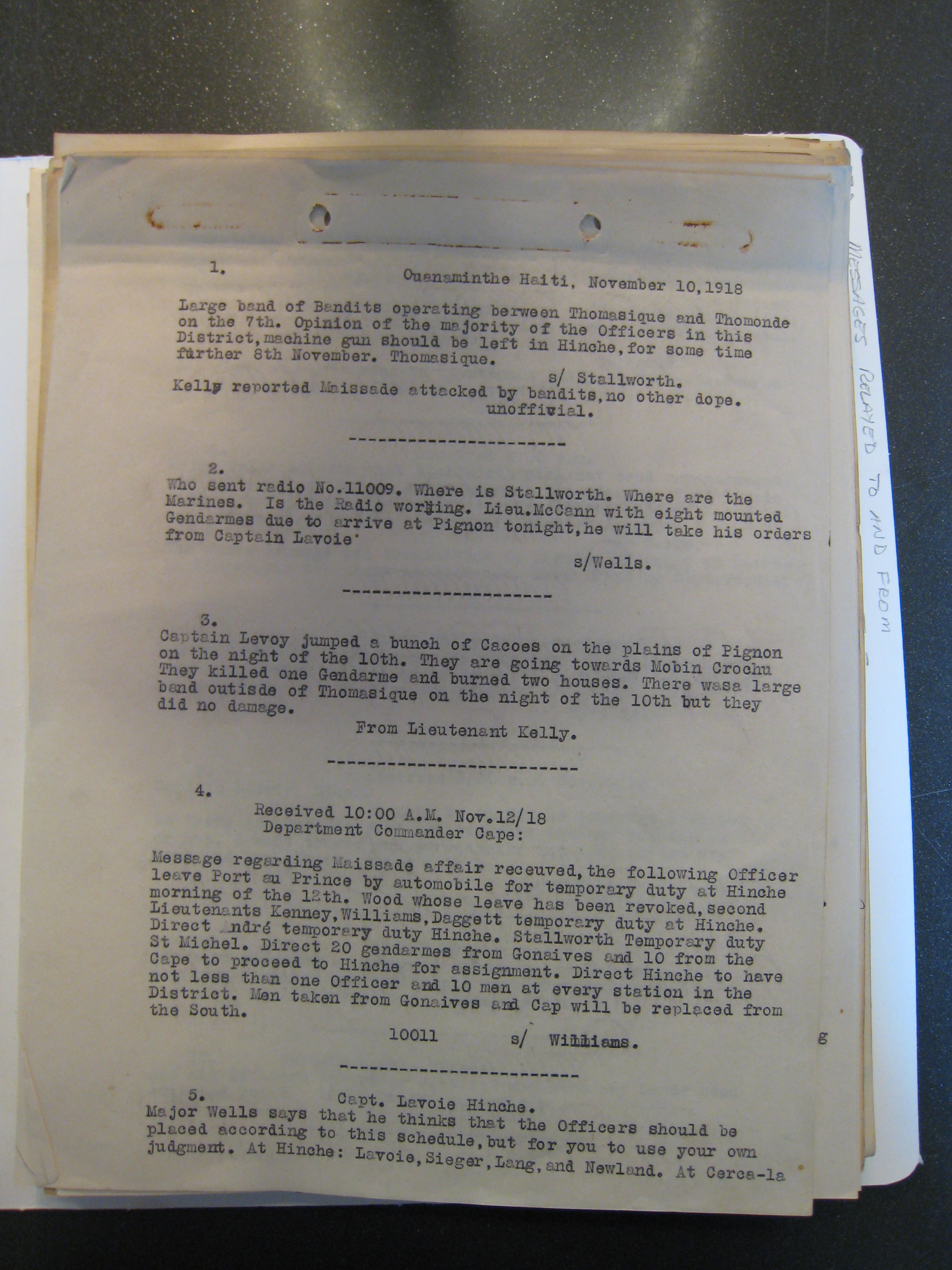

They also speak to desperation and macabre inventiveness in the face of fear. Some Marines discovered that they could try getting the ‘truth’ out of Haitians in novel ways. They applied wires from radio sets to Haitian people’s bodies, and shot electric current through them during interrogation sessions, hoping to use their “new media” to simultaneously terrorize bodies and extract information from them. Electrotorture enacted, literally, the relationship between technology, the production of knowledge and imperial violence.
The histories of radio played out in different registers elsewhere in the Caribbean. While Haiti eventually acquired a broadcasting station in 1926, there was no local radio in Jamaica until 1939.. British colonial officials, distracted by their bloated empire and feeling the economic pinch in any case, had no appetite for building a local station, though Kingston’s residents frequently called for one. While wealthy residents of Jamaica who could afford shortwave receivers had the world at their fingertips—the BBC, US programs, music from Cuba’s powerful stations—the majority of Jamaicans listened instead to their own voices in songs and popular theater, mostly in Jamaican patois.
As the British Empire relegated Jamaica to the margins, capital, people, and many sounds came from the US. Indeed, strapped British officials conscripted amateur radio operators and their US-bought equipment for state purposes. When passing British ships needed to test communications, they asked amateurs to donate their time and expertise. The most prominent of those, the New Yorker John Grinan, achieved some fame in the ham radio world for his experiments with shortwave radio. A participant in the first exchange of transatlantic signals, and one of the operators who helped relay Tom Heeney’s 1928 boxing match against Gene Tunney between New York and New Zealand (via Jamaica), Grinan lent his technological expertise to the British. When striking Jamaican workers cut telephone and telegraph lines amidst labor unrest in the summer of 1938 colonial officials, lacking access to wireless equipment, asked amateur operators like Grinan to police the rebellion, relaying whatever information they could from their rural stations to Kingston.
In the aftermath, colonial officials hoped the new radio station, created with equipment donated by Grinan, would provide a means of calming the unruly masses through educational broadcasting. But the new station’s programming was so dull, and receivers were so expensive and so unreliable, that few listened. It was only in the late 1950s, through the contributions of people like the actress, writer, and radio personality Louise Bennett that the sounds of patois eased radio’s participation into voluble soundscapes long populated by sound systems, music and talk.
As Bennett joked and chided in patois and local musicians like Bob Marley finally got air time, their performances rescued radio from its elitist roots and people finally tuned in.
By that time in Cuba, both the government and its opposition knew that controlling radio meant wielding power, or at least creating the illusion of that power. Cuba’s commercial ties to the US meant that it took part in its neighbor’s vociferous radio culture. Ads, radios, programs and music crisscrossed the Atlantic and shaped transnational listening. By the 1930s, a large radio public tuned in regularly to radionovelas, music and news available throughout the day. So it seemed to make perfect sense when governments claimed airspace to propagate messages and dissenters tampered with communications networks or deployed underground broadcasts—often from outside of Cuba—to convey their discontent. It was this radio world in which students decided that in order to topple a dictator you needed to occupy a radio station.

Understanding Caribbean radio as a regional history—defined more by circuits and soundwaves than national borders—brings new dimensions to bear on radio histories more generally. Spanning the Caribbean allows me to think about how various listening publics came to be and the contingent nature of those publics. Imperial politics, machines—as instruments of curiosity, desire and violence—and voices converged and diverged in distinct ways to conjure particular publics in particular moments. In order to overcome disturbing origins, radio needed to take part in pre-existing publics. In Jamaica, the inclusion of programs in patois resuscitated a feeble medium. The voices of people like Louise Bennett rendered radio a welcome attraction rather than a patronizing nuisance. In Haiti, radio publics also grew as Kreyol radio plays replaced US-sanctioned programming. Francois Duvalier understood that he could use radio to appeal to many people, drawing them in with celebrations of Haiti’s African roots and Kreyol language. When he became dictator soon after, the publics were already captive. On the other hand, Cuba did not have such a stark linguistic divide. So as soon as radio blanketed the country it could take part in fuelling political rifts. Listening in Cuba meant choosing sides, as all sides spoke through the radio. As the oppositional 1950s turned into the revolutionary 60’s, the battle of voices—the Voice of America, the Voice of Martí, the Voice of Fidel, continued. Understanding the region as a transfer point for empire and capital places the Caribbean at the center of many aspects of the history of communications technologies. It also colors that history with troubling tones whose listeners are long overdue.
—
Alejandra Bronfman is Associate Professor of History at the University of British Columbia, where she teaches courses on Caribbean and Latin American history, historical theory and practice, race in the Americas, and media histories. She is currently working on two projects: A Voice in a Box: Media, Empire and Affiliation in the Caribbean, which records the unwritten histories of sonic technologies in the early twentieth century, and Biography of a Sonic Archive, which draws from the extensive career of Laura Boulton to interrogate the use of recordings in the making of a sonic, exotic Caribbean. http://alejandrabronfman.wordpress.com/
—
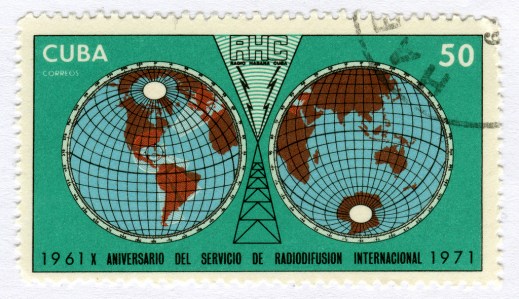
Featured image: “Cuba 1619 – 10th Anniversary of Radio Havana Cuba” by Flickr user Joseph Morris, CC BY-NC-ND 2.0
—

REWIND! . . .If you liked this post, you may also dig:
Decolonizing the Radio: Africa Abroad in the Age of Independence– Samantha Pinto
“Everyone I listen to, fake patois…”– Osvaldo Oyola
Hello, Americans: Orson Welles, Latin America, and the Sounds of the “Good Neighbor”– Tom McEnaney
—
Share this:

Musical Encounters and Acts of Audiencing: Listening Cultures in the American Antebellum

DOI: https://doi.org/10.59350/6z1w7-sk254
Editor’s Note: Sound Studies is often accused of being a presentist enterprise, too fascinated with digital technologies and altogether too wed to the history of sound recording. Sounding Out!‘s last forum of 2013, “Sound in the Nineteenth Century,” addresses this critique by showcasing the cutting edge work of three scholars whose diverse, interdisciplinary research is located soundly in the era just before the advent of sound recording: Mary Caton Lingold (Duke), Caitlin Marshall (Berkeley), and Daniel Cavicchi (Rhode Island School of Design). In examining nineteenth century America’s musical practices, listening habits, and auditory desires through SO!‘s digital platform, Lingold, Marshall, and Cavicchi perform the rare task of showcasing how history’s sonics had a striking resonance long past their contemporary vibrations while performing the power of the digital medium as a tool through which to, as Early Modern scholar Bruce R. Smith dubs it, “unair” past auditory phenomena –all the while sharing unique methodologies that neither rely on recording nor bemoan their lack. The series began with Mary Caton Lingold‘s exploration of the materialities of Solomon Northup’s fiddling as self-represented in 12 Years a Slave. Last week, Caitlin Marshall treated us to a fascinating new take on Harriet Beecher Stowe’s listening practice and dubious rhetorical remixing of black sonic resistance with white conceptions of revolutionary independence. Daniel Cavicchi closes out “Sound in the Nineteenth Century” and 2013 with an excellent meditation on listening as vibrant and shifting historical entity. Enjoy! —Jennifer Stoever, Editor-in-Chief
—
“To listen” is straightforward enough verb, signifying a kind of hearing that is directed or attentive. Add an “er” suffix, however, and “listen” moves into a whole new realm: it is no longer something one does, an attentive response to stimuli, but rather something one is, a sustained role or occupation, even an identity. Everybody listens from time to time, but only some people adopt the distinct social category of “listener.”
And yet listeners have emerged in diverse historical and social contexts. Arnold Hunt, in his recent book The Art of Hearing, for example, points to the congregants of the Church of England in the late sixteenth and early seventeenth centuries, whose sermon-gadding and intense repetitive listening to preachers became a form of popular culture. Shane White and Graham White, in The Sounds of Slavery, argue that early nineteenth-century black slaves adopted listening, or “acting soundly,” as a way of being that gave everyday sounds—conversation, cries of exertion, hymns—multiple layers of meaning and a power unknown to white overseers. Jonathan Sterne, in The Audible Past, describes the post-Civil War culture of sound telegraphy, in which young working class men trained themselves to employ “audile technique” for bureaucratic purposes, rendering their hearing objective, standardized, and networked.

We might add our own contemporary iPod era to these examples. We live in a time, after all, when it entirely acceptable to appear alone in public, ears connected to an iPod, head bobbing to the grooves of a vast archive of recorded music. Sampling, playlists, streaming–thanks to playback technologies, the U.S. has become a nation of obsessive listeners, and the power to “capture” a sound and re-hear it, something that began with the phonograph, remains a time-bending drama that can awaken people to their own aurality. Technologized listening, in fact, has spawned many of the icons of music discourse in the past 100 years: Edison’s tone testers in 1910s, record-collecting jitterbugs in the 1930s, audiophiles of the Hi-Fidelity era in the 1950s, Beatles fans with their bedroom record players in the 1960s, the “chair guy” in Memorex’s famous ad campaign of 1980, dancing listeners silhouetted in iPod posters since 2003.
But I think also that phonograph-centric narratives have obscured earlier, equally powerful cultures of listeners. The focus of my recent research, for example, has been the world of antebellum concert audiences. Between 1830 and 1860, the United States developed concentrated population centers filled with boosters and recent migrants eager to embrace a life based on new kinds of economic opportunity. Shaping much of the urban experience was a growing commercialization of culture that generated new and multiple means of musical performance, including parades, museum exhibitions, pleasure gardens, band performances, and concerts. Together, these performances significantly enhanced the act of listening: for people used to having to make music for themselves in order to hear it, a condition common to most Americans before 1830, access to public performances by others provided an opportunity for working and middle-class whites (women, African Americans, and the poor were another matter) to stop worrying about making music and, with the purchase of a ticket, to solely, and at length, assume an audience role.

The odd circumstance of purchasing the experience of listening provided class-striving urbanites with new possibilities for self-transformation. For many young, rural, white men, for example, arriving to the city for the first time to take clerking jobs in burgeoning merchant houses, being able to hear diverse performances of music was associated with a cosmopolitanism that brimmed with social possibility. Thus, for instance, Nathan Beekley, a young clerk, recently arrived in Philadelphia in 1849, found himself attending multiple performances of music several nights a week, including more and more appearances at the opera as a way to avoid “rowdies.” In New York City during the 1840s, George Templeton Strong, a young lawyer in Manhattan, derided his own musical abilities and instead attended every public musical event he could find, carefully chronicling his listening experiences and analyzing his reactions in a multi-volume journal. Walt Whitman, a young man on the make in Brooklyn and New York between 1838 and 1853, regularly attended every sound amusement he could, including the Bowery Theatre, dime museums, temperance lectures, political rallies, and opera, writing in Leaves of Grass, “I think I will do nothing for a long time but listen/And accrue what I hear into myself.”
This culture of listening was, in many ways, very much unlike ours. Despite an expanded access to performance, for instance, professional concerts before the mid-1850s were often understood as part of a wider ecology of sound. Very few listened to music in ways that we might expect today–focused on a “work,” in a concert hall, without distraction. Listening, in fact, was as much a matter of local happenstance as personal selection—a passing marching band, echoes of evening choir practice at a nearby church, an impromptu singing performance at a party. Such experiences were marked by the momentary thrill of spontaneity and discovery rather than the studied appreciation of familiarity; in any moment of hearing, it was difficult to know how long the encounter might be, or even what sounds, exactly, were being heard. Cities like Boston and New York were especially rich with such surprise encounters.

Francis Bennett, a young arrival to Boston in 1854, for example, encountered, in his first night in the city, a band concert and the “cries” from a “Negro meeting house,” and within weeks became enamored of fife and drum bands, often leaving work to follow one and then another as far as he dared. Young writer J. T. Trowbridge was more stationary but equally enthusiastic about what he heard from his New York rooming house in 1847: “The throngs of pedestrians mingled below, moving (marvelous to conceive) each to his or her ‘separate business and desire;’ the omnibuses and carriages rumbled and rattled past; while, over all, those strains of sonorous brass built their bridge of music, from the high café balcony to my still higher window ledge, spanning joy and woe, sin and sorrow, past and future….”
Music listeners were also often listeners of other forms of commercial sound, especially theater, oratory, and church services, which, together, comprised a complex sonic culture. This was especially reinforced by the physical spaces in which they shared such diverse aural experiences. In a rapidly-growing society, there often was not time or immediate resources to construct buildings dedicated to specific uses; instead, existing structures–typically a “hall” or “opera house”–served mixed uses.

As historian Jean Kilde noted in When Church Became Theater, evangelists in the Second Great Awakening often rented urban theaters for services; and congregations, in turn, rented churches to drama troupes, ventriloquists, and musicians to raise money. This “mixed-use” of buildings was reinforced by hearers, who often engaged in their own “mixed-use” understandings of what they heard. They evaluated sermons as they would a theatrical performance or found church choirs thrillingly entertaining rather than piously inspirational. Conversely, they listened to symphonic concerts with a religious solemnity.
This culture of antebellum, middle-class urban listeners didn’t last long, succumbing to the class sorting by post-Civil War social reformers, who mocked the indiscriminate over-exuberance of antebellum listeners as a kind of “mania” and a form of social disorder. As Lawrence Levine explains in Highbrow Lowbrow, over the course of the nineteenth century, developing a “musical ear” became increasingly paramount, reverence for great works of art shaped audience response, and listening became a specific skill to be learned. Music became something to appreciate not simply hear. By the 1890s, a true listener was someone who, in the words of critic Henry Edward Krehbiel (in his enormously popular How to Listen to Music, from 1897), “will bring his fancy into union with that of the composer” (51).
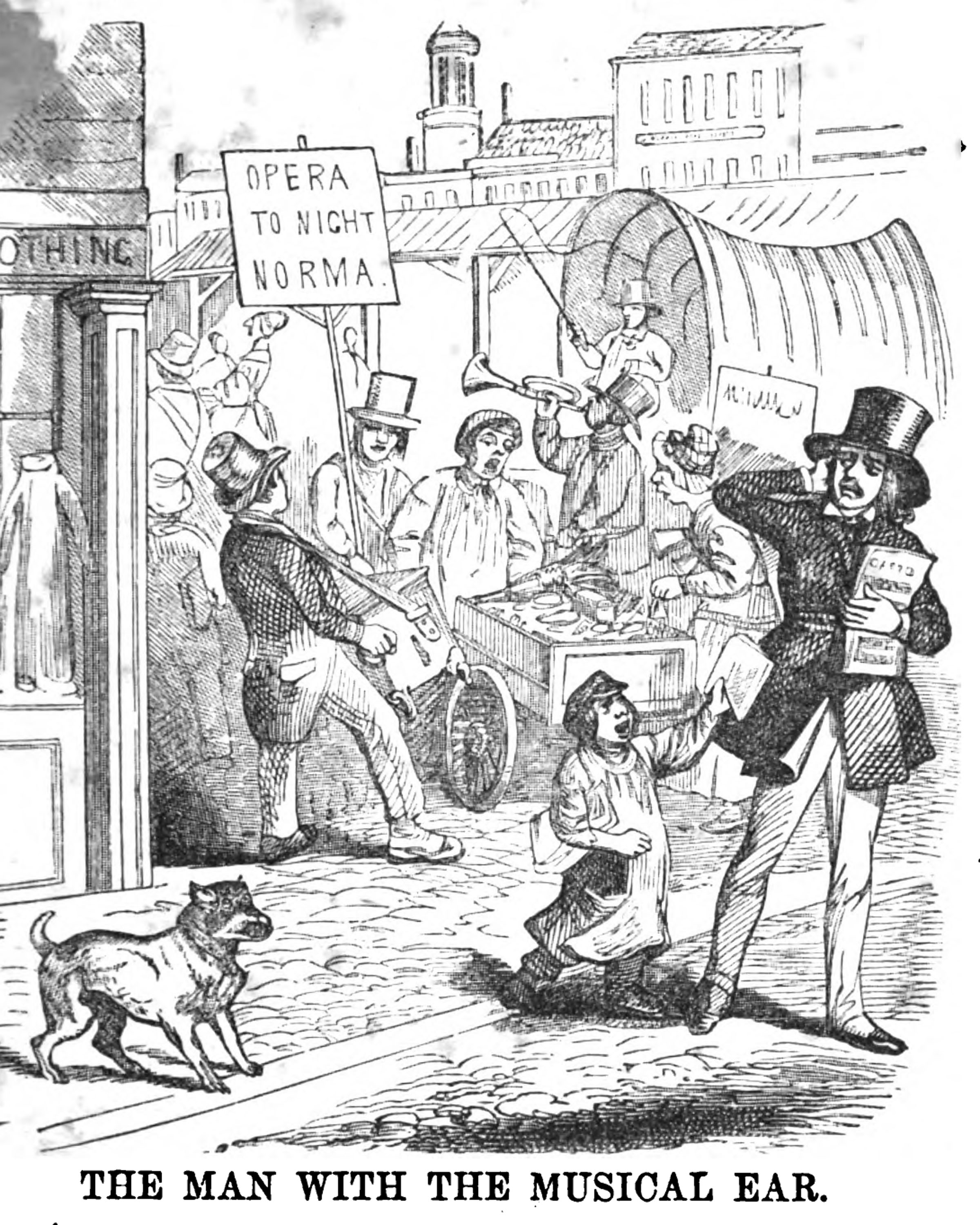
In many ways, the controlled silent listening favored by reformers directly paved the way for music technologies, like the phonograph, that similarly sought to control and manipulate listening. But it was the urban music listeners of the 1840s and 1850s who were responsible, in the first place, for identifying and accentuating the joys and possibilities of “just listening.”
—
Featured Image: Etching of Jenny Lind Singing at Castle Garden in New York City, 1851
—
Daniel Cavicchi is Dean of Liberal Arts and Professor of History, Philosophy, and the Social Sciences at Rhode Island School of Design. He is author of Listening and Longing: Music Lovers in the Age of Barnum and Tramps Like Us: Music and Meaning Among Springsteen Fans, and co-editor of My Music: Explorations of Music in Daily Life. His public work has included Songs of Conscience, Sounds of Freedom, an inaugural exhibit for the Grammy Museum in Los Angeles; the curriculum accompanying Martin Scorcese’s The Blues film series; and other projects with the Public Broadcasting System and the National Park Service. He is currently the editor of the Music/Interview series from Wesleyan University Press and serves on the editorial boards of American Music and Participations: the Journal of Audience Research.
—
REWIND! . . .If you liked this post, you may also dig:
“Como Now?: Marketing ‘Authentic’ Black Music,” –J. Stoever
Hearing the Tenor of the Vendler/Dove Conversation: Race, Listening, and the “Noise” of Texts –Christina Sharpe
How Svengali Lost His Jewish Accent––Gayle Wald
—
Share this:




Current Top Posts





April 2021

January 2020

November 2019

October 2019

August 2019

April 2014

November 2017

March 2015

December 2017

October 2015


Recent Comments