
Vocal Gender and the Gendered Soundscape: At the Intersection of Gender Studies and Sound Studies

DOI: https://doi.org/10.59350/c66e0-sdz16
Editor’s Note: Welcome to Sounding Out!‘s annual February forum! This month, we’re wondering: what ideas regarding gender and sound do voices call forth? To think through this question, we’ve recruited several great writers who will be covering different aspects of gender and sound. Regular writer Regina Bradley will look at how music is gendered in Shonda Rhimes’ hit show Scandal. A.O. Roberts will discuss synthesized voices and gender. Art Blake will share with us his reflections on how his experience shifting his voice from feminine to masculine as a transgender man intersects with his work on John Cage. Robin James will return to SO! with an analysis of how ideas of what women should sound like have roots in Greek philosophy. Me? I’ll share a personal essay/analysis of what it means to be called a “loud woman.”
Today we start our February forum on gender and sound with Christine Ehrick‘s selections from her forthcoming book Radio and the Gendered Soundscape in Latin America. Below, she introduces us to the idea of the gendered soundscape, which she uses in her analysis on women’s radio speech from the 1930s to the 1950s. She will make you think twice about the voices you hear on the radio, in podcasts, over the phone…
In the meantime, lean in, close your eyes, and let the voices whisk you away.–Liana M. Silva, Managing Editor
—
Several years ago, while aboard a commercial airline awaiting take off, I heard the expected sound of a voice emerging from the cockpit, transmitted via the plane’s P.A. system. The voice gave passengers the usual greeting and general information about weather conditions, flight time, etc. What was unusual, and caught the otherwise distracted passengers’ attention, was the fact that the voice speaking was female. People looked up from their magazines and devices not because of the “message” but because of the “medium”: a voice that deviated from the standard soundscape of commercial aviation, a field comprised mostly of men.
For this historian, interested in vocal gender and the female voice in particular, the incident was a fascinating demonstration of both the voice as performance of the gendered body, and the fact that the human voice can and often does communicate beyond (and sometimes despite) the words being spoken. In this essay I want to briefly discuss some of the ideas I explore more fully in my forthcoming book, a study of women/gender and golden age radio titled Radio and the Gendered Soundscape in Latin America: Women and Broadcasting in Argentina and Uruguay, 1930-1950 (forthcoming, Cambridge 2015). In this book, I use the stories of five women and one radio station to explore the possibilities and limits for women’s radio speech, and to pose some larger questions about vocal gender and the gendered soundscape. For this post, I present the conceptual framework that I use to understand how gender is constructed through the voice.
Gender and sound have both been explored as categories of historical analysis, but largely in isolation from one another. The historiographical impact of gender analysis is almost too obvious to mention; suffice to say that attention to gender has altered the very questions historians ask of the past and the way we understand structures of power and historical change. More recently, historians have begun to incorporate R. Murray Schafer’s concept of the soundscape and what Jonathan Sterne has called “sonic thinking” into their analysis of the past (The Sound Studies Reader, 3). But not enough consideration has been given within the field of history to the ways sound may be gendered and gender sounded.
I bring these three threads together – gender, sound, and history – via the concept of the gendered soundscape. Helmi Järviluoma, Pirkko Moisala and Anni Vilkko introduce the term in their book Gender and Qualitative Methods (2004), which asks readers to contemplate the way gender – and gendered hierarchies – may be projected and/or heard in sound environments. We not only “learn gender through the total sensorium,” as they put it; gender is also represented, contested and reinforced through the aural (85). Thinking historically about gendered soundscapes can help us conceptualize sound as a space where categories of “male” and “female” are constituted within the context of particular events over time, and by extension the ways that power, inequality and agency might be expressed in the sonic realm—in other words, tuning in to sound as a signifier of power. Although many of us have been well-trained to look for gender, I consider what it means to listen for it.
The soundscape, of course, is not only gendered; other aspects of social hierarchy, such as race, class and sexuality, are also performed and perceived in the aural realm. Greg Goodale’s analysis in Sonic Persuasion: Reading Sound in the Recorded Age (2011) of “the race of sound,” which argues that sound constructs rather than simply reiterating race, provides a useful framework for understanding both what we might call the gender of sound and the ways gender and race might intersect in the soundscape (76-105). As we learn to become more “ear-oriented” scholars, in other words, we come to perceive power, oppression, and agency in entirely new ways.
One of the most immediately gendered sound categories is the human voice, a richly historical convergence of human biology, technology and culture. We can and do hear gender in most human vocalizations; linguists seem to agree that, when listening to adult (non-elderly) voices speaking above a whisper “gender determination is usually a simple task” (See, for example, David Puts, Steven Gaulin and Katherine Verdolini in “Dominance and the Evolution of Sexual Dimorphism in Human Voice Pitch” and Michael Jessen in “Speaker Classification in Forensic Phonetics and Acoustics”). When we hear a voice without visual referent, as in the airplane example above or when listening to the radio, we immediately tend to classify the voices as “male” or “female.”

Voice differences have roots in biological sex difference. With the onset of puberty, the larynx is enlarged and vocal folds increase in length and in thickness, resulting in a decrease in frequency (Hz) of vocal fold vibration and thus a lowering of voice pitch. But while bodies classified as biologically female experience about a one-half octave average drop in voice pitch with puberty, biological males tend to experience a full octave average drop in pitch, with the result being that adult male voices tend to operate within a lower frequency range than female voices. However, gendered constructions of the human voice vary widely over time and place.
Biology (body size, hormonal secretions, age, and other physiological factors) is no way destiny when it comes to the human voice. Linguists distinguish between “anatomical voice quality features,” which in essence set the parameters of comfortable pitch range given a person’s vocal anatomy (the range outside of which is difficult to easily maintain one’s speaking voice) and “voice quality settings,” which refers to where someone places their voice within that range (See Monique Adriana Johanna Biemans’ thesis, Gender variation in voice quality.) Bound to some degree by these physiological parameters, humans can and do place their voices in ways that are consistent with the performative aspects of gender, and voice pitch is both highly variable and subject to cultural/historical framing and self-fashioning (For more on this subject, see Anne Karpf, The Human Voice: How this Extraordinary Instrument Reveals Essential Clues About Who We Are, 2006). Thus like other aspects of gender, voice is culturally and historically constructed and performative.
Conceptualizing the voice as a sonic expression of the gendered body requires revisiting both the tendency of feminist scholars to equate “women’s voice” with writing or discourse, and the tendency of some media scholars to refer to voices without immediate visual referent (in film, radio) as “disembodied.” In their Introduction to Embodied Voices: Representing Female Vocality in Western Culture (1997), Leslie C. Dunn and Nancy A. Jones concisely articulate the challenge for scholars interested in the sonic/acoustic dimensions of women’s voices:
Feminists have used the word “voice” to refer to a wide range of aspirations: cultural agency, political enfranchisement, sexual autonomy, and expressive freedom, all of which have been historically denied to women. In this context, “voice” has become a metaphor for textual authority…This metaphor has become so pervasive, so intrinsic to feminist discourse that it makes us too easily forget (or repress) the concrete physical dimensions of the female voice upon which this metaphor was based. (1)
Thinking about voice in terms of vocal gender brings us to the complex relationship between voice and body. The concept of disembodiment conveys the sometimes uncanny effect of hearing (especially female) voices without an immediately discernible source. It also underscores the destabilizing effect of these unseen female voices liberated thus from patriarchy’s specular regime. Yet to refer to voices from an unseen source as “disembodied” is to suggest that the voice is somehow separate from the body, a problematic formulation.
Simply: if the voice is not the body, what is it? Even when it travels over long distances (via telephone or radio, for example) and/or if its source remains out of sight, the body is there, present via the sound vibrations it produces. Stepping away from concepts like disembodiment frees us to explore the nuances of the relationship between the voice and the body, and the presence of gendered bodies in the soundscape, particularly with regard to the vertiginous relationships between bodies and voices that are gendered female.
Gender and history impact how we read the tone, velocity and pitch of the voice, but they also shape parameters of where and when particular voices are invited to speak or expected to remain silent. And here of course we encounter the ways gender hierarchy is expressed and constructed in the acoustic/vocal arena, as well as racial categorization. Kathleen Hall Jamieson puts it succinctly in Eloquence in an Electronic Age: The Transformation of Political Speechmaking (1990): “History has many themes. One of them is that women should be quiet” (67). While by no means absent, women’s voices have remained largely outside of the realm of what Schafer calls “signal”: sounds listened to consciously and that often convey messages and/of authority. Just as other aspects of gender inequality become naturalized, patriarchy tunes our ears to listen to certain voices differently. In these formulations, women’s voices are thus subject to categorization as “noise” or “unwanted sound” (see Mike Goldsmith, Discord: The Story of Noise) and therefore dissonant, disruptive, and potentially dangerous.
The discomfort (or dissonance) with women’s voices, especially women’s voices speaking publicly and/or with authority, carried over into and shaped the history of radio, making early and golden age broadcasting an ideal venue for an historical exploration of gender and voice. What did it mean to hear women’s voices on the radio? How did radio rework the gendered dimensions of public and private space, and by extension the place of the female voice in the public sphere?
The emergence of radio in the early twentieth century was part of a larger revolution in human communication which Walter Ong termed in Orality and Literacy: The Technologizing the Word (1983) a “secondary orality,” an historical moment which reawakened older oral traditions and communal listening in a very different historical and technological context (3). It also reawakened a focus on the human voice, with all of its implications for the gendered soundscape.
In many parts of the world, the rise of radio also coincided with an upsurge in feminist politics and discourses calling for women’s full citizenship and other related matters. As Kate Lacey notes in Feminine Frequencies: Gender, German Radio and the Public Sphere 1923-1945 (1997), “the arrival of radio heralded the modern era of mass communication, while women’s enfranchisement confirmed the onset of mass politics in the twentieth century.” Researching the history of women and radio – and particularly the sometimes hostile reactions to women’s radio voices – led me to appreciate the ways gender is performed and perceived via the voice, and from there into larger questions about the way social hierarchies – of gender, but also of race/ethnicity, class and sexuality – are reproduced and challenged within the sonic realm.
In this way we can better begin to contemplate the historical significance of women’s radio speech in understanding the sonic construction of gender. Depending on content and context, these voices carried the potential to not only challenge taboos on women’s oratory, but to assert the female body into spaces from which it had previously been excluded—like the cockpits (can’t help but note the name here) of commercial airliners.
–
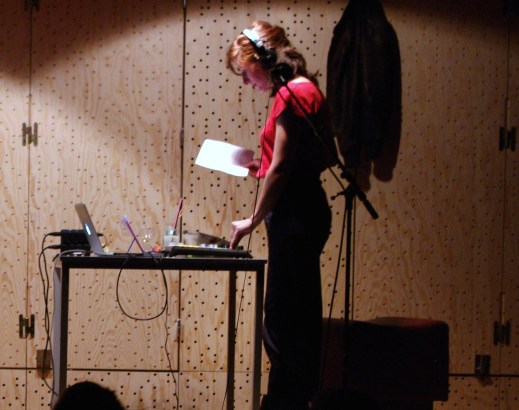
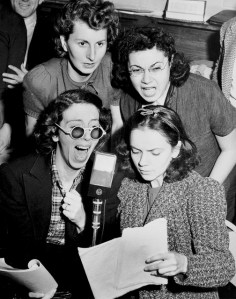
Featured image: “ateliers claus – 140522 – monophonic – Radio Femmes Fatales” by Flickr user fabonthemoon, CC BY-NC-SA 2.0
–
Christine Ehrick is an Associate Professor in the Department of History at the University of Louisville. Her second book, Radio and the Gendered Soundscape in Latin America: Women and Broadcasting in Argentina and Uruguay, 1930-1950 will be published by Cambridge University Press in Fall 2015. This book explores women’s presence and especially their voices – on the airwaves in the two leading South American radio markets of Buenos Aires and Montevideo. Her current work looks at comedy, gender and voice, with a focus on mid-twentieth century Argentine comedians Niní Marshall and Tomás Simari.
Thanks to Cambridge UP for allowing me to use some excerpts from the forthcoming book in this essay.
–

REWIND! . . .If you liked this post, you may also dig:
Look Who’s Talking, Y’all: Dr. Phil, Vocal Accent and the Politics of Sounding White– Christie Zwahlen
On Sound and Pleasure: Meditations on the Human Voice– Yvon Bonefant
Heard Any Good Games Recently?: Listening to the Sportscape–Kaj Ahlsved
—
Share this:

Reproducing Traces of War: Listening to Gas Shell Bombardment, 1918

DOI: https://doi.org/10.59350/bjmd1-g2d64
Welcome to World Listening Month 2014, our annual forum on listening in observation of World Listening Day on July 18th, 2014. World Listening Day is a time to think about the impacts we have on our auditory environments and, in turn, its affects on us [for the full deets, peep our recent SO! Amplifies post by Eric Leonardson, Executive Director of the World Listening Project]. We kick off our month of thinking critically about listening with a post by media historian Brian Hanrahan, who listens deeply to sonic traces of the past to prompt us to question our desires for contemporary media representations of “reality.” It also marks the global 100 year anniversary of World War I this August 2014: a moment of silence. —J. Stoever, Editor-in-Chief
—
For some reason that I don’t fully understand, I am very emotionally moved by the space around a sound. I almost think that sometimes I am recording space with a sound in it, rather than sound in a space. –Walter Murch
If you want to listen to the past, there’s never been a time like the present. Every year, it seems, new old recordings are identified, new techniques developed to recover sounds thought irrecoverable. Here is Bismarck’s voice, preserved on a cylinder in 1889. Here, older still, is Edison’s. There is the astonishing recuperation of phonautograms – reverberation traced onto soot-blackened paper in the mid-nineteenth century, digitally processed and played back in our own. But as that processing underlines, no sound recording straightforwardly reproduces the real. An acoustic artifact is a compound of materiality, form and meaning, but also a place where technology meets desire. Old recordings meet the listener’s longing halfway; they invoke a reality always out of reach. And not simply a longing to hear, but also to touch, and be moved by, the fact of an absent existence.
Take, for instance, HMV 09308. In October 1918, just before the end of the Great War, William Gaisberg, a sound recordist of the pre-electric era, took recording equipment to the Western Front in order to capture the sound of British artillery shelling German lines with poison gas. Gaisberg died not long after, probably from Spanish flu, although some say he was weakened by gas exposure during the recording. Nonetheless the “Gas Shell Bombardment” record – a 12-inch HMV shellac disc, just over 2 minutes at 78 rpm – was released a few weeks later, just as the war came to an end. Initially intended to promote War Bonds, ultimately the record was used to raise money for disabled veterans.
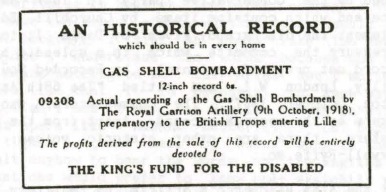
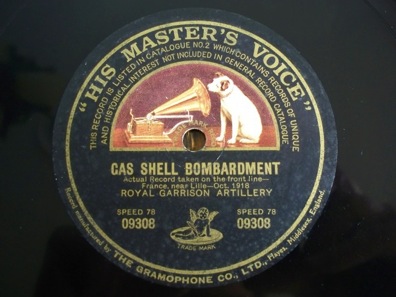
For decades, the HMV recording had a reputation as one of the very earliest “actuality” recordings – one documenting a real location and event beyond the performative space of the studio, imprinted with the audible material trace of an actual moment in space and time. Documents like this – no matter what the technology – usually come with additional symbolic authentication. Here, the record’s label does some of that work. This “historic recording,” says the subtitle, is an “actual record taken on the front line.” Publicity pieces drove home the message. In the popular HMV magazine The Voice, Gaisberg – or probably his posthumous ghost-writer – described the expedition in detail, claiming the track to be a “true representation of the bombardment.”
.
In the same issue, a Major C.J.C. Street compared the recording to his own experience on the Front. “Its realism,” he wrote, ”took my breath away… I played the record many times… finding at each attempt some well-remembered detail.” He didn’t say so in his article, but Street – an artillery officer, a novelist and a propaganda man for the intelligence agency MI7 – was in fact the impresario of the record. This was not the first time he had found astute uses for sound media. The previous year he had put together a record that set artillery drill commands to popular tunes – the recording was both a propaganda release and an army training tool for new recruits. With the Gas Shell record, Street knew he wasn’t just selling recorded sound, but also an auratic sense of closeness to an overwhelming reality, the palpable proximity of war and death. Authenticating detail helped to underpin this sense of an absent real made present. Street cued the listener for those “well-remembered details.” In particular, he singled out one indistinct rattly flap-whizz noise, hearing in it, he claimed, the sound of a round with a “loose driving-band.”
The record stayed in the HMV catalog until 1945, but only in the early 1990s were its production history and authenticity claims seriously examined. In specialist journals, archivists, collectors and amateur historians undertook a collective forensic and critical analysis. A promising auditory witness was located: 95-year-old Lt.-Col. Montagu Cleeve another former artillery officer, in his time a developer of “Boche Buster” railway gun, later a music professor – was invited to critically assess the recording. Cleeve vouched unreservedly for its authenticity. He heard in it, he said, an unmistakable succession of sounds – the clang of the breech, the gigantic report of the firing explosion, the distinctive whiny whistle of a gas shell on its way across no-man’s-land. Others looked to data rather than the memories of old soldiers. One expert on pre-electric recording noted the angles commanded in firing instructions, correlated them with known muzzle velocities for 4.5 and 6-inch howitzers, then used this and other information to “definitively” explain the counter-intuitive anti-Doppler sound of the shells’ whistling. He also identified the audible echo effect – the curious “double report” of the guns heard here – as the sound of a brass recording horn violently resonating at a distance of exactly 26.5 meters from the guns.
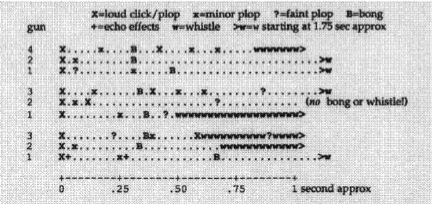
Eventually, skepticism won out. Close listening at slow speeds – just careful attention and notation, nothing more elaborate – revealed inconsistencies and oddities in the firing noises. The bongs, plops and whistles seemed internally inconsistent. Some of the artillery sounds – ostensibly a battery of four, firing in quick succession – varied implausibly with each successive firing. Physical evidence from the record’s groove, as well as extraneous noises – surface crackle and fizz, and, audible within the recording, the swish of a turntable – seemed to indicate at least two rudimentary overdubs, in which the output of one acoustic horn was relayed into a second, possibly using an auxetophone, an early compressed-air amplifier. All this resulted in a double- or triple-layered sonic artifact. Finally – the crucial evidence, although oddly it was hardly noticed at the time – an alternative take was located. In this take, according to its discoverer, the entire theatrics of gunnery command is simply absent, and there is no sound at all of whistling shells in motion. What was left was a skeleton sequence of clicks, thuds and cracks, supplemented with only a single closing insert, the portentous injunction “Feed the Guns with War Bonds!”
In short, it seems highly likely that any original field recording was, at the very least, post-dramatized with performed voices and percussive and whistling sound effects. So, it is tempting to say, that clears that up. The recording’s inauthenticity is proven. File under Fake. But in fact, if we don’t stop there, if we set aside narrow and absolutist ideas of authenticity, and instead explore the recording’s ambiguity and hybridity, then Gas Shell Bombardment becomes all the more interesting as an historical artifact.
Let’s assume, for the sake of argument, that some form of basic recording was done in France, very possibly a staged barrage specifically performed for Gaisberg’s visit, and that this recording then had effects added back at HMV in London. The record might then be seen less as a straightforward documentary, and instead as an unusual version of the “descriptive speciality,” a genre of miniature phonographic vignette dating back to the 1890s, far predating longer-form radio drama. Very little is known about these early media artworks, but it is a fair generalization to say that in America the genre was more slanted towards vaudeville comedy, whereas in Europe, imperial and military scenes predominated. As early as 1890, for example, there had been German phonographic representations of battles from the Franco-Prussian war. The Great War saw a flourishing of the genre. Scholars are just beginning to take an interest these old phonographs; here’s one recent essay on the “Angel of Mons,” for example, a British acoustic vignette of a famous incident on the Western Front.
Listen to a 1915 German descriptive speciality, depicting the attack on the fortress of Liège the previous year:
.
As a descriptive speciality, Gas Shell Bombardment is unusual because it incorporates an actual indexical trace. But such traces – as emphasized by Charles Sanders Pierce and many later media-theoreticians– do not resemble their referent, they are caused by it. The bullet hole does not look much like a bullet; thunder is lightning’s trace, not its likeness. But for Street and Gaisberg, the trace’s lack of resemblance caused problems: the original recording’s lack of detail, cues and clues, but above all its lack of internal dimensionality, created a perceptual shortfall and a lack of credibility. Maybe they hoped that the guns, by sheer force of amplitude, would overcome the spatially impoverished, reverbless reproduction of pre-electric recording. If so, it didn’t work. Without added effects, the guns’ trace was as flat and “body-less” as a sequence of Morse. It was a sound without a scene. The producers’ interventions aimed to thicken the primary artifact with referential-sounding detail, but also to heighten the sense of materiality and spatiality, and to strengthen the sense of diegetic presence, of worlded thereness. The soldiers’ voices – louder and quieter, close-up and farther-out – and the fake-Doppler of the “shell whistling” lent the recording narrative direction (literally, some trajectory) and “authenticating” points of detail. But above all they gave a sense of internal space to the recording, a space into which the listener could direct her attention.
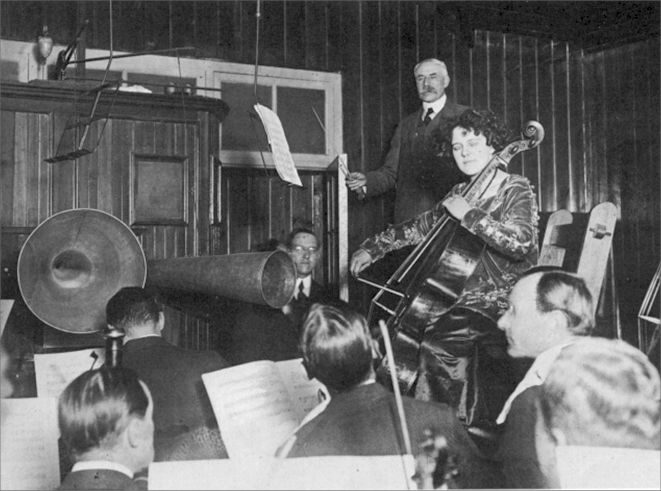
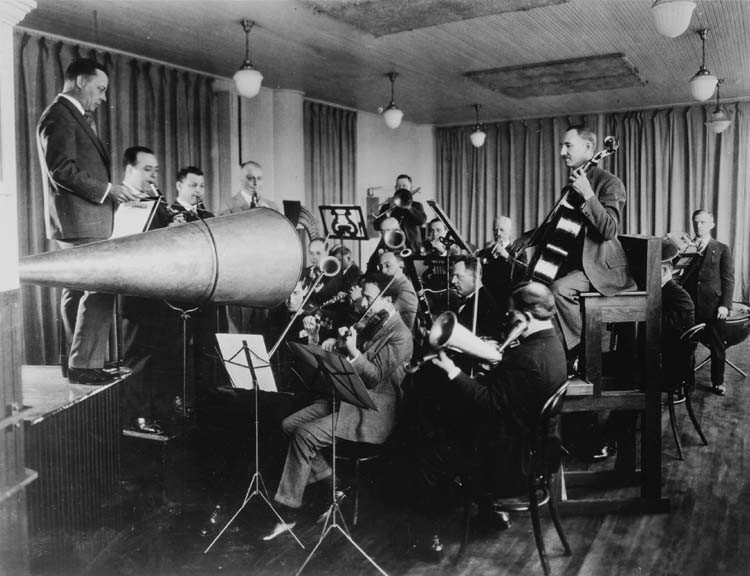
In this context, we can only admire the creativity and performative élan of the unknown production crew. We know little about effects production in early phonography. It is a safe bet that some techniques were adopted from theatre, and that there was overlap with silent film accompaniment. But whatever the method used, it would have called for the awkward orchestration of a limited number of iconic sounds to create an impression of a spatially coherent and materially detailed sonic environment. The recordist and his team would first have had to imagine how relative loudness – of voices, of material objects struck and sounded – might create a sense of spatial depth when transduced through the horn’s crude interface. Then they would have had to perform this as a live overdub, keeping time with the base track of the gun recording played through another horn. And all this done with participants and equipment crowded tightly around the mouth of the huge horn, crammed into the tiny pick-up arc, a scene looking something like this image of Leopold Stokowski’s pre-electric recording sessions or this photograph of the recording of a cello concerto.
As well as this hybrid of trace and live performance, there is another performance here – Gaisberg’s journey itself. With twenty years of recording experience, Gaisberg was probably very well aware that the expedition would not yield a “realistic” recording of the guns. But the expedition had to be made, so that it could be said to have taken place. Expectations had to be primed and colored, so that, to use André Bazin’s famous phrase about photographs, the recording could partake in an “irrational power to… bear the belief” of the listener. The journey, and the accounts of Gaisberg and Street are not a supplement to the “true representation” of the gas bombardment. They are part of that representation. Moreover, in subsequent writing it is noticeable that the manner of Gaisberg’s death becomes a rhetorical amplification for the authenticity of the recording’s trace, as if his fatal inhalation (of gas molecules or flu bacilli) were itself a deadly indexation, paralleling the recording’s claim to capture the breath of the War, and even of History itself.
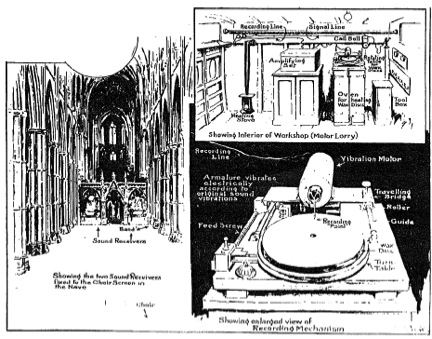
In media-historical terms, the Gas Shell Bombardment recording can be understood as a late, transitional artifact from phonography’s pre-microphonic era. The desire for the sonic trace, for an ever more immersive proximity to events was there, but electro-acoustic technology was not yet in place. Two years later, in 1920, Horace Merriman and Lionel Guest made the first experimental electrical recording, arguably also the first true field recording. The event, appropriately enough, was an official war memorial service in London, where Merriman and Guest – working for Columbia Records – put microphones in Westminster Abbey, running cables to a remote recording van parked in the street outside, where they sat amidst heating ovens and cutting lathes. By the end of the 1920s, remote recording and broadcasting, while never straightforward, were well on the way to ubiquity.
Claims made on behalf of technologies of reproduction may seem simplistic, but there’s a grain of truth to their simplicity. If there were nothing special – even magical – in the referentiality of the camera that captures the moment, the recording that’s like being there, the liveness of the live broadcast, these things would not play the role they do in everyday life and in the ideological fabric of society. But there is falsehood too, in over-simplifying the nature and affective charge of old photographs, old footage, old recordings. These are made things, composed of different materials, media, signs and conventions; they are inseparable from the desires and expectations they induce and direct. They function in part by mimesis and verisimilitude, but also through the gaps, blank spots and false illusions of their trace. They can – rightly – intensify our feeling towards the past, but should also prompt us to think about our own desires and investments.
—
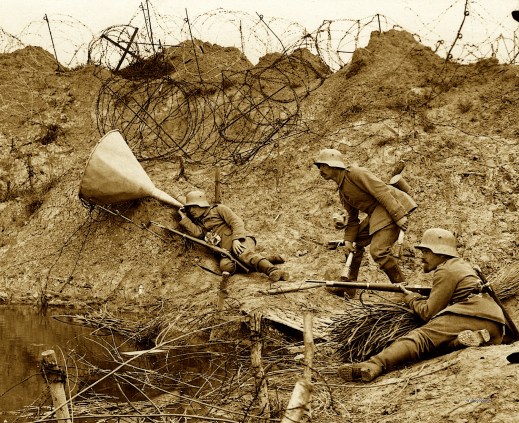
Image by Flickr User DrakeGoodman, “Horchposten im Spengtrichter vor Neuve-Chapelle 6km nördlich von La Bassée Nordfrankreich 1916,” A trio of lightly equipped soldiers from an unidentified formation oblige the photographer by looking serious and pretending they’re just metres from the enemy, listening for activity in his lines. The improvised “listening device” is actually a large funnel, probably liberated from a nearby farm.
—
Brían Hanrahan is a film, media and cultural historian, whose work focuses on the history of acoustic media, German and European cinema and the culture of the Weimar Republic.
—
Edited post-publication at 8:00 pm EST on July 7, 2014
–
REWIND!…If you liked this post, you may also dig:
SO! Reads: Susan Schmidt Horning’s Chasing Sound: Technology, Culture and the Art of Studio Recording from Edison to the LP–Enongo Lumumba-Kasongo
A Brief History of Auto-Tune–Owen Marshall
DIY Histories: Podcasting the Past–Andrew Salvati
—
Share this:




Current Top Posts





April 2021

January 2020

November 2019

October 2019

August 2019

April 2014

November 2017

March 2015

December 2017

October 2015


Recent Comments